The Erne Ford Encirclement1247 CE
In 1247, warfare across north-western Ireland and Connacht exposed fragile power among Gaelic, Anglo-Irish and maritime allies. Maurice FitzGerald’s force outmanoeuvred Tír Conaill’s defenders at Ballyshannon, killing Máel Sechlainn Ó Domhnaill and installing a provisional ruler, though losses followed during withdrawal. In Connacht, Toirrdelbach Ó Conchobair and allies captured strongholds, burned Galway and other settlements, while retaliatory raids devastated communities. Waterways, fords, crannogs and castles shaped campaigning, and sea travel brought both opportunity and disaster. Churchmen mediated evacuations and maintained wider connections. Meanwhile, partition of the Marshal inheritance reshaped Leinster’s lordship. The year ended without lasting political settlement or conquest.

Dateline
A Northern Campaign
In 1247, warfare in Ireland was concentrated with exceptional intensity along the north-western frontier of the Anglo-Irish colony and across Connacht. The year’s best-documented encounter came at Bél Átha Seanaigh, the ford of Ballyshannon on the Erne, where a force led by Maurice FitzGerald defeated the defenders of Tír Conaill. Yet the same annals that preserve that victory also record burned settlements, contested lake-forts, a major raid on Galway, clerical appointments and deaths, and a maritime expedition ending in disaster. Far from a simple tale of advance by one side and defeat for the other, 1247 reveals a landscape in which military success was precarious, political allegiances crossed cultural boundaries, and control of roads, river crossings, islands and strongholds mattered greatly.
The terminology of the Irish annals needs care. Their writers often call the settlers and their allies Galla, usually rendered ‘Foreigners’ or ‘English’, while modern historians commonly use Anglo-Norman or Anglo-Irish for the colonial lordship. These labels should not conceal the mixed character of the armies. Gaelic rulers could ally with colonial magnates; men from Scotland’s western seaways fought in Irish conflicts; and loyalties were shaped by dynastic rivalries as much as by language or origin.
A Week at the Ford
The principal event can be dated only as closely as the annalists allow. Maurice FitzGerald led a large host first to Sligo and then to Assaroe on the Erne, arriving on the Wednesday after the feast of Saints Peter and Paul. Maurice was not, despite some later summaries, the serving justiciar in 1247: John FitzGeoffrey had replaced him in 1245. FitzGerald nonetheless remained a powerful lord with a base at Sligo and a strong private interest in extending influence into Tír Conaill.
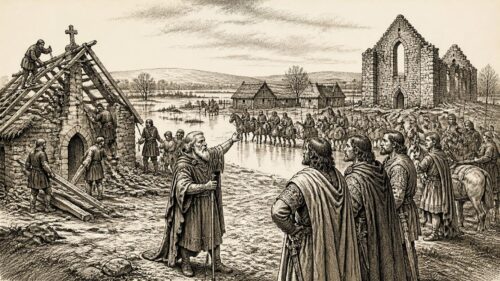
Máel Sechlainn Ó Domhnaill, king of Tír Conaill, assembled the Cenél Conaill and Cenél nEógain at Ballyshannon. For a full week, according to both the Annals of Connacht and the Annals of Ulster, they prevented either ‘Foreigner or Gael’ from crossing the ford. That detail is important. The Erne was not merely a geographical obstacle: the ford was a strategic choke-point, controlling movement between the southern approaches, the core territories of Tír Conaill and routes towards the north-west coast. A force holding it could compel an invading army either to withdraw, seek an alternative passage, or take substantial risks.
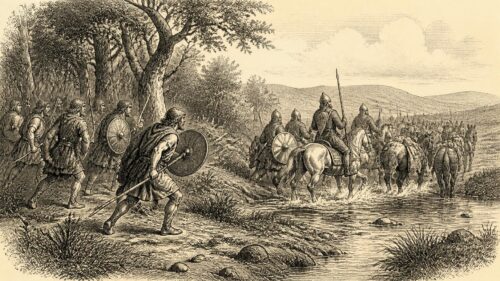
The stalemate ended through manoeuvre rather than a frontal breakthrough. Cormac, son of Diarmait and grandson of Ruaidrí Ó Conchobair, was sent with a substantial mounted force westward across the plain. He then turned south towards the edge of the bog and moved eastward until he reached another Erne crossing at Áth Cúil Uaine, identified with a ford near modern Belleek. The defenders did not realise the danger until Cormac’s cavalry appeared behind them, on their own side of the river. As the attention of the Cenél Conaill shifted to this threat, FitzGerald’s main force charged across the ford at Ballyshannon. The defenders were caught between the two bodies of attackers.
Máel Sechlainn Ó Domhnaill was killed in the ensuing defeat, together with Gilla Muinelach Ó Baigill and the annals’ unnamed ‘Mac Somairle’, described as king of Argyll. The latter’s presence gives the battle a wider Irish Sea dimension. He was a lord from the Gaelic-Norse world of the western Scottish seaways, fighting beside Ó Domhnaill; modern scholarship differs over his precise identification, so the annalistic title is the safest description. Cenél nEógain’s participation likewise demonstrates that the defence of Tír Conaill was not the work of one lordship alone.
Victory was neither bloodless nor completely secure for FitzGerald. The Annals of Connacht say that many of his men drowned while crossing the Finn on the return journey, while others were killed at Termon Magrath during the pursuit of plunder. Among the dead was William Brit, sheriff of Connacht, and his brother, called a renowned young knight. FitzGerald’s army ravaged Tír Conaill before departing and left Ruaidrí Ó Canannáin as king ‘for the nonce’. That wording is revealing: the appointment was presented as provisional rather than as a settled political order. The battle changed the immediate balance of power, but it did not create a durable conquest.
Connacht in Revolt
The campaign at the Erne formed one part of a larger crisis. Earlier in 1247, Toirrdelbach Ó Conchobair escaped from Athlone castle. His imprisonment had followed the mounting disputes within Connacht’s ruling dynasty and between Gaelic lords and the colonial interests established in the province. His escape returned an energetic opponent to the field at a moment when authority was already fragmented.
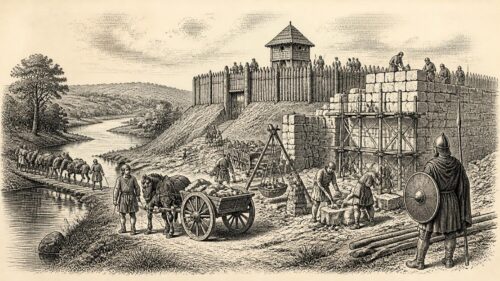
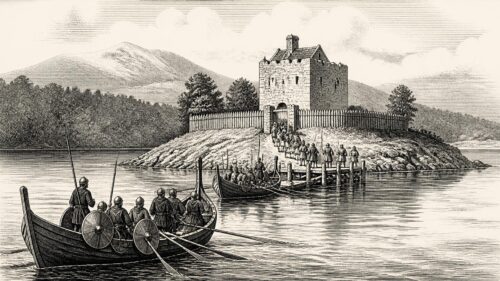
Conflict centred on defensible places as well as open country. Milid Mac Gosdelb seized Feda Conmaicne, expelled Cathal Mag Ragnaill, occupied the crannog of Claenloch and installed a garrison. A crannog, an artificial or adapted island residence, used water and difficult terrain as part of its defence; its seizure represented control over people, supplies and a local route network, not simply possession of a building. Cathal Mag Ragnaill received help from Cathal and Toirrdelbach, sons of Áed Ó Conchobair. They retook the crannog and its lake, demolished the castle of Lecc Derg on the Saturday before Pentecost, and expelled the Clann Gosdelb from the territory.
One striking detail complicates any picture of rigidly separate communities. Men in the castle would not emerge unless Clarus Mac Mailin, the archdeacon, escorted them west across the Shannon to Tumna. He did so. The episode shows a churchman acting as a trusted guarantor in a military evacuation: religious office could provide authority and practical protection amid a local war.
Toirrdelbach’s wider offensive was still more destructive. With Donnchad Mac Gilla Pátraic of Osraige, he gathered the ‘sons of kings’ of Connacht and attacked colonial settlements. The annals state that they reached the districts of Fid Ó nDiarmata and Muintir Fathaig, then burned Galway’s town and castle. They also record many deaths and name the seneschal of Connacht, Mac Elgeit, as killed by Donnchad. Galway in 1247 was a fortified river-mouth settlement rather than the later walled city familiar today, but it was already an important colonial foothold at the entrance to western Connacht. Burning both settlement and castle was an attack on habitation, defence, storage and administration at once.
The raiders withdrew towards Carra when colonial forces gathered against them. Elsewhere, Burrishoole was burned; Roscommon and Ardcarne were burned by the Galls; and Tadc, son of Conchobar Ruad, later burned the great island of Claenloch, where the annalist says twenty-eight Galls died. Such notices cannot yield a full casualty total or reconstruct the experience of every household. They do, however, show the practical human cost of war: homes, food stores, crops, livestock, religious sites and local security could all be imperilled by raids and retaliatory burnings.
Waterways, Church and Connection
Water remained both a highway and a hazard. Ó Dubda and Ó Baigill assembled a fleet to plunder Carbury, perhaps seeking to exploit the coastal and estuarine routes that linked north Connacht, Sligo and Donegal. One ship’s crew, including Magnus Ó Baigill, drowned at Indsi Thuathruis. The entry is a concise reminder that maritime power depended on small vessels and crews exposed to sudden loss, even before an enemy was encountered.
Ecclesiastical affairs continued within this violence. Tomaltach Ó Conchobair was consecrated bishop of Elphin at Tuam on the Sunday before Septuagesima. Benedictus Mag Oirechtaig, erenagh of Aghagower, was treacherously killed at the festival of the Cross, demonstrating that church landholders were not immune from dynastic conflict. In the north, the Annals of Ulster record the institution of Raighned, generally identified as Reginald of Bologna, to the archbishopric of Armagh in Rome. Conchobar Ó Muiredaig, bishop of Uí Fhiachrach Aidhne, died at Bristol. His death there does not establish the purpose of his journey, but it is firm evidence of clerical movement across the Irish Sea and of Irish diocesan links with the wider church.
Leinster’s Divided Inheritance
A quieter but consequential development occurred in Leinster. In May 1247, the great estate of the Marshal earls of Pembroke and lords of Leinster was partitioned after the failure of William Marshal’s male line. The inheritance was divided among the five Marshal daughters and their heirs. This was not a battlefield event, and its immediate local effects varied from place to place; it should not be treated as the cause of every later difficulty in Leinster. Nevertheless, it marked the end of an unusually cohesive transnational lordship whose estates had linked Ireland, Wales and England under one family administration.
For tenants, burgesses, clergy and neighbouring Gaelic rulers, the new arrangement meant that dealings once directed towards a single paramount lord could increasingly involve several great interests. Later writers overstated the partition as the beginning of colonial decline, but the event belongs firmly to 1247 and altered the political framework within which Leinster’s towns, castles and lordships operated.
An Unsettled Balance
The year therefore closed without a stable settlement. FitzGerald’s victory at Ballyshannon removed Máel Sechlainn Ó Domhnaill and briefly enabled the installation of a rival ruler in Tír Conaill. In Connacht, however, Toirrdelbach Ó Conchobair and his allies had demonstrated the vulnerability of colonial settlements from Galway to Mayo and around the Shannon basin. The patterns visible in 1247—alliances across the Irish Sea, campaigns focused on fords and castles, burnings that struck civilian places, and churchmen mediating or travelling through contested worlds—make the year a vivid snapshot of power in motion rather than a finished conquest.
Primary Sources
- Annála Connacht: Annal 1247
- Annála Connacht (Irish text)
- The Annals of Ulster: Year U1247
- Annals of Ulster (Irish text)
- Annals of the Four Masters: M1247
- Annals of Loch Cé
- Annals of Loch Cé A.D. 1014–1590 (Irish text)
- Annales Dominicani de Roscoman
- O'Donnell (Ó Domnaill), Maelsechlainn
- FitzGerald, Maurice fitz Gerald
- O'Connor (Ó Conchobair), Fedlimid
- FitzGeoffrey, John
- O'Neill (Ó Néill), Brian
- MacGillapatrick (Mac Gilla Pátraic), Donnchad
- O'Donnell (Ó Domnaill), Gofraid
- Marshal Partition of 1247: A Medieval Text’s Journey Through Early Modern Ireland
- A Community in Competition: The Barons of Leinster in Thirteenth-Century Ireland
- The Partition of Ireland 774 Years Ago
- Parks, Pleas, and Pastures: The Extents of the Marshal Earls of Pembroke’s Lands in England and Wales, ca. 1247
- County Galway Urban Archaeological Survey