Connacht Campaign1235 CE
In 1235, Richard de Burgh and Justiciar Maurice FitzGerald led a broad Anglo-Irish army into Connacht, burning Roscommon and Elphin, raiding cattle, and disrupting communities. The expedition extended into Thomond, forcing King Donnchad Ó Briain to surrender hostages and tribute, before pursuing Fedlimid Ó Conchobair’s allies across western coastal and island regions. At Lough Key, attackers deployed ships, siege engines and a floating ram to capture the Rock, but its garrison lost it within twenty nights. Fedlimid later made peace and retained five cantreds. The campaign demonstrated lordship power, yet Connacht remained damaged, politically contested and far from securely conquered.
Dateline
In 1235 the struggle for Connacht reached a destructive new stage. A large Anglo-Irish army, mustered by Richard de Burgh and joined by Maurice FitzGerald, the justiciar of Ireland, entered the province from Athlone. Its progress was not a single neat conquest, nor did it end the authority of the Connacht king Fedlimid Ó Conchobair. Yet the campaign showed how far the Lordship of Ireland could now mobilise men, horses, ships, siege equipment and political allies across the island. It also exposed the cost borne by local communities: burned settlements and churches, seized cattle, disrupted food supplies, flight to islands and fastnesses, and the hard bargains of hostages and peace.
A Host Across Ireland
The Annals of Connacht, an exceptionally detailed source for the year, records that Richard de Burgh assembled “the Galls of Ireland” for a hosting into Connacht. “Galls” is the annalists’ usual word for the English-speaking settlers and magnates of the Lordship, though their forces included people of varied local origins. The named leaders indicate the expedition’s unusual breadth: Maurice FitzGerald as justiciar; Hugh de Lacy, earl of Ulster; Richard de Burgh himself; Walter de Ridlesford with the men of Leinster; and John de Cogan with those of Munster. This was therefore more than a private raid. It brought together leading baronial power with the Dublin government and regional military followings.
The immediate background was the long dispute over Connacht. Richard de Burgh had inherited a royal claim to much of the province, while Fedlimid, son of Cathal Crobderg Ó Conchobair, claimed the kingship and sought to exercise it independently. Earlier interventions, alliances and imprisonments had failed to produce a stable settlement. By 1235, royal policy and the leading settlers’ interests converged behind renewed intervention. That broad context explains the campaign; it should not, however, obscure the fact that the annals give 1235 itself a remarkably concrete sequence of movements and encounters.
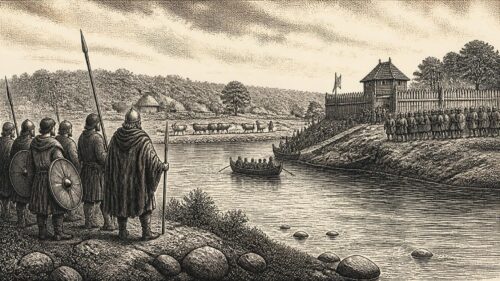
The host crossed at Athlone and moved westward through Roscommon, which it burned, and then to Elphin, where the great church was burned. The route mattered. Athlone was the main crossing-point on the Shannon between the lordship’s central territories and Connacht; Roscommon and Elphin lay in the political heartland of the Ó Conchobair kingdom. The destruction of an important church was both a material blow and a breach of the protection normally expected by ecclesiastical places. It demonstrates that war could not be cleanly separated from religious life, even when commanders professed reverence for it.
Boyle Abbey and Thomond
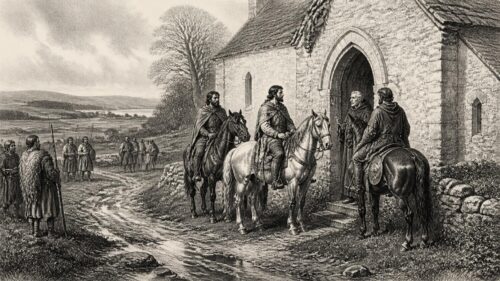
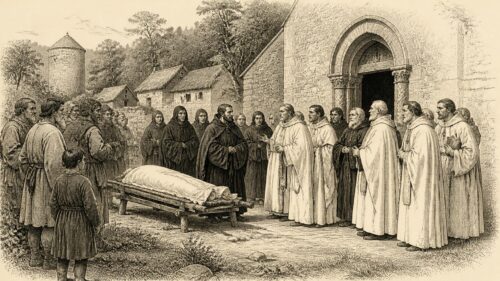
On the eve of Trinity Sunday, the army reached the Cistercian monastery of Boyle. Some soldiers broke into its storehouse or sacristy and carried off valuables, including chalices and vestments. The annals add an important corrective: the leading men of the host condemned the plundering, restored what they could recover, and paid compensation for the rest. That response did not undo the invasion’s wider devastation, but it reveals a recognised distinction between authorised war-making and sacrilege. Boyle was no minor outpost. Founded in the twelfth century under Mac Diarmada patronage, it was among Connacht’s foremost Cistercian houses, a religious centre embedded in the region’s political and landed world.
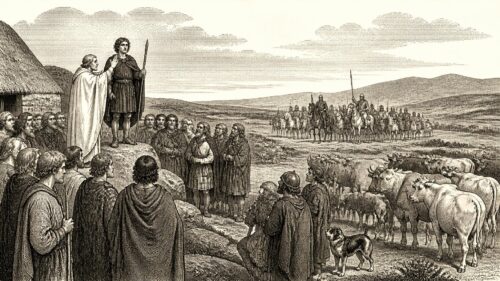
From the Boyle district, raiding parties ranged through nearby territories and brought substantial prey, above all livestock, to Ardcarne. Cattle were the portable wealth on which households, lordships and armies depended. Their loss meant far more than an immediate financial setback: it reduced milk and meat supplies, breeding stock, manure, transport capacity and the means of paying followers or meeting hospitality obligations. The annalists’ repeated attention to cattle is therefore a close view of everyday economic warfare.
Then came the campaign’s most striking change of direction. At the urging of Eógan Ó hÉidín, who sought revenge on Donnchad Cairprech Ó Briain, king of Thomond, the host turned unexpectedly south through Uí Maine and Máenmaige into Thomond. Donnchad had aligned himself with Fedlimid against the invasion. The sudden march caught the people of Thomond without time to withdraw stock or organise resistance, and the army took extensive spoils.
Fedlimid and the Connacht forces followed to honour their commitment to the men of Thomond. The annals describe repeated skirmishes, followed by a harder encounter in which the combined Connacht and Thomond force fought vigorously but was overcome by armoured troops and a strong mounted force. The description is not a neutral battlefield report: it praises Connacht courage and blames a decision by Donnchad for Thomond’s heavier losses. Still, it points to a genuine military imbalance. Mail-clad cavalry and organised infantry could be especially formidable when opponents were obliged to fight in the open rather than rely on difficult ground, ambush or withdrawal.
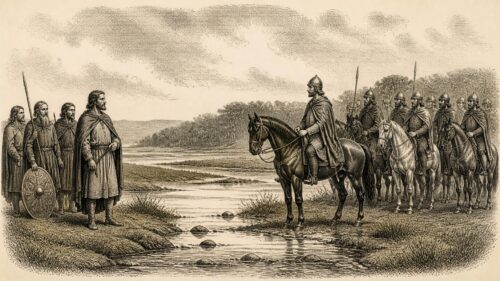
The next day Donnchad made peace, surrendering hostages and tribute after much of his people’s wealth had been plundered and many had been killed. Hostages were not symbolic tokens. They were living guarantees that could restrain a ruler’s choices and bind a political settlement to the fortunes of particular families. Donnchad’s agreement detached Thomond from Fedlimid at a critical moment and allowed the invading army to return its attention to Connacht.
Flight, Islands and Cattle
Back in the west, the expedition secured the peace of Áed Ó Flaithbertaig, who, the annals say, acted to preserve his people, cattle, land and territory. The wording is revealing: protecting dependants and herds was inseparable from protecting lordship. Fedlimid chose a different course. He withdrew towards Domnall Mór Ó Domnaill in Tír Chonaill, taking cattle from Conmaicne Mara and Conmaicne Cúile and leaving country stripped of provisions for the advancing enemy. This was a defensive scorched-earth strategy, painful for local people but intended to deny the host fodder and food.
The army nevertheless pressed into western Connacht. At Dún Mughthord it demanded peace and hostages from Magnús, son of Muirchertach Muimhnech Ó Conchobair; he refused. Raiding forces then plundered Achill and carried away herds. The campaign also became a maritime operation. Áed Ó Flaithbertaig and Eógan Ó hÉidín brought forces and vessels overland to a coastal inlet, where they joined the justiciar’s troops. Magnús and his men used ships and islands to strike at the invaders, while the invaders in turn dragged boats along the shore, launched them, and landed armoured soldiers on islands occupied by Magnús’s followers.
The annals’ detail conveys the vulnerability of island communities. Cattle on the islands of the Mullet were taken ashore in a single day. Their owners faced capture, death, thirst or hunger if deprived of stock and prevented from moving freely. It would be wrong to turn that account into a precise demographic measure, but it plainly records the human consequences of raiding in a coastal landscape where boats, strands, sounds and islands could offer both refuge and danger.
The Rock on Lough Key
Having raided Umhaill by land and sea, the host moved north-east via Eas Dara and the Curlew Mountains. It struck at Ó Domnaill because he had sheltered Fedlimid, then came to the crossing at Port na Carraige on Lough Key. The objective was the Rock, defended by followers of Fedlimid and Cormac Mac Diarmada. Here the campaign produced one of the year’s most memorable scenes of medieval Irish warfare.
The justiciar and his allies protected Clarus Mac Máelín, archdeacon of Elphin, and the canons of Holy Trinity Island, and visited the community to pray. This was no contradiction-free act of piety after the burning of Elphin and the incident at Boyle, but it confirms the standing of the canons and the political usefulness of ecclesiastical protection. The annals associated with this monastic milieu preserve unusually close knowledge of the siege.
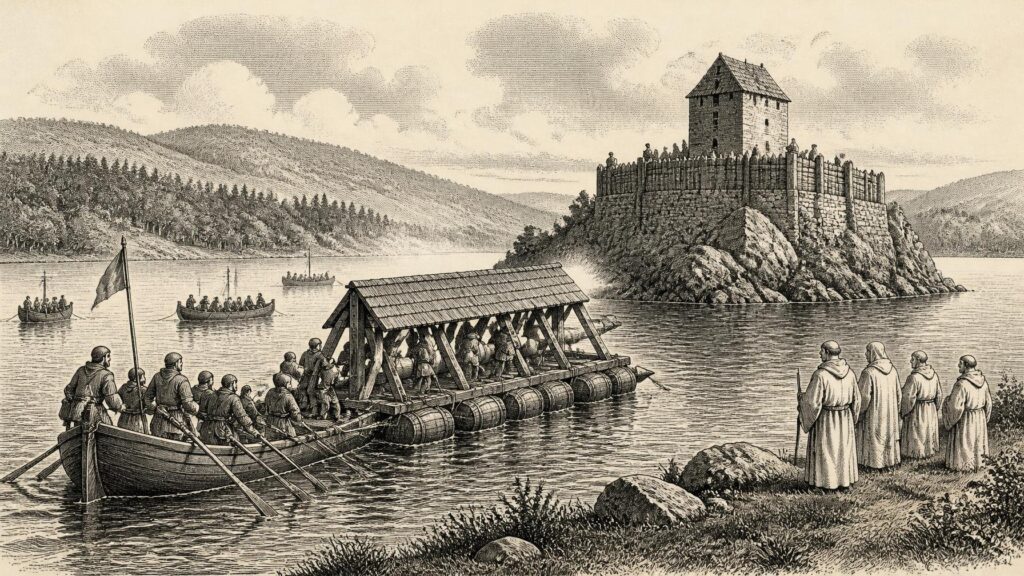
The attackers brought a fleet and siege engines onto the lake. They first hurled stones at the Rock from an engine raised on an earthen platform. When that failed, they dismantled houses at Ardcarne to make boats, gathered combustible materials, and constructed a floating ram supported by empty casks. A large vessel, topped with a boarded shelter, towed the device towards the stronghold. Faced with these preparations, the defenders surrendered on terms. Maurice FitzGerald installed a garrison of armed settlers and supplied it with food and drink.
Victory lasted only twenty nights. When the constable and many of his men went outside, a member of the garrison closed the gate against them and yielded the Rock to Cormac Mac Diarmada. The surviving settlers fled to the protection of Holy Trinity Island. Cormac then demolished the fortress so that it could not readily be reoccupied. This reversal is crucial. The 1235 expedition inflicted immense damage and altered political calculations, but it did not establish effortless or permanent command over every strongpoint.
Settlement Without Security
The annals state that Fedlimid subsequently made peace with the justiciar and received the king’s five cantreds. The arrangement marked a drastic contraction of the Connacht king’s effective position, while leaving him a recognised lordship rather than removing him entirely. Its exact practical terms and later development should not be read backwards from subsequent grants and castle-building. What can safely be said for 1235 is that military devastation had produced negotiation, not a final end to Ó Conchobair kingship.
Other notices underline the year’s wider instability. Fedlimid demolished Meelick castle, a potent reminder that fortifications remained contested instruments rather than settled markers of control. In the north, Domnall son of Áed Ó Néill, king of Cenél nEógain, was killed by Domnall Mac Lochlainn, who took the kingship. In south Connacht, Matadán Ó Madadháin, king of Síl Anmchada, died; Isaac Ó Máelfhagmair, erenagh of Killala, also died. Such brief annalistic entries show political and ecclesiastical offices continuing beneath the shadow of the great campaign.
For Ireland as a whole, 1235 was not simply the year Connacht was “conquered”. It was the year in which an exceptionally broad lordship army demonstrated its reach; in which Gaelic rulers responded through alliance, negotiation, mobile wealth and maritime resistance; and in which Lough Key briefly became a theatre of floating siegecraft. The campaign strengthened de Burgh and settler ambitions, but its burning, plunder and fragile settlements left behind a province still contested, damaged and far from quiet.
Source References
Hover over a number to see the source. Select it to open the source.

- [1] Annála Connacht: Annal 1235
- [2] Annála Connacht: Irish Text, Annal 1235
- [3] Annals of Loch Cé: Annals 1225–1239
- [4] Annals of Loch Cé: Irish Text, Annals 1225–1239
- [5] Annals of the Four Masters: Annals 1232–1238
- [6] Annals of the Four Masters: Irish Text, Annals 1232–1238
- [7] Annals of Ulster: Irish Text, Year U1235
- [8] Annals of Inisfallen: Annals 1228–1236
- [9] FitzGerald, Maurice fitz Gerald
- [10] Burgh, Richard de
- [11] O'Connor (Ó Conchobair), Fedlimid
- [12] O'Brien (Ó Briain), Donnchad Cairprech
- [13] Lacy, Hugh de
- [14] O'Donnell (Ó Domnaill), Domnall Mór
- [15] CELT Project: Annála Connacht
- [16] Annals in Cotton MS. Titus A. XXV: TEI Header
- [17] Boyle Cistercian Abbey
- [18] School of the West
- [19] Ireland under the Normans, 1169–1333
- [20] Ireland under the Normans
- [21] Feudal Charters of the De Burgo Lordship of Connacht, 1237–1325 (B.M. Add. MSS. 6041)
- [22] Occupation of Connaught by the Anglo-Normans after A.D. 1237
- [23] The Red Book of the Earls of Kildare
- [24] Annals of the Four Masters: Editorial and Bibliographic Information
Primary Sources
- Annála Connacht: Annal 1235
- Annála Connacht: Irish Text, Annal 1235
- Annals of Loch Cé: Annals 1225–1239
- Annals of Loch Cé: Irish Text, Annals 1225–1239
- Annals of the Four Masters: Annals 1232–1238
- Annals of the Four Masters: Irish Text, Annals 1232–1238
- Annals of Ulster: Irish Text, Year U1235
- Annals of Inisfallen: Annals 1228–1236
- FitzGerald, Maurice fitz Gerald
- Burgh, Richard de
- O'Connor (Ó Conchobair), Fedlimid
- O'Brien (Ó Briain), Donnchad Cairprech
- Lacy, Hugh de
- O'Donnell (Ó Domnaill), Domnall Mór
- CELT Project: Annála Connacht
- Annals in Cotton MS. Titus A. XXV: TEI Header
- Boyle Cistercian Abbey
- School of the West
- Ireland under the Normans, 1169–1333
- Ireland under the Normans
- Feudal Charters of the De Burgo Lordship of Connacht, 1237–1325 (B.M. Add. MSS. 6041)
- Occupation of Connaught by the Anglo-Normans after A.D. 1237
- The Red Book of the Earls of Kildare
- Annals of the Four Masters: Editorial and Bibliographic Information