Bun Gaillme1232 CE
In 1232, Connacht’s contested kingship linked local dynastic rivalry to English royal politics. Richard de Burgh released Fedlimid Ó Conchobair after his patron Hubert de Burgh’s fall, while Áed mac Ruaidrí retained a precarious restoration. De Burgh’s castle at Bun Gaillme and Adam Staunton’s at Dunamon embodied efforts to secure enduring authority. Conchobar, Áed’s son, died invading the Three Tuatha, weakening his dynasty. Elsewhere, chieftains fought, hostages were taken, crops destroyed and coastal warfare continued. Yet churches were consecrated, regular canons organised, and religious figures were praised for learning, hospitality and care, showing warfare and institution-building advancing together across Ireland.
Dateline
In 1232, the political struggle for Connacht was expressed in unusually concrete forms: a captive king was released, a rival was restored, and new castles rose at Bun Gaillme and Dunamon. These were not isolated local incidents. They belonged to a contest over lordship in the west of Ireland, where the descendants of Ruaidrí Ó Conchobair, the sons of Cathal Crobderg, and Richard de Burgh’s Anglo-Norman following all sought influence. The evidence comes chiefly from Irish annals, which are especially rich for Connacht and the north-west. They record events under the year 1232, but do not always supply a full sequence of dates; where sources differ over chronology, the year is best understood as a turning-point rather than as a neatly ordered campaign diary.
A Reversal in Connacht
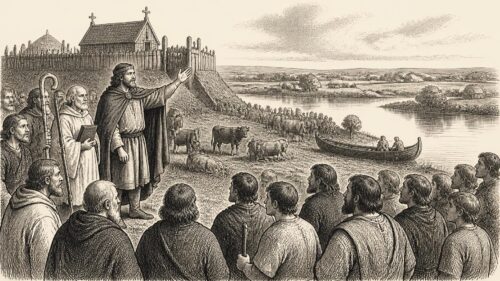
The central political fact of the year was the release of Fedlimid mac Cathail Chrobderg Ó Conchobair. He had been seized at Meelick by Richard de Burgh in 1231, in what the Annals of Connacht call a breach of guarantees. During his captivity, Áed mac Ruaidrí Ó Conchobair had again obtained the kingship of Connacht through an accommodation with de Burgh. The annals place both Fedlimid’s liberation by the Galls—the English or Anglo-Normans—and Áed’s restoration in 1232. This was therefore not a settled succession but a contested distribution of power, managed in part by an external lord with military resources and royal authority behind him.
Events in England sharpened the change. Hubert de Burgh, the powerful justiciar of England and Richard de Burgh’s uncle, fell from royal favour on 29 July 1232. In August, King Henry III ordered Richard to release Fedlimid; in September Richard was displaced as justiciar of Ireland by Maurice FitzGerald. These firmly dated acts of royal intervention did not instantly determine affairs on the ground in Connacht, but they deprived Richard de Burgh of the exceptional political backing that had helped him dominate the province. Fedlimid’s release thus connected Irish dynastic conflict to a crisis at the English royal court.
For people living in Connacht, a king’s imprisonment or restoration was not merely a matter of pedigree. Kingship shaped demands for cattle, food-renders, hostages, fighting men and loyalty. It also determined which local rulers could expect protection and which might be treated as enemies. The resumption of rule by Áed mac Ruaidrí was consequently precarious from the outset, because Fedlimid was free again and Richard de Burgh’s position had been checked. The killing of Áed in the following year was not inevitable, but 1232 clearly created the unstable conditions from which that later conflict emerged.
Castles at Bun Gaillme and Dunamon
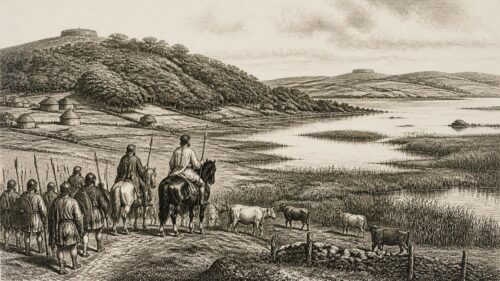
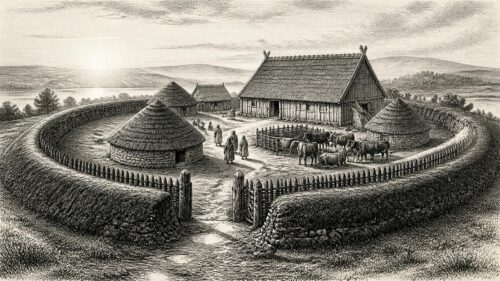
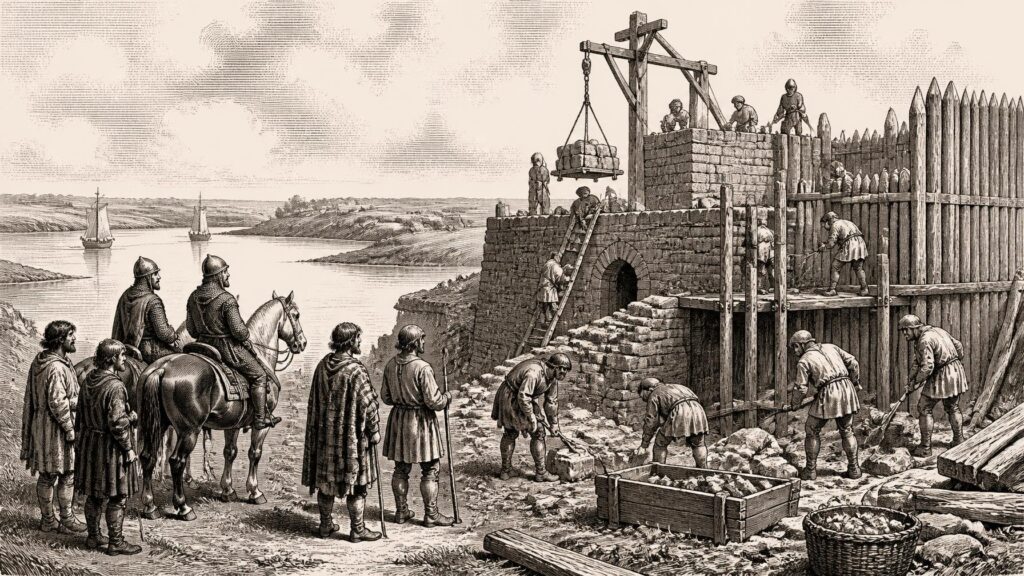
Two castle works recorded in 1232 reveal the material side of this struggle. Richard de Burgh built a castle at Bun Gaillme, while Adam Staunton began one at Dunamon. The annals are concise, but their significance is plain. A castle was a defended residence, a storehouse, a rallying point for mounted troops and a statement that its builder intended to exercise continuing authority over a district. It could protect a river crossing, oversee movement, secure supplies and provide a base from which rents or tribute might be enforced.
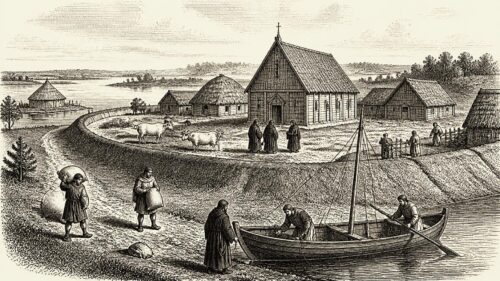
Bun Gaillme, at the mouth of the River Galway, was a particularly strategic place: it gave its holder a foothold on the boundary between the Connacht interior and the Atlantic-facing coast. Its construction should not be mistaken for the immediate creation of a later town or a complete transformation of the surrounding countryside. Yet the decision to fortify it in this year demonstrates de Burgh’s ambition to make his claims in Connacht durable. Dunamon likewise represented an attempt to anchor power in the central-western landscape. The two works show that lordship was being asserted not only through agreements with rival kings but through permanent defensive sites.
The castle-building also helps explain why Connacht’s political dispute concerned more than a binary opposition between Irish and newcomer. Richard de Burgh made and unmade alliances with branches of the Ó Conchobair dynasty; Irish rulers and their followers, in turn, chose among competing royal candidates. Fortification strengthened one coalition at a time. It did not erase the older political map, but it altered the balance of risk for neighbouring communities.
A Prince Falls in the Tuatha
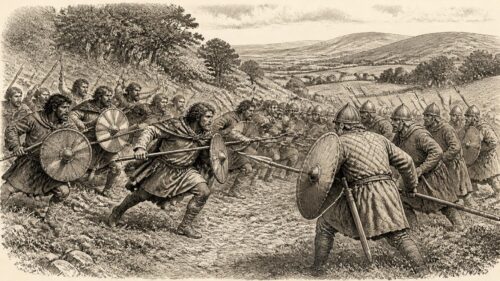
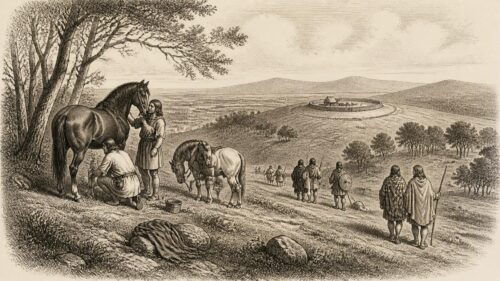
Conflict within Connacht was immediate. Conchobar, son of Áed mac Ruaidrí, escaped from the Galls and gathered Connacht princes around him. He then invaded the Three Tuatha, a territory in the province, but was killed with Gilla Cellaig Ó hÉidin, Gilla Crist son of Donnchad Mac Diarmata and many others. The Annals of Ulster, Annals of Connacht and later compilations agree on the defeat, even if their phrasing differs. This was a serious blow to Áed’s position: the death of an adult son and royal heir narrowed his family’s support at the very moment Fedlimid had regained his freedom.
The annals add a vivid, perhaps commemorative, detail: the people of the Tuatha whitened the handles of their axes because it had been said that Conchobar was killed by a man carrying a white-handled axe. Such details should not be over-read as literal reportage from the battlefield. They do, however, preserve how an episode of local resistance could acquire a memorable emblem. The weapons named were tools of close fighting; the conflict was fought not in distant abstraction but among communities whose cattle, fields and households could be exposed to armed raiding.
Violence and Succession Beyond Connacht
Further north-east, Áed Ó Fergail, chief of Annaly, was burned to death on an island in Loch Cuil by his own kinsmen, the sons of Áed Ciabach Ó Fergail. He had held the chieftainship for nine years. The episode is stark evidence of the dangers attached to lordship in the Irish midlands. Kinship supplied legitimacy and allies, but it also supplied rivals with claims and motives. The annals do not explain every cause of the killing, and no responsible account should invent one. What can be said is that control of Annaly changed through violence within the ruling kindred rather than through a recorded external conquest.
In the north, Domnall Ó Lochlainn, king of Cenél nÉogain, led a force described as containing both English and Irish troops into Tír Chonaill. It damaged Fanad and other parts of the territory and took hostages from Domnall Ó Baigill and Ó Taircheirt. Domnall Ó Domnaill responded with a raid reaching Tullaghoge in Tyrone, where cattle were killed, crops burned and further damage inflicted. A connected naval encounter around Mevagh and Eaghinis ended with the destruction of crews and the death of a son of Niall Ó Domnaill. These entries show that sea routes, coastal landing places and island waters were integral to northern warfare. They also show that hostages, livestock and standing corn were central targets: war struck wealth, subsistence and political security at once.
Churches, Canons and Care
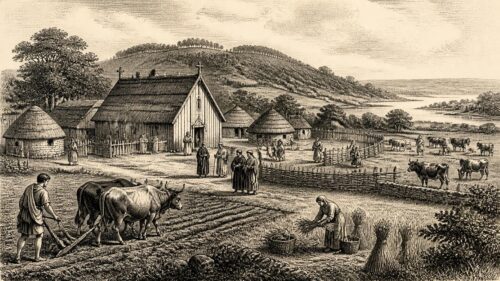
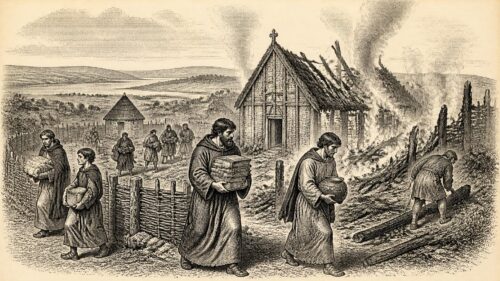
Amid political insecurity, the year also contains unusually revealing notices of religious organisation and social provision. At Kilmore in Tírarraidh, Donnchad Ó Conchobair, bishop of Elphin, consecrated a church after Fedlimid granted the place to Conn Ó Flannacáin. Conn, then prior, instituted canons there. Consecration and the establishment of a canonical community gave the site a formal religious standing, but they also created an institution with land, personnel, worship and obligations to its locality. Such foundations helped organise learned and devotional life in a region where secular politics were unstable.
A near-contemporary annal preserved in Cotton MS Titus A. XXV adds another development: Clarus Mac Máelín, archdeacon of Elphin, began a house of regular canons at Áth Moga. Its community was linked administratively with the canons of Holy Trinity on Lough Oughter, serving the two houses in alternate years. The arrangement is a useful reminder that monastic and canonical houses were networks rather than isolated buildings. Clerics, books, food, labour and authority could circulate between them.
The deaths recorded in 1232 illuminate the values attached to such institutions. Fachtna Ó hAllgaith, coarb of Drumacoo and official of Uí Fhiachrach, was remembered for maintaining both a guesthouse and a leper-house, for learning, and for benefiting the countryside. Gilla na Naem Ó Dálaigh, an eminent poet, was similarly praised for a guesthouse that supported rich and poor alike. Tipraide Ó Braein, coarb of St Coman, died on pilgrimage at Inis Clothran and was described as learned in theology, history and law. These are commemorative notices, not inventories, but together they indicate that hospitality, care for the sick, instruction and learned accomplishment were recognised public goods.
Munster and a Wider Island
The Annals of Inisfallen record the death of Donnchad Ó Longargáin, former archbishop of Cashel. He had resigned his see years earlier after disputes in which ecclesiastical rights, Anglo-Norman power and control of Cashel were deeply entangled. His death in retirement closed the career of a churchman whose life had shown how closely episcopal authority and territorial politics could meet. The same annals record Domnall Got Mac Carthaig’s brief imprisonment by his brother Cormac, his release after three months, and a subsequent violent raid against Muirchertach Ó Mathgamna. The annalist’s claim that ‘the south’ remained with Domnall’s descendants is retrospective and dynastic in tone; it should not be read as proof that all southern Munster passed under one man’s uncontested rule in 1232.
Thus 1232 was not a year of one national event, nor did any single authority command the whole island. It was a year in which political change became visible in prisoners released, heirs killed, hostages taken, crops burned and castles begun. Yet it was also a year of consecrated churches, new canonical organisation, pilgrim-scholars, poets and charitable households. In Ireland’s fractured thirteenth-century landscape, warfare and institution-building proceeded together, each shaping the world in which the other operated.
Source References
Hover over a number to see the source. Select it to open the source.
- [1] Annála Connacht
- [2] Annála Connacht (Irish text)
- [3] The Annals of Ulster
- [4] Annals of the Four Masters, Part 7
- [5] Annals of the Four Masters
- [6] Annals of Inisfallen, Part 75
- [7] The Annals in Cotton MS. Titus A. XXV
- [8] The Annals in Cotton MS. Titus A. XXV (text)
- [9] Burgh, Richard de | Dictionary of Irish Biography
- [10] O'Connor (Ó Conchobair), Áed | Dictionary of Irish Biography
- [11] O'Connor (Ó Conchobair), Fedlimid | Dictionary of Irish Biography
- [12] Ua Conchobair, Cathal Mór Crobderg | Dictionary of Irish Biography
- [13] Ua Conchobair, Ruaidrí | Dictionary of Irish Biography
- [14] FitzGerald, Maurice fitz Gerald | Dictionary of Irish Biography
- [15] Lacy, Hugh de | Dictionary of Irish Biography
- [16] Luke | Dictionary of Irish Biography
- [17] O'Melaghlin (Ó Máel Shechlainn), Cormac | Dictionary of Irish Biography
- [18] Burgh, William de | Dictionary of Irish Biography
- [19] Ua Longargáin, Donnchad (Dionisius) | Dictionary of Irish Biography
- [20] Ó Briain, Mairín (Marianus, Maurianus) | Dictionary of Irish Biography
Primary Sources
- Annála Connacht
- Annála Connacht (Irish text)
- The Annals of Ulster
- Annals of the Four Masters, Part 7
- Annals of the Four Masters
- Annals of Inisfallen, Part 75
- The Annals in Cotton MS. Titus A. XXV
- The Annals in Cotton MS. Titus A. XXV (text)
- Burgh, Richard de | Dictionary of Irish Biography
- O'Connor (Ó Conchobair), Áed | Dictionary of Irish Biography
- O'Connor (Ó Conchobair), Fedlimid | Dictionary of Irish Biography
- Ua Conchobair, Cathal Mór Crobderg | Dictionary of Irish Biography
- Ua Conchobair, Ruaidrí | Dictionary of Irish Biography
- FitzGerald, Maurice fitz Gerald | Dictionary of Irish Biography
- Lacy, Hugh de | Dictionary of Irish Biography
- Luke | Dictionary of Irish Biography
- O'Melaghlin (Ó Máel Shechlainn), Cormac | Dictionary of Irish Biography
- Burgh, William de | Dictionary of Irish Biography
- Ua Longargáin, Donnchad (Dionisius) | Dictionary of Irish Biography
- Ó Briain, Mairín (Marianus, Maurianus) | Dictionary of Irish Biography