Tibohine’s Contested Burial1229 CE
In 1229, the disputed burial of Diarmait Mac Gilla Carthaig, erenach of Tibohine, exposed rivalry between Boyle’s Cistercians and Trinity’s canons, leaving his body at Drum for three days before settlement. The year also brought clerical deaths, resignations and the loss of learned canon Gerald Ó Catháin, amid Connacht’s instability after 1228. Duibessa Ó Conchobair died as a nun, while rulers of Desmond and Corcu Laígde died. Henry III granted Dublin a mayoralty and Drogheda urban liberties, disafforested lands linked with Glendalough, and Ballybeg Priory was conventionally founded. These events reveal regional institutions, succession, patronage and authority across medieval Ireland.
Dateline
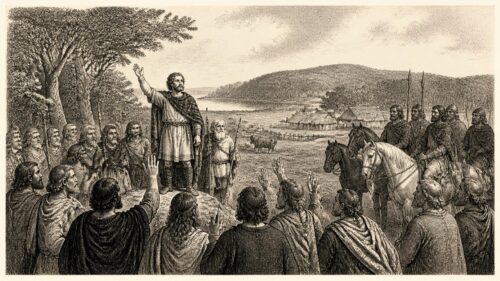
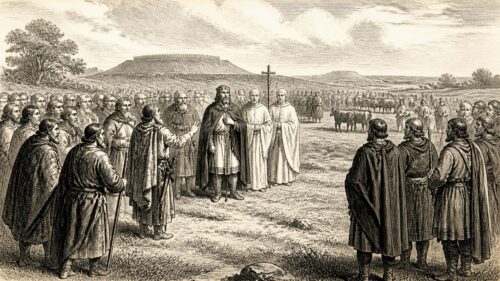
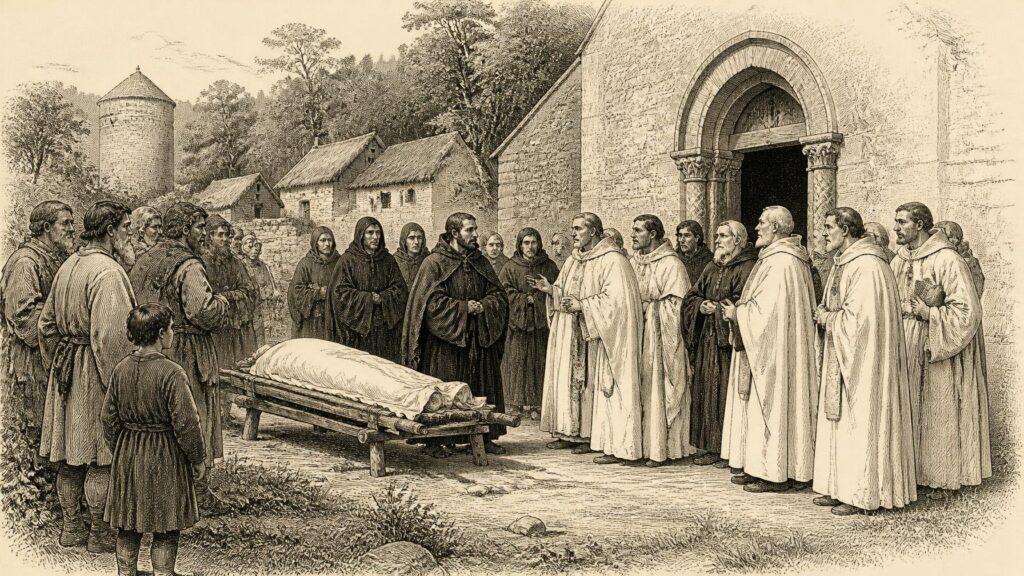
The most vivid Irish episode securely assigned to 1229 did not take place on a battlefield or in a royal hall. It concerned the body of Diarmait Mac Gilla Carthaig, erenach of Tibohine in Connacht, an archpriest whom the Annals of Connacht praises as the outstanding figure for charity and humane conduct in his region. On his death, monks of Boyle and canons of the Trinity disputed his burial. His corpse lay for two days and nights in the church at Drum because the monks would not permit interment; only at the end of the third day was it taken from them ‘equitably’, in the annalist’s judgement. No day or month is supplied, but the episode belongs firmly to 1229.
That extraordinary delay gives the year a distinctive focus. It reveals a Connacht in which church institutions were important landholders, patrons and custodians of local prestige, yet were also capable of open rivalry. Alongside it, the surviving record preserves royal deaths in Desmond and Corcu Laígde, a clutch of ecclesiastical vacancies, new urban privileges in Dublin and Drogheda, and royal interventions in the wooded lands associated with Glendalough. These were not fragments of a single national programme. They were developments in several political worlds across Ireland, linked only loosely by the lordship of Henry III and by the island-wide authority claimed by Latin Christianity.
A Burial and Its Claimants
The word erenach points to an office deeply rooted in Irish ecclesiastical society. An erenach was not merely a parish priest: he was a hereditary or locally embedded manager of a church estate, responsible for lands, revenues and hospitality as well as religious obligations. The annalist’s unusually warm description of Diarmait Mac Gilla Carthaig suggests that his reputation rested on the practical exercise of such responsibilities. Charity and hospitality mattered materially in a countryside where religious houses, churches and their officers offered food, shelter, alms and mediation.
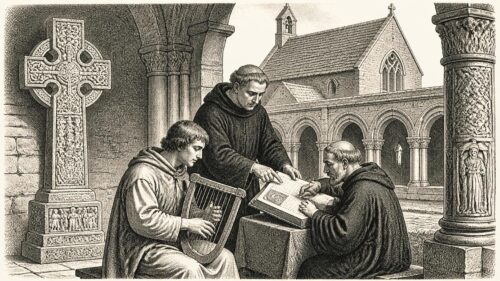
His death immediately exposed competing institutional claims. Boyle was a major Cistercian abbey, founded in the twelfth century under Mac Diarmata patronage and one of the most significant monasteries in Connacht. The canons of the Trinity belonged to a different clerical tradition. The annal does not explain whether the disagreement concerned burial fees, jurisdiction, family association, rights in Tibohine’s church lands, or the honour due to a distinguished cleric. It would be unsafe to choose between these possibilities. What it does show is that burial was public business: control of a grave could express authority over a person’s memory, kin, property and spiritual community.
The eventual settlement is described as just, but its terms are not recorded. Nor is there reason to imagine a quiet funeral. For three days, a dead churchman remained unburied while two religious communities pressed their rights. The incident is a rare glimpse of institutional friction at ground level, far removed from the grander language of conquest and kingship.
Several other obits reinforce the ecclesiastical character of the year. Gilla Ísu Ó Cléirig, bishop of Leyney, died. Gilla an Choimded Ó Duillennáin, coarb of St Fechín, and Muiredach Ó Gormgaile, prior of Inis Mac nÉrin, also died. Dionysius Ó Mórda resigned as bishop of Síl Muiredaig. Diarmait Ó Fiaich, abbot of the church of Gilla Mo-Laise Ó Gillarain and a man of Tuam, died and was buried at Ardcarne. The accumulation should not be mistaken for evidence of a general mortality crisis; annalists recorded eminent clerics selectively. Yet it does indicate a year of consequential succession in Connacht’s religious networks.
Learning, too, suffered a recorded loss. Gerald Ó Catháin, described as the most learned man in the order of canons, died in 1229. The phrase is evidence not for a school whose curriculum can be reconstructed, but for the esteem attached to learning among the Augustinian canons. Books, liturgy, legal knowledge, Latin training and Irish literary culture depended on such communities and on individuals who moved between church houses, dioceses and lordly households.
Connacht After Upheaval
The burial dispute unfolded in a province still shaken by the political catastrophe of 1228. In that preceding year Áed, son of Cathal Crobderg Ó Conchobair and king of Connacht, had been killed at Geoffrey de Marisco’s court. The Annals of Connacht then describes bitter conflict between the sons of Ruaidrí Ó Conchobair, Áed and Toirrdelbach. It portrays Connacht as devastated and says famine followed, with churches and secular communities plundered and clerics and skilled people driven away.
This is indispensable context, but it must not be converted into an event of 1229. No surviving annal entry explicitly says that famine continued through this calendar year, or records a major Connacht campaign in it. Rather, 1229 appears in the annal as a pause in the narrative of great military action: a year in which the human consequences of insecurity are glimpsed through deaths, resignations and a quarrel over a burial. The conflict would break into the open again in 1230, when Áed son of Ruaidrí and his supporters rose against Richard de Burgh, Mac William, and the Anglo-Irish interest. That later outbreak confirms the instability surrounding 1229, but should not be retrojected as a battle or rebellion already under way.
Duibessa, daughter of Ruaidrí Ó Conchobair and wife of Cathal Mac Diarmata, died as a nun in 1229. Her notice quietly connects dynastic marriage, the Mac Diarmata lordship of Moylurg and religious life. It also cautions against imagining political families as only military households. Women of ruling kindreds could enter religious life, and their deaths belonged in the annal’s political as well as devotional record.
Deaths and Succession in the South-West
In Desmond, the death of Diarmait Dúna Draignéin Mac Carthaig is independently recorded by both the Connacht annals and the Annals of Inisfallen. The latter identifies him as son of Domnall Mac Carthaig and king of Desmumu. This agreement makes the death one of the year’s most securely attested political events. It mattered because the Mac Carthaigs remained central to the shifting balance of power in south Munster, where Gaelic dynasties, Anglo-Norman lordships and church institutions competed and cooperated.
The sources do not provide a dated inauguration for a successor in 1229. Later annalistic material identifies Diarmait’s brother Cormac Fionn as ruler, while the record for 1230 places Cormac Mac Carthaig in a major Connacht expedition alongside Mac William and other Irish and Anglo-Irish forces. It is therefore reasonable to see Diarmait’s death as a turning point in Mac Carthaig leadership, but not to invent a ceremonial accession or a settled transfer of power during the year itself.
In the far south-west, the Annals of Inisfallen also records the death of Donnchad Ó hEtersceóil, king of Corcu Laígde. Even brief notices such as this are reminders that Ireland was not governed through a single hierarchy. Kingship remained layered and regional: the lord of a comparatively small people could still be styled king, maintain local standing and command the attention of annalists.
Charters, Woods and Towns
Not all change in 1229 was expressed through succession. In Dublin, Henry III’s charter created the office of mayor and permitted the citizens to elect one annually. Richard Muton is traditionally identified as the first mayor. The original 1229 instrument is now lost, but its existence was recited in a later Dublin charter, and the mayoralty is recognised in the surviving statutory record. This was an important development in the governmental life of the colonial capital: civic office offered the city’s burgesses a defined corporate voice, even though it did not make Dublin politically independent of royal government or magnate power.
The crown also issued a charter for Drogheda on the Louth side of the Boyne. Its later description as a grant of liberties and customs comparable to Dublin’s underlines the growing importance of towns as sites of trade, tolls, legal privilege and royal revenue. Dublin and Drogheda were not representative of all Irish settlement. Most people still lived in rural communities shaped by lordship, church estates, seasonal agriculture and cattle. But urban charters altered the legal and commercial landscape of the ports and river crossings on which royal authority depended.
Late in the year, royal orders dated 8 November and 4 December directed that woods within specified lands of the see of Dublin, formerly associated with Glendalough, be disafforested. ‘Forest’ here was a legal category, not simply woodland: it denoted land subject to special royal regulation of hunting and resources. Disafforestation removed that status. The orders therefore illuminate a real contest between royal forest rights and ecclesiastical liberties, while also showing that Wicklow’s wooded uplands were politically valuable terrain, not an empty frontier.
In north Cork, Ballybeg Priory is traditionally dated to 1229, when Philip de Barry endowed an Augustinian house dedicated to St Thomas near Buttevant. The precise language of foundation and endowment varies in later accounts, so the safest conclusion is that the priory’s establishment belongs to this period and is conventionally placed in 1229. Its emergence fits a wider pattern: Anglo-Norman landholders expressed lordship through grants to reformed religious orders, while monasteries became places of worship, burial, estate management and local economic activity.
A Year of Institutions
Viewed together, the evidence for 1229 is less a chronicle of one dramatic event than a map of institutions under pressure and renewal. At Drum, monks and canons contested a burial. In Connacht and Desmond, clerical and royal deaths opened questions of succession. In Dublin and Drogheda, royal charters strengthened civic frameworks. Around Glendalough, the crown adjusted the reach of forest law. At Ballybeg, a new priory represented the extension of religious patronage into a lordly landscape. The surviving sources are uneven, regional and often retrospective. Even so, they show an Ireland in which authority was exercised not only with armies and hostages, but through graves, charters, woods, churches and the communities that depended upon them.
Primary Sources
- Annála Connacht
- Annála Connacht: Diplomatic Edition
- Annals of Inisfallen, Annal AI1229
- Annals of Inisfallen: Diplomatic Edition
- Irish Script on Screen: MS C iii 1, The Annals of Connacht
- Burgh, Richard de
- Henry of London
- Luke
- FitzGerald, Maurice fitz Gerald
- Key Dates in the History of Dublin’s Lord Mayor
- History of the Lord Mayor
- Dublin City Charter No. 35: 24 January 1374 [13 Henry III]
- Statute Law Revision Act 2007, Schedule 1
- Ballybeg Augustinian Priory
- History of Ballybeg, County Cork
- Boyle Cistercian Abbey
- School of the West
- County Roscommon Urban Archaeological Survey: Boyle
- Calendar of Documents Relating to Ireland, 1171–1307
- The Woods of Ireland
- Calendar of Ancient Records of Dublin, in the Possession of the Municipal Corporation of that City