Patrick’s Shrine at Áth Sige986 CE
Dateline
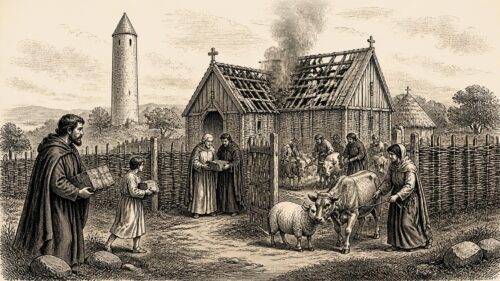
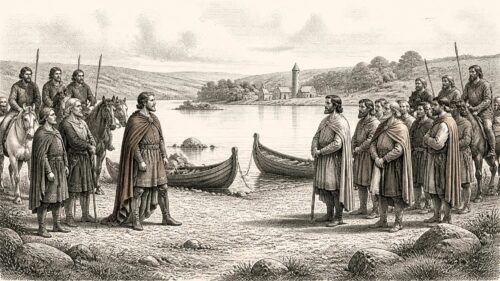
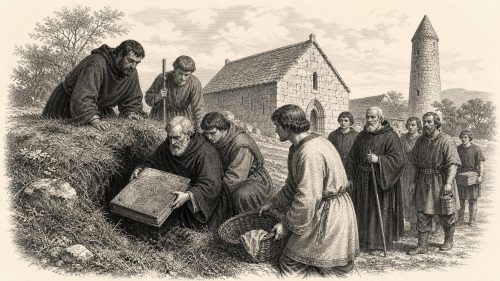
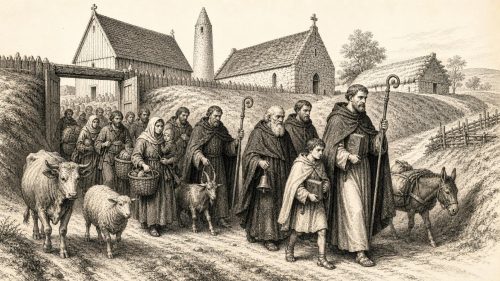
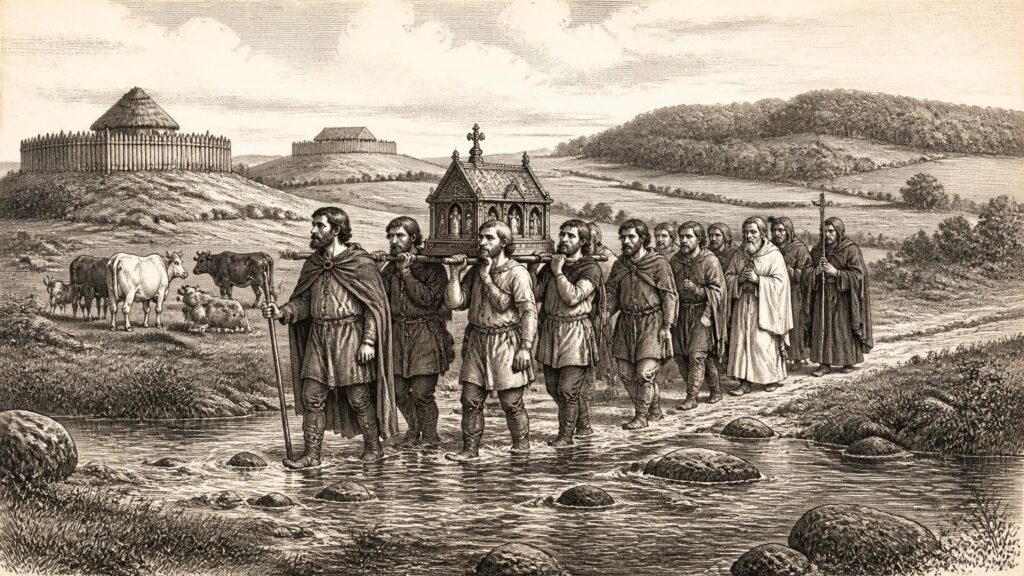
In 986, an episode involving the shrine of St Patrick brought royal authority, local conflict and ecclesiastical privilege into unusually sharp focus. The surviving annals are brief, and their differing chronologies require care, but the central record is clear enough: Máel Sechnaill mac Domnaill, king of Tara and ruler of Mide, removed Patrick’s shrine from Áth Firdiad, modern Ardee, to Áth Sige during a war involving the sons of Cairellán. A settlement followed. The king then rendered what the annalist calls Patrick’s due: a visitation involving the men of Mide, clergy and laity alike, hospitality or a feast from every fortress, seven cumala, and further payments in full.
This was not a private devotional gesture. In tenth-century Ireland, the relics, shrines and rights associated with major saints were bound up with jurisdiction, political allegiance and wealth. Moving Patrick’s shrine placed an object of exceptional religious authority under royal control at a moment of danger. The subsequent settlement made that authority visible in material terms: attendance, food, payment and recognition by communities throughout Mide. The episode is a vivid reminder that political order could be negotiated not only through battle and hostages, but through a saint’s cult and the obligations owed to it.
A Settlement Under Patrick’s Protection
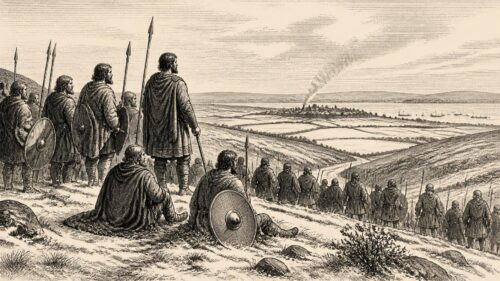
The account in Chronicon Scotorum names Áth Firdiad as the shrine’s starting point and Áth Sige as its destination. It attributes the removal to warfare connected with Cairellán’s son; the Annals of Tigernach instead refer to Cairellán’s sons. Neither source supplies the underlying dispute, identifies every party, or permits a reconstruction of the fighting. It would therefore be wrong to turn the notice into a detailed campaign narrative. What can safely be said is that a local conflict had become serious enough to involve both a major Patrician object and Máel Sechnaill’s intervention.
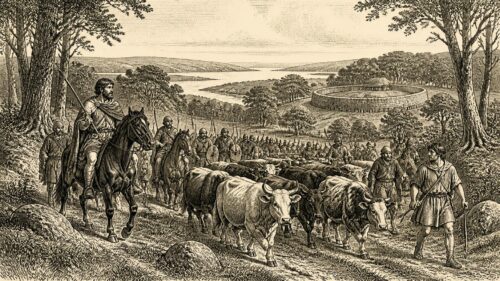
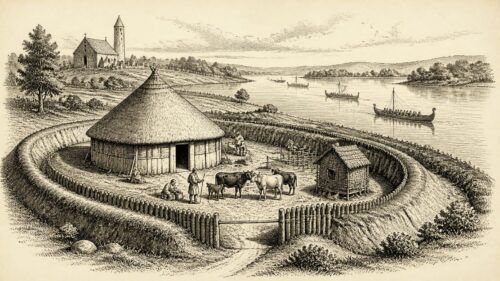
The peace that followed mattered because it was framed as the fulfilment of Patrick’s rights. The wording implies a formal circuit or visitation of the men of Mide, embracing both churchmen and laypeople. Such an occasion would have united religious observance with political display. A ruler’s ability to summon people, provide hospitality and enforce compensation was an important practical measure of power. The reference to every fortress is especially revealing. In this context a fortress need not mean a stone castle of the later Middle Ages. It points instead towards the dispersed world of chiefly residences and defended farmsteads, many of them timber-built enclosures or ringforts, where local authority, livestock and household resources were concentrated.
The seven cumala and the unspecified additional dues should not be reduced to a modern cash value. A cumal was a recognised unit of value in Irish legal and social language, and its appearance here signals a settlement expressed in acknowledged terms of rank and restitution. The king was not merely ending a quarrel; he was underwriting an agreement whose legitimacy rested upon Patrick’s name. Ardee, lying in the Boyne valley between the northern approaches and the midlands, was well placed for such a contest over routes, ecclesiastical assets and influence.
Máel Sechnaill’s Midlands
Máel Sechnaill had ruled Mide from 978 and, after his victory over Dublin’s forces at Tara in 980, stood as the pre-eminent ruler among the Uí Néill. Yet Ireland was not a unified kingdom governed through a single administration. His authority depended on personal lordship, military capacity, kin alliances, tribute and the cooperation of powerful churches. The shrine settlement therefore illuminates how kingship worked at ground level. A king of Tara could act decisively in a dispute, but resolution still required local peace-making, ecclesiastical consent and payments that made obligations tangible.
Events elsewhere in the annals show that 986 was not a year of calm beneath a settled national hierarchy. Muirghius son of Domnall, king of Uí Maine in what is now east Galway and south Roscommon, died according to the Annals of Tigernach; Chronicon Scotorum calls him slain. The disagreement prevents certainty about the manner of his death, but both notices mark a change at the head of an important Connacht polity. In northern Ireland, Flaithrí Ua Loingsig, king of Dál Araide, was recorded as having been strangled. A later annalistic compilation describes him as killed by his own people. These compressed notices offer no full explanation, but they demonstrate the risks attending provincial rule and succession.
At Armagh, the ecclesiastical centre most closely associated with Patrick, a “great disturbance” took place on Sunday 25 July, shortly before Lammas. The Annals of Ulster identify the antagonists as Uí Echach and Uí Nialláin and record casualties, including the son of Trénar son of Celecán. The exact date is unusually valuable, while the causes remain unstated. It should not be assumed that this fighting was connected directly to the removal of Patrick’s shrine. Rather, the two records together reveal a northern political landscape in which communities competed in and around places carrying enormous sacred and strategic weight.
Columba’s Sea-Lanes
The same year brought violence across the Irish Sea world. The Annals of Ulster report that three Danish ships reached the coast of Dál Riata. One hundred and forty of their people were executed and others sold, a bleak notice of a failed raiding or landing party and of captivity as a consequence of warfare. Dál Riata lay principally in western Scotland, but it belonged to a maritime zone long connected to Ireland by kinship, monastic networks, seafaring and trade. Its appearance in an Irish chronicle is wholly unsurprising.
More devastating was the attack on Í, Iona, the monastery of Colum Cille. The Annals of Ulster date the plundering to Christmas Night and say that Danes killed the abbot and fifteen senior members of the community. The Annals of Inisfallen likewise record the plundering of Í and devastation in the Isles, adding the death of Iona’s bishop. Chronicon Scotorum names Máel Ciaráin Ua Maigne, successor of Colum Cille, as suffering “red martyrdom” at the hands of Danes at Dublin. The wording and locations are not fully identical, so the sources should not be made to say more than they do; nevertheless, they converge upon an exceptional catastrophe for the Columban community in or around this year.
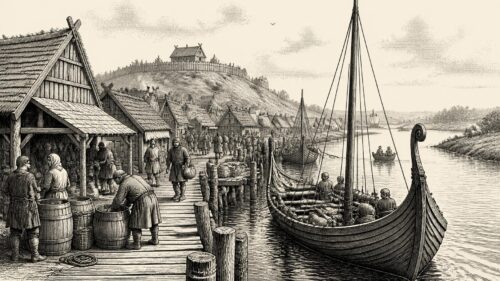
Iona was geographically in the Hebrides but spiritually and historically inseparable from Ireland. Founded by Colum Cille, an Irish saint, it remained a centre of learning, art, pilgrimage and Columban authority. Its connections extended to Irish houses, including Kells, and its vulnerability also reflected the enduring reach of Scandinavian maritime power. The attackers should not be imagined as strangers to an otherwise sealed Irish world: Dublin, Waterford and Limerick had long been centres in which Scandinavian and Gaelic interests met through warfare, lordship, commerce and intermarriage. Yet the killing of an abbot and elders at a famous monastery made the insecurity of sea routes painfully evident.
Churches, Households and Production
A further report, preserved in Chronicon Scotorum, says that Clonmacnoise was burned on the eve of the Friday before Easter. The Annals of the Four Masters place the same burning under their entry for 985, illustrating the chronological problems that sometimes divide later annalistic traditions. It is best treated as an event securely belonging to this immediate period rather than assigned without qualification to a precise calendar year. The damage was significant whichever dating is preferred. Clonmacnoise stood at the junction of the Shannon waterway and the east–west route across the midlands: a religious community, royal burial place, centre of craftsmanship, learning and exchange, rather than an isolated retreat.
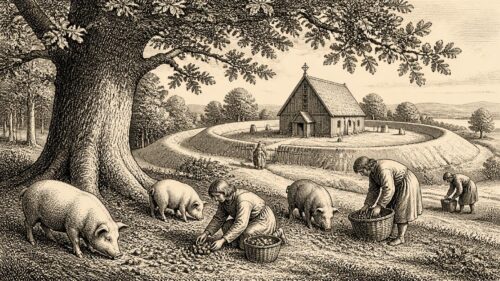
For ordinary households, politics was experienced through demands for cattle, food-renders, labour, military service and protection. Cattle remained central to wealth and dispute, while the wooded landscape also supplied seasonal resources. The Annals of Inisfallen record an abundance of mast in 985 that lasted until the end of the following year. This is a modest but useful glimpse of environmental conditions affecting 986. Mast—principally the fruit of woodland trees—could support pigs and other livestock and eased pressure on managed fodder. It does not prove universal prosperity, but it suggests that at least one annalist considered the abundance noteworthy enough to record across two seasons.
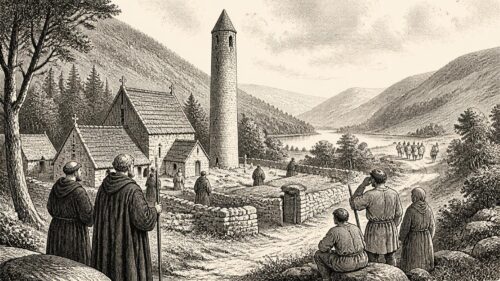
Most people lived not in towns but in rural settlements of small farmsteads and ringforts, cultivating crops, tending animals and sustaining households tied to local lords. Monastic centres, however, gathered clerics, tenants, craftsmen, visitors and traders, and could command lands and food supplies on a much larger scale. Their churches, books, relics and metalwork embodied learning and devotion, but also accumulated wealth. That dual character helps explain why Patrick’s shrine could settle a conflict and why Iona and Clonmacnoise were so exposed when violence came.
A Year of Fragile Authority
The records for 986 do not describe a single island-wide war or a decisive shift in the contest between Máel Sechnaill and Brian son of Cennétig, the rising ruler of Munster. Brian’s later challenge to Máel Sechnaill should not be projected backwards as though it determined every event of this year. Instead, 986 shows authority being made and contested in several registers at once: at Ardee through the removal and restitution of a saint’s shrine; at Armagh through local violence; in Uí Maine and Dál Araide through changes in rulership; and on Iona through a maritime assault with consequences felt across the Columban world.
Patrick’s shrine is the year’s most revealing image. It was portable, sacred and politically charged. Its movement during war, followed by an agreement that required public dues from Mide, shows how Irish rulers and churches could use sanctity to bind communities to peace. But the Christmas attack on Iona also shows the limits of such protections. In 986, Ireland’s religious institutions remained indispensable centres of authority and culture, even as conflict on land and sea repeatedly tested the security on which they depended.
Primary Sources
- The Annals of Ulster, Year U986
- The Annals of Ulster
- The Annals of Tigernach, Annal T986
- The Annals of Tigernach
- Chronicon Scotorum, Annal CS986
- Chronicon Scotorum, Irish Text
- Chronicon Scotorum: Bibliography and Publication Details
- Annals of the Four Masters, Annal M986
- Annals of the Four Masters
- Annals of Inisfallen, Annal AI986
- Annals of Inisfallen
- The Chronology and Sources of the Early Irish Annals
- Home Page for Dr Daniel P. McCarthy
- Vikings in Ireland
- History and Stories: Iona Abbey
- St Mary’s Abbey, Iona, Monastic Settlement
- Iona, Early Christian Monastery
- Clonmacnoise Monastic Site Highlights
- High Crosses
- Ringforts / Ráthanna
- Ordinary People in Early Christian Ireland
- The Earthen Rath or Lios
- The Rock of Cashel
- Queen Gormlaith, Brian Boru and the Northmen of Dublin