Mag Aí in Ashes984 CE
In 984 Máel Sechnaill mac Domnaill, king of Mide and Tara, campaigned into Connacht, burning Mag Aí, killing leading men and attacking island settlements, probably crannogs. Connacht retaliated eastwards at Loch Aininn, or Lough Ennell, burning land and killing the king of Fir Chell. Annalistic dating varies between 984 and 985, reflecting chronological differences rather than separate campaigns. Deaths of ecclesiastical leaders, including Fogartach Ua Congaile of Daiminis, highlighted churches’ political and learned importance. Domnall Claen of Leinster was killed by Uí Cheinnselaig rivals. Together, these events reveal interconnected lordships, warfare, ecclesiastical authority and unstable regional kingship in tenth-century Ireland.
Dateline
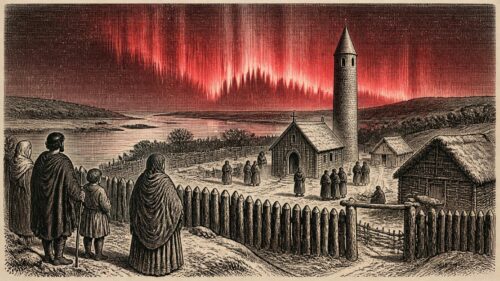
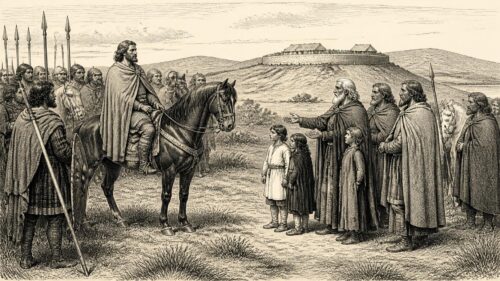
The clearest event that can be assigned to calendar year 984 was a hard, westward assertion of power by Máel Sechnaill mac Domnaill, king of Mide and holder of the kingship of Tara. The Irish annals record that he led an army into Connacht, devastated Mag Aí and struck at its islands. The account is brief, but its vocabulary is unusually forceful: the plain was reduced to ashes, leading men were killed, and island settlements were attacked. Connacht answered with a retaliatory raid eastwards towards Loch Aininn, now Lough Ennell, where the men of Connacht burned territory and killed the king of Fir Chell.
That sequence makes 984 more than a note of one king’s aggression. It shows how authority in late tenth-century Ireland was exercised: not through a single state with fixed frontiers, but through military expeditions, tribute, hostages, destruction of resources and the ability to compel – or resist – submission. The raid also brought fighting into a landscape whose farms, lakes, churches and royal places had long sustained Connacht’s rulers.
A Date with a Problem
The dating of Irish annals requires care. The same campaign appears under 984 in the Annals of the Four Masters, but under 985 in the surviving text of the Annals of Tigernach and Chronicon Scotorum. The Annals of Ulster, however, explicitly identifies its relevant entry as “AD 984 alias 985”. This is not evidence for two campaigns. It reflects the differing chronological systems, copying practices and later year-numbering of the annalistic traditions. The campaign is therefore best treated as belonging to calendar 984, without pretending that a month or day is known.
The same caution matters for other notices around the year boundary. The killing of Domnall Claen, king of Leinster, by the Uí Cheinnselaig is placed under 984 in Tigernach, while the Ulster annals position the corresponding notice in a year marked 983/984. It belongs securely to the immediate political horizon of 984, but no more precise date should be imposed. Annalistic evidence is exceptionally valuable, yet it is terse and its chronological labels are not always identical to the modern calendar.
Máel Sechnaill’s Western Campaign
Máel Sechnaill’s target was Connacht, and particularly Mag Aí: the fertile central plain of what is now County Roscommon, closely associated with Cruachain or Rathcroghan, the old royal landscape of Connacht. This was not an empty symbolic destination. It was a settled and productive region, crossed by routes linking the Shannon basin with western Connacht and containing places of political and ceremonial importance. An attack on Mag Aí could damage the resources of rival rulers while announcing that their core territory was vulnerable.
The annalists do not explain the immediate cause of the expedition. They do not state that Connacht had rebelled, withheld tribute or allied with a named enemy. It would be unsafe to supply a motive simply because later Irish politics often followed such patterns. What can be said is that Máel Sechnaill had the capacity to bring an army from the midlands into Connacht, and that he chose to make a devastating demonstration there. The destruction of Mag Aí was a political act as much as a military one: it projected the reach of a ruler whose authority was founded on personal lordship, kinship, armed followings and the extraction of dues.
Máel Sechnaill had risen to prominence after his victory over the Dubliners at Tara in 980. By 984 he was the leading figure among the southern Uí Néill and occupied the kingship of Tara, the pre-eminent claim to island-wide overlordship. Yet that did not give him effortless command over Ireland. Munster was being reshaped by the growing power of Brian, son of Cennétig, while Leinster, Connacht, the northern Uí Néill and the Hiberno-Norse towns retained rulers and interests of their own. The Connacht campaign should be understood within that competitive world: a powerful king enforcing superiority, not administering a unified realm.
Islands Under Attack
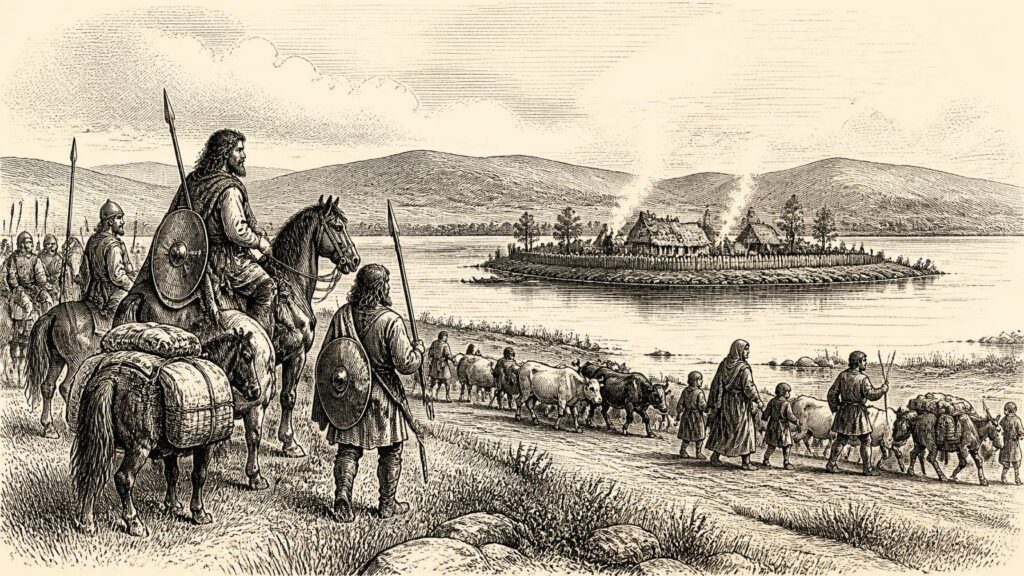
One detail gives the raid a distinctive character. Tigernach says that Máel Sechnaill destroyed Connacht’s artificial islands; the Four Masters says that he destroyed its islands. These were probably crannogs and comparable lake settlements: defended or prestigious residences constructed on, or enhanced from, small islands in lakes and wetlands. Such places could contain houses, storehouses, workshops, landing places and protective palisades. They were connected to wider lordly landscapes rather than isolated refuges.
Attacking island settlements demanded boats, local knowledge or control of the lake edge. It was therefore more than an indiscriminate sweep across open country. The record suggests a campaign aimed at places where people, goods and authority were concentrated. The phrase does not permit an archaeological inventory of what was burned at each site, nor can particular surviving crannogs be identified with confidence as victims. Even so, the annal’s emphasis shows that watery strongholds mattered enough to be singled out.
For households caught in the path of such an army, the consequences were immediate. Early medieval rural life depended on cattle, dairying, crops, stores, labour and the security of farmsteads. Burning a district endangered food supplies and shelter, while the loss of cattle or the disruption of seasonal work could have effects beyond the campaigning season. The annals name slain chieftains, as they commonly do, but the destruction described at Mag Aí necessarily reached beyond elite casualties. It affected tenants, dependants, craftspeople and religious communities whose livelihoods were bound into the same regional economy.
Connacht Strikes Back
Connacht did not accept the assault passively. The annals report a counter-raid as far as Loch Aininn, identified with Lough Ennell in modern County Westmeath. There the raiders burned territory and killed the king of Fir Chell, a people of the midlands. The route itself is revealing. Lough Ennell lay within the broader sphere of Mide, Máel Sechnaill’s home province. By carrying war to that lake district, the Connachtmen replied not merely at a frontier but within territory associated with their attacker’s power.
Neither side’s action is presented as a decisive battle. This was reciprocal raiding: mobile forces inflicting damage on land and people, then withdrawing with the political message delivered. Such warfare could settle little permanently, but it could test alliances, weaken a rival’s dependants and establish reputations for effective leadership. In a society where kingship rested partly on protecting followers and distributing wealth, the killing of Fir Chell’s ruler was a pointed answer to the killing of Connacht’s chiefs.
The exchange also warns against imagining western Ireland as remote from the main currents of power. Mag Aí and Lough Ennell were linked by movement through the midlands, by lake routes and by the political geography of lordships. Connacht could be invaded from Mide; Connacht’s forces could in turn reach into Mide. The island’s regions were diverse, but they were not sealed off from one another.
Churches, Learning and Local Authority
Calendar 984 also brought recorded deaths in major ecclesiastical communities. Fogartach Ua Congaile, described by the Four Masters as a distinguished scribe and abbot of Daiminis, died; the Ulster annals likewise call him superior of Daiminis. Daiminis, Devenish Island in Lower Lough Erne, was a significant island church site. Flaithlem, superior of Saigir, and Máel Finnia, superior of Domnach Pátraig, also died. The death of Eochaid, airchinneach of Daimliag Chianáin, is recorded separately, and unlike the others he was slain.
These notices illuminate a connected ecclesiastical world rather than a church separated from secular politics. An abbot or airchinneach was not simply the head of a small devotional household. Major churches held land, received gifts, maintained learned personnel and stood within local networks of kin and lordship. A “distinguished scribe” such as Fogartach represents the labour of writing, copying and preserving texts on which annalistic memory itself depended. His death was worth recording because learning was a form of institutional wealth and prestige.
Other obituaries cluster around the uncertain 983–84 annal boundary: Uisíne Ua Lapáin, superior of Daire Calgaig, the predecessor of medieval Derry; Muiredach Ua Flannacáin, lector of Armagh; and regional rulers including Domnall Claen of Leinster and Flaithbertach Ua hÁnluain of Uí Nialláin. Their exact placement within the modern calendar cannot always be fixed, but together with the securely dated 984 notices they show a year in which leadership changed at many levels. Kings, local dynasts, abbots, church officers and scholars formed overlapping political and cultural hierarchies.
Leinster’s Violent Transition
Domnall Claen’s death belongs to this same unsettled moment. He was killed by the Uí Cheinnselaig, a powerful Leinster dynasty and rivals of the Uí Dúnlainge line from which Domnall came. The annals offer no narrative of negotiations or succession arrangements, only the blunt statement of killing. Yet the event demonstrates the fragility of provincial kingship. A ruler could be recognised as king of Leinster and still fall to competitors from within the province.
That instability mattered beyond Leinster. Dublin, its Hiberno-Norse rulers and Leinster’s competing dynasties were bound into the politics of the eastern coast, while Máel Sechnaill’s authority depended on preventing hostile combinations there. His earlier campaigns had already reached Leinster and Dublin. In 984, the western attack on Connacht and the transition in Leinster were separate developments, but both reveal the same political reality: Ireland’s leading kings had to contend continually with regional rivals, not merely foreign enemies.
A Year of Reach and Reprisal
Nothing in the evidence allows 984 to be called a turning point on the scale of a famous battle. No treaty survives, no new town was founded, and no single ruler secured undisputed mastery. Its importance lies in the unusually clear glimpse it gives of power at work. Máel Sechnaill’s army could burn Mag Aí and assault lake settlements far to the west. Connacht could retaliate at Lough Ennell and kill a midland king. Churches continued to preserve learning and authority, even as their leaders died or were killed. And the contested kingship of Leinster could change through violence.
The year therefore stands as a record of connected landscapes: the royal plain of Mag Aí, island settlements on western lakes, the shores of Lough Ennell, monastic centres from Devenish to Saigir, and the rival dynastic territories of Leinster. In 984, fire, water, cattle wealth, religious institutions and armed lordship were all part of the same Irish political world.
Primary Sources
- The Annals of Ulster
- Part 554 of The Annals of Ulster
- The Annals of Tigernach
- Part 15 of The Annals of Tigernach
- Annals of the Four Masters
- Part 9 of Annals of the Four Masters
- Chronicon Scotorum
- Part 112 of Chronicon Scotorum
- Annals of Inisfallen
- Part 54 of Annals of Inisfallen
- Irish Chronicles and Their Chronology
- Chronological Synchronisation of the Irish Annals
- Exploring the Irish Annals
- Rathcroghan
- Rathcroghan – A Royal Site in Connacht
- Rathcroghan Archaeological Complex Conservation Study
- The Social and Ideological Role of Crannogs in Early Medieval Ireland
- The Archaeology of Livestock and Cereal Production in Early Medieval Ireland, AD 400-1100
- Module 1: Transformation from Pre-Norman Monasticism to the Introduction of the Religious Orders into Ireland in the Twelfth Century
- The Archaeology of Early Christianity in the North of Ireland, Volume 2
- Vikings in Early Medieval Ireland: Church-Raiding, Politics and Kingship
- Early Medieval Ireland, AD 400-1100: The Evidence from Archaeological Excavations