Mathgamain’s Hostage Raid969 CE
In 969, Ireland remained a fragmented political landscape of competing kingships, churches and Scandinavian towns. Mathgamain son of Cennétig demonstrated Dál Cais ambitions in Munster by leading a hosting against the son of Bran and taking hostages, converting military pressure into overlordship. Despite Limerick’s burning in 967, its ruler Ímar retained power, killing Beólán Litil and his son. Elsewhere, rulers were killed, while Ardgal of Ulaid and Donnocán of Airgialla died in conflict involving Dublin allies. Disputed dates complicate events around Domnall ua Néill’s struggle with Clann Cholmáin. Deaths and campaigning reveal power’s dependence on communities, resources, alliances and coercion.
Dateline
In 969, Ireland was not a kingdom with a single settled centre of government, but a patchwork of rival overkingships, lesser lordships, ecclesiastical communities and Scandinavian port towns. The year’s surviving notices are brief, yet they disclose a country in which authority had to be repeatedly demonstrated in the field. In Munster, Mathgamain son of Cennétig advanced his claim to supremacy through a hosting and the taking of hostages. In the north and midlands, kings and churchmen died amid contests involving Dublin’s Scandinavian forces. The evidence does not allow a continuous narrative of the year, but it permits a vivid view of how power worked: through armed followings, personal alliances, hostage-taking, control of routes and the ability to strike at opponents’ dependants.
A Cautious Calendar
The dating of these events needs care. The Annals of Inisfallen, whose entries are especially valuable for Munster, place several notices under 969. Other annalistic compilations preserve related events under different year headings. The Annals of Ulster label their entry “968 alias 969”; Chronicon Scotorum places a northern battle associated with the deaths of Ardgal of Ulaid and Donnocán of Airgialla under 970; and the much later Annals of the Four Masters group a wider sequence under 969. Such discrepancies arise from the difficult transmission and synchronisation of medieval annals, not necessarily from disagreement over what happened.
Accordingly, the most secure approach is to distinguish between what is explicitly entered under 969 and what belongs to the immediate sequence of campaigning around it. Mathgamain’s expedition and several killings appear directly in the Inisfallen record for the year. The struggle between Domnall ua Néill and the midland Clann Cholmáin, although placed under 969 by the Four Masters, is more prudently treated as a closely connected conflict whose precise calendar year remains uncertain. That restraint matters. Irish political history is rich enough without making a disputed annal heading carry more certainty than it can bear.
Mathgamain Takes Hostages
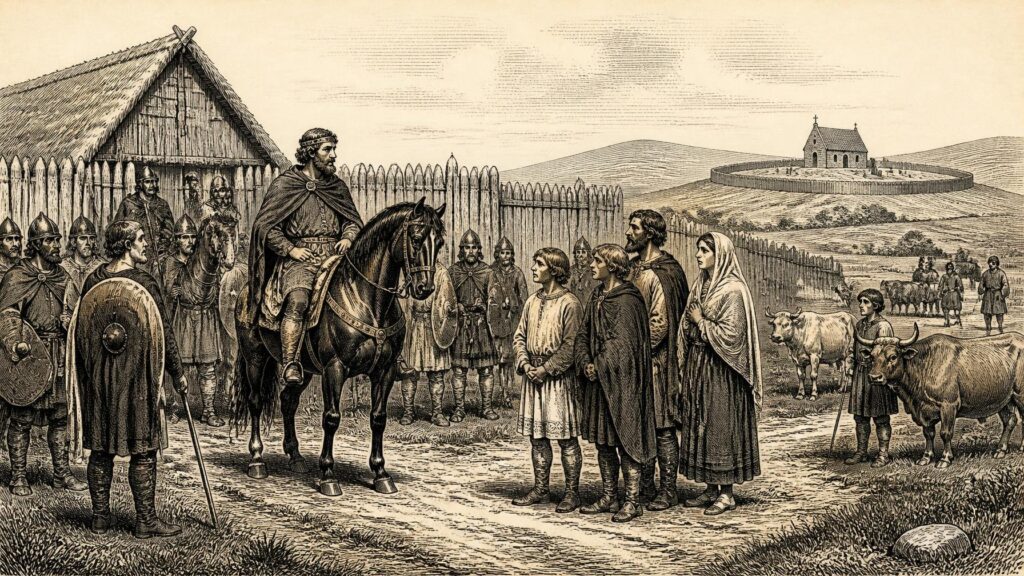
The clearest southern event is the Annals of Inisfallen entry that Mathgamain led a hosting against “the son of Bran” and took hostages from him. A hosting was not simply a raid by a few armed men. It was a public mobilisation of a ruler’s followers, an assertion that he could summon military service and carry it into another lord’s territory. The annalist does not name the place, describe a battle or give the number of hostages. What matters is the political result: Mathgamain compelled submission from an opponent of sufficient standing to be identified through his father.
Hostages were central to Irish politics. They were not merely prisoners seized after defeat, although force lay behind the practice. Their removal bound a subordinate ruler to good conduct, made future resistance costly and advertised the victor’s reach. They might be members of ruling families or other people of high value to a community. Their safety depended on the continued observance of an agreement. The taking of hostages therefore turned a military demonstration into a relationship of overlordship. In a landscape where boundaries were fluid and formal institutions limited, this was one of the most practical means by which a king made a claim to authority real.
Mathgamain’s action belongs to the rapid rise of the Dál Cais in northern Munster. Two years earlier, according to the same annals, he had defeated the foreigners of Limerick at Sulchuait and Limerick itself was burned the next day. That victory did not eliminate the Scandinavian presence on the Shannon, nor did it settle Munster. Rather, it gave Mathgamain prestige and military leverage which he now used against Irish rivals. The 969 hostage-taking shows that his ambitions extended beyond retaliation against a coastal settlement. He was seeking obedience from neighbouring powers and building a wider Munster following.
Limerick Still Armed
The same annal gives a corrective to any simple story of Scandinavian collapse. It records that Ímar of Limerick killed Beólán Litil and Beólán’s son. The victims are not otherwise explained in the entry, so their status and the immediate cause of the killing cannot responsibly be reconstructed. Yet the notice is important. Ímar remained able to command violence and to intervene decisively in the politics of the Shannon region after Mathgamain’s celebrated success of 967.
“Foreigners” in Irish annals is a broad contemporary label, usually applied here to the Scandinavian communities of Ireland and their leaders. It should not suggest a separate world sealed off from Irish society. Dublin, Limerick, Waterford and other coastal settlements were places of trade, craft production, shipping and political negotiation, as well as centres capable of mounting armed expeditions. Their rulers made alliances with Irish dynasties; Irish kings could hire, fight beside, attack or bargain with them. The killing ordered by Ímar in 969 is therefore best understood within local competition rather than as an episode in an uncomplicated Irish-versus-Viking war.
Limerick’s position at the Shannon estuary made it strategically valuable. River and sea routes linked its inhabitants to the islands, western coasts and Irish Sea world, while the Shannon gave access towards the midlands. Control of such a settlement offered opportunities for exchange and for coercion. Mathgamain’s earlier burning of Limerick and Ímar’s recorded violence in 969 reveal two powers testing one another in the same region, neither yet able to impose an uncontested settlement.
Killings and Northern Alliances
Elsewhere, the Inisfallen annalist notes that Tresach son of Máel Muine, king of Gabair, was killed by Máel Sechnaill. The brevity of the notice prevents a confident account of motive or location. It does, however, show that smaller kingships mattered. The word “king” did not denote only an island-wide ruler: Ireland contained multiple levels of kingship, from local dynasties to men who claimed wider superiority. A killing such as this could alter the balance within a district, open a succession dispute and draw stronger neighbours into local affairs.
The most consequential northern notice records the deaths of Ardgal son of Matudán, king of Ulaid, and Donnocán son of Máel Máire, king of Airgialla. Inisfallen attributes their deaths to the son of Congalach and to the foreigners of Dublin. A related account in Chronicon Scotorum, entered under 970, describes a battle at Cell Mona in which Domnall son of Congalach, allied with Dublin’s foreigners, opposed Domnall ua Néill, king of Tara; Ardgal and Donnocán were among those who fell. The overlap makes it very likely that the records concern the same episode, but it does not justify pretending that its exact calendar placement is settled.
What is clear is the political pattern. Domnall ua Néill, of the northern Uí Néill, was trying to sustain a claim to the kingship of Tara and a wider pre-eminence. Domnall son of Congalach, a ruler from Brega, could join forces with Dublin against him. Ardgal of Ulaid and Donnocán of Airgialla were not peripheral spectators: their deaths underline the cost of choosing sides in contests that crossed provincial boundaries. Alliances were assembled around immediate interests, dynastic rivalries and access to strategic territories, not around permanent national blocs.
Meath and the Limits of Tara
The later Annals of the Four Masters place a dramatic reversal for Domnall ua Néill under 969. They say that Clann Cholmáin drove him north across Sliabh Fuaid, after which he returned with northern forces, devastated Meath, Uí Fhailge and Fotharta, and established a camp in every cantred of Meath from the Shannon to Belach Dúin. Chronicon Scotorum places Domnall’s expulsion from Meath under 971, while modern scholarship commonly treats the wider campaign as belonging to 970–71. The episode should therefore be connected to 969 as part of the same political crisis, rather than treated as firmly dated within it.
Even with that caveat, the story illuminates the year’s political world. Tara was an immensely potent royal idea, but its holder could not command obedience merely by possessing a title. Meath was the heartland of Clann Cholmáin, Domnall ua Néill’s southern Uí Néill rivals. Their capacity to expel him demonstrates how constrained an overking could be when operating beyond his own northern base. The reported network of camps, if accepted as broadly authentic, points to a hardening method of rule: not just a destructive raid, but temporary territorial occupation intended to compel compliance.
Churches, Communities and Daily Stakes
The annals also preserve signs of the ecclesiastical world that sustained Irish learning and local organisation. The Annals of Ulster, under their ambiguous 968/969 heading, record the deaths of Cinaed ua Cathmaíl, superior of Daire Calgaig; Máel Finnéin, bishop of Cenannas and successor of Ultán and Cairnech; and Eógan son of Cléirech, bishop of Connacht. They also notice Saerlaith, daughter of Elcomach, who died aged one hundred, and Beollán son of Ciarmac, king of Loch Gabor. These cannot all be assigned without qualification to the modern calendar year 969, but they are valuable evidence for the human landscape surrounding it.
Church offices were not detached from society. A successor, bishop, abbot or superior could oversee worship, schooling, manuscripts, land, food renders and dependent households. Major ecclesiastical centres were places of prayer and burial, but also of exchange and authority. The death of a leading churchman could therefore matter politically and economically as well as spiritually. The much later Four Masters add notices of the deaths of Tuathal, successor of Ciarán and bishop-abbot of Clonmacnoise, together with other senior churchmen. Because those notices align differently in other annals, they should be read as evidence of an ecclesiastical transition around this period, not as securely dated events of 969.
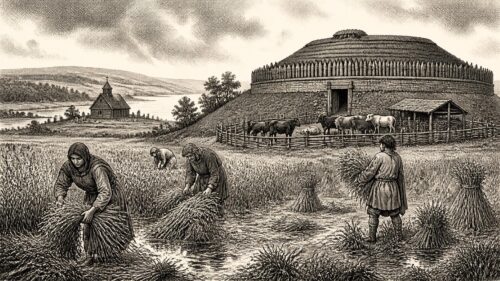
For most people, the year’s contests were experienced not through royal titles but through their consequences. Armed hostings needed food, animals, transport and labour. A community whose lord surrendered hostages could face new demands and new obligations; one caught between rival forces risked the loss of cattle, grain and security. Cattle remained a principal measure of wealth, while cereals, mills and seasonal labour underpinned subsistence. Ringforts, farmsteads, monastic precincts and riverine settlements formed the ordinary settings of life. The annals seldom name the families who bore these burdens, but the politics they record depended upon them.
An Uneasy Ascendancy
Thus 969 was not a year of a single decisive battle or constitutional change. It was a year in which the mechanisms of Irish power are unusually visible. Mathgamain converted military movement into submission by taking hostages; Ímar of Limerick retained the capacity to kill and intimidate; regional kings died in an alliance-driven northern conflict; and Domnall ua Néill’s authority faced severe pressure in the midlands. The entries are sparse, their chronology sometimes difficult, but their combined message is clear. Ireland’s future was being shaped not by one ruler governing a united realm, but by ambitious leaders competing to make local obedience into wider dominion.
Primary Sources
- Annals of Inisfallen, Annals AI960–AI969
- The Annals of Ulster, Year U969
- Annals of the Four Masters, Annals M963–M972
- Chronicon Scotorum, Annals CS970–CS971
- Chronicon Scotorum: Bibliographical and Editorial Information
- Annals of Tigernach: Background Details and Bibliographic Information
- Cogadh Gaedhel re Gallaibh: The War of the Gaedhil with the Gaill
- Ua Néill, Domnall
- Vikings in Scotland and Ireland
- General Vikings in Ireland
- The Annals of Inisfallen: CELT Navigator
- The Annals of Ulster AD 431–1201: CELT Published Text
- List of Published Texts at CELT
- Exploring the Irish Annals
- Early Christian Monasteries
- Patrician and Early Christian Architecture
- The Vikings, Ninth to Tenth Centuries
- The Coming of Christianity to Clare
- Farming and Archaeology
- Discover the Walled Towns of Ireland: How Did the Walled Towns Evolve?
- Excavations and Archaeological Buildings Survey: Robing Room, Bishop’s Palace, Kilkenny
- Middle Ages: Limerick