Kings, Clerics and Fire1138 CE
In 1138, Ireland’s contested political order produced both stalemate and upheaval. Toirdelbach Ua Conchobair’s coalition confronted Meath, Leinster and Dublin without battle, confirming his reach but not supremacy. In Munster, Cormac Mac Carthaig, royal patron of reform and Cashel’s Romanesque chapel, was murdered through an Uí Briain-backed conspiracy, restoring their over-kingship while preserving Mac Carthaig resistance in Desmond. Raids, killings and crop destruction exposed local rivalries and contributed to famine. Armagh’s new primate, Gilla Meic Liac, visited Munster, while clerical deaths and fires affected churches. At Armagh, Máel Brigte completed a Gospel manuscript, demonstrating enduring scholarship amid conflict and instability.
Dateline
The record of this year is unusually revealing, but it must be read with care. Irish annals were copied, combined and recalibrated over centuries, so an event may appear under neighbouring years in different texts. The killing of Cormac Mac Carthaig and several ecclesiastical notices are securely associated with 1138, while the campaign at Inis Mochta is entered under 1138 by the Annals of the Four Masters but under 1139 in Mac Carthaigh’s Book. Such variations do not make the accounts worthless; rather, they warn against claiming an exact day or sequence where none survives.
A Contested High-Kingship
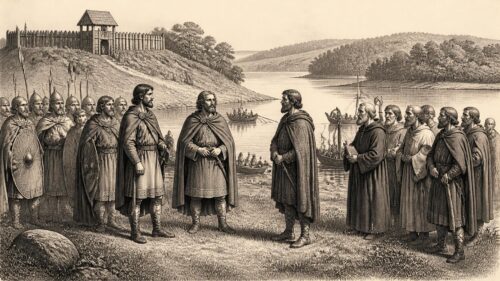
Ireland remained a patchwork of provincial kingdoms and smaller lordships linked by tribute, hostages, fosterage, marriage and frequently changing alliances. Toirdelbach Ua Conchobair, king of Connacht and claimant to the high-kingship, was still the island’s most formidable ruler, but his authority was neither uniform nor uncontested. In 1138 he joined Tigernán Ua Ruairc of Bréifne and Donnchad Ua Cerbaill of Airgialla in an advance against Murchad Ua Máelshechlainn, king of Meath. Ua Ruairc’s participation marked a significant realignment, for he had previously opposed Ua Conchobair and had close family connections with the Meath dynasty.
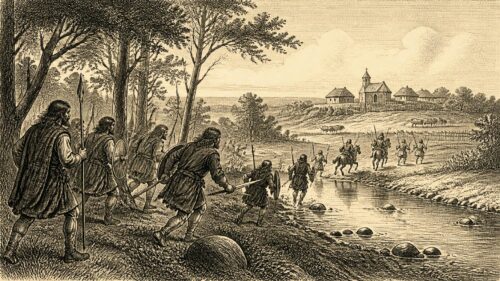
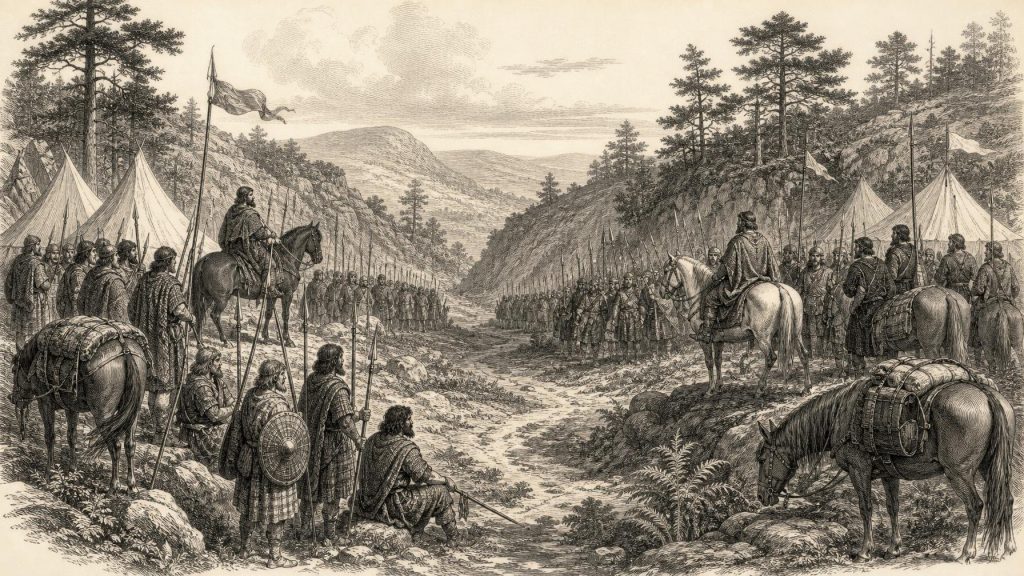
Ua Máelshechlainn did not stand alone. Diarmait Mac Murchada brought the Leinstermen to his aid, while the Norse-Gaelic inhabitants of Dublin also supported the Meath side. The rival hosts confronted one another at Craeb Maige Lorgaig, apparently separated by only a small wooded pass. For a week they remained encamped face to face. No general battle followed, neither side surrendered hostages, and the forces eventually withdrew. This bloodless outcome was not insignificant. It demonstrated that Ua Conchobair could assemble an extensive coalition, but also that the combined strength of Meath, Leinster and Dublin could still deny him a decisive settlement.
The Fall of Cormac
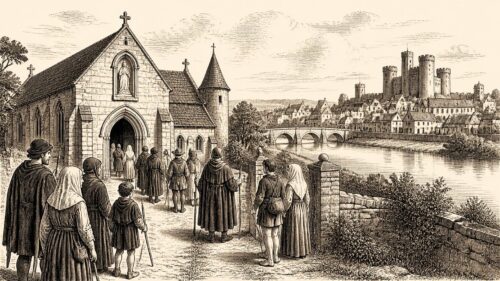
The year’s greatest political shock occurred in Munster. Cormac Mac Carthaig had risen from the kingship of Desmond to claim authority over much or all of Munster, challenging the Uí Briain rulers of Thomond. His ambitions were political, military and ecclesiastical. He cultivated reforming churchmen, supported religious foundations and commissioned the celebrated Romanesque chapel on the Rock of Cashel, begun in 1127 and consecrated in 1134. His patronage linked royal generosity with sacred authority: annalists praised him for giving wealth, clothing and food and for improving both territories and churches.
In 1138 Cormac was killed by treachery in his own residence at Mag Tamnach, generally identified with Mahoonagh near Newcastle West in County Limerick. The sources agree that Tairdelbach Ua Briain was responsible, but differ over the immediate deed. The Annals of Tigernach accuse Tairdelbach himself, describing him as Cormac’s father-in-law, spiritual kinsman and fosterer. Mac Carthaigh’s Book instead names Diarmait Súgach, son of Mathgamain Ua Conchobair of Ciarraige, and Ua Tailcín as the killers, acting at Tairdelbach’s instigation. The Four Masters combine elements of these traditions. What can be stated firmly is that Cormac died through an Uí Briain-backed conspiracy rather than in open battle.
Conchobar Ua Briain then assumed the over-kingship of Munster. Yet Cormac’s death did not erase Mac Carthaig power in Desmond, where his brother Donnchad and later his son Diarmait continued the dynasty. Instead, the killing reopened the long contest between the Uí Briain north of the Munster mountains and the Mac Carthaig rulers of the south. It also removed one of the leading royal patrons of church reform and architecture in pre-conquest Ireland.
Raids and Ravaged Fields
Smaller conflicts reveal how unstable the midlands and north remained. Tigernán Ua Ruairc raided Meath and killed Áed Ua Confhiacla. At the place translated as the Gap of the Hornless Cow, Ua Ruairc and the people of Delbna Mór defeated a force in which Domnall Ua Ciardha, king of Cairbre, was slain. In the north, Ragnall son of Ímar Ua Catháin, lord of Craeb, Cianachta and Fir Lí, was treacherously killed by a branch of Cenél nÉogain. Máel Ruanaid Ua Cairelláin, praised for wisdom, appearance and martial accomplishment, was also slain, by Cenél Moain. These notices show violence operating at several levels: provincial kings pursued large coalitions while local dynasties fought over lordship, succession and borderlands.
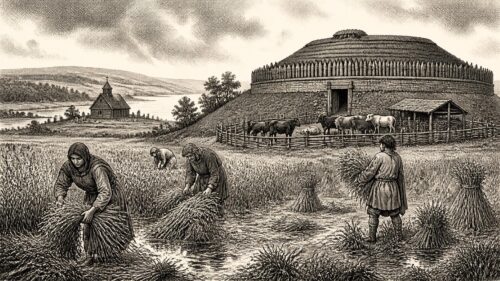
After the great stand-off, the Meath forces destroyed the corn of Uí Briúin and Fernmag. The annalist explicitly connected this devastation with severe famine in the following year. Crop destruction was therefore not incidental raiding but a calculated attack on a rival’s ability to feed households, warriors and livestock. It reminds us that the burdens of high politics fell heavily upon farming communities whose fields lay along contested routes.
The same Meath-Leinster-Dublin alliance attacked Inis Mochta, an ecclesiastical island site in what is now County Meath. Many attackers attempted to cross the lake on rafts or by swimming. Defenders came out in boats, killing or drowning a substantial number, while those who reached the island withdrew without burning it. The annalist credited the island’s survival to God and its patron saint. Although the precise annal-year varies, the episode illustrates the tactical value of lakes and islands as refuges, as well as the presence of Dublin’s Norse-Gaelic warriors in inland campaigning.
Armagh and the Reforming Church
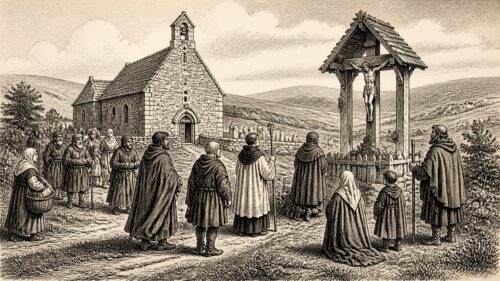
Ecclesiastical authority remained inseparable from politics. Gilla Meic Liac, also known as Gelasius, had succeeded Malachy Ua Morgair at Armagh in 1137. In 1138 he made his first recorded visitation of Munster and received tribute there. A visitation asserted Armagh’s claim to primacy, gathered material support and allowed its head to negotiate with kings, bishops and major churches. Gilla Meic Liac belonged to the northern Cenél nÉogain world but supported reform, making him a politically acceptable successor after Malachy’s struggle against hereditary control of the primatial church.
The year also brought notable clerical deaths. Gilla Críst Ua Morgair, bishop of Clogher and brother of Malachy, died and was buried in the church of Saints Peter and Paul at Armagh. The Four Masters remembered him as an exemplary preacher and servant of both clergy and laity. Máel Pátraic Ua Drugáin, chief lector of Armagh, died while on pilgrimage at an island in Lough Ree on 2 January. His elaborate obituary reflects the prestige of the lector, who directed advanced teaching and the interpretation of religious texts.
Four important religious settlements—Kildare, Lismore, Tech Moling or St Mullins, and Swords—were recorded as burned. The terse notices do not identify a common cause, and it would be unsafe to assume that every fire resulted from warfare. Timber roofs, densely grouped buildings, lamps and domestic hearths made ecclesiastical settlements vulnerable to accidental conflagration, while raiders also deliberately burned churches, houses and stored produce. Rebuilding demanded labour and patronage, disrupting worship, hospitality, schooling and the care of relics.
A Book Made at Armagh
Against this background of death and fire, one exceptional cultural achievement can be placed directly in 1138. Máel Brigte Ua Máel Uanaig, a 28-year-old scribe working at Armagh, produced the manuscript now known as the Gospels of Máel Brigte. Its colophons identify the scribe, place and year, and even refer to Cormac Mac Carthaig’s killing. Written on vellum, the book contains the Latin Gospels, prefatory material, commentary, Irish inscriptions and decoration continuing older Insular traditions. Its exegesis drew substantially upon established Hiberno-Latin learning rather than the newest continental schools, yet the manuscript proves that biblical scholarship at Armagh remained active and intellectually engaged.
The death of Amlaíb Mór mac Fir Bisig, remembered as a master of history and poetry among Uí Fiachrach and as a learned cleric associated with Cong, further illuminates Ireland’s scholarly culture. History, genealogy and praise poetry were practical instruments of society, preserving claims to land, rank and ancestry as well as communal memory. Scholars could serve churches and dynasties simultaneously; literacy and oral learning were not isolated from politics but helped define legitimate authority.
Work, Wealth and Regional Life
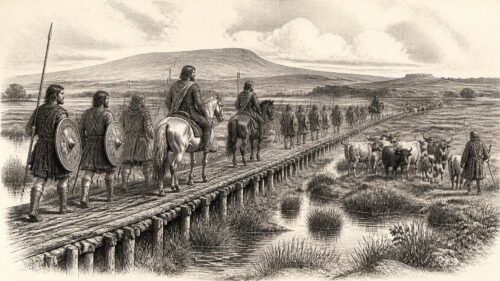
For most people, life continued through mixed farming, herding, craftwork and obligations to local lords and churches. Cattle remained the most visible measure of wealth and a principal target of raids, but the destruction of cornfields shows the essential place of cereal cultivation. Tribute supported royal households, clerical communities, poets, guests and armed followers. Kinship and fosterage bound elites together, yet Cormac’s fate demonstrates that such intimate ties could be broken when control of a province was at stake.
Dublin’s involvement in the Meath campaigns also shows that the coastal towns were not detached foreign enclaves. Their Norse-Gaelic rulers and fighting men participated in Irish alliances, while merchants connected Dublin, Waterford, Wexford, Cork and Limerick with Britain and the wider Irish Sea. No specific commercial agreement can be dated to 1138, and coin use remained limited outside Dublin, but ships, ports and urban craftsmen formed an increasingly important part of the political economy.
The year ended without a single power mastering Ireland. Ua Conchobair had displayed his reach but failed to overcome Meath; the Uí Briain had recovered Munster’s over-kingship through Cormac’s murder but had not destroyed the Mac Carthaig challenge. Amid these struggles, Armagh asserted its primacy and produced a remarkable Gospel book. The surviving picture is therefore one of violent competition, resilient institutions and cultural work continuing within an unsettled political landscape.
Primary Sources
- Annals of the Four Masters, Part 24
- The Annals of Tigernach, Part 22
- Mac Carthaigh's Book, Part 3
- Harley MS 1802: Gospels of Máel Brigte
- Exegesis on the Four Evangelists
- Mac Carthaig, Cormac
- Ua Briain, Conchobar
- Ua Conchobair, Tairdelbach (O'Conor, Turlough)
- Ua Ruairc, Tigernán
- Ua Máelshechlainn, Murchad
- Mac Murchada, Diarmait (MacMurrough, Dermot)
- Ua Cerbaill, Donnchad
- Gilla meic Liac (Gelasius)
- Malachy (Máel-M'áedóc) Ua Morgair
- Mac Lochlainn, Muirchertach
- Conservation Works at Cormac’s Chapel, Rock of Cashel
- Cormac's Chapel, Cashel, Tipperary
- Inis Mochta/Inishmot
- The Economy of Early Medieval Ireland
- The Dublin Region in the Middle Ages: Settlement, Land-use and Economy
- Exploring the Irish Annals
- St Bernard of Clairvaux's Life of St Malachy of Armagh