
Kings, Relics and Winter1093 CE
In 1093, Muirchertach Ua Briain of Munster expanded his influence through Connacht, Mide and reconciliation with his brother Diarmait, but failed to secure lasting control over Connacht after Síl Muiredaig returned from exile. His northern rival, Domnall Ua Lochlainn of Ailech, allied with Ulaid against southern power and blinded a regional rival. Covenants at Lough Neagh, Cashel and Lismore, guaranteed by revered relics, underscored religion’s political role. Annals also record churchmen’s deaths, changing manuscript production, severe frost, wind damage, pestilence and abundant woodland mast. Cattle, agriculture, towns and Irish Sea links shaped society. Ireland remained politically divided despite ambitious overlordship.
Dateline
Ireland in 1093 was dominated by a contest for power rather than by any universally accepted high-kingship. Muirchertach Ua Briain, king of Munster and the leading ruler of the southern half of the island, was extending his authority through campaigns, hostages and carefully managed submissions. Against him stood Domnall Ua Lochlainn, king of Ailech and the foremost power among the Northern Uí Néill. Between these rivals lay provincial and local kingdoms whose rulers could submit, rebel or change allegiance as circumstances demanded. The surviving annals make 1093 unusually vivid: they record expeditions and political killings, a covenant sworn on sacred relics, severe weather, disease and a valuable harvest from Ireland’s woodlands.
The Connacht Crisis
The year’s most important sequence unfolded in Connacht. Its established overking, Ruaidrí na Saide Buide Ua Conchobair, had been blinded and deposed in 1092 by Ua Flaithbertaig interests in western Connacht. His fall fractured the authority of Síl Muiredaig, the dominant branch of the Uí Briúin Aí, and offered Muirchertach an opportunity to determine who would rule the province.
The Annals of Inisfallen give the fullest account. Muirchertach led a hosting into Connacht, imprisoned Áed son of Cathal Ua Conchobair, and installed Gilla na Naem Ua hEidin as king of Síl Muiredaig. Ua hEidin belonged to the Uí Fhiachrach Aidhne of southern Connacht and therefore lacked the hereditary standing of an Ua Conchobair within the Síl Muiredaig heartland. His elevation was less a settled succession than an attempt by the Munster king to govern Connacht through a dependent ruler.
The arrangement rapidly failed. Áed son of Cathal was killed while a prisoner near Limerick. Sources differ over the immediate responsibility: the Annals of Inisfallen blame followers of Ua Flaithbertaig, while the Four Masters name Fogartach Ua Fogartaig and describe treachery. The killing prompted renewed revolt. Muirchertach returned to Connacht, demanded fifty cows from Ua Flaithbertaig as compensation, plundered Síl Muiredaig territory and imprisoned Gilla na Naem. The Annals of Ulster summarise the outcome starkly: Síl Muiredaig were expelled from Connacht, only to return without permission.
This was not a permanent conquest. Muirchertach could march across the Shannon, seize cattle and prisoners, and nominate a king, but he could not easily replace local political loyalties. The exiles found refuge in Tír Eógain, the territory associated with his northern rival. Their return demonstrated both the resilience of Síl Muiredaig and the practical limits of distant overlordship.
Submission and Northern Resistance
Muirchertach nevertheless achieved an important diplomatic success when Domnall son of Flann Ua Máel Sechlainn, king of Tara or Mide, submitted to him at Limerick. The choice of place mattered. Limerick was not merely a port but a principal Ua Briain royal centre, where the appearance of a rival king publicly acknowledged Muirchertach’s superior position. This submission helped give him broad influence across the southern half of Ireland, although Domnall’s survival as king shows that submission did not necessarily mean annexation.
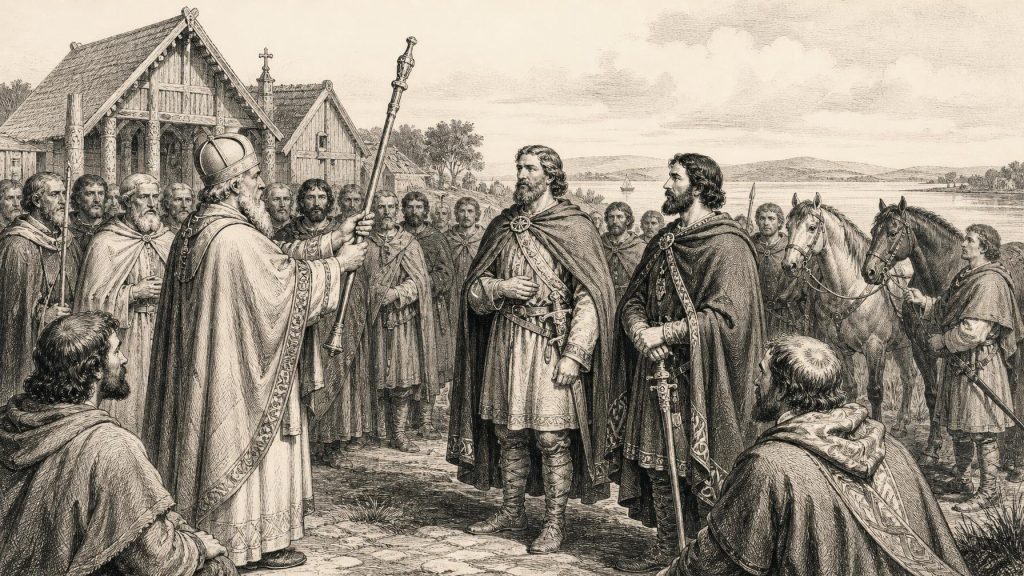
Domnall Ua Lochlainn answered the expansion of Ua Briain power by strengthening his own alliances. At Dornann Dabaill, on the edge of Lough Neagh, he met Donnchad Ua hEochada, king of Ulaid. According to the Annals of Inisfallen, they made a covenant against Muirchertach and Leth Moga, the traditional southern half of Ireland. Numerous relics were pledged as guarantees, including the Bachall Ísu or Staff of Jesus, one of the chief relics associated with Patrick and Armagh.
The alliance developed into a northern offensive, but Donnchad and the Ulaid proved reluctant partners. Secondary reconstruction of the annalistic record indicates that the allied forces advanced through Mide and encountered Ua Briain power in northern Leinster before the Ulaid withdrew. Their departure deprived Domnall of the momentum needed for a major invasion. The episode illustrates the difficulty faced by every would-be high-king: even agreements solemnised by relics depended on the interests of regional rulers.
Domnall was more successful in asserting control nearer home. Áed Ua Canannáin, king of Cenél Conaill, was blinded on his orders. Blinding was a calculated political punishment, usually intended to disqualify a rival from kingship without creating the blood-feud that execution might provoke. Together with the covenant at Lough Neagh, it shows Domnall securing his north-western flank while organising resistance to Muirchertach.
Peace Within Munster
Muirchertach also repaired a dangerous division within his own dynasty. His brother Diarmait Ua Briain, previously banished during the disputed succession after their father’s death, submitted to him. Peace was concluded at Cashel and Lismore in the presence of Domnall Ua hÉnna and the nobles of Munster. Once again, relics including the Staff of Jesus guaranteed the covenant.
Cashel represented traditional Munster kingship, while Lismore was an eminent ecclesiastical centre with strong regional connections. Holding the settlement at both places joined royal custom to sacred authority. The reconciliation did not end every future rivalry between the brothers, but in 1093 it freed Muirchertach to concentrate on Connacht, Mide and the northern coalition.
Churches, Relics and Learning
The prominence of relics in both major agreements reveals how closely religion and politics were connected. A relic was not a decorative witness. It represented a saint’s continuing authority, and an oath sworn upon it placed reputation, salvation and political legitimacy at risk. Armagh’s Patrician relics could therefore serve rulers from opposing coalitions, reflecting the church’s island-wide prestige.
The annals record the deaths of several churchmen, including Áed, superior of Duleek; Ailill Ua Niallán, associated with the successions of Ciarán, Crónán and Colmán Mac Duach; and other erenaghs or hereditary administrators of ecclesiastical estates. Such titles remind us that major churches were communities of worship, landholding, hospitality, education and political influence. The Four Masters also place a destructive fire at Armagh in this year, although it is not reported by all the principal annalistic witnesses and should therefore be treated cautiously.
Manuscript production itself was changing. The principal original hand of the Annals of Inisfallen ended during 1092, and the entries for 1093 belong to the continuation of a living chronicle by later scribes. At roughly the same time, though not securely in this exact year, Clonmacnoise was producing Lebor na hUidre, the Book of the Dun Cow. Annals, genealogies, religious texts, poetry and vernacular tales were being preserved within wealthy ecclesiastical centres even as those centres remained vulnerable to fire and warfare.
Winter, Wind and Pestilence
The natural conditions of 1093 received exceptional attention. The Annals of Inisfallen report very heavy frost and snow at the end of 1092 and beginning of 1093. The Four Masters likewise describe lakes frozen by severe cold. Later in the year, a violent wind stripped grain from the ears and brought down many trees. The same Munster record mentions a widespread febrile pestilence that killed many people. Medieval terminology cannot identify the disease precisely, but the entry suggests a serious epidemic rather than an isolated outbreak.
Against these hardships, the Annals of Ulster record a great mast harvest. Acorns, beech mast and hazelnuts were important resources, especially for feeding pigs, while nuts could also supplement human diets. The contrast is striking: storms could damage standing grain and disease could take many lives, yet woodland abundance might improve the supply of pork and winter food.
Cattle remained both livelihood and political currency. The fifty cows exacted from Ua Flaithbertaig were compensation, tribute and a visible confession of liability. For most inhabitants, however, cattle supplied milk, hides and status, while grain, pigs, sheep, fishing, woodland produce and household crafts sustained a predominantly rural society. Ireland’s Norse-founded towns, particularly Dublin, Waterford, Cork and Limerick, supported specialised crafts and overseas trade. Dublin silver pennies and imported goods circulated within this wider economy, although barter, livestock payments and weighed precious metal remained important.
An Irish Sea Horizon
Irish chroniclers also noted the deaths of Malcolm III of Scotland, his son Edward and Queen Margaret, as well as the killing of Rhys ap Tewdwr of Deheubarth by Norman forces. These were not merely distant curiosities. Irish rulers, clerics, merchants and dynasties were connected to Britain, the Isles and continental Europe by sea routes, marriage, exile and ecclesiastical correspondence. Muirchertach’s later diplomacy would make these links even more visible.
By the end of 1093, Muirchertach Ua Briain had gained submissions, reconciled with his brother and demonstrated his ability to intervene decisively in Connacht. Yet Síl Muiredaig had returned, while Domnall Ua Lochlainn remained secure in the north and capable of constructing alliances against him. The year therefore marked a major advance in Ua Briain ambition, but not the creation of a united monarchy. Power still rested upon repeated hostings, hostages, cattle, personal loyalties and sacred guarantees—and every settlement remained open to challenge.
Primary Sources
- The Annals of Ulster: Year U1093
- Annals of Inisfallen: English Translation
- Annals of Inisfallen: Original Text
- Annals of the Four Masters: Annal M1093
- The Annals of Tigernach
- Chronicon Scotorum
- Ua Briain, Muirchertach
- Ua Lochlainn (Mac Lochlainn), Domnall
- Ua Conchobair, Ruaidrí na Saide Buide
- Ua hEochada, Donnchad
- Ua hÉnna, Domnall
- Ua Conchobair Fhailge, Conchobar
- Ua Briain, Tairdelbach
- Ua Bráein, Tigernach
- The Viking Age in Ireland
- 950–1450: Vikings, Normans and Medieval Mints
- Early Medieval Collections
- Irish School of Illumination, c. 650–1100
- High Crosses
- Clonmacnoise Visitor Guide
- Early Medieval Ireland, AD 400–1100: The Evidence from Archaeological Excavations
- The Viking Age in Ireland: National Museum Guide
- National Kingship and Royal Government in Ireland
- Perception and Reality: Ireland c. 980–1229
- The Development of the Office of Provincial King in Early Medieval Leinster