
Hostages and Burned Churches1049 CE
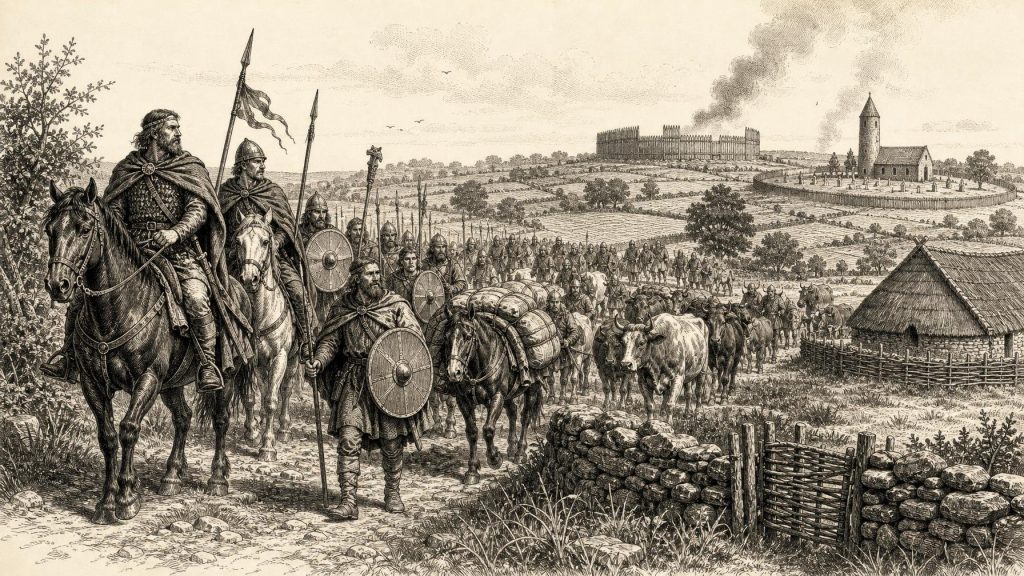
In 1049, Ireland lacked an uncontested ruler, as provincial kings pursued authority through alliances, hostages, warfare and submission. Ulaid, Leinster and perhaps Norse-Gaelic forces invaded Mide seeking Brega hostages; Conchobar Ua Maelsechlainn killed captives, prompting widespread burning of churches and fortresses. Donnchad mac Briain received Leinster and Osraige’s hostages, signalling temporary southern supremacy. Dynastic killings affected several regions. At Armagh, Amalgaid’s death brought an orderly Clann Sínaig succession, while other church leaders died. Bréifne burned Roscommon around this period. An Irish-based fleet raided Wales and England. Warfare burdened rural communities, despite continuing agriculture, trade, urban craft and monastic learning networks.
Dateline
Ireland in 1049 was a country without a single uncontested ruler. Its provincial kings and numerous local dynasties competed through alliances, hostages, raids and carefully staged submissions. The year’s surviving record is unusually revealing about the strain within this political system. A coalition invaded Mide to recover hostages; its enemies answered by killing those captives; churches and strongholds were burned in retaliation. Elsewhere Donnchad mac Briain asserted authority over Leinster and Osraige, several regional rulers died violently, and the leadership of Armagh passed smoothly between members of a powerful ecclesiastical family. These events are firmly associated with 1049 in one or more Irish annals, although differences between chronicles require caution over some details.
The Struggle for Mide
The year’s largest recorded Irish campaign was directed against Mide and Brega. The Annals of Tigernach report a hosting by the Ulaid and Leinstermen, while the later Annals of the Four Masters add “foreigners”, a term normally applied in this period to the Norse-Gaelic forces of towns such as Dublin. The allies entered Mide seeking the hostages of the men of Brega. Such captives were not merely prisoners of war. Hostages embodied political submission, guaranteed agreements and allowed an overlord to demonstrate publicly that lesser rulers accepted his authority.
Conchobar Ua Maelsechlainn, a dominant figure among the divided descendants of the former high-king Máel Sechnaill, refused the coalition’s demand in the most drastic fashion. The hostages were killed, together with Toirdelbach Ua Cathasaigh. The latter belonged to a leading family of Brega and may have been especially important to the negotiations. The Annals of Ulster also accuse Conchobar of killing Muirchertach, son of Máel Sechnaill, in violation of a pledge made before God and man. The precise relationship between these killings is not fully explained, but the annalists clearly regarded broken guarantees and treacherous violence as central features of the crisis.
The invading forces then burned the country, including both churches and fortresses. This was punitive devastation rather than an attempt to occupy every settlement. Destroying crops, houses, enclosures and stored provisions weakened the enemy’s ability to support warriors or pay tribute. Burning a fort attacked a lord’s authority; burning a church struck a religious, economic and political centre that might shelter people, valuables and livestock. The annalists’ explicit pairing of churches and strongholds conveys the breadth of the retaliation.
The coalition also illustrates the reach of contemporary diplomacy. Ulaid in the north-east, Leinster in the south-east and probably Norse-Gaelic maritime forces could cooperate against the rulers of Mide. The sources do not name the commanders, so it would be unsafe to assign the expedition directly to particular kings. Nevertheless, it fits the wider pressure being exerted on Mide by Leinster and its allies. No victory settlement is recorded. The campaign instead ended with dead hostages and a devastated landscape, leaving the underlying contest unresolved.
Donnchad’s Southern Authority
A separate hosting was led by “the son of Brian”, meaning Donnchad mac Briain, king of Munster and son of Brian Bóruma. Donnchad advanced to Mag nAirb and received the hostages of Leinster and Osraige. Mag nAirb has not been securely identified, and the annals provide no route or battle. The important point is the political result: representatives of two powerful south-eastern kingdoms acknowledged Donnchad’s superiority, at least temporarily.
This submission should not be mistaken for permanent conquest. Diarmait mac Maíl na mBó was building a formidable power base in Leinster, while Osraige retained its own ruling interests between Leinster and Munster. Hostages could be surrendered when an army was present and repudiated when the balance changed. Donnchad’s success therefore shows that Brian’s dynasty still possessed the resources to assemble a major hosting and compel recognition. It does not mean that Leinster and Osraige had been absorbed into a stable kingdom of Ireland.
Violence Within Dynasties
Several shorter entries reveal conflict at a more local scale. Flaithbertach Ua Loingsig was killed by a son of Conchobar Ua Loingsig, apparently in a struggle within a northern ruling kindred. Ímar Ua Béice, king of Uí Méith in the borderlands north of Brega, was also killed, although the surviving record does not identify his slayer.
In Munster, Conchobar Ua Cinn Fhaelad, king of Uí Chonaill Gabra in what is now western County Limerick, was killed by the king of Eóganacht Locha Léin, a dynasty centred in the south-west. In Corcu Baiscinn, broadly corresponding to western County Clare, King Aneislis son of Domnall was killed by his brother’s grandson. These were not minor private quarrels. Kingship depended upon support within an extended royal kindred, and several adult relatives might possess credible claims. A killing could remove a rival while opening a new cycle of vengeance and disputed succession.
Change at Armagh
The most important ecclesiastical death of the year was that of Amalgaid, successor of Patrick and head of Armagh. The Annals of Ulster state that he died penitently in Christ after twenty-nine years as superior, placing his death at the beginning of July. A short lament preserved with the notice emphasises the grief caused by his passing. His long tenure had begun around 1020, giving him unusual institutional continuity through decades of warfare and changing kingships.
Amalgaid belonged to Clann Sínaig, an ecclesiastical dynasty whose members repeatedly controlled Armagh’s senior offices. On the day of his death he was succeeded by his brother Dub-dá-Leithe, previously the lector or head of learning. Aed Ua Forreth then became lector. The orderly transfer demonstrates that major monasteries were governed through established networks of kinship, scholarship and patronage. The “successor of Patrick” was not simply a modern-style diocesan bishop: he headed a wealthy religious community, guarded Patrick’s spiritual inheritance and could exercise influence through relics, tribute, arbitration and alliances with kings.
Two other church leaders died in 1049: Máel Cainnig Ua Tuaichlig, coarb of Devenish, and Tuathal Ua hUail, superior of Both Chonais, probably the monastery now represented by Botheoney in County Donegal. Their notices are brief, but they indicate the network of regional churches lying beneath the great political centres. Monastic communities served as places of worship, burial, teaching, hospitality, production and exchange, making their leaders significant figures in local society.
The Burning of Roscommon
The Annals of Tigernach place the burning of Ros Comáin in 1049, stating that men of Bréifne burned both its stone house and great church. The Four Masters assign related destruction at Roscommon to 1050 and describe the burning of its bell-house. This difference is a reminder that annalistic year-numbers do not always align perfectly. The attack can responsibly be connected with the period around 1049, but its exact calendar placement is less secure than the Armagh succession or the Mide expedition.
Roscommon’s religious settlement was associated with St Commán and stood near the eastern approaches to Connacht. Its substantial stone buildings marked it as an established institution rather than an isolated cluster of huts. The attack by Bréifne’s forces probably belonged to regional competition for tribute, routes and influence. Whatever its immediate cause, destruction there would have affected clergy, dependants, tenants and travellers as well as buildings and sacred property.
Across the Irish Sea
An English source adds an overseas dimension. The Anglo-Saxon Chronicle records that thirty-six ships came from Ireland into the River Usk during the summer of 1049 and joined Gruffudd ap Rhydderch, ruler in southern Wales, in attacks upon English territory. “From Ireland” describes the fleet’s point of departure, not necessarily the ethnicity of every crew member. It was probably drawn largely from the mobile Norse-Gaelic maritime world linking Dublin and other Irish ports with Wales, western Britain and the Isles.
No Irish annal identifies the fleet or its sponsor, so it cannot securely be attributed to Dublin’s king or to any Irish provincial ruler. Its appearance nevertheless shows that Ireland’s coastal towns and sea-warriors remained active participants in British politics. Ships carried merchants, migrants and churchmen in peaceful circumstances, but the same maritime expertise could transport mercenaries and raiders. Irish Sea connections were therefore economic and cultural as well as military.
Life Beyond the Annals
The chronicles concentrate on kings, clergy and violent deaths, leaving ordinary experience largely unrecorded. Archaeology supplies the broader setting, though it cannot assign routine activities to 1049 alone. Most people lived in a managed rural landscape of enclosed farmsteads, fields, woodland, routeways and occasional crannogs. Cattle remained vital stores of wealth and sources of dairy food, hides and traction, while sheep, pigs and cereal crops also contributed substantially to survival. Oats and barley were especially important, and the agricultural year required continual herding, ploughing, sowing, harvesting and maintenance.
For farming families, the year’s hostings meant more than distant contests between nobles. Armies consumed provisions, seized animals, damaged fields and took captives. The burning in Mide could erase years of accumulated work in a single season. Churches and forts offered some protection, but the record for 1049 shows that neither was inviolable.
Life in the Norse-Gaelic towns differed from that of the countryside. Dublin was a centre of woodworking, metalworking, textile production and international exchange, with silver pennies and weighed bullion circulating alongside payments in goods and livestock. Imported pottery, soapstone, metals and luxury objects testify to contacts with Britain and continental Europe. Yet urban and rural economies were interdependent: towns required food, timber, hides and labour from their hinterlands, while Irish rulers valued ports for revenue, ships and access to overseas markets.
Learning also continued amid the disorder. Lectors directed monastic schools, scribes maintained religious and historical texts, and poets preserved genealogy and political memory. Flann Mainistrech, the celebrated historian and poet of Monasterboice who died in 1056, was an active contemporary. His career represents the scholarly world in which biblical chronology, Irish genealogy and accounts of kingship were being organised into enduring narratives. The very survival of notices for 1049 owes much to such ecclesiastical habits of record keeping.
The year consequently presents no simple story of national rise or decline. Donnchad mac Briain could still exact hostages from major southern kingdoms, but no ruler could impose lasting peace. Alliances crossed provincial and ethnic boundaries, while royal relatives fought within their own kindreds. Armagh demonstrated institutional resilience; Roscommon and the churches of Mide experienced the vulnerability of sacred places. Behind every terse annal entry stood communities obliged to rebuild, renegotiate loyalties and continue the work of farming, worship and trade.
Primary Sources
- The Annals of Ulster: Year U1049
- The Annals of Tigernach: Annal T1049
- Annals of the Four Masters: AD 1049–1050
- Chronicon Scotorum
- Annals of Inisfallen
- Amalgaid
- Donnchad
- Flann Mainistrech
- Chronological Synchronisation of the Irish Annals
- The Anglo-Saxon Chronicle
- Gruffudd ap Llywelyn, King of Gwynedd and Overlord of the Welsh
- Viking Collections
- 950–1450: Vikings, Normans and Medieval Mints
- The Archaeology of Livestock and Cereal Production in Early Medieval Ireland, AD 400–1100
- Agriculture, Settlement and Society in Early Medieval Ireland
- The Archaeology of Early Medieval Ireland, c.400–1169: Settlement and Economy
- Early Medieval Dwellings and Settlements in Ireland, AD 400–1100
- Early Medieval Ireland: Archaeological Excavations 1930–2009
- Extracts from the Urban Archaeological Survey: County Roscommon
- Hostages in the Middle Ages
- Raiding and Warring in Monastic Ireland
- The Provisioning of Irish Armies in the Eleventh and Twelfth Centuries
- S. Stefano al Monte Celio, Donnchad mac Briain and Papal Legates in Ireland, 1064–1203
- A New History of Ireland, Volume I: Prehistoric and Early Ireland