Armagh After Martinmas933 CE
In 933, annalistic sources record interconnected conflicts across northern Ireland, while differing chronologies and casualty figures require caution. Muirchertach and Conaing, sons of Niall Glúndub, suffered defeat at Mag Uatha, but Conaing later defeated Ulaid forces and Muirchertach overcame raiders led by Matudán of Ulaid and Amlaíb son of Gothfrith, recovering plunder. Scandinavian groups based on inland and coastal waters participated in local alliances and warfare. Around Martinmas, Amlaíb plundered Armagh, a wealthy religious and political centre. Death notices for rulers and Bard Bóinne, chief poet, demonstrate the political and cultural consequences of contested authority, strategic waterways and regional violence.
Dateline
The evidence for 933 CE presents Ireland not as a single kingdom but as a densely connected field of local powers, ecclesiastical centres and armed fleets. The year is unusually revealing because several annals preserve a chain of northern conflicts involving Muirchertach son of Niall, Conaing son of Niall, the Ulaid, men described as “foreigners”, and Armagh. Yet it also requires care. The annals’ year-numbering is not wholly uniform: the Annals of Ulster label their relevant section “AD 932 alias 933”, while Chronicon Scotorum places much the same sequence under 933. The discussion below therefore treats the northern episodes as securely connected with 933, while avoiding false precision where later compilations arrange material differently.
A Setback at Mag Uatha
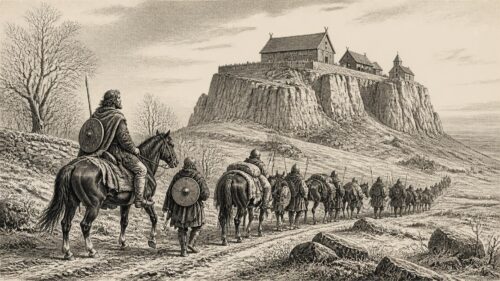
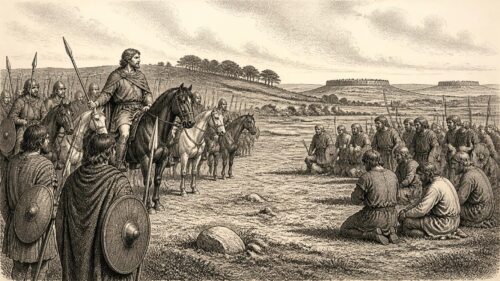
The year opened, or at least was remembered, with a serious reverse for Muirchertach son of Niall and Conaing son of Niall. At Mag Uatha, Fergal son of Domnall son of Áed and Sicfrith son of Uathmarán inflicted a rout upon them. The Annals of Ulster name two rulers among the dead: Máelgarb, king of Derlas, and Conmal, king of Tuath Achaidh; they add that two hundred others fell. Chronicon Scotorum records the defeat too, although its shorter account does not give the same total.
Such numbers should not be treated as modern casualty statistics. Annalists used figures to convey scale and consequence, and they rarely explain the tactical course of a battle. Nevertheless, the named dead matter. Their presence shows that the conflict drew in subordinate kings and their followings, rather than being a private feud between a few leading families. In tenth-century Ireland, political authority rested on personal lordship, tribute, military service and the ability to protect dependants. A defeat which killed recognised local rulers could unsettle those relationships long after fighting stopped.
Muirchertach was one of the foremost figures of the Northern Uí Néill, the powerful dynastic network based across much of the north. Conaing, his associate in this encounter, was likewise a son of Niall Glúndub, the high king killed by the Dublin Vikings in 919. The defeat at Mag Uatha did not end Muirchertach’s career; later annals show him again as king of Ailech and as a formidable commander. But in 933 it demonstrated the limits of Northern Uí Néill strength. Prestige had to be renewed continually, and an unsuccessful expedition could invite rivals to test a lord’s position.
War Within Ulaid
Conflict then spread across the north-east. The Annals of Ulster state that Conaing defeated the Ulaid at Ruba Con Chongalt, where three hundred or somewhat more died. The wording is significant: Ulaid was a province composed of competing peoples and kingships, not a unitary state commanded without question by one ruler. The entry records a substantial defeat but does not tell us which particular community bore the burden of it, nor whether the clash followed a raid, a dispute over overlordship or a campaign for tribute.
Chronicon Scotorum gives a related but not identical notice. It attributes a rout of the “province of Ireland” to Daaigh son of Niall and to foreigners of Loch nEchach, modern Lough Neagh, and gives the much larger figure of 1,200 or more dead. The divergence cautions against forcing both records into one neat narrative. The traditions may preserve different stages of a northern campaign, or a name may have been altered in transmission. What can responsibly be said is that armed groups linked to the sons of Niall and to Scandinavian forces operating from Lough Neagh were central to the violence in and around Ulaid during this year.
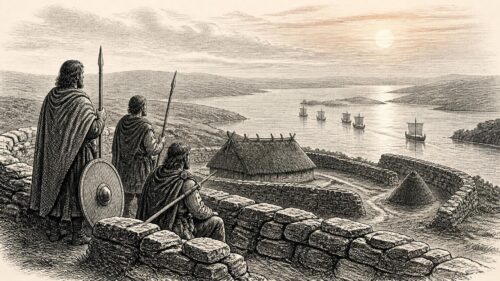
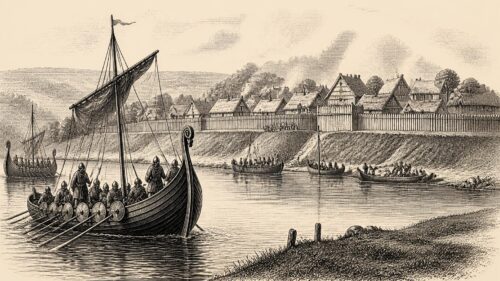
The lake was not a remote backdrop. Its waters connected shores, islands and river routes, permitting ships to carry warriors, supplies and plunder. Viking-age fleets in Ireland were not merely raiding parties arriving from overseas: some were entrenched in Irish waterways and were involved in local alliances. The northern annals repeatedly refer to foreigners on Lough Neagh, Lough Erne, Strangford Lough and other inland waters. In 933, military power moved through this watery landscape as readily as it did along overland routes.
Matudán, Amlaíb and the Counterstroke
The clearest episode of the year began with a coalition. Matudán son of Áed, ruler of the Ulaid, joined Amlaíb son of Gothfrith and a foreign force in an expedition that plundered westward as far as Sliabh Beatha and southward as far as Mucnamha. The phrasing in the annals is compressed, but the geography points towards a broad incursion across the northern interior, including parts of Airgialla. This was not a simple contest of “Irish” against “Vikings”. An Ulaid king and the son of a Scandinavian ruler acted together, pursuing interests that were evidently compatible at that moment.
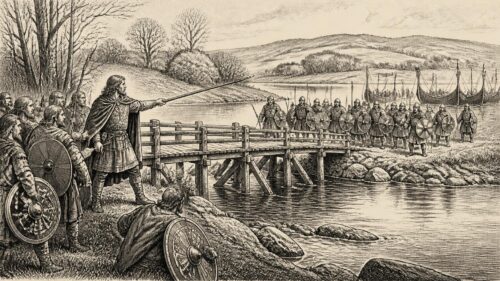
Muirchertach overtook the raiders and defeated them. The Annals of Ulster say they lost twelve score men—240—and their spoils; Chronicon Scotorum gives 1,200 dead. The difference again rules out certainty about the scale of slaughter, but both accounts agree on the essentials: Muirchertach intercepted the force, won, and recovered plunder. That recovery was politically important. Spoil consisted not only of portable valuables but could include cattle, foodstuffs, church goods and captives. Returning it demonstrated that a ruler could defend territory and recompense allies. Victory also answered the setback at Mag Uatha by restoring Muirchertach’s reputation as an effective northern war-leader.
For ordinary people, the distinction between a raid and a campaign may have mattered less than its immediate effects. A force travelling through settled country required food, animals and guides, whether acquired by requisition, agreement or violence. Communities near roads, river crossings, churches and lakeshore landing places were vulnerable. The sources do not permit a reconstruction of individual households in 933, and it would be wrong to invent one. They do, however, make clear that warfare could reach far beyond royal residences and battlefields.
Armagh at St Martin’s Tide
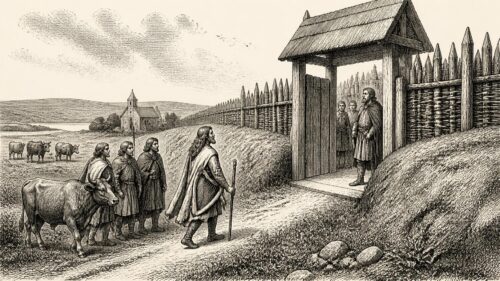
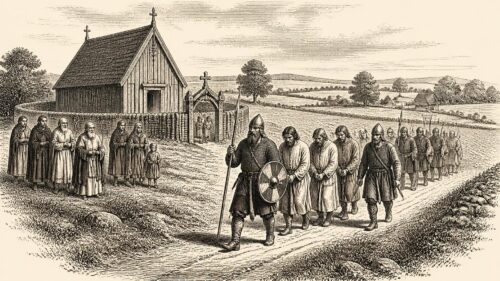
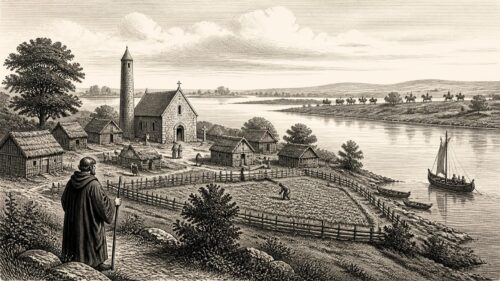
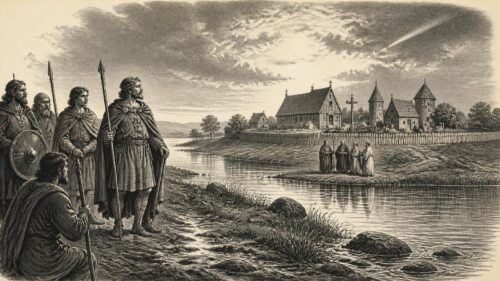
The year’s most resonant ecclesiastical event was the plundering of Armagh by Gothfrith’s son from Loch Cuan, the sea lough now known as Strangford Lough. Chronicon Scotorum records the raid under 933; the Annals of the Four Masters more specifically places it about the feast of St Martin, 11 November, and names the leader as Amlaíb, son of Gothfrith. The identification accords with the preceding coalition in which an Amlaíb son of Gothfrith fought alongside Matudán. The exact sequence and wording vary between compilations, but an attack on Armagh in the Martinmas season of 933 is firmly embedded in the annalistic record.
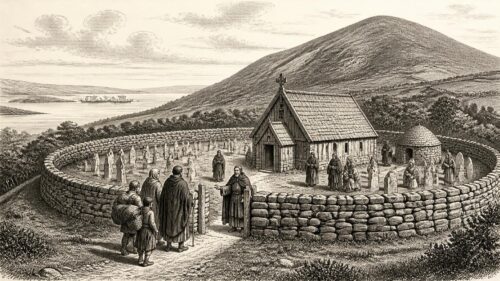
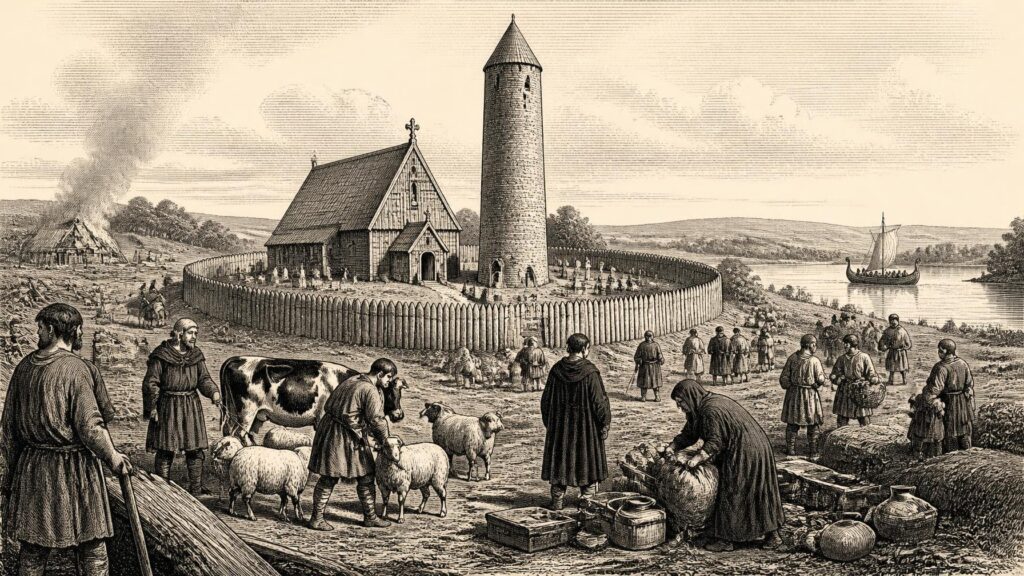
Armagh was no ordinary church. Its community claimed the inheritance of St Patrick and was a major religious, learned and political institution. It held lands, received dues, maintained clergy and scholars, and served as a meeting-place within wider networks of patronage. Plundering it was therefore both materially profitable and symbolically charged. Raiders could seize wealth, livestock and food, but an assault also challenged a centre whose authority extended far beyond its immediate settlement.
The timing may have sharpened the shock. Martinmas was a major point in the agricultural and religious calendar, associated with the approach of winter and, in many places, with the management of stock and obligations. We cannot know precisely what was taken at Armagh, nor should the episode be imagined as the total destruction of the church. The community endured, and its status survived. Yet the annal’s decision to preserve the raid shows that contemporaries regarded it as a grave affront.
Its consequences were not only ecclesiastical. Armagh lay within Airgialla, the region through which Matudán and Amlaíb’s earlier force had travelled. The raid indicates how a military alliance could project power from coastal and lacustrine bases into the inland heart of the north. It also reveals why control of sea loughs mattered: Loch Cuan offered access to the Irish Sea, while northern waterways made movement, retreat and resupply possible.
Poets, Kings and Recorded Loss
Amid the war notices, the annals register deaths that illuminate the social order. Cuilén son of Cellach, king of Osraige, died and is described by the Annals of Ulster as “an excellent layman”. The phrase signals esteem, though it does not explain the basis of that reputation. Osraige, situated between the larger political spheres of Leinster and Munster, was an important regional kingdom. The death of its king was therefore a significant succession moment, even if the sources do not preserve the immediate outcome.
Céilecán son of Gairbíth, chief of the Airthir, also died. Such brief notices remind us that the political map was made up of many territories whose rulers might appear in the annals only when they died, were defeated or formed part of a larger host. Kingship was layered: over-kings depended upon lesser kings, and lesser kings relied in turn on kin groups, client communities and ecclesiastical connections.
The killing of Bard Bóinne, called chief poet of Ireland, is perhaps the year’s most poignant cultural notice. He was slain by the Uí Cormaic of Uí Echach. The title should not be reduced to that of a court entertainer. A leading poet belonged to a learned professional world that cultivated praise, satire, genealogy, historical memory and formal language. Poets could enhance a ruler’s standing by preserving ancestry and public reputation; their work was part of political culture. Bard Bóinne’s death is evidence that this learned order, too, could be caught in the violence of regional rivalry.
A Year of Connected Frontiers
By year’s end, 933 had exposed the fragility and resilience of power in northern Ireland. Muirchertach suffered a defeat, then struck back successfully against a coalition of Ulaid and Scandinavian forces. Conaing’s victory over the Ulaid points to further fractures among Irish rulers. Amlaíb son of Gothfrith and the Loch Cuan fleet could work with an Irish king one season and plunder Armagh at Martinmas. These were overlapping struggles for movement, tribute, prestige and resources, not a straightforward confrontation between fixed ethnic camps.
The evidence does not justify claiming a national turning point in 933. It does justify seeing the year as a concentrated illustration of tenth-century Irish realities: political authority was contested; waterways were strategic; churches were wealthy and vulnerable institutions; and learned people as well as warriors were woven into the consequences of conflict. The annals preserve only fragments, but their fragments show a country whose local worlds were connected by ships, roads, alliances, plunder and memory.
Primary Sources
- The Annals of Ulster
- Year U933, The Annals of Ulster
- The Annals of Ulster: TEI Header and Editorial Information
- Chronicon Scotorum
- Annals of the Four Masters
- Part 4 of Annals of the Four Masters
- Irish Texts at CELT
- Translated Texts at CELT
- Exploring the Irish Annals
- The Dating of the Irish Annals
- The Vikings in Ulaid
- The Vikings in Ninth-Century Ireland: Sources and Settlements
- Viking Ireland Afterthoughts
- Vikings in Irish Chronicles, 794–902: Data
- Hoards: Viking Age Gold and Silver from Ireland
- Rathbeagh Ringfort, Co Kilkenny
- Fragmentary Annals of Ireland
- Fragmentary Annals of Ireland: Published Text
- Appendix: The Chronicles as a Record of Literacy, 797–1002
- The Original Chronology of the Irish Chronicles, ca 550–730