Alpthann’s Winter Rout926 CE
In 926, annalistic sources record Scandinavian raids and Irish responses across a politically fragmented Ireland. Foreigners from Strangford Lough sacked Dún Sobairche, while southern traditions report attacks on Kildare. Muirchertach son of Niall defeated raiders at Snám Aignech and later routed Alpthann son of Gofraid’s fleet-derived force near Dundalk, killing Alpthann and besieging survivors until Dublin’s king Gofraid intervened. These successes enhanced Muirchertach’s northern standing but did not end Scandinavian power or establish national unity. Elsewhere, Fergus of Lurg was killed by Bréifne, Colmán of Clonmacnoise and Clonard died, and Waterford’s fleet moved to Loch Gair in a notable redeployment.
Dateline
For Ireland, 926 is unusually well illuminated by terse but connected annalistic notices. They place a Scandinavian force from Loch Cuan, modern Strangford Lough, in violent motion across the north-east; they record two successes by Muirchertach son of Niall; and they preserve the death of Colmán son of Ailill, head of both Clonmacnoise and Clonard. A Munster annal also notes the striking movement of Waterford’s fleet to Loch Gair. These are not ingredients for a continuous campaign narrative: medieval annals preserve outcomes, not dispatches. Yet together they show how coasts, lakes, river crossings, monasteries and royal networks made Ireland’s politics intensely mobile.
There is a chronological caution at the outset. The Annals of Ulster label their material “925 alias 926”, a feature of their dating system rather than a reason to move the events out of 926. More importantly, the notices are not necessarily arranged in the order in which they happened. The landing of Alpthann’s fleet has an explicit date, 4 September; the battle late in the year is dated 28 December. Other notices belong securely to the annal year but cannot be assigned a day or even a season.
Violence from Loch Cuan
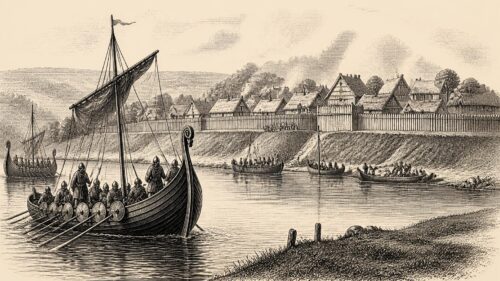
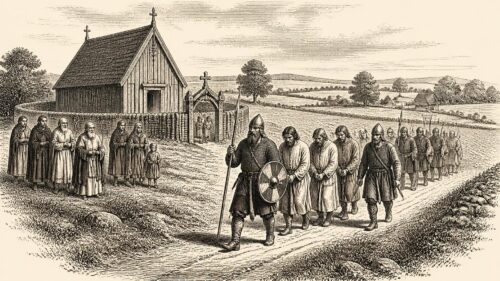
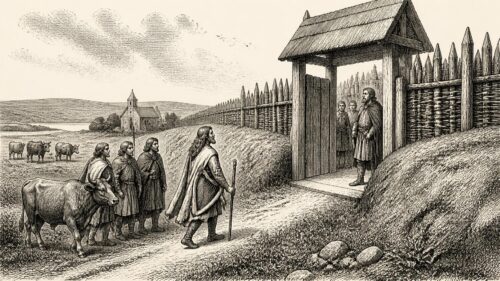
The first firmly recorded danger came from the foreigners based at Loch Cuan. They sacked Dún Sobairche, generally identified with Dunseverick on the north Antrim coast, and the Annals of Ulster say that many people were killed or taken captive. The wording is important. It tells us that the attack was not merely a raid on property or a symbolic blow against a fort: it involved the seizure and death of people whose labour, kinship ties and status mattered to their communities.
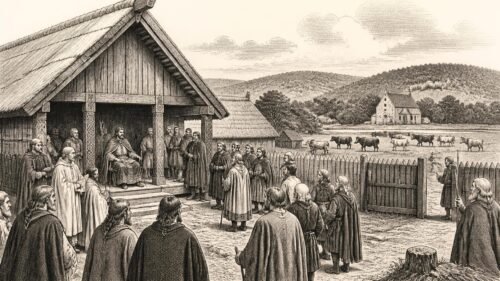
Dún Sobairche stood within the political world of Ulaid, a province divided among competing dynasties rather than governed as a single centralised state. Its coastal setting made it exposed to seaborne attack but also part of the Irish Sea zone through which ships, warriors, goods and news travelled. The raiders described by Irish sources as Gall, “foreigners”, should not be treated as a uniform people permanently separate from Ireland. By 926 Scandinavian leaders and their followers were embedded in the politics of Dublin, Waterford, Limerick and the western seaways, and could make or break alliances with Irish rulers. The immediate victims at Dún Sobairche, however, experienced that wider world as a sudden local catastrophe.
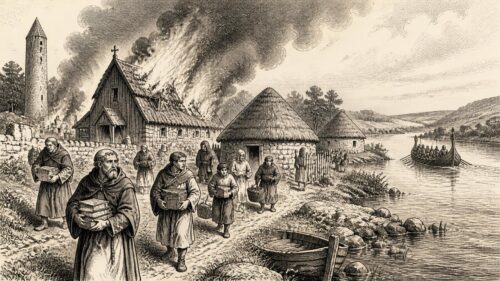
Chronicon Scotorum adds an important, though differently framed, southern notice: foreigners from Port Láirge, Waterford, plundered Cell Dara, Kildare, and it says that Dublin foreigners plundered the church again in the same year. This is not corroborated in precisely that form by every surviving annalistic tradition, so it should not be inflated into a detailed two-stage siege. It nonetheless fits the broader picture of armed maritime groups reaching wealthy ecclesiastical centres in Leinster. A major church was at once a sacred place, a settlement, a storehouse of movable wealth and a node of patronage. Its vulnerability had political as well as devotional consequences.
Muirchertach’s Northern Response
The year’s central figure is Muirchertach son of Niall, a leading member of Cenél nÉogain, the dominant Northern Uí Néill dynasty. He was the son of Niall Glúndub, killed fighting Dublin’s Scandinavians in 919, but in 926 he was not yet king of Ailech: that kingship was held by his cousin Fergal son of Domnall. Muirchertach’s prominence therefore rested on military capacity, dynastic standing and the followers he could bring into the field, rather than on a simple claim to provincial sovereignty.
The Annals of Ulster record that he routed foreigners at Snám Aignech and state that 200 were beheaded. Such figures are annalistic claims, not a modern muster roll, but the entry leaves no doubt that Muirchertach won a conspicuous and lethal victory. It also demonstrates that violence was not confined to ships or coastal sites. A force able to intercept enemies at a crossing or landing-place needed intelligence, local support, supplies and men accustomed to moving overland quickly.
On 4 September, the same annals date the arrival at Linn Duachaill of a fleet from Loch Cuan under Alpthann son of Gofraid. Linn Duachaill lay at or near Annagassan, Co. Louth, on the southern side of Dundalk Bay. Archaeology has identified a probable Viking longphort, a defended ship-camp, in the area. That setting made strategic sense: a fleet could use the sea and estuary while a fortified base anchored access to routes through the northern midlands and towards Ulaid.
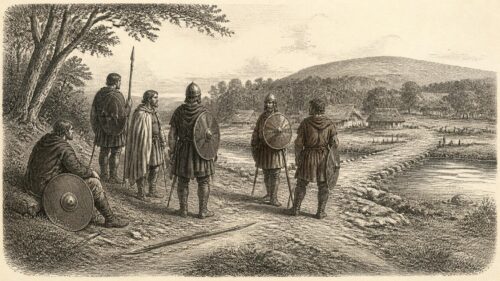
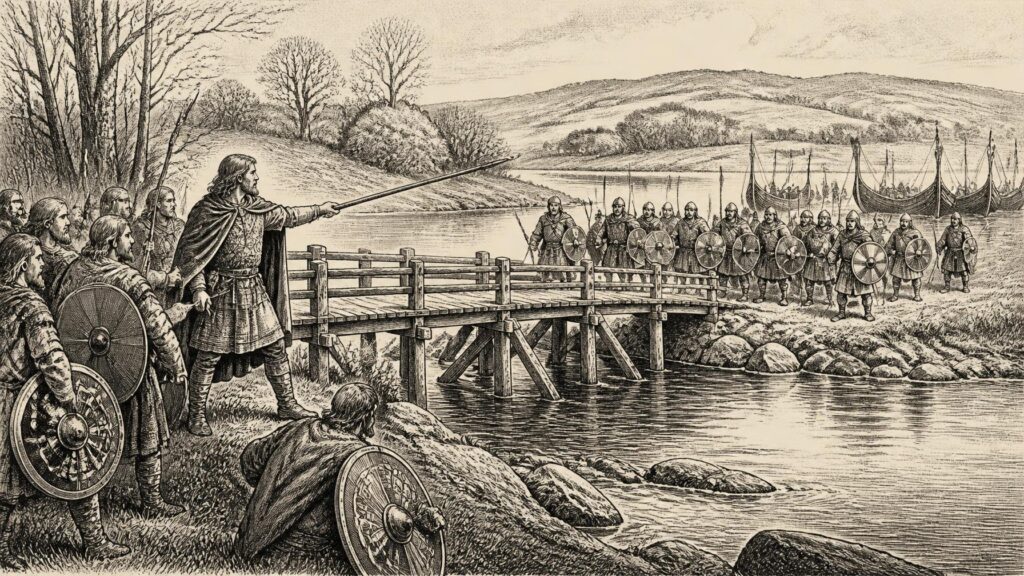
The late-December entry is more detailed. On 28 December Muirchertach inflicted a rout at the bridge of Cluain na Cruimther. Alpthann was killed and his army suffered what the annalist calls a great destruction. Half of the force was then besieged for a week at Áth Cruithne, until Gofraid, king of the foreigners of Dublin, came to their aid. The annal does not describe the fighting, armour, weather or numbers of the besiegers, and none should be invented. What it does establish is a sustained operation, not an accidental skirmish: the battle killed a commander, survivors were contained for seven days, and Dublin’s ruler judged intervention necessary.
Chronicon Scotorum preserves a related but not identical tradition. It credits the men of Ulaid and Muirchertach with a slaughter of 800 foreigners, naming Albdan son of Gofraid, Aufer and Rolt among the dead. The discrepancy in names, total and emphasis warns against combining every detail into one exact reconstruction. Both accounts nevertheless agree on the essentials: an invading force associated with Gofraid’s family was badly defeated, Muirchertach was central to the resistance, and the conflict involved Ulaid as well as the Northern Uí Néill.
A Contested Island, Not a National War
These victories did not expel Scandinavian power from Ireland. Gofraid still ruled at Áth Cliath, Dublin, and could relieve trapped followers. Dublin was not a distant foreign outpost but a kingdom with ships, manpower, trading connections and influence along the Irish Sea. Nor did Muirchertach’s achievement make him king of Ireland. Donnchad Donn of Clann Cholmáin held the kingship of Tara, while local rulers retained their own interests from Brega and Leinster to Connacht, Munster and Ulaid.
Still, 926 mattered in the competition for northern authority. Defence against a maritime enemy could validate a leader’s claim to protect churches, client peoples and territories. Later political tradition celebrated Muirchertach as na Cochall Craicinn, “of the leather cloaks”, but that later epithet should not be projected back as evidence for what his troops wore in 926. The secure point is less picturesque and more significant: repeated victories over raiders helped make him one of the most formidable Irish dynasts of his generation.
Another Ulster notice exposes the continuing fragility of local rule. Fergus son of Duiligén, king of Lurg, was killed by the men of Bréifne. Lurg lay in the north-western interior, far from the bridge battle and Waterford’s waters. Its king’s death is a reminder that the island’s political violence did not derive solely from Scandinavian incursions. Rival Irish peoples fought over lordship, land, tribute and succession, while the annals commonly preserve only the fatal outcome.
Colmán’s Two Churches
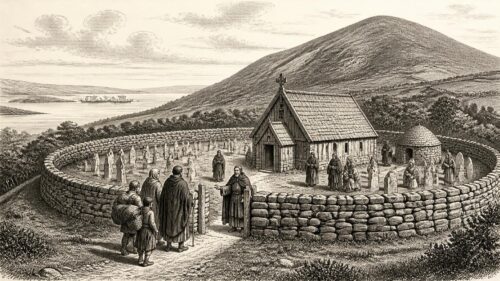
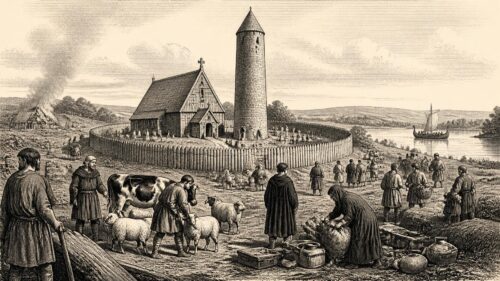
Colmán son of Ailill died in 926 as superior of Cluain Iraird, Clonard, and Cluain Moccu Nóis, Clonmacnoise. The Annals of Ulster call him both scribe and bishop; the Annals of Inisfallen likewise remember his joint abbacy. This combination conveys a great deal. Senior churchmen were administrators of communities and estates, guardians of relics and learning, and figures whose authority could extend across more than one major foundation.
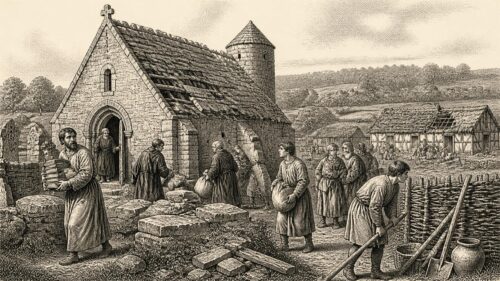
Clonmacnoise, beside the Shannon and the east–west route of the Esker Riada, was a settlement of national importance as well as a monastery. Its riverine position linked religion, craftsmanship, travel and political patronage. Later annalistic tradition credits Colmán with building its stone church, while other evidence associates him and Flann Sinna, the former king of Tara, with ambitious ecclesiastical building there in the early tenth century. Those associations should not be mistaken for a construction project dated to 926; the event firmly placed in this year is Colmán’s death. Yet that death marked the removal of a church leader deeply connected to the monumental and intellectual life of two important communities.
The year’s sparse record does not permit confident statements about harvests, prices, ordinary diet or climate. It does, however, show the conditions that shaped everyday security. Coastal households could face killing or captivity; communities near major churches faced plunder; and rulers had to supply armed followings capable of campaigning into winter. At the same time, the Waterford notice in the Annals of Inisfallen points to continued southern mobility. It says that the fleet of Port Láirge came “over land” and settled on Loch Gair. The annal gives neither route nor method, so it cannot prove how vessels were moved. It does show a maritime force deliberately repositioning between waterways, an impressive logistical act in a landscape where rivers, lakes and short overland hauls connected regional theatres.
What 926 Reveals
Thus 926 was not a year in which one side settled Ireland’s future. It was a year in which power was exercised through movement: fleets shifted from Strangford Lough to Annagassan and from Waterford towards Loch Gair; raiders struck a north-coast stronghold and, in one tradition, Kildare; Muirchertach’s forces pursued and contained an enemy army; and Dublin intervened to save survivors. Alongside that violence, Colmán’s death records the continuing centrality of learned ecclesiastical institutions. Ireland’s political map was made of many lordships and church communities, but in 926 the sea routes and crossings between them were the places where their rivalries became most visible.
Primary Sources
- The Annals of Ulster: Year U926
- The Annals of Ulster
- Chronicon Scotorum: Annal CS926
- Chronicon Scotorum
- Annals of Inisfallen: Annal AI926
- Annals of Inisfallen
- Annals of the Four Masters, Volume 2 English Translation
- Annals of the Four Masters: Annals M923–M924
- Muirchertach na Cochall Craicinin
- Donnchad Donn
- Flann Sinna
- The Vikings in Ulaid
- Early Medieval Dwellings and Settlements in Ireland, AD 400–1100: Volume 1 Text
- Early Medieval Ireland: Archaeological Excavations, 1930–2009
- The Clonmacnoise Group 912–1100 and Its Relationship with the ‘Chronicle of Ireland’
- Vikings in Early Medieval Ireland
- Clonmacnoise Monastic Site
- Clonmacnoise Visitor Guide
- High Crosses
- Irish School of Illumination, c. 650–1100
- Exploring the Irish Annals
- Annals of Inisfallen to Go on Public Display in University College Cork