Island Histories
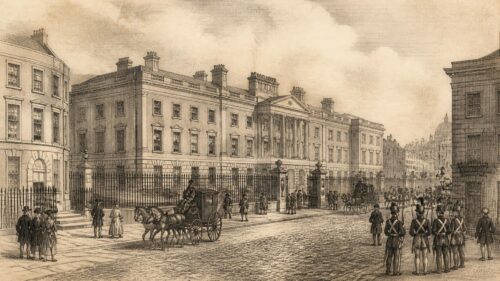
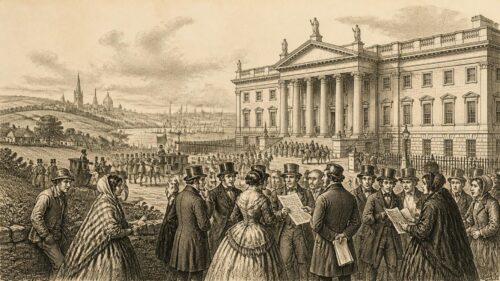
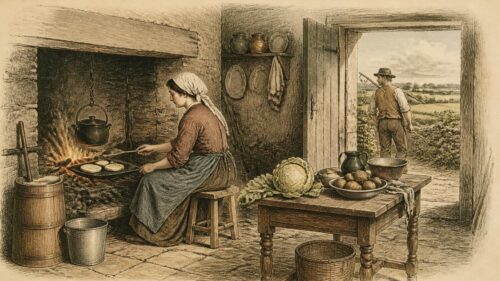
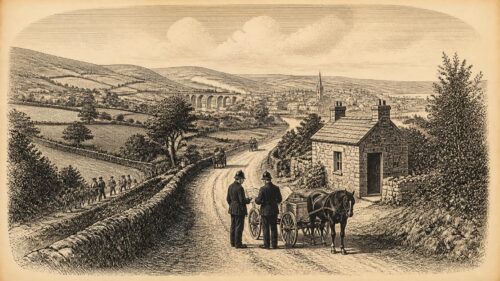
AI generated historical illustration, not a contemporary photograph.
At a Glance
Changing Island
Ireland’s history cannot be reduced to a single uninterrupted national story. It is the history of an island shaped by migration, Atlantic connections, local lordships, religious change, colonial conquest, famine, diaspora, competing constitutional loyalties and repeated efforts to reconcile identities. The names Ireland, Éire and the island itself have held different political meanings at different times. A responsible account therefore distinguishes the geographical island from the modern Republic of Ireland and Northern Ireland, and distinguishes documentary evidence from later patriotic memory and folklore.
Situated at Europe’s western edge, Ireland was never isolated in the absolute sense sometimes implied by romantic description. The Irish Sea linked it to Britain; western sea routes connected it with Scotland, Wales, England, the Atlantic seaboard of France and Iberia, and eventually the wider world. Yet the island’s separation by water affected the scale and character of invasions, trade, settlement and political control. Power was often regional and negotiated. Even when rulers claimed authority over all Ireland, their effective reach varied greatly from place to place.
The physical landscape mattered. Fertile eastern and southern lowlands encouraged dense farming populations and routes of communication, while mountains, bogs, lakes and wooded districts complicated administration and campaigning. Rivers and coasts created corridors rather than simple frontiers. The distribution of monuments, settlements and later towns reveals a long interaction between local environments and wider currents. Ireland’s historical development was thus neither predetermined by geography nor detached from it.
Evidence differs markedly across the centuries. For prehistoric Ireland, archaeology provides the principal record: pollen, animal bone, settlement traces, burial places, tools and monuments. Early medieval history combines archaeology with law tracts, saints’ lives, genealogies and annals, sources that are invaluable but composed for particular religious, dynastic and literary purposes. From the later Middle Ages, official records, legal documents and correspondence become fuller, although they too reflect the concerns of governments, churches and landowners more readily than those of poorer people. Modern Ireland produces an abundance of newspapers, census returns, photographs, oral testimony and state papers, but abundance does not remove disagreement over meaning.
Folklore is also part of Ireland’s past, though it is not straightforward factual testimony about remote antiquity. Stories of the Tuatha Dé Danann, Cú Chulainn, Fionn mac Cumhaill and saintly founders preserve cultural memory and were repeatedly reshaped by storytellers, antiquaries and national movements. They can reveal how communities imagined landscape, ancestry and justice. They cannot by themselves establish an exact event, migration or prehistoric chronology. The distinction is especially important in a country where mythology, place-name tradition and political identity have often met.
Earliest Communities
Human settlement followed the end of the last Ice Age, when environmental conditions gradually permitted habitation. Archaeology indicates that communities arrived by sea, and the island’s first inhabitants lived by hunting, fishing and gathering. Their material traces are necessarily fragmentary. Mesolithic sites show adaptable communities exploiting coasts, rivers, woodland resources and seasonal movement. They did not leave written accounts; the historical questions are therefore questions of evidence, comparison and probability rather than of named peoples or rulers.
Farming transformed the island. In the Neolithic period, people cultivated crops, kept livestock, cleared woodland and made more durable claims upon particular places. This was not merely an economic alteration. It changed work, diet, mobility, settlement and ideas about the dead. Tombs and ceremonial enclosures required collective effort, suggesting communities capable of organising labour across households and perhaps across wider territories. Archaeologists debate the balance between incoming farming populations and the adoption of agriculture by existing groups, while genetic research has added another form of evidence. Neither archaeology nor genetics authorises simple tales of a single people replacing another in one decisive moment.
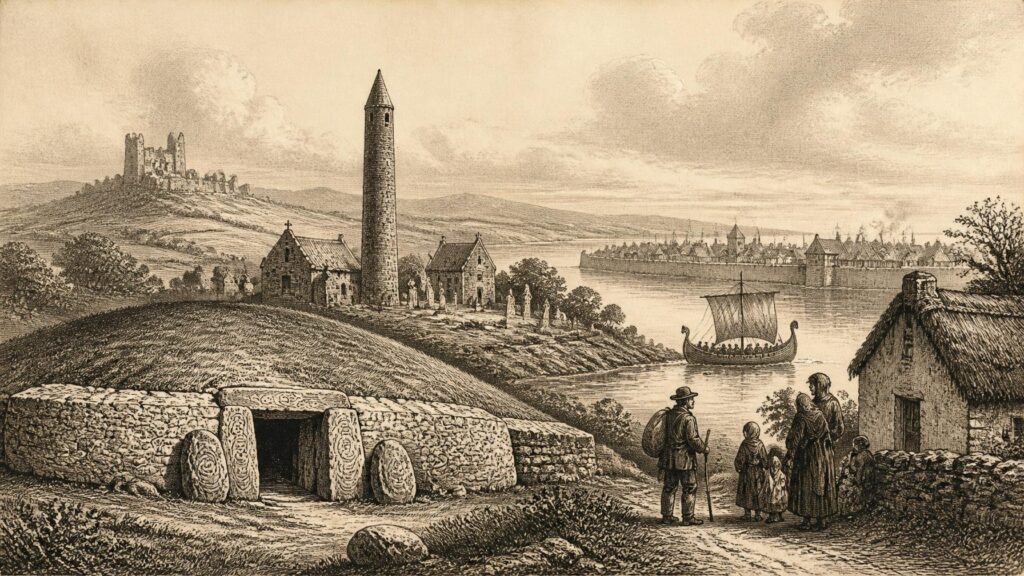
Brú na Bóinne in the Boyne valley is among the clearest witnesses to this world. Newgrange, Knowth and Dowth form part of an extensive ritual landscape, not isolated marvels. Their passage tombs, art and carefully constructed settings demonstrate technical skill and social organisation. At Newgrange, the alignment that admits winter-solstice light into the chamber is tangible evidence of close observation of seasonal cycles. It should not be turned into unsupported certainty about a complete prehistoric religion. The monument tells us that cosmology, remembrance and place were important; it does not provide a written creed.
Bronze Age and Iron Age Ireland left changing patterns of burial, metalwork, enclosure and settlement. Gold ornaments, weapons and imported objects indicate craft specialisation and participation in far-reaching exchange networks. The term “Celtic”, common in popular accounts, needs care. Languages related to Celtic were certainly central to later Irish history, but the idea of a homogeneous, invading Celtic people who arrived fully formed and explained every ancient monument is no longer an adequate historical model. Cultural change was long, varied and regionally uneven.
By the early centuries of the first millennium, Ireland contained numerous small kingdoms and kin-based polities. Roman writers knew of Hibernia, but Rome did not conquer the island. Contacts with Roman Britain nevertheless existed through trade, movement and raiding. The absence of Roman provincial government mattered: there were no Roman towns, roads or administrative institutions to inherit in the manner of Britain. Yet Ireland was part of the changing world around the Irish Sea, not beyond it.
Christian Transformations
Christianity became established in Ireland during the fifth century, although the familiar image of Saint Patrick single-handedly converting an entirely pagan island is a devotional simplification. Patrick was a historical person: his own surviving writings, the Confessio and the Letter to the Soldiers of Coroticus, provide rare contemporary testimony. They describe a former captive who returned as a missionary, conscious of an expanding Christian world and hostile to enslavement and violence. They do not give a complete account of conversion, nor do they justify every later legend attached to his name.
Conversion was a process involving missionaries, local elites, family networks and new institutions. Christianity offered literate connections with Britain and continental Europe, but it was adapted within Irish social structures. Churches and monasteries became centres of worship, learning, landholding, production and political influence. Bishops mattered, but monastic communities and their leaders often had exceptional prominence. Great ecclesiastical sites such as Armagh, Clonmacnoise, Clonard, Bangor and Kildare accumulated patronage, relics and intellectual authority.
Early Irish society was organised through overlapping kin groups and petty kingships rather than a unified territorial state. The concept of a high king was real as an ideal and sometimes powerful in practice, especially for dynasties able to command alliances and tribute, but it did not mean permanent central government. Brehon law tracts, preserved in manuscripts whose surviving forms are later than many of the customs they describe, show a sophisticated legal culture concerned with status, compensation, fosterage, contracts and land. They should be read critically: normative legal writing describes ideals and categories, not a census of ordinary conduct.
The manuscript culture of early medieval Ireland has left a remarkable legacy. Latin learning and Irish vernacular writing flourished together. Monasteries and ecclesiastical centres copied texts, while poets, jurists and genealogists served secular patrons. The Book of Kells is an extraordinary artistic object, but it should not stand alone as a symbol of a uniformly peaceful “island of saints and scholars”. Irish churches existed amid dynastic conflict, slave raiding and competition for wealth. Learning and warfare were not opposites in this society.
Irish monks, clerics and scholars travelled abroad, and continental connections were significant. Columbanus, for example, founded monasteries in what are now France, Switzerland and Italy. The traffic was two-way: books, religious ideas, artistic styles and people moved between Ireland, Britain and the Continent. Later accounts sometimes magnified this influence into a claim that Ireland preserved European civilisation during a universal dark age. The documented achievement is substantial enough without that exaggeration.
Sea Kings
Viking activity began with raids on coastal religious sites in the late eighth century. Such raids were traumatic and conspicuous because monasteries held portable wealth and were often accessible from rivers and coasts. The annals record attacks, killings and burnings, but their concentration on ecclesiastical communities can distort the wider picture. Viking groups were not a single permanent enemy, and their role changed from raiding to overwintering, settlement, trade, alliance-making and kingship.
By the ninth and tenth centuries, Scandinavian settlers had founded or developed longphuirt and towns, including Dublin, Waterford, Wexford, Cork and Limerick. These settlements connected Ireland more intensively to the Irish Sea world, northern Britain, the Isles, Scandinavia and continental markets. Dublin in particular became an important port and political prize. Its history included trade in silver, textiles, livestock and enslaved people, a reality that complicates celebratory stories of urban origins.
Gaelic and Scandinavian communities interacted in many ways. There was warfare, but also intermarriage, bilingualism, commercial partnership and political alliance. The category “Hiberno-Norse” captures some of this mixing, although lived identities were undoubtedly more fluid than the label implies. Irish kings fought Vikings and also employed Viking forces against Irish rivals. Scandinavian rulers adopted Christianity, and towns became part of the island’s political fabric rather than foreign enclaves awaiting removal.
Brian Bóruma, later known as Brian Boru, emerged from Munster and built a formidable coalition in the late tenth and early eleventh centuries. His victory over the Dublin-led forces at Clontarf in 1014 became a foundational episode in later nationalist memory. The evidence does not support the popular claim that Clontarf expelled the Vikings from Ireland. Vikings continued to live, trade and rule in Irish towns afterwards. The battle was instead part of a complex struggle involving Irish, Norse, Norse-Gaelic and overseas participants, as well as rival claims to supremacy.
The annals are central sources for this era, but they require cautious reading. Entries were written and copied within particular centres; chronology can be difficult; retrospective political assumptions may colour presentation. Their value lies precisely in their proximity to learned traditions and their detailed notices of deaths, battles, weather, church affairs and dynastic succession. Used alongside archaeology, coin finds and external sources, they permit a much richer history than either folklore or simple invasion narratives.
Lordship Arrival
The Anglo-Norman intervention of 1169–71 altered Irish politics profoundly, but it did not instantly create an English Ireland. Diarmait Mac Murchada, the expelled king of Leinster, sought military assistance from Anglo-Norman lords in Wales and western Britain. Richard de Clare, known as Strongbow, became the best known of these leaders. Their success at Wexford, Dublin and elsewhere reflected not only military technology but Irish divisions, local alliances and Diarmait’s own ambitions.
King Henry II crossed to Ireland in 1171, receiving submissions from many rulers and churchmen. His intervention asserted royal authority over the adventurers and established the basis of the Lordship of Ireland. Papal claims, royal diplomacy and military presence all featured in contemporary justifications, but sovereignty on paper differed from control on the ground. Royal government became strongest in and around the eastern area later called the Pale, while great Anglo-Norman lordships and Gaelic dynasties exercised varying degrees of autonomy elsewhere.
The newcomers built castles, founded boroughs, introduced new forms of lordship and redirected landholding. They also entered Irish politics. Families such as the de Burghs, Fitzgeralds and Butlers became deeply rooted, acquired Irish languages and customs in varying measure, and pursued interests that could diverge sharply from those of the English crown. Medieval Ireland was not divided into two fixed communities. Gaelic, English, Welsh, Flemish, Scandinavian and mixed populations lived under multiple legal and social arrangements.
The fourteenth century brought severe pressures: warfare, dynastic fragmentation, plague and economic disruption. English royal influence contracted in many regions. The Statutes of Kilkenny of 1366 attempted to prevent settlers of English descent from adopting Irish language, dress, marriage and legal practices. Their very provisions demonstrate the extent of cultural interaction that legislators feared. They do not prove a neat racial separation; rather, they reveal a colonial administration struggling to regulate a society more entangled than its categories allowed.
Gaelic revival is a useful but incomplete phrase for the later medieval period. Some Gaelic lordships expanded, and the reach of the Dublin administration diminished. Yet the island remained a network of shifting lordships, church jurisdictions, ports and family alliances. Late medieval Irish culture produced poetry, chronicles, legal learning and lordly patronage of high quality. It was neither a timeless survival nor an isolated world, but a society adapting to political change and wider commercial contact.
Royal Conquest
Tudor governments sought to transform the limited medieval lordship into a more centralised kingdom. Henry VIII was declared King of Ireland in 1541, a constitutional change intended to reinforce crown authority and draw Gaelic and Anglo-Irish elites into a reformed political order. “Surrender and regrant” offered some lords English titles and recognised estates in return for allegiance. It could be pragmatic, but it also brought local systems of succession and landholding under increasing pressure.
The Reformation complicated conquest. The English crown promoted ecclesiastical change, dissolved monasteries and claimed authority over the church, but the new religious settlement was implemented unevenly. Most of the population remained Catholic, while the state’s ability to provide clergy, institutions and education was limited. Later conflict was therefore both political and religious, though neither element can be reduced to the other. Gaelic lords, Old English Catholics, Protestant settlers and crown officials formed alliances that shifted with circumstance.
Elizabethan expansion was exceptionally violent. Campaigns in Munster and Ulster involved fortification, scorched-earth methods, famine and the seizure of land. The Desmond rebellions devastated parts of Munster. In Ulster, Hugh O’Neill, earl of Tyrone, led a major confederacy against the crown during the Nine Years’ War. His forces won important victories and sought Spanish support, but defeat at Kinsale in 1601 changed the balance decisively. O’Neill’s submission followed in 1603, at the beginning of James I’s reign.
The Flight of the Earls in 1607, when leading Ulster Gaelic nobles left Ireland, became a symbol of the collapse of the old order. It was not the disappearance of Gaelic society, which persisted in language, custom, farming, poetry and local power. Nonetheless, it removed figures capable of leading large territorial resistance and opened the way for the Plantation of Ulster. Crown policy allocated extensive lands to English and Scottish settlers, undertakers, servitors and institutions, while many native inhabitants were displaced, relocated or incorporated as tenants under new landlords.
Plantation was more than settlement. It remade land titles, towns, religious institutions, military security and political expectations. Its effects varied across Ulster, and settlers did not form a uniform bloc. But the plantation helped establish the demographic and confessional geography that would later shape unionism, nationalism and partition. It is historically misleading to portray seventeenth-century Ulster as either wholly colonised or wholly resistant; its society was built through unequal encounters among groups with different resources and protections.
Confederate Kingdoms
The rebellion of 1641 began in Ulster amid fears among Catholics of further land confiscation and political exclusion. It spread into a wider and devastating series of conflicts linked to the Wars of the Three Kingdoms. Reports of massacres, especially of Protestant settlers, circulated rapidly and became central to Protestant political memory. Atrocities occurred, but contemporary accounts require close examination because rumour, propaganda and inflated casualty claims were common. The suffering of civilians was real even where particular narratives were unreliable.
Irish Catholic leaders created the Confederation of Kilkenny in 1642, establishing a remarkable, if fragile, political and military organisation. It governed parts of the country, raised armies and conducted diplomacy while professing loyalty to Charles I. The Confederacy contained divergent interests: Old English Catholics, Gaelic Irish leaders, clergy, landowners and soldiers disagreed over religion, land, royal authority and the terms of a possible settlement. It was not a modern nation-state, but it showed the capacity for coordinated Catholic politics under extreme pressure.
Oliver Cromwell’s campaign from 1649 and the subsequent conquest were catastrophic. The sieges of Drogheda and Wexford became enduring emblems of massacre and dispossession. Exact interpretation of the killings, responsibility and numbers has remained contested, but there is no serious doubt about the brutality of the campaign and the enormous damage of conquest, disease, famine and transplantation. Catholic landownership fell dramatically. The phrase “To hell or to Connacht”, often treated as a literal universal order, expresses a broad reality of forced relocation and confiscation rather than a complete description of every individual experience.
The Restoration after 1660 did not reverse the fundamental transfer of land. Protestant landowners, many with roots in earlier plantations or Cromwellian grants, held political power. James II’s attempt to recover his position after the English Revolution brought Ireland into another war. The Williamite conflict ended with William III’s victory and the Treaty of Limerick in 1691. The treaty’s provisions became the subject of lasting dispute because Catholic hopes for toleration and security were soon undermined by the Penal Laws.
The eighteenth-century Protestant Ascendancy was never simply a social description: it was a structure of political privilege anchored in landholding, established church status and restricted franchise. Catholics formed the majority but endured disabilities affecting property, education, public office and political participation; Protestant dissenters also faced exclusion in some areas. Enforcement changed over time, and local realities differed, but the legal order reinforced unequal power. Irish political culture developed within, against and around that inequality.
Union Challenges
The eighteenth century brought economic growth in some sectors, especially linen in Ulster, commercial expansion in Dublin and improved connections with Atlantic markets. It also produced a more confident Protestant political class. Henry Grattan and others sought legislative independence from Westminster, and the Irish Parliament gained greater autonomy in 1782. Yet that parliament represented a narrow electorate and rested upon the Ascendancy. Its achievement did not solve the larger question of Catholic equality.
The American and French Revolutions stimulated debate about rights, representation and national belonging. The Society of United Irishmen began in Belfast and Dublin with reformist aims that crossed religious lines. Repression, war with revolutionary France and the failure of peaceful reform pushed parts of the movement towards insurrection. The rebellion of 1798 was widespread but uneven, marked by radical idealism, sectarian violence and harsh government reprisals. In Ulster, the failure to unite Protestant and Catholic radicals exposed the depth of communal fear and division.
The Act of Union was passed in 1800 and came into effect on 1 January 1801. It abolished the Irish Parliament and incorporated Ireland into the United Kingdom of Great Britain and Ireland. The Union was promoted as a means of securing the state after rebellion, but it was achieved through intense political management and patronage. Promised Catholic emancipation did not immediately follow because George III opposed it. The result intensified the sense among many Catholics and nationalists that the Union had been imposed without the equality it was supposed to facilitate.
Daniel O’Connell transformed mass constitutional politics. A Catholic barrister with formidable organisational and rhetorical gifts, he led the campaign that helped achieve Catholic emancipation in 1829. His later Repeal movement sought restoration of an Irish legislature. O’Connell insisted upon peaceful mobilisation, demonstrating the political power of meetings, associations, newspapers and the Catholic clergy. He did not achieve repeal, but he created a template for popular politics that later movements adapted.
Industrialisation affected Ireland unequally. Belfast became a major industrial city with linen, shipbuilding and engineering, while much of the island remained predominantly rural and dependent on small-scale agriculture. These divergent economic experiences later reinforced different political outlooks. They should not, however, be treated as inevitable causes of unionism or nationalism. Both traditions contained social and regional variety, and religious affiliation, landholding, class and imperial connection all mattered.
Famine Rupture
The Great Famine was the central social catastrophe of nineteenth-century Ireland. Potato blight appeared in 1845 and recurred over subsequent years, striking a population in which many labourers and cottiers depended heavily on the potato because of poverty, subdivision of holdings and limited alternatives. Crop disease was the immediate trigger; mass death was not an unavoidable natural outcome. The scale of suffering reflected pre-existing inequality, landlord–tenant relations, market structures, administrative choices and the limitations of British relief policy.
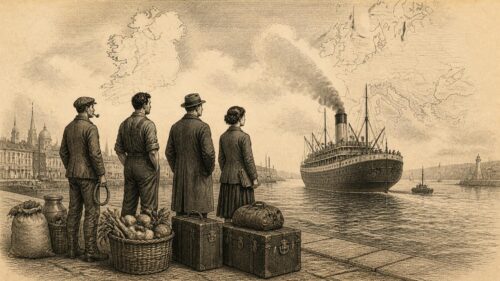
Death, disease, eviction and migration reshaped communities. The population, which had exceeded eight million before the crisis, fell dramatically through mortality and emigration by the 1851 census. Exact totals remain estimates, but historians agree that roughly one million people died and another million or more emigrated during the famine years. Those figures do not convey the full reality of hunger, fever, family separation, workhouse discipline, overcrowded “coffin ships” and the loss of local language communities.
The response of the British state evolved through food relief, public works, soup kitchens and the Poor Law, yet it was inadequate to the emergency and frequently constrained by laissez-faire assumptions, fiscal caution and the belief that Irish property should bear Irish relief costs. Private charity, Quaker aid, local committees and international donations saved lives but could not compensate for the failure of systems intended to protect the poor. Historians debate emphasis and responsibility, but no defensible account treats the famine as merely a bad harvest.
The famine accelerated an already developing pattern of emigration that would become a defining feature of Irish life. Ireland’s diaspora built communities in Britain, the United States, Canada, Australia, New Zealand, South America and elsewhere. Emigrants carried family ties, remittances, language, religion, politics and memories of dispossession. Diaspora support later aided nationalist causes, but emigrant experience was diverse: some prospered, many faced prejudice and low wages, and some left under desperate compulsion rather than hopeful choice.
Land politics changed after the famine. Tenant-right agitation, the Land League, parliamentary nationalism and a succession of land acts gradually reduced landlord power and expanded peasant proprietorship. Michael Davitt’s movement linked economic justice with national politics; Charles Stewart Parnell created an electoral machine capable of exerting leverage at Westminster. The “land question” did not mean the same thing to every tenant or region, but it became inseparable from arguments about self-government and the legitimacy of British rule.
Revolutionary Years
Home Rule dominated late nineteenth- and early twentieth-century constitutional debate. Irish Parliamentary Party leaders sought devolved government within the United Kingdom. Unionists, particularly in the north-east, opposed it, fearing loss of political influence, threats to Protestant interests and separation from an imperial economy. The Third Home Rule Bill became law in 1914 but was suspended because of the First World War. Armed volunteer organisations on both sides reflected how constitutional crisis had become militarised.
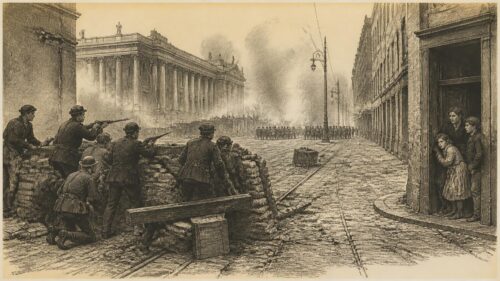
The Easter Rising of 1916 was a military failure in immediate terms, but the execution of many leaders and the political aftermath altered public opinion. The Proclamation’s language of national sovereignty and equal citizenship became foundational, even though the rising did not command universal support at the time. The election of December 1918 gave Sinn Féin a decisive mandate in most Irish constituencies outside unionist Ulster. Its elected representatives formed Dáil Éireann in January 1919 rather than taking their Westminster seats.
The War of Independence followed, involving the Irish Republican Army, the Royal Irish Constabulary, British forces, intelligence operations, reprisals and political negotiation. It was neither a conventional war between equal states nor an uncomplicated popular uprising. Violence varied by region, and civilians experienced intimidation and fear from several directions. The Truce of July 1921 led to negotiations and the Anglo-Irish Treaty of December 1921.
The treaty established the Irish Free State as a self-governing dominion within the Commonwealth, while confirming Northern Ireland’s option to remain within the United Kingdom. It also required an oath of allegiance and accepted partition in practice. For supporters, it offered substantial autonomy and a route to fuller independence. For opponents, it betrayed the republic declared in 1919 and accepted an imperial connection and divided island. The split led to the Civil War of 1922–23, a conflict whose bitterness entered families, local communities and party politics for generations.
Northern Ireland had been established by the Government of Ireland Act 1920 with its own parliament at Stormont. Its unionist majority supported continued union with Britain; its substantial nationalist minority often experienced discrimination in housing, employment, electoral arrangements and policing. The Free State, later constitutionally renamed Ireland in 1937, built its institutions amid economic constraints, Catholic social influence and the continuing emotional force of partition. In 1949 it formally left the Commonwealth and became the Republic of Ireland.
Partition Legacies
The decades after partition were shaped by contrasting state projects. In the Republic, governments pursued sovereignty, cultural revival and economic development with varying success. Irish language policy carried symbolic importance but could not reverse the long historical decline of Irish as the dominant daily language across most of the country. In Northern Ireland, unionist rule maintained the constitutional link with Britain but failed to secure broad nationalist consent. Civil-rights protests in the late 1960s raised demands for equality and reform.
The conflict known as the Troubles developed from this crisis. Republican and loyalist paramilitaries, the police, the British Army and political institutions all played parts in a period marked by killings, bombings, internment, displacement and profound trauma. No single phrase can adequately distribute responsibility or capture every experience. The conflict was rooted in constitutional division and unequal structures, but it also involved choices by organisations and individuals that inflicted grievous harm upon civilians.
Political settlement came slowly through dialogue, ceasefires, public pressure and the involvement of the British and Irish governments, Northern Irish parties and international actors. The Good Friday Agreement, signed on 10 April 1998 and endorsed in referendums north and south, established power-sharing arrangements, North–South institutions and a framework based upon consent. It recognised the legitimacy of both unionist and nationalist aspirations, and affirmed that Northern Ireland’s constitutional status could change only with majority consent there.
The agreement did not erase division, bereavement or disputed memory. Its achievements are better understood as institutions and principles for managing disagreement than as proof that history has ended. Debates over flags, language, victims, policing, parades, borders and identity continue. The agreement’s architecture nonetheless replaced a conflict in which political identity could appear mutually exclusive with one that formally permits British, Irish or both identities and makes constitutional change subject to democratic consent.
Contemporary Ireland is shaped by migration, European integration, economic transformation, changing religious practice and renewed discussion of constitutional futures. The Republic’s relationship with the European Union has altered the context in which independence is understood; the United Kingdom’s departure from the EU raised particular questions for Northern Ireland and cross-border life. Historical understanding remains essential because present arguments draw upon inherited memories. Yet history should illuminate rather than imprison. The island’s past shows enduring conflict, but also exchange, adaptation, mixed communities and political imagination.
Remembered Ireland
Ireland’s history is continually remade through commemoration. Anniversaries of 1916, the famine, the 1798 rebellion, the Battle of the Boyne and the Good Friday Agreement can invite careful reflection, but they can also encourage selective memory. A mature historical culture does not demand that every tradition tell the same story. It asks that claims be tested, that victims are not instrumentalised, and that complexity is not mistaken for disloyalty.
Archives, archaeology and scholarship have transformed knowledge of the island. Digital editions of annals and manuscripts allow readers to encounter difficult primary sources; excavations continue to alter interpretations of ancient settlement; census materials, estate papers and witness statements recover aspects of ordinary life obscured by elite records. New evidence does not make old questions disappear, but it makes simplistic answers less persuasive.
The most enduring lesson is that Ireland has been plural for a very long time. Gaelic and Norse, Catholic and Protestant, Irish-speaking and English-speaking, rural and urban, unionist and nationalist, newcomer and descendant of migrants all belong to histories that cannot be honestly separated into pure strands. The past contains conquest and resistance, but also coexistence and interdependence. To acknowledge this is not to soften injustice. It is to recognise that the historical island has always been more varied than the stories told in its name.