Cormac’s Eighty Ferryings907 CE
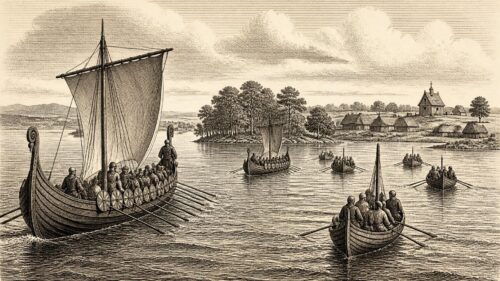
In 907, Cormac mac Cuilennáin, king-bishop of Cashel, and Flaithbertach mac Inmainén led Munster forces through the midlands, challenging Flann Sinna and Uí Néill influence. Annals record fighting at Mag Léna, the death of Máel Craíbe of Cenél Fiachrach, Connacht hostages, and fleet-borne plundering around Lough Ree. Their Christmas campaign reached Uí Néill territories, Mag Aí and Clonmacnoise, requiring eighty ferryings, an uncertain phrase indicating arduous transport. These expeditions demonstrated Munster’s mobile, alliance-based power without creating unified rule. Cét became king of Corcu Modruad locally. Mortality is noted cautiously in Ulster’s annals; Cormac’s defeat came the following year in 908.
Dateline
The year 907 found Ireland’s political centre of gravity moving across rivers, lakes and plains rather than resting in any single royal seat. Cormac mac Cuilennáin, king of Cashel and a churchman of exceptional standing, led the men of Munster northwards with Flaithbertach mac Inmainén. Their progress brought war into the Shannon basin, pressure upon the Uí Néill, demands upon Connacht, and a conspicuous arrival at Clonmacnoise around Christmas. The annals offer no tidy narrative of causes and consequences, but their compressed notices preserve an extraordinary picture of royal power exercised through armed hosting, boats, hostage-taking and movement over difficult country.
Evidence and the Year
Dating must be handled carefully. The Annals of Inisfallen, a chronicle compiled in Munster, place the chief events under 907. Chronicon Scotorum independently records campaigns by Cormac and Flaithbertach in the same annal, including an expedition to Mag Léna, the taking of Connacht hostages and the plundering of the islands of Lough Ree from a fleet. The Annals of Ulster, however, register only churchmen’s deaths and a “year of mortality” under their heading corresponding to 906/907. Its brief phrase gives neither disease, locality nor scale. It is evidence that contemporaries or compilers associated the year with serious mortality, not evidence from which to reconstruct a national epidemic.
Later annals sometimes put other incidents under 907 which can be shown, from comparison with earlier chronicles, to belong several years later. Those have no place in a year-by-year account of 907. Likewise, Cormac’s fatal battle at Belach Mugna belongs to September 908, not to this year. It is relevant only as the looming outcome of the political course visible in 907.
A Munster Advance
Cormac was not merely a regional king. He was an Éoganacht ruler of Cashel, described in near-contemporary tradition as a bishop and later remembered as a learned man, scribe and religious figure. His kingship of Munster, begun in 901 or 902 depending on the annalistic reckoning, carried a claim to command the resources of a large southern overkingdom. Across the island, Flann Sinna of Clann Cholmáin was king of Tara and the leading ruler of the southern Uí Néill. Neither man governed a centralised state: authority depended on alliances with subordinate kings, ecclesiastical communities and armed followers, renewed through personal presence.
The first notice for 907 in the Annals of Inisfallen is stark: the men of Munster plundered Lough Ree, reached Mairg in Leinster and Mag Léna, and killed Máel Craíbe son of Cathalán, king of Cenél Fiachrach, with many others. The itinerary is formidable. Lough Ree lies on the Shannon; Mairg was in the Leinster borderlands; Mag Léna lay farther east in the Midlands. The report does not prove a single unbroken march, nor does it permit modern estimates of numbers killed. It does establish that Munster’s war-band operated far beyond its southern heartland and that a local ruler of Cenél Fiachrach died in the violence.
Chronicon Scotorum gives the confrontation at Mag Léna a sharper political edge. It says that Cormac and Flaithbertach led the men of Munster there, where Leth Cuinn—the northern half of Ireland in political language—was assembled around Flann mac Máel Sechnaill. Its wording indicates a reverse for Flann’s side. This was therefore more than ordinary cattle-raiding. It was a challenge to the reach and prestige of Tara’s king in the central plain, at a point where routes between Munster, Leinster, Mide and Connacht met.
Boats on Lough Ree
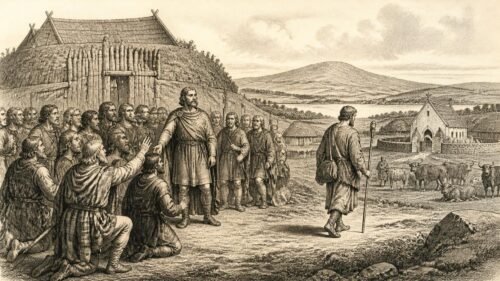
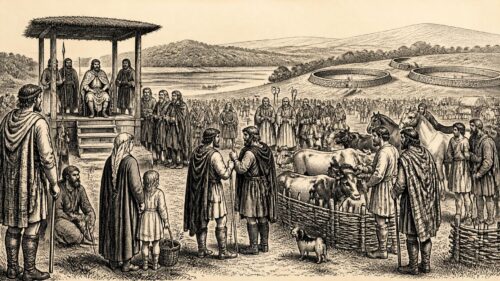
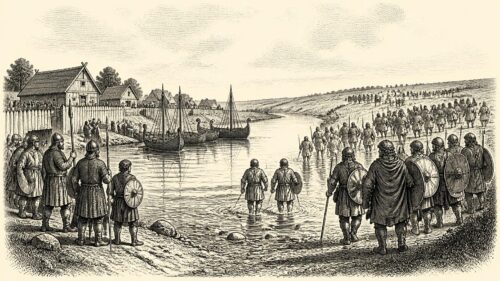
A second expedition, again attributed to Cormac and Flaithbertach, struck at the Uí Néill and Connacht. The Munster force took hostages from Connacht and plundered the islands of Lough Ree “from their fleet”. Hostages were not casual prisoners. They were political securities, usually people of rank whose custody underwrote submission, agreement or future good conduct. Their seizure announced that Munster’s rulers had compelled, or claimed to have compelled, obedience from Connacht leaders.
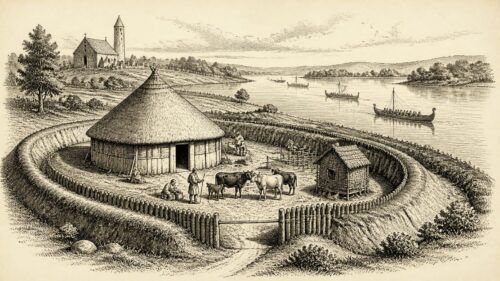
The fleet deserves equal attention. The Shannon and its great lakes were arteries through the Irish midlands, carrying people, goods, livestock where practicable, messengers and armed contingents. Water did not eliminate hardship: boats had to be built, crewed, supplied, protected and moved between navigable stretches. Yet a force with vessels could strike islands and shore settlements, cross water barriers, and keep its campaigning force connected over a wide area. In 907, Munster was using that mobility to project power into lands associated with Flann’s wider political sphere.
For the inhabitants of the islands and lake shores, “plundering” meant immediate disruption rather than an abstract diplomatic gesture. Annals do not describe individual households, but armed requisition and seizure would have threatened stored food, animals, tools, valuables and people. Campaigning forces also required provisions. The movement of a royal host through a farming landscape imposed obligations upon communities whether they actively resisted, submitted or simply lay in the line of march. The record is silent on prices, harvests and trade in 907; it would be irresponsible to invent an economic crisis. It does show, however, that control of waterways and access to rural resources had direct political value.
Clonmacnoise at Christmas
The most memorable detail in the Inisfallen entry concerns the Christmas season. Cormac and Flaithbertach led a Munster hosting to Mag na Cuirre, took hostages of the Uí Néill, then went shortly afterwards to Mag Aí in Connacht and obtained their demands. The annalist adds a deliberately striking contrast: at Christmas they were in the east, and on the Kalends of January, 1 January, in the west. The campaign plainly crossed the boundary of the calendar year. What can safely be said is that the 907 operation continued through Christmas and that its movement into the opening days of 908 belonged to the same expedition.
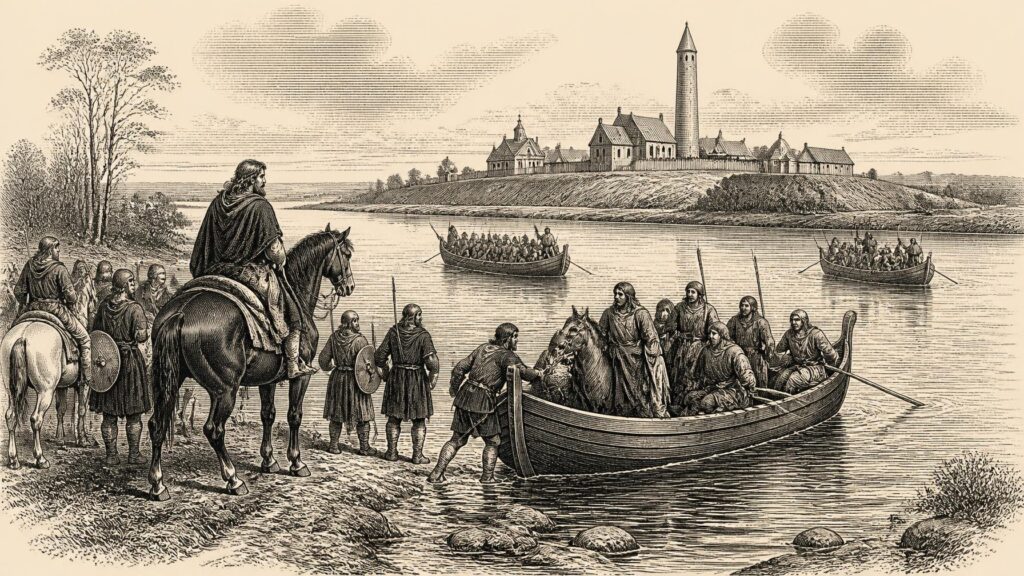
The annal then says that Cormac made ocht fichit imarchor before his party reached Clonmacnoise during that Christmas: literally “eight score” movements or ferryings. Modern translators mark the exact sense as uncertain. It may refer to repeated crossings, portages or stages of transport; it cannot safely be converted into 160 boats, 160 miles, or 160 individual river-crossings. Even with that caution, the phrase preserves the effort behind royal display. This was no effortless progress along a map. It was a laborious expedition requiring sustained transport, local knowledge and organised manpower.
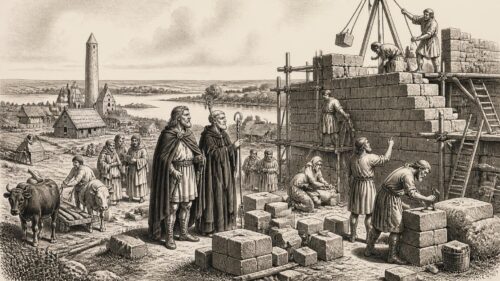
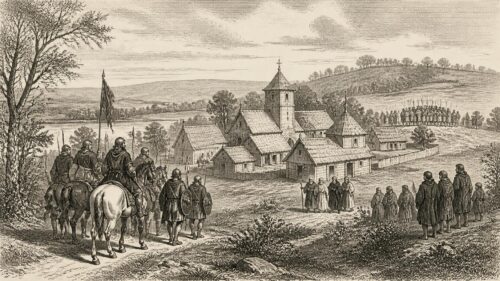
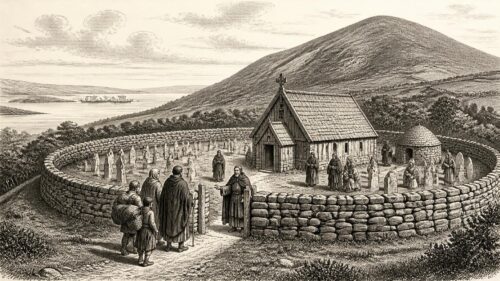
Clonmacnoise was a consequential destination. Set beside the Shannon at the intersection of north–south river movement and east–west routes along the eskers, it was already a major ecclesiastical settlement with a substantial lay population as well as clerics. It was a place of worship, learning, craftsmanship, exchange and political patronage. Its association with the kings of Mide made Cormac’s arrival particularly resonant. The annal does not explicitly say that he attacked, occupied or compelled the monastery. Presence at Clonmacnoise should not be inflated into conquest. But a king of Cashel reaching the great Shannon monastery at Christmas, amid a campaign against Uí Néill interests, was an unmistakable assertion of reach.
Churchmen and Kingship
Cormac’s career illustrates how closely ecclesiastical and royal authority could overlap. He was a king with a religious vocation, but this did not make his government separate from warfare. His host moved through sacred and secular landscapes alike, and monastic centres were important political nodes because they held land, people, learning, prestige and remembered connections with ruling dynasties. The survival of annals, genealogies and learned writing from such communities is itself a reminder that literacy was embedded in these institutions, alongside farming, hospitality and lordship.
That does not mean that every cleric supported every campaign, or that the Church functioned as a single institution. The sources name Flaithbertach beside Cormac as co-leader in 907, but give little reliable detail about his status or motives at this date. Later storytelling made him a powerful and controversial figure in Cormac’s downfall. For 907, the secure point is simpler: two named leaders commanded Munster forces in a series of major expeditions.
Local Change in the West
Amid the large-scale campaigning, the Inisfallen annalist records a local succession: Cét son of Flaithbertach took the kingship of Corcu Modruad, in the Burren region of north County Clare. The entry is brief, without explaining whether the change followed death, agreement or conflict. Its importance lies in scale. Ireland in 907 was not governed only through Cashel and Tara. Numerous smaller peoples and dynasties retained their own kingships, and their succession mattered sufficiently to be entered beside the movements of the greatest provincial host.
The contrast is revealing. Cormac’s men could range from Lough Ree to Mag Aí and Clonmacnoise, while Corcu Modruad still had its own ruler, political territory and local history. Overkingship was an active relationship, made visible in hostages, tribute-like demands and armed visits, rather than a settled territorial administration.
An Unfinished Contest
By the end of 907, Cormac had demonstrated military mobility and political ambition on a scale unusual even for a king of Munster. His campaigns had damaged opponents, brought Connacht hostages into Munster’s power, pressed the Uí Néill and reached Clonmacnoise in midwinter. Yet the sources do not show a new united Ireland under Cashel. They show a contested island, in which success had to be repeatedly performed and defended.
The following year would expose the limits of that advance. In September 908, Cormac was killed at Belach Mugna by the combined forces of Flann Sinna, Cerball of Leinster and Cathal of Connacht. That defeat must not be read back as inevitable. In 907, the evidence records not collapse but momentum: an ambitious southern kingship, fleets on the Shannon, hostages in hand, and a king whose difficult Christmas journey carried Munster’s authority into the island’s political heart.
Primary Sources
- Annals of Inisfallen
- Annals of Inisfallen: Irish Text
- The Annals of Ulster
- The Annals of Ulster: Year U908
- Chronicon Scotorum: Annals CS903–CS908
- Annals of the Four Masters: Annals M903–M912
- Fragmentary Annals of Ireland
- Cormac
- Flann Sinna
- Clonmacnoise Visitor Guide
- Clonmacnoise Monastic Site
- Clonmacnoise Monastic Site: Highlights
- Irish School of Illumination
- High Crosses
- Early Medieval Ireland, AD 400–1100: The Evidence from Archaeological Excavations
- Cormac’s Metrical Testament: ‘Mithig Techt Tar Mo Thimna’
- The Practice of Irish Kingship in the Central Middle Ages
- The Multivocality of the Cross of the Scriptures
- Towards a Relative Chronology of the Irish Chronicles
- CELT: Annals of Inisfallen Project Record