Treóit’s Unnamed Killing903 CE
In 903, Irish annals recorded political and ecclesiastical transitions rather than a major campaign. Máel Finnia of Brega, recently associated with Dublin’s Scandinavian expulsion, died and received praise emphasising piety, generosity and martial authority. At Treóit near Tara, Máel Mithig and Áengus committed an unnamed killing at Flann Sinna’s instigation, showing royal influence exercised through kinship and local allies. Deaths among rulers in Laíges, Tuirbe and Uí Cheinnselaig indicated regional succession pressures. Senior churchmen also died, underlining monasteries’ administrative and political importance. Divergent annals require chronological caution. The year reveals power resting on fragile relationships between dynasties, churches and communities.
Dateline
The record for 903 is unusually revealing precisely because it is so spare. The Irish annals preserve no great battle, royal assembly or foreign invasion securely assignable to this calendar year. Instead, they note deaths, changes among regional rulers and church leaders, and one stark act of violence at Treóit, near Tara. Taken together, these entries show an Ireland in which royal power, ecclesiastical standing and local security were intimately entangled.
Chronology needs care. The Annals of Ulster label their material “AD 902 alias 903”, reflecting the complications of medieval annalistic year-reckoning, while the Chronicon Scotorum also has a 903 heading. This article follows the modern editions’ placement of the entries in 903. A much later compilation, the Annals of the Four Masters, places the Battle of Belach Mugna under its year 903; however, the Annals of Ulster date that battle to 13 September 908. It is therefore not treated as an event of 903.
A King of Brega Dies
The most consequential recorded death was that of Máel Finnia son of Flannacán, king of Brega. Brega was the rich, politically charged plain north of the Liffey and Boyne, extending across much of modern Meath, Dublin and Louth. Its rulers stood close to Tara, the symbolic centre of Irish overkingship, and could influence the routes between Leinster, the midlands and the northern kingdoms. Máel Finnia’s death mattered not merely as the passing of a local lord, but as a change in the balance of power beside the heartland of the Southern Uí Néill.
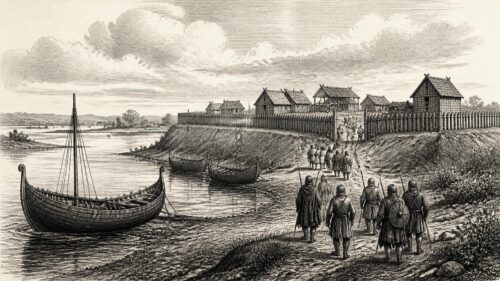
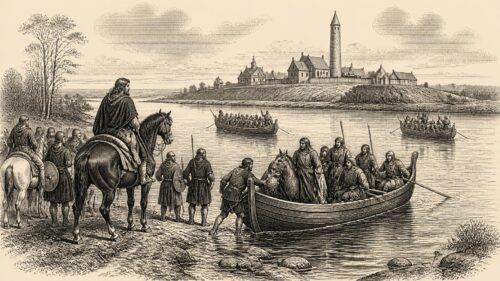
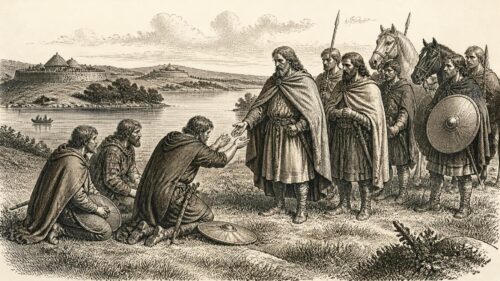
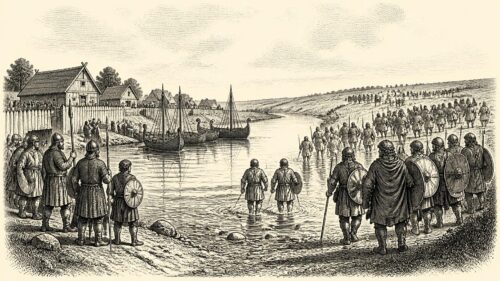
His recent record gave his death an added weight. In the annals’ entry for the preceding year, Máel Finnia and the men of Brega joined Cerball son of Muirecán, king of Leinster, in driving the Scandinavian rulers from their fortified base at Áth Cliath, Dublin. The annalist says that ships were left behind and that the defeated foreigners escaped across the sea wounded and broken. The language is triumphal and should not be mistaken for a permanent end to Scandinavian activity in Ireland; it does, however, attest a real collapse of Dublin’s Viking regime at this moment. Máel Finnia’s death in the following year removed one of the Irish leaders credited with that success.
The Annals of Ulster call him a “religious layman”, a description that deserves attention. It did not mean that he had ceased to be a king. Rather, it presented a secular ruler as a person of recognised piety, an important quality in a society where churches, saints’ cults and dynasties were bound together by patronage, landholding and commemoration. His obituary is followed by a three-stanza praise-poem. It celebrates his generosity, prowess in war and lordship of Brega, calling him peaceful yet fierce in battle. Such verses were not neutral biographies. They were public political memory, preserving an ideal of rulership in which liberality, Christian respectability and military capacity belonged together.
The language of the poem is extravagant: Máel Finnia is said to have been a match for all Ireland. That cannot be read literally as evidence that he ruled the island. Flann Sinna, king of Tara, remained the leading overking in the midlands. Yet the poem is valuable because it shows what his followers wished to claim for a Brega ruler at his death. In a land of competing kingships, reputation was itself a resource. Praise could reinforce the standing of a family as effectively as a boundary, a hostage agreement or an armed retinue.
Treóit and Royal Direction
Later in the year the annalist recorded that “a killing was committed” at Treóit by Máel Mithig son of Flannacán and Áengus, grandson of Máel Sechnaill, at the instigation of Flann son of Máel Sechnaill. The brevity is frustrating. No victim is named, no motive is supplied, and the source does not say whether the act was a judicial execution, a political murder or violence arising from a dispute. It would be irresponsible to supply those missing details.
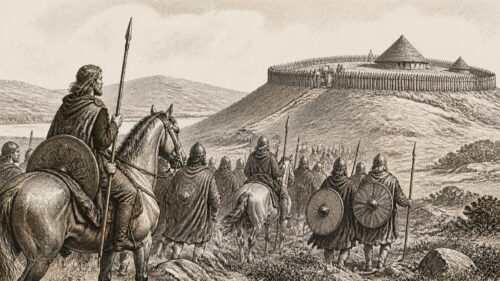
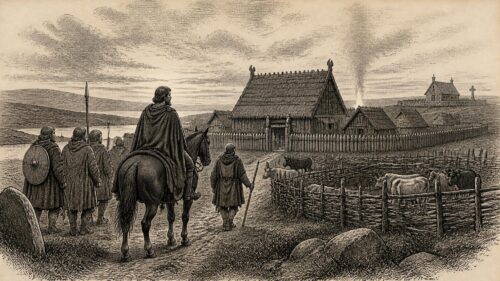
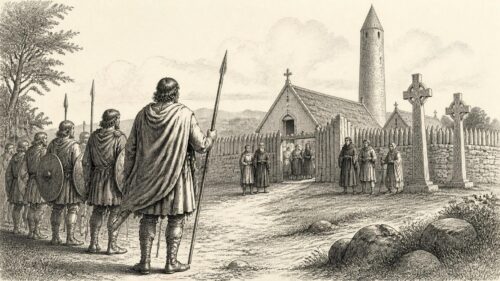
What can be said is significant enough. Treóit, modern Trevet in County Meath, lay in southern Brega, only a short distance from Tara. It was an ecclesiastical settlement within a densely occupied and politically sensitive landscape of royal sites, ringforts, farms and churches. Violence there was thus not an anonymous incident on a remote frontier. The named participants connected it directly to leading kindreds. Máel Mithig was Máel Finnia’s brother and successor in the Brega dynasty; Áengus was a grandson of Flann Sinna; and the annalist expressly identifies Flann Sinna as the instigator.
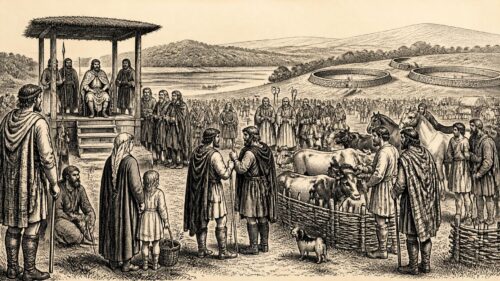
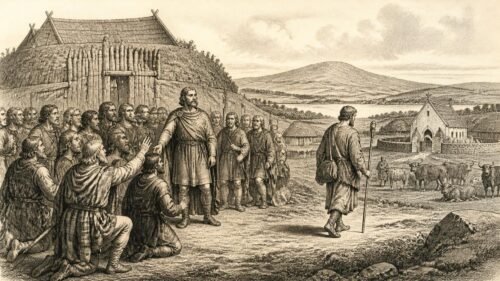
The entry offers a rare glimpse of power working through kinship. Flann Sinna did not necessarily travel to Treóit himself, but the wording makes him responsible for the action. His grandson acted alongside the incoming Brega ruler. That partnership may indicate lordship, alliance or both. It also illustrates the limited and practical nature of early medieval Irish kingship. Authority was exercised through personal connections, military followers, client rulers and control of important places, not through a permanent state bureaucracy. The episode at Treóit was a reminder that the king of Tara’s influence could reach into Brega through men whose claims were grounded in family as much as office.
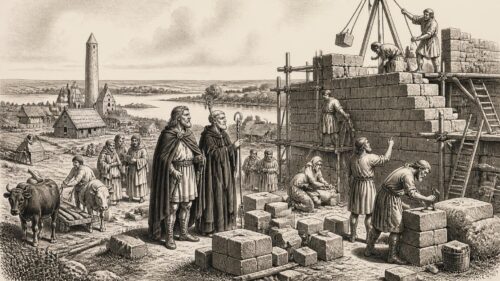
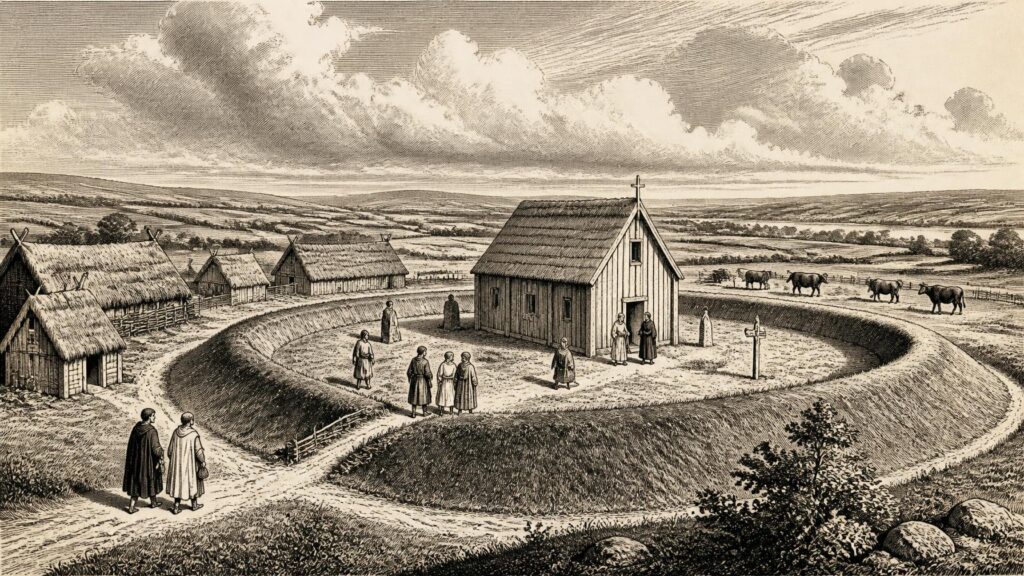
Treóit’s status as a church site makes the report still more arresting. Ecclesiastical enclosures were places of worship, burial, learning, farming and exchange, inhabited by clerics as well as lay workers and visitors. They were also embedded in politics. Churches possessed land, cattle, books, precious liturgical objects and the prestige of saintly association; rulers sought their support, while churchmen relied on powerful patrons for protection. A killing at such a place did not prove that the church approved it, but it demonstrates that sanctuary and secular coercion could exist uncomfortably close together.
Deaths Across the Provinces
The year’s other notices map a wider pattern of change. The Annals of Ulster record the deaths of Ceinnétig son of Gaíthíne, king of Laíges, and Aindiaraid son of Máel Muire, king of Tuirbe. Laíges, broadly corresponding to much of modern County Laois, occupied a strategic position between the midlands, Leinster and Munster. The loss of a king there would have required a new settlement within the ruling kindred, though the annals do not tell us how that succession unfolded. The lesser kingdom of Tuirbe is even more obscure, a useful warning that much of Ireland’s political geography is visible only in passing through the survival of royal obituaries.
The Chronicon Scotorum adds the death of Dub Gilla son of Etarscél, king of Uí Cheinnselaig, the powerful Leinster dynasty centred in the south-east. Its inclusion reinforces the impression of a year marked by turnover among regional elites rather than by one island-wide confrontation. Such deaths could be dangerous moments. Kingship was normally held within a royal lineage, but it did not automatically pass from father to eldest son. Brothers, cousins and rival branches could all possess plausible claims. The sources do not permit a narrative of fighting in Laíges or Uí Cheinnselaig in 903, but they do establish that political relationships in several regions had to be renegotiated.
Churches, Office and Memory
Three prominent churchmen also died according to the Annals of Ulster: Caínchomrac, bishop and superior of Lugbad; Máel Ciarán, abbot of Tír dá Glas and Cluain Eidnech; and Cellach son of Saergus, anchorite and bishop of Ard Macha. These notices show the scale of ecclesiastical office. Máel Ciarán’s combined authority over Tír dá Glas, at Terryglass on Lough Derg, and Cluain Eidnech demonstrates that senior clerics could be associated with more than one community. Their responsibilities were religious, but also administrative and economic, involving the management of lands, dependants, food renders and inherited ecclesiastical rights.
Cellach’s description as both anchorite and bishop is especially revealing. An anchorite pursued an ascetic religious vocation, yet episcopal status placed him within the public hierarchy of the church. In Ireland these were not always opposing identities. Spiritual prestige could strengthen a church’s political authority, while aristocratic patronage and ecclesiastical office could support religious life. Ard Macha, Armagh, was a pre-eminent Patrician centre; the death of one of its bishops was therefore more than a local personnel change, even if the annal provides no account of the succession.
The later Annals of the Four Masters preserve a somewhat different selection of ecclesiastical deaths for its entry headed 903, including abbots at Louth, Derry and Druim Mór and a prior of Kildare. Its divergent record should not simply be combined with the Ulster entries as if every notice were contemporary and perfectly synchronised. Rather, the variations show why the annals must be read as related but distinct compilations, copied and reorganised over centuries. Their agreements can corroborate a death; their differences can reveal transmission, local interests and chronological displacement.
An Uneventful Year?
For most people, 903 was not experienced through the deaths of kings or the decisions of Flann Sinna. Rural households continued to depend on cattle, grain, dairying and seasonal labour; many lived in or near enclosed farmsteads, while monastic communities operated as substantial settlements with workshops, fields, livestock and guests. The annals do not record a famine, epidemic, exceptional weather event or nationwide harvest failure for this year. Silence is not proof that ordinary life was easy, but it means that no such condition should be invented.
Nor should the absence of a Viking entry for 903 be turned into a claim that the island had become safe. The fall of the Dublin base in the previous year changed the immediate political landscape, yet seaborne raiding and Scandinavian return remained possibilities in the Irish Sea world. The year’s surviving evidence instead captures a pause after a major reversal: Brega had lost the king who helped expel Dublin’s rulers; his brother was now implicated in violence carried out under the direction of Tara’s king; and churches from Louth to Armagh and Terryglass faced changes of leadership. In 903, Ireland’s history was written less by a single battlefield than by the fragile succession of people, offices and alliances on which power depended.
Primary Sources
- The Annals of Ulster: Year U902
- The Annals of Ulster: Year U903
- The Annals of Ulster: Year U904
- The Annals of Ulster: Year U908
- The Annals of Ulster
- Chronicon Scotorum: Annals CS901–CS904
- Chronicon Scotorum: Annals CS905–CS909
- Chronicon Scotorum
- Annals of the Four Masters
- Vikings in Irish Chronicles, 794–902: Data
- Flann Sinna
- Exploring the Irish Annals
- Annals of Inisfallen: Annals AI900–AI909
- Annals of Inisfallen
- Dromiskin
- Early Christian Sites
- Early Christian Monasteries
- Early Monastic Churches
- Ordinary People in Early Christian Ireland
- High Crosses
- Visit Hill of Tara with Discover Ireland
- Irish School of Illumination
- Archaeological Survey