Máel Ruanaid’s Burning901 CE
In 901, Máel Ruanaid, designated heir of Ireland and son of high king Flann Sinna, was burned to death with companions by the Luigne, exposing the insecurity of succession and the reach of local rivalries. Among the victims were a neighbouring king and an ecclesiastical superior, illustrating intertwined secular and religious power. Annalistic dating remains uncertain, particularly for Cormac son of Cuilennán’s accession as bishop-king of Cashel, generally placed in 901–902. Notices of abbots’ deaths show monasteries’ regional importance. The article cautions against assigning Dublin’s Viking expulsion, famine, or other undocumented events securely to 901, despite gaps in surviving evidence.
Dateline
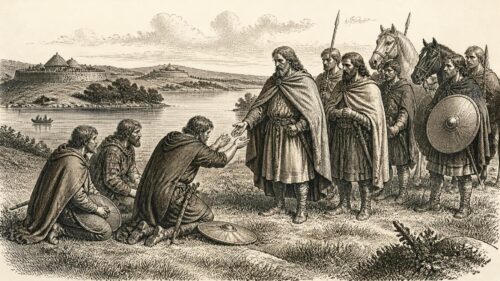
In 901, a violent killing in the midlands exposed a fault-line at the heart of Irish kingship. Máel Ruanaid, son of Flann Sinna, was not merely another prince among many: the annals call him rígdamna Érenn, “heir designate of Ireland”. Yet this was not a modern office with a guaranteed succession. It proclaimed rank, expectation and political intent within a society where royal power depended on kinship, armed followings, land, church alliances and the ability to exact recognition from other rulers. Máel Ruanaid’s death, with several companions, was therefore a grave blow to his father’s authority.
The evidence for 901 also requires care. Irish annals preserve closely related records but do not always attach events to the same modern calendar year. The killing of Máel Ruanaid is securely associated with 901 in modern historical accounts, although the Annals of Ulster place it under a heading marked “AD 900 alias 901”. The accession of Cormac son of Cuilennán at Cashel is entered under 901 by the Annals of Inisfallen and Chronicon Scotorum, while modern reference works commonly give 902. It belongs to the immediate political horizon of this year, but its precise calendar placement cannot be stated with certainty.
A Royal Heir Killed by Fire
The fullest account of Máel Ruanaid’s death is stark. He was killed by the Luigne, named as the sons of Cernachán son of Tadc and the son of Lorcán son of Cathal. Chronicon Scotorum adds the terrible detail that he died when a house was set on fire. The Annals of Ulster says that many nobles perished with him, including Máelchrón son of Domnall, king of Cenél Laegaire, and Dub Cuilinn, superior of Ros Ech. It too specifies that they were all killed by fire.
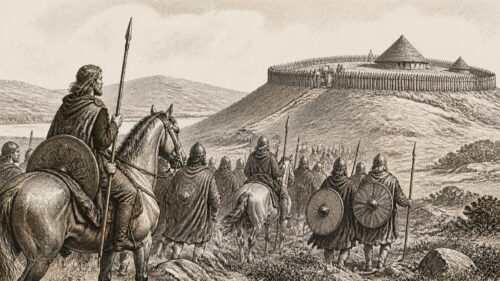
No surviving contemporary annal explains the immediate cause of the attack, identifies the site, or tells us whether the victims had marched against the Luigne, been surprised while travelling, or entered a place thought safe. Those gaps matter. It would be tempting to turn the episode into a fully plotted rebellion against Flann Sinna, but the sources do not permit it. What they do establish is that the heir apparent of the dominant Clann Cholmáin branch of the southern Uí Néill, a neighbouring king and an ecclesiastical superior were destroyed together by a regional force.
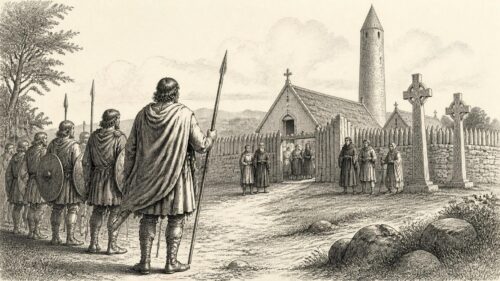
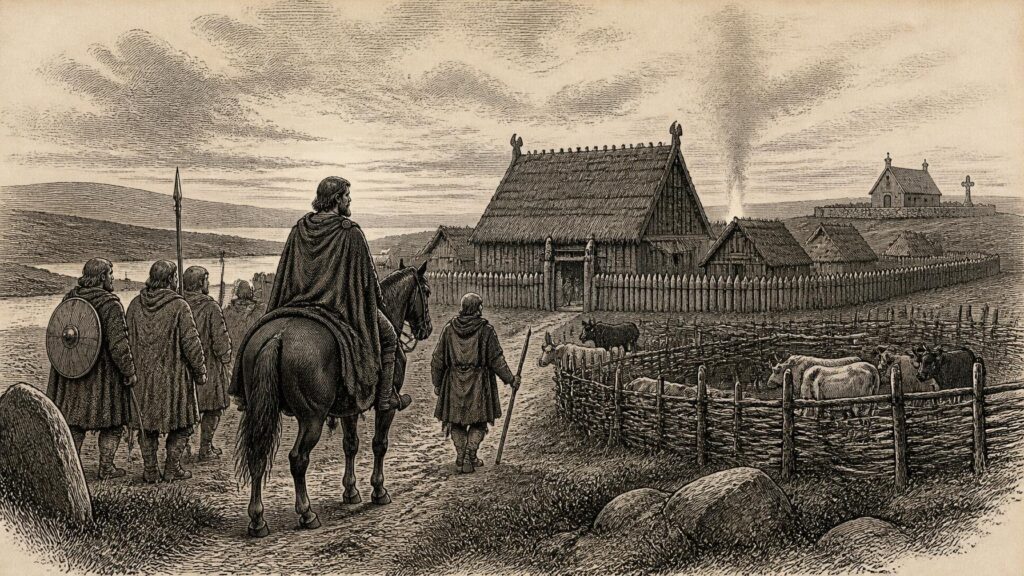
The combination of victims reveals how closely political and religious authority could travel together. Máelchrón ruled Cenél Laegaire, a people of the northern midlands associated with the wider political world of Brega and Tara. Dub Cuilinn’s title, “superior”, marks him as head of an important ecclesiastical community. Their presence beside the high king’s son suggests a party of considerable consequence, though it does not reveal its purpose. Fire was more than an instrument of killing: in a landscape of timber halls, enclosed farmsteads and churches containing valuable books, metals and provisions, it was a weapon capable of destroying shelter, status and stored wealth at once.
Flann Sinna’s Diminished Heirship
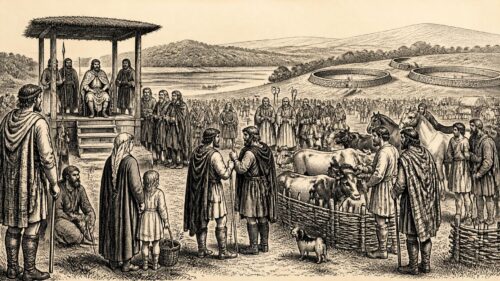
Flann Sinna, Máel Ruanaid’s father, was king of Tara and the foremost overking in Ireland. The later Annals of the Four Masters describes 901 as his twenty-fifth year. That formula should not be mistaken for evidence of a unitary Irish monarchy. Flann’s pre-eminence rested on the strength of Clann Cholmáin in Mide, on relationships with the rulers of Brega and Leinster, and on the difficult business of receiving hostages, tribute and military support. Other provincial kings retained their own ambitions and armed retinues.
Against that background, the title given to Máel Ruanaid is revealing. Irish succession was not simple primogeniture. Several adult men of a royal kindred might be eligible for office, and a designated heir could be challenged, displaced or killed before taking power. Calling Máel Ruanaid heir designate advertised Flann’s hopes for continuity; his death demonstrated their fragility. The loss did not end Flann’s kingship in 901, nor do the annals record an immediate settlement. It did, however, remove the son publicly marked out for the greatest inheritance in Ireland.
The episode also cautions against viewing “high kingship” as distant from local politics. The Luigne were not anonymous outsiders but a people with their own leaders and interests. A royal heir could be overcome by men rooted in a particular territory. Irish politics operated simultaneously at many levels: household and kin-group, local kingdom, province and wider overkingship. The burning of Máel Ruanaid’s party shows these levels colliding with lethal force.
Cormac at Cashel
In the south, the annals record a change of kings at Cashel. Cormac son of Cuilennán succeeded Cenn Gécáin, also called Finnguine. The Annals of Inisfallen describes the new ruler as a noble bishop and a celibate, while Chronicon Scotorum simply records the change of kings. The difference in dating between the sources and modern reconstructions means that the accession should be treated as an event placed in the 901–902 annalistic transition, rather than assigned a day or season in 901.
Even so, Cormac’s emergence is central to understanding the political atmosphere around the year. Cashel was the principal royal centre of the Éoganacht dynasties of Munster. Its kingship carried authority far beyond the limestone height itself, across a web of subject and allied peoples in the south. Cormac was an unusual but not unprecedented figure: a ruler presented in the annals as both cleric and king. His election or acceptance indicates that ecclesiastical standing could reinforce dynastic claims, particularly where succession among royal branches was contested or difficult.
Later tradition made Cormac into one of early medieval Ireland’s exemplary learned rulers. He is credited with Sanas Cormaic, Cormac’s Glossary, a work explaining difficult and archaic words, and possibly with the lost Psalter of Cashel. A poem is attributed to him in the Book of Leinster, and later narratives praise his scholarship, music and piety. None of this allows us to date the composition of a glossary or poem to 901, and the surviving manuscripts are later than Cormac’s lifetime. It does show, however, why his accession was remembered as more than an ordinary dynastic substitution: he embodied the close prestige of learning, Christian discipline and royal rule.
Monasteries, Offices and Memory
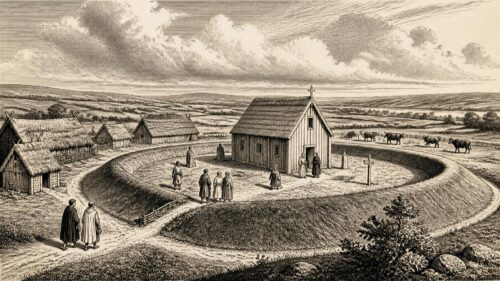
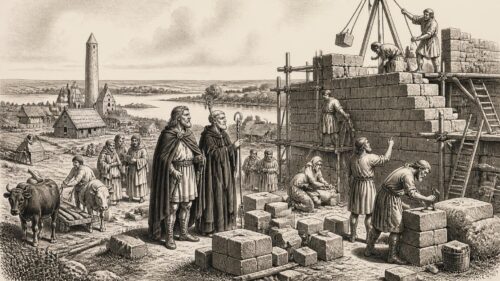
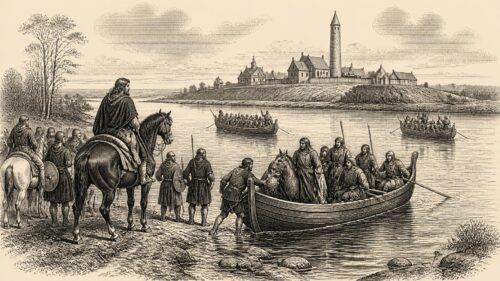
The year’s notices are also a reminder that monasteries were active institutions, not isolated places of prayer. The Annals of Inisfallen records the death of Máel Brigte son of Brolach, abbot of Inis Cathaig, the great island monastery now known as Scattery in the Shannon estuary. The Annals of Ulster records the death of Tipraite son of Nuadu, superior of Condaire and of other monasteries, naming Lann Ela and Lathrach Briúin. Such obituaries preserve a map of ecclesiastical jurisdictions, relationships and resources that stretched across regions.
The Annals of the Four Masters, compiled much later but drawing on older annalistic material, also places the death of Innreachtach son of Dobhailen, abbot of Bangor, on 26 April 901. That exact date should be used cautiously because it comes through a seventeenth-century compilation, but the notice is valuable testimony to Bangor’s continued standing. The same compilation names the deaths of abbots and priors at Sruthair Guaire, Cill Achaidh and Achadh Bó Cainnigh. Offices such as abbot, prior and superior were positions of practical as well as spiritual responsibility: they concerned land, tenants, food renders, cattle, hospitality, teaching and the custody of books and sacred objects.
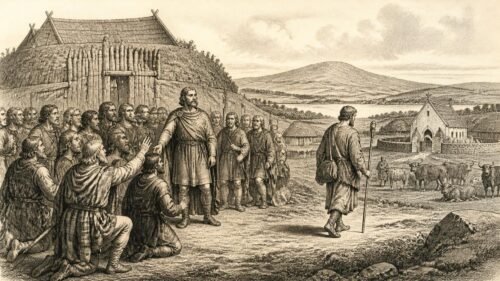
For ordinary people, the annals offer few individual voices. Most lived in rural settlements, raising cattle, sheep and pigs, cultivating cereals, maintaining houses and enclosures, and owing labour or renders to secular lords and ecclesiastical communities. Archaeology and early Irish legal material indicate an economy in which livestock was a major measure of wealth, while cereal production and milling had increasing importance. A killing such as Máel Ruanaid’s could therefore disturb more than a royal family: movements of armed men required food, animals and transport, while the destruction of a house could erase stores and displace dependants.
What Cannot Be Put in 901
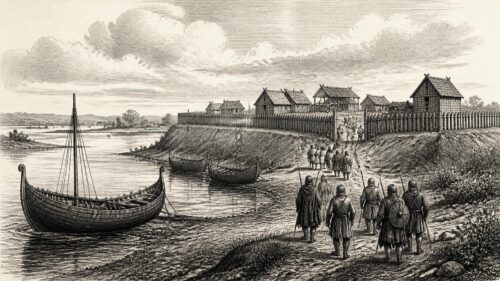
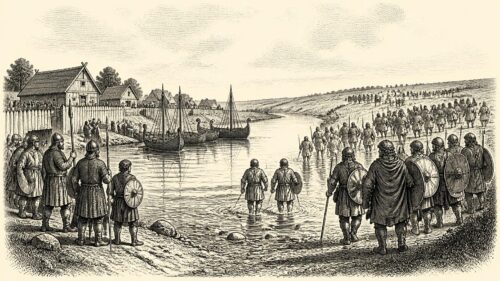
Restraint is especially necessary regarding the Vikings of Dublin. A famous annalistic notice says that the “heathens” were driven from Áth Cliath by Máel Finnia of Brega and Cerball of Leinster. But the Annals of Ulster place it under 902, with an “901 alias 902” heading, whereas the Annals of the Four Masters assigns a comparable event to 897. It should not be presented as a securely dated occurrence of calendar year 901. Dublin nevertheless remained an important nearby power and seaborne connection in the Irish Sea world; the uncertainty itself illustrates the hazards of converting annal headings into exact modern dates.
There is likewise no securely dated annalistic notice of famine, epidemic, exceptional weather, major construction or overseas diplomacy for this calendar year. Silence does not mean such conditions were absent. It means that the surviving record does not responsibly allow them to be claimed for 901. What can be seen clearly is a political order in which a high king’s nominated heir could be burned to death by regional opponents, while a bishop-king’s rise at Cashel opened a new and consequential phase in Munster. In that narrow but revealing frame, 901 was a year when succession looked both sacred and dangerously insecure.
Primary Sources
- The Annals of Ulster, Year U901
- The Annals of Ulster, Year U902
- Annals of Inisfallen, Annals AI900–AI909
- Annals of the Four Masters, Annals M897–M902
- Chronicon Scotorum
- Cormac
- Flann Sinna
- Fragmentary Annals of Ireland, Part 22
- Cormac mac Cuilennáin of Cashel
- Part 5 of Book of Leinster, Formerly Lebar na Núachongbála
- Cormac mac Cuillenáin and the Jesters
- Early Medieval
- Early Christian Monasteries
- Churches and Ecclesiastical Enclosures
- The Rock of Cashel
- The Economy of Early Medieval Ireland
- Agriculture, Settlement and Society in Early Medieval Ireland
- Residence, Ritual and Rulership: A State-of-the-Art for Royal Places in Early Medieval Ireland
- Making Provincial Kingship in Early Medieval Ireland: Cashel and the Creation of Munster
- The Practice of Irish Kingship in the Central Middle Ages
- Kingship, Society, and Sacrality: Rank, Power, and Ideology in Early Medieval Ireland