Ímar’s Son at Lismore883 CE
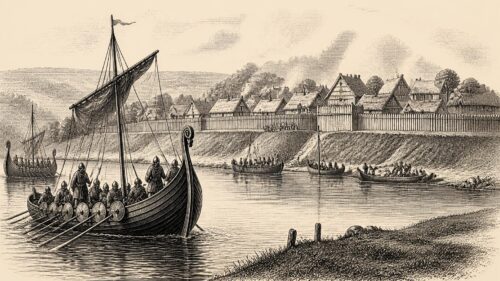
In 883, Les Mór (Lismore), an important Munster monastery on the Blackwater, was burned by an unnamed son of Ímar, illustrating the reach of Scandinavian dynastic violence beyond coastal centres. The annals provide no details of casualties, damage or motive, but the attack threatened a community dependent on religious prestige, land, stores and local support. Elsewhere, Eochucán of Ulaid was killed, Aengus, heir designate of the North, was beheaded, and rulers in Brega and Meath died or were slain. Deaths of bishops at Armagh and Lusca also mattered. These fragmentary records depict contested local kingship, interconnected Irish-Scandinavian politics, and insecurity.
Dateline
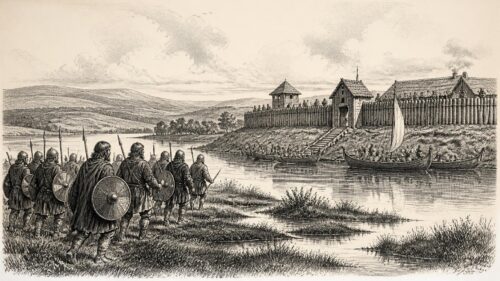
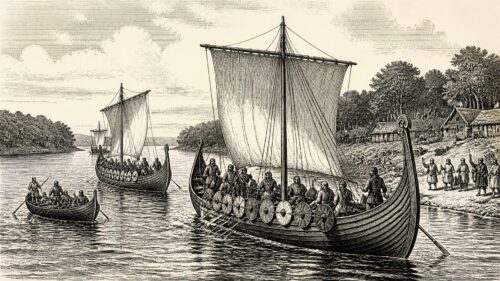
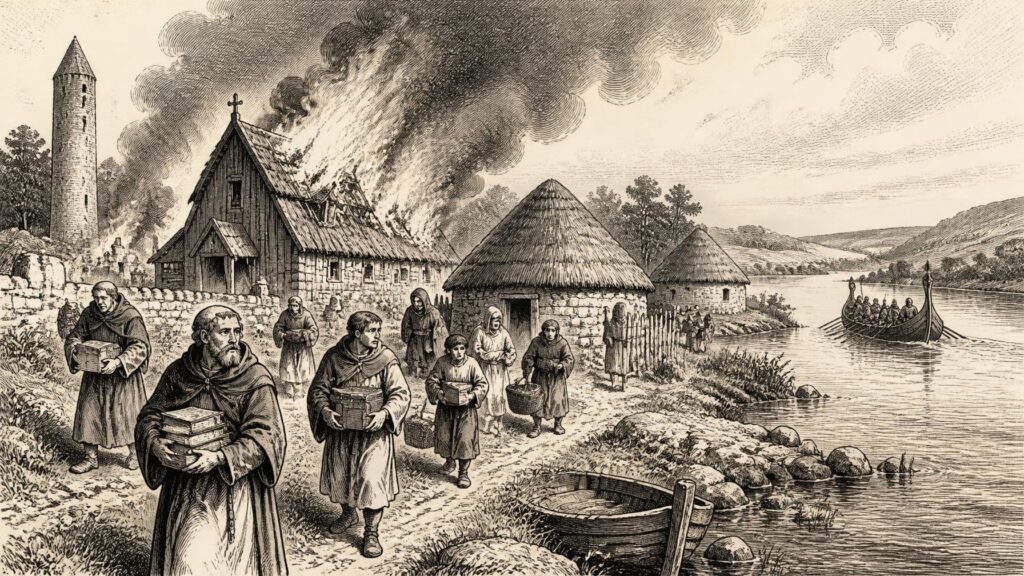
In 883, the sharpest recorded blow in Ireland fell on the Munster monastery of Les Mór, modern Lismore, on the River Blackwater. The Annals of Inisfallen record simply that it was burned by “the son of Ímar”. The brevity is striking. It supplies neither the raider’s personal name nor the scale of loss, the season, the route taken, or the fate of the community. Yet the notice is important precisely because Les Mór was not an isolated church: it was a long-established ecclesiastical settlement in the Déisi, with religious authority, landed resources and learned associations. Its burning shows that Scandinavian dynastic violence could reach well beyond the eastern seaboard and Dublin’s immediate hinterland.
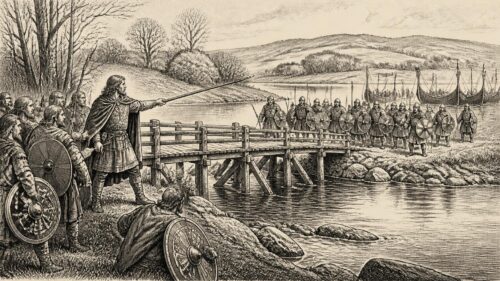
The year also exposes insecurity elsewhere. Annalistic entries conventionally placed under 883 report killings among the Ulaid in the north-east, the execution of a northern heir, deaths among rulers in Brega and Meath, and a murder involving people identified with both Scandinavian and Irish political worlds. The evidence does not describe a single campaign or island-wide crisis. Rather, it presents a fractured political landscape in which monasteries, royal kindreds and regional peoples faced separate but overlapping contests for wealth, status and survival.
Dating a Difficult Year
Irish annals are indispensable for 883, but they must be read with care. The Annals of Inisfallen place the burning of Les Mór under their annal for 883. The Chronicon Scotorum also has a coherent group of notices under 883, including the killing of Eochucán, one of the kings of Ulaid, and the death of Cathasach, superior and bishop of Armagh. The Annals of Ulster preserve much the same cluster, but their heading at this point carries a one-year chronological displacement: entries conventionally cited as U883 appear beneath a rubric which gives AD 882, while its following heading gives AD 883.
This is not a reason to discard the notices, but it is a reason not to attach invented days or months to them. The events discussed here belong responsibly to the annalistic year normally called 883, not to a precisely reconstructable modern calendar. A further warning comes from the much later Annals of the Four Masters, which place a raid on Kildare and the seizure of 280 people under 883. Earlier annalistic evidence assigns that episode to 886. It therefore cannot safely be treated as an event of 883, however vivid its later dating may be.
The Burning of Les Mór
The destruction of Les Mór is the year’s clearest event in Munster. The annalist’s phrasing, “the burning”, is stark and does not permit a fuller invented narrative. We do not know whether the attackers burned a church, domestic buildings, storehouses, an outer settlement, or more than one part of the complex. Nor does the entry state that people were killed or captured. Those silences matter. A burned monastery should not automatically be turned into a massacre.
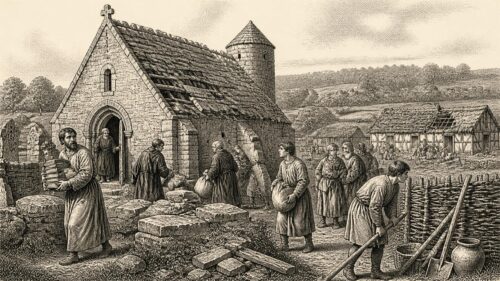
Even so, fire was a grave assault on a religious community. Lismore had been founded in the seventh century by Carthach, or Mochuta, after his departure from Rahan. It occupied a valuable position on the Blackwater in what is now west County Waterford, and had developed as a centre of ecclesiastical life and learning. Earlier Irish scholarship and canon-law have associations with Lismore, while a monastic settlement also depended upon cultivated land, livestock, rents, food stores, artisans and dependent households. A fire could therefore imperil worship, books, metalwork, shelter, winter provisions and the resources needed to sustain the community.
The choice of target was not accidental in any simple sense of monasteries being undefended treasure houses. Churches concentrated portable wealth, food and political influence, but they were also embedded in local lordship. An attack on Les Mór could damage the Déisi and the wider Munster world as well as the saint’s household. The annal does not identify an Irish ally, local guide or opponent, so none should be supplied. It does, however, reveal how an attack by a Scandinavian leader could affect a major inland-connected religious centre in the south.
Les Mór had suffered before. Annalistic notices record Viking attacks there in the earlier ninth century, including a burning in 833. The 883 assault was thus not the beginning of Scandinavian contact with the monastery, but another episode in a long and changing relationship between Irish ecclesiastical centres and maritime raiders. Repetition did not make such attacks routine for those who lived through them: rebuilding, replacing property and restoring the settlement’s authority would have demanded labour and local support.
Ímar’s Unnamed Son
The assailant is named only through his father. Ímar, who died in 873, had been a joint ruler among the Scandinavians of Dublin and one of the most formidable figures in the Irish Sea world of the mid-ninth century. His career joined warfare in Ireland with campaigns in Britain and Scotland. By 883 he had been dead for a decade, but his descendants and associates remained potent. The anonymous “son of Ímar” who burned Les Mór demonstrates that dynastic identity still carried political force.
It would be wrong, however, to imagine a settled, unified Viking kingdom directing every action from Dublin. The sources do not name this son, his ships, his followers or his base. Nor do they say that he was king of Dublin. The late ninth century was marked by competition within Scandinavian leadership as well as by dealings with Irish rulers. Raiding could provide immediate wealth and prestige in such a competitive environment; it could also announce a claimant’s continuing capacity to command men and ships. That is a plausible setting for the assault, but it remains context rather than a stated motive.
Another entry conventionally assigned to 883 makes the entanglement clearer. The Annals of Ulster and Chronicon Scotorum record the death of a son of Auisle at the hands of Óttar son of Iergne and Muirgel daughter of Máel Sechnaill. Auisle had been one of the leading Scandinavian figures active in Ireland during the 850s and 860s. The victim’s own name is not preserved, and the brief notice does not explain the circumstances. Yet it records an act of violence involving a Scandinavian lineage, a man with a Norse name and an Irishwoman explicitly identified through a major Irish royal name. It is a small but valuable corrective to any picture of two sealed communities, “Irish” and “Viking”, confronting one another without personal or political connections.
Killings in the North-East
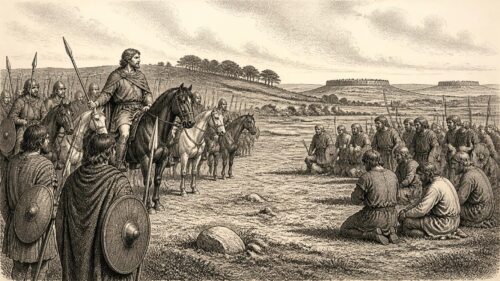
The northern notices of 883 are equally severe. Eochucán son of Áed, described as one of two kings of Ulaid, was killed by the sons of Ainfíth son of Áed. This was not a conflict between a simple kingdom and outsiders. Ulaid was a region and a kingship in which rival kindreds exercised power, and joint or competing kingship could reflect that political reality. The killing of Eochucán by the sons of another leading figure points to a contest within the north-eastern ruling order.
The same annalistic year records that Aengus son of Máel Dúin, “heir designate of the North”, was beheaded by the Dál Araidi. The wording gives Aengus an elevated standing, but does not explain his immediate claim, where he was captured, or what provoked the killing. Beheading was an emphatic public form of execution, and the loss of an heir could alter the calculations of many families dependent on a prospective ruler. The Dál Araidi were themselves a major political people of Ulster, not a marginal force. The entry therefore signals conflict among powerful northern interests rather than a peripheral disturbance.
Other short notices reinforce the impression of instability across the central and eastern regions. Cumuscach son of Domnall, king of Cenél Loegaire, died; Ainfíth son of Mugrón, king of the Mugdorna of Brega, was killed; and Braen son of Tigernach was slain by Ainfíth son of Gairbíth. The annals rarely pause to explain the consequences of such deaths, but kingship in Ireland was exercised through kin groups, client relationships, tribute and control of territory. The removal of a ruler or royal claimant could quickly produce further bargaining, retaliation or succession disputes.
Armagh, Lusca and the Rural Majority
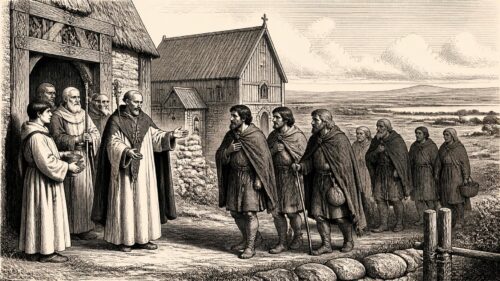
Not every entry for 883 concerns violent death. Cathasach son of Robartach, superior and bishop of Armagh, died or “rested”, as the annals phrase it. Armagh was the foremost church of Patrick and a centre of religious prestige reaching far beyond its immediate territory. Cathasach’s death meant a change in leadership at an institution that combined spiritual authority with property, learning and political influence. Máel Ruáin, bishop of Lusca in north County Dublin, also died. Such notices are reminders that episcopal and monastic offices were woven into the governance of early medieval Ireland, rather than standing apart from it.
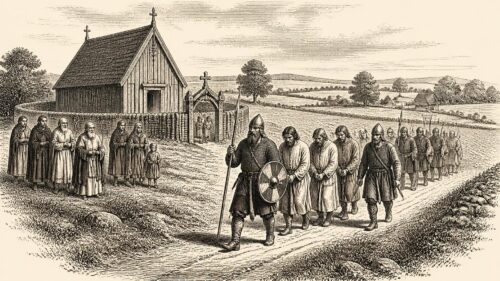
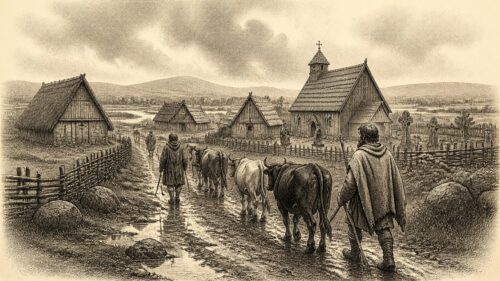
For most people, however, 883 was lived in a predominantly rural world of farmsteads, fields, pasture, mills and local routes. Archaeology shows an economy based on both livestock and crops, with cattle, sheep, pigs, dairying, grain processing and textile work shaping household labour. A monastery such as Lismore belonged to that landscape: its survival depended on food, labour, transport and the contributions of surrounding communities. The annals do not tell us what harvest was gathered in 883, nor do they describe ordinary families by name. They do show how warfare could intrude upon their world—through the burning of a major settlement, the death of local rulers and the insecurity created by rival armed followings.
A Year of Connected Vulnerability
The record for 883 does not justify a grand claim that Ireland was collapsing under Scandinavian attack. Nor does it support a comforting story in which Irish politics and Viking affairs were separate. Les Mór’s burning, the killing of Auisle’s son, the deaths in Ulaid and the succession losses in Brega and Meath instead show a country of many powers. Maritime raiders could strike a Munster monastery; Scandinavian and Irish names could appear together in a killing; and regional dynasties could destroy their own rivals with ruthless finality.
What survives is fragmentary, but its pattern is unmistakable. Religious communities remained central to wealth, memory and authority, making them consequential targets. Kingship remained local and contested, even beneath the wider claims of Flann Sinna, king of Tara. And the Irish Sea world was already binding Ireland to Scandinavian, British and northern Atlantic politics. In 883, the flames at Les Mór offer the year’s most vivid image, but the annals reveal a wider landscape in which no major community could assume that distance, sacred status or inherited rank guaranteed security.
Primary Sources
- Annals of Inisfallen
- The Annals of Ulster
- Chronicon Scotorum
- Annals of the Four Masters, Part 71
- Vikings in Irish Chronicles, 794–902: Data
- Ímar (Ívaar)
- Flann Sinna
- Carthach (Mochuta)
- Church-Raiding and Politics in the Era of Amlaíb and Ímar
- Church-Raiding and Politics in the Later Ninth Century
- Ireland in the Viking Age
- Woodstown in the Irish Annals
- The Longphort Phenomenon in Early Christian and Viking Ireland
- The Viking Slave Trade: Entrepreneurs or Heathen Slavers?
- Early Medieval Ireland: Archaeological Excavations, 1930–2009
- The Archaeology of Livestock and Cereal Production in Early Medieval Ireland, AD 400–1100
- The Economy of Early Medieval Ireland
- Early Christian Monasteries
- Early Irish Population-Groups: Their Nomenclature, Classification, and Chronology, Part 3
- TEI Header for The Annals of Ulster