Colum Cille’s Refuge Shrine878 CE
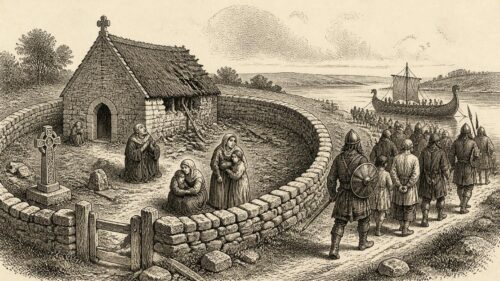
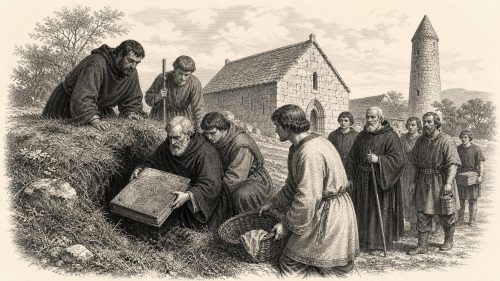
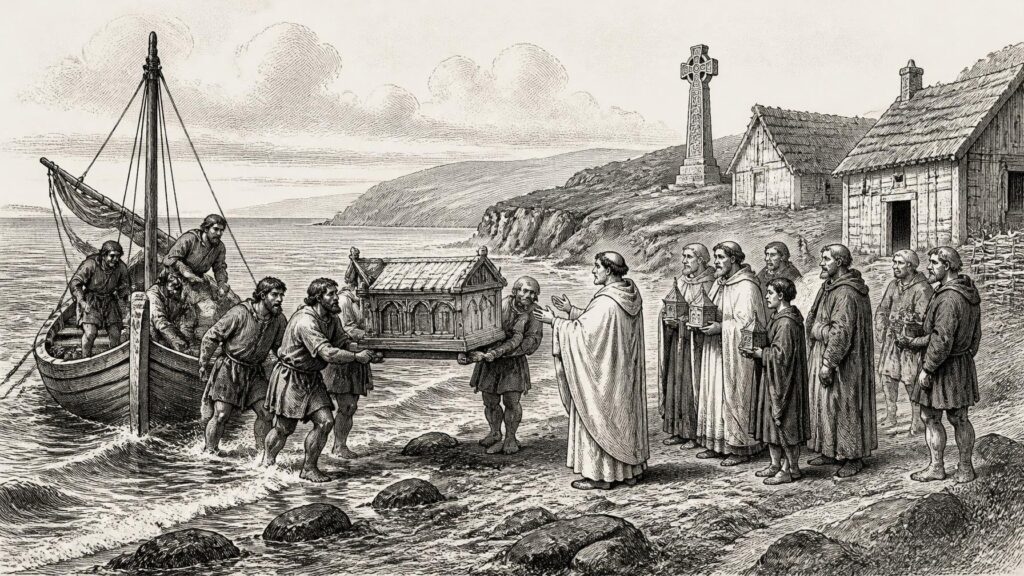
In 878, whose annalistic dating requires caution, Ireland experienced local political instability, disrupted public ceremony, unusual weather reports and significant religious refuge. Gairbíth of Conaille and Cumuscach of Uí Chremthainn were killed in northern conflicts, while Congal of Ciarraige Luachra died in Munster. Tailtiu’s major fair was cancelled without stated justification, signalling a failure of collective order and lost opportunities for trade and negotiation. Annals recorded a great wind, lightning, supposed blood-rain, and lunar and solar eclipses in October. Most notably, Colum Cille’s shrine and relics reached Ireland, removed from danger posed by Scandinavian foreigners, affirming Columban resilience and continuity.
Dateline
In 878, Ireland’s annalists registered a striking mixture of local violence, interrupted public life, extraordinary weather and celestial events, and one moment of profound religious significance: the arrival in Ireland of the shrine of Colum Cille, together with his other sacred relics, brought in flight from “the foreigners”. The entries are brief, as annals usually are, but their combination gives the year an unusual emotional texture. Authority was contested in the north-east; a great gathering at Tailtiu failed to take place; people witnessed—or were told that they had witnessed—portentous phenomena in earth and sky; and the most revered portable objects of the Columban community crossed the sea to safety.
A Year With Difficult Dates
The chronology needs handling with care. Medieval Irish annals survive in later manuscripts and employ systems of year-reckoning that do not always align neatly with modern calendar dating. The entry conventionally labelled 878 in the Annals of Ulster carries an internal AD heading of 877, yet its paired eclipses are securely tied to 15 and 29 October 878. This makes the calendar year 878 a responsible frame for the events discussed here. The Annals of Inisfallen, meanwhile, place the death of Congal son of Lachtnán, king of Ciarraige Luachra, under 878. Where an annal provides no day or season, none should be invented.
Killings in the Northern Kingdoms
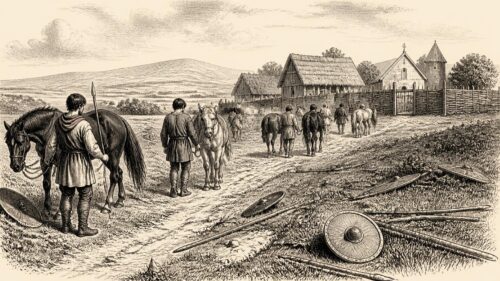
Two political killings recorded in the Annals of Ulster reveal the fragility of lordship in northern Ireland. Gairbíth son of Máel Brigte, king of Conaille, was beheaded by the Uí Echach. Cumuscach son of Muiredach, king of Uí Chremthainn, was killed by the Ulaid. Neither notice supplies a battle site, the immediate cause, or the succession that followed. Their spareness is itself instructive: violence between neighbouring peoples and dynasties was sufficiently familiar to be entered as fact without explanation.
Conaille lay in the politically crowded north-eastern zone around the later county of Louth, while Uí Chremthainn was an Airgíalla people whose territory lay further inland, in the region of later Monaghan and adjacent districts. The Ulaid, centred in eastern Ulster, were not a single modern-style state but a constellation of rulers and client groups. The deaths of Gairbíth and Cumuscach therefore belong to a landscape in which boundaries, tribute, kinship and military followings were continually negotiated. A king’s death could mean far more than the loss of one man: it opened claims to land, hostages, revenues and the loyalty of churches and secular dependants.
The deaths should not be inflated into evidence for an island-wide war. They were local affairs, but local affairs mattered greatly in a country without a single permanent royal administration. The overkings of the great dynasties could demand submission and lead hostings, yet day-to-day power rested in many smaller kingdoms. In 878, the annals show that the northern political map remained combustible even when the surviving record preserves no great campaign.
A Munster King’s Death
The Annals of Inisfallen add a southern notice: Congal son of Lachtnán, king of Ciarraige Luachra, died. Ciarraige Luachra was a Munster kingdom associated with the western and north-western reaches of modern County Kerry and its hinterland. The entry does not say whether Congal died peacefully, nor does it name his successor. Nevertheless, it reminds us that kingship was intensely local throughout Ireland. The political story of 878 was not confined to the better-recorded northern dynasties or to the Scandinavian coastal settlements. Rulers of smaller Irish peoples remained central to the organisation of land, military service and status in their own districts.
For ordinary households, these successions were unlikely to be abstract matters. Kings and their leading kindreds collected food-rents and renders in cattle, grain, dairy produce and labour; they also offered, or were expected to offer, protection, judgement and hospitality. A change of ruler could alter the immediate demands placed upon tenants and clients, as well as the safety of roads and grazing lands. The sources do not tell us how Ciarraige Luachra experienced Congal’s death, but they do preserve the fact that his kingship was important enough to be recorded.
Tailtiu Without Its Fair
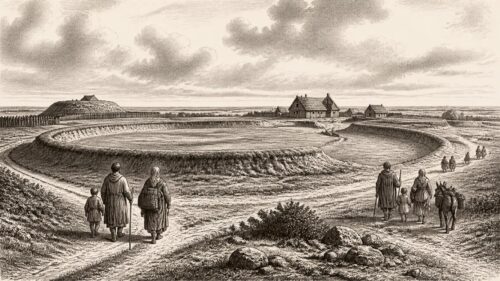
One of the year’s most revealing notices is not a battle or a death but an absence. The fair, or óenach, of Tailtiu was not held, “although there was no just and worthy reason for this”. Tailtiu, near modern Teltown in County Meath, was among the most celebrated assembly sites in Ireland. Such an occasion was more than a market. It brought together elites and wider communities for political display, legal business, marriage negotiations, contests, racing, hospitality and exchange. Its association with the kingship of Tara gave it particular ideological weight.
The annalist’s complaint suggests that the cancellation was seen as a public failure rather than an unavoidable response to invasion, famine or epidemic. Yet the text does not identify who prevented it, and it would be wrong to attach the failure to a named king or faction. The important point is that the normal performance of collective order did not occur. In a society where authority was enacted through assemblies as much as through written commands, a missed óenach could be read as a visible lapse in kingship and social concord.
Its economic consequences are harder to measure but should not be ignored. Seasonal gatherings gave people opportunities to barter animals, foodstuffs, tools, cloth and prestige goods, and to make relationships that extended beyond a single túath or petty kingdom. The failure of Tailtiu therefore meant the loss of a major meeting-place as well as a ceremonial disappointment. It offers a rare glimpse of how political weakness could touch travel, trade and the rhythms of communal life.
Wind, Blood and Eclipses
The same annal records a great wind and lightning, followed by what it calls a shower of blood: clots of gore and blood were said to have been found in the fields. This is a report of perception and interpretation, not evidence that blood literally fell from the sky. Medieval observers could describe unusual deposits, coloured rain, storm damage or other alarming phenomena in language shaped by religious expectation. The annalist preserved the event because it seemed extraordinary and meaningful. We cannot now identify the natural cause from the wording alone.
The astronomical notices are firmer. A lunar eclipse was observed on 15 October, at about the third watch of the night, followed fifteen days later by a solar eclipse on 29 October, around the seventh hour of daylight. The precision is remarkable. It shows that learned ecclesiastical observers retained an interest in calculation, lunar age and the ordering of the calendar—skills bound up with the computus used to establish Easter. The sequence also gave contemporaries a dramatic frame for the year. To modern readers, eclipses are predictable alignments of sun, moon and earth; to many ninth-century viewers, they could also be signs demanding moral or political reflection.
The storm, the reported blood-rain and the eclipses need not have been physically connected. The annal does not say that they were. But their placement together demonstrates how a chronicle could join weather, marvel and celestial order into a record of a troubled time. Natural events were part of history because they affected fields, travel and buildings, but also because they were interpreted through a Christian understanding of providence.
The Columban Treasure Reaches Ireland
The most consequential religious event of 878 was the arrival in Ireland of the shrine of Colum Cille and his other minna, or holy objects, fleeing the foreigners. Colum Cille, known in Latin as Columba, was one of the foremost saints of the Irish and Gaelic world. His monastic federation linked churches in Ireland with Iona and communities in what is now Scotland. A shrine was not simply a container. It made the saint’s continuing presence tangible, concentrated claims to spiritual authority and could be carried in ritual, diplomacy and crisis.
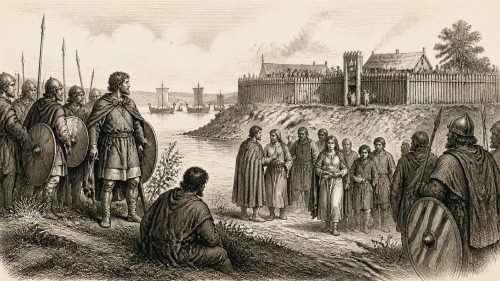
The annal does not name the ship, the route, the Irish destination or the particular raiding force that prompted the removal. Nor does it explicitly state that the shrine came directly from Iona, even though the event is closely connected by modern scholarship with the Columban world across the North Channel. What can be said securely is that ecclesiastical leaders judged their portable sacred treasures too vulnerable to leave where they were. The “foreigners” of the annalistic vocabulary normally denotes Scandinavian raiders and settlers, but the entry records flight rather than a specific attack.
That distinction matters. Viking activity did not erase Christian institutions, nor did every Scandinavian group act in the same way. Iona itself continued to matter after earlier raids. Yet the movement of Colum Cille’s shrine shows that danger remained real enough to alter the geography of devotion. Relics, books, precious metalwork and trained personnel were movable assets. Their removal protected material wealth, certainly, but also protected a community’s memory, reputation and ability to claim the saint’s favour.
For Ireland, the arrival renewed the island’s role as a refuge and centre of the Columban familia. It also brought an object of exceptional symbolic power into an Irish political environment already marked by disputed lordships and the failure of Tailtiu’s assembly. The year’s notices do not form a single narrative of collapse. Rather, they show a society in which violence, religious resilience, learned observation and long-established institutions continued together. In 878, the shrine’s sea crossing gave that resilience its most memorable form.
Primary Sources
- The Annals of Ulster: Year U878
- The Annals of Ulster
- Annals of Inisfallen: Part 5, Including Annal I878
- Annals of Inisfallen
- Annals of the Four Masters
- Fragmentary Annals of Ireland
- Vikings in Irish Chronicles, 794–902: Data
- Vikings in Ireland and Scotland
- Iona and the Shrine of Columba, c. 800–1200
- Iona and the Shrine of Columba, c. 800–1200 (PDF)
- A New Jerusalem ‘At the Ends of the Earth’: Interpreting Charles Thomas’s Excavations at Iona Abbey 1956–63
- From Kingdom to Colony: Framing the English Conquest of Ireland
- The Cultural Practice of Assembly Among Medieval Gaelic Peoples of Ireland
- Identity, Exemplarity and the Ideal King in Early Medieval Ireland
- Home Page for Dr Daniel P. McCarthy
- Chronological Synchronisation of the Irish Annals
- The Dating of the Irish Annals
- The Chronology and Sources of the Early Irish Annals
- The Chronological Apparatus of the Annals of Ulster AD 82–1019
- The Irish Annals: Their Genesis, Evolution and History
- Annals of Inisfallen to Go on Public Display in University College Cork
- Exploring the Irish Annals