
Gofraid Expelled from Dublin1094 CE
In 1094 Muirchertach Ua Briain, king of Munster, recovered influence across Ireland amid rivalry with Domnall Ua Lochlainn. After campaigning involving Dublin, Meath, Leinster and northern forces, he expelled Gofraid Méránach, probably Godred Crovan, from Dublin, securing its maritime wealth. Domnall Ua Máel Sechlainn of Meath was killed and Muirchertach divided Meath between dependent rivals. His authority nevertheless met limits: Connacht’s Síl Muiredaig defeated Munster-backed forces at Fidnach, and one expedition failed to obtain hostages. Armagh’s abbot visited Munster successfully, while violence, severe weather and scarcity compounded disruption. Dublin’s trade and crafts endured. The year redistributed power without unifying Ireland.
Dateline
The year was a turning point in the recovery of Muirchertach Ua Briain, king of Munster, from earlier reverses. His campaigns altered the leadership of Dublin and Meath, while conflict in Connacht and Ulster showed how far Ireland remained divided among competing dynasties. The annals provide unusually substantial coverage, but they were written from different regional viewpoints and sometimes compress several stages of a campaign into a single entry. Their agreement on the principal developments is therefore more reliable than every detail of their narratives.
A Contested High-Kingship
Ireland had no single monarch exercising uniform government over the island. Powerful provincial rulers sought tribute, hostages and military service from lesser kings, and claims to the high-kingship depended upon repeatedly demonstrating superiority. Muirchertach, a great-grandson of Brian Bóruma, commanded Munster and could normally draw support from Leinster and Osraige. His principal rival was Domnall Ua Lochlainn, king of Ailech and leader of the northern Cenél nEógain. Meath, Connacht, Ulaid and Dublin were not passive territories between them: each possessed rulers and factions capable of shifting the balance.
Muirchertach had previously suffered setbacks at the hands of Domnall Ua Lochlainn and had struggled to secure Connacht. By 1094, however, he was again able to operate far beyond Munster. His authority remained personal and negotiated rather than administrative. Armies, fleets, hostages, tribute and the installation of dependent kings were the working instruments of power.
The Struggle for Dublin
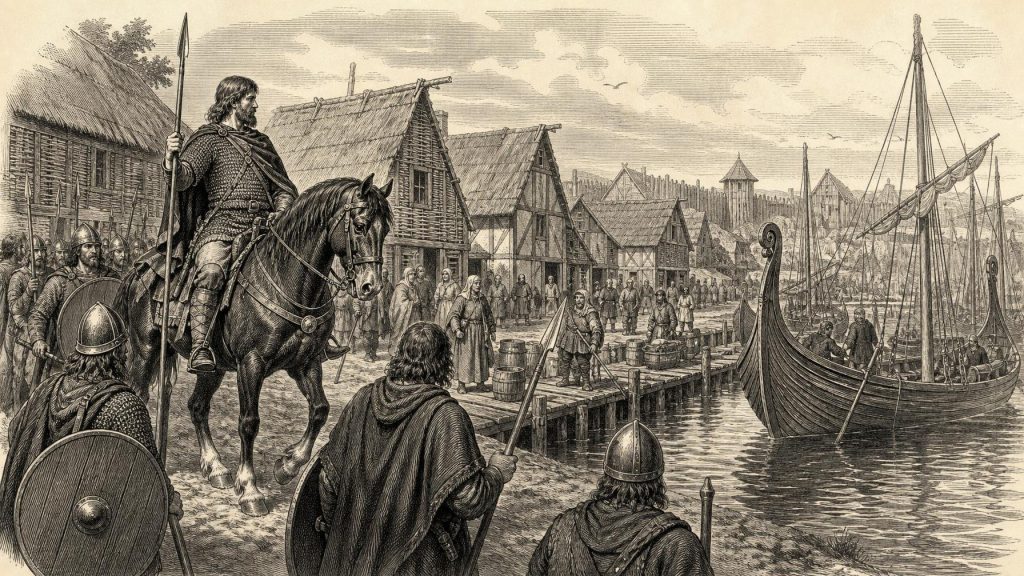
The most consequential events centred upon Dublin. The city was ruled by Gofraid Méránach, generally identified with Godred Crovan, king of Man and the Isles. Gofraid’s position connected Dublin to the wider Norse-Gaelic world of the Irish Sea. Control of the city offered much more than prestige: Dublin possessed ships, skilled fighting men, commercial wealth and contacts extending to Britain and beyond.
The fullest account, preserved by the later Annals of the Four Masters, describes a remarkable gathering at Dublin. Muirchertach arrived with Munstermen, Leinstermen and the forces of Osraige. Domnall Ua Lochlainn came with Cenél nEógain and Cenél Conaill, while Domnall Ua Máel Sechlainn brought the men of Meath, Donnchad Ua hEochada led the Ulaid, and Gofraid supposedly contributed ninety ships. The combined forces moved into Leinster, burned Uachtar Ard and put Muirchertach’s southern allies to flight without a major slaughter. The coalition then fragmented: the Ulaid departed rather than participate in the plundering of Leinster.
What followed is more securely attested across the annalistic traditions. Muirchertach returned to Dublin and expelled Gofraid from its kingship. The Annals of Inisfallen present the year as one of extensive warfare between Ua Briain, the northern half of Ireland and Gofraid. Whatever the precise sequence, the outcome was decisive. Dublin was detached from Gofraid’s maritime kingdom and brought back under Ua Briain influence. Muirchertach’s hold would still require maintenance, but the city increasingly became one of the principal bases of his power.
Meath Divided
The Dublin struggle was closely connected to upheaval in Meath. Domnall son of Flann Ua Máel Sechlainn, king of Meath and claimant to the prestigious kingship of Tara, was deposed and killed during the year’s campaigns. The sources differ over responsibility. Some concise entries associate his death directly with Muirchertach’s expedition. The fuller narrative says that, after being driven into Airgíalla, Domnall returned with a small following, seized cattle in eastern Meath and was overtaken near Loch Léibinn. Members of his own side, including the Luigne, then killed him. Muirchertach created the circumstances of his fall, but the exact manner of his death reflects local betrayal as well as external conquest.
Meath was subsequently divided between two Ua Máel Sechlainn rivals, Donnchad and Conchobar. The Annals of Inisfallen describe a Munster siege in Mag Léna, widespread burning and the displacement of communities from western Meath and Tethba before both new rulers gave hostages to Muirchertach. Such language may magnify devastation, but the partition itself is recorded by several chronicles. By supporting competing kings, Muirchertach weakened Meath’s capacity for united resistance while avoiding the impossible task of governing it directly.
Connacht’s Counterstroke
Muirchertach also campaigned in Connacht, although one expedition returned without obtaining hostages. This failure demonstrates the limits of his apparent ascendancy. The Síl Muiredaig, the leading Ua Conchobair kindred, had been attacked and displaced by him in the previous year, but they rapidly reasserted themselves.
At the battle of Fidnach, Tadc son of Ruaidrí Ua Conchobair and the Síl Muiredaig defeated forces drawn from Thomond, Corcomroe and western Connacht, including supporters of Ua Flaithbertaig. The annals report about three hundred dead and name several fallen nobles, though medieval casualty totals should be treated cautiously. The victors then plundered western Connacht. Fidnach was not simply a local encounter: it frustrated Munster influence in the west and confirmed Tadc as an important leader. Connacht remained divided, but it was not subdued.
Armagh’s Southern Visitation
A major ecclesiastical event was the first visitation of Munster by Domnall son of Amalgaid, the abbot of Armagh and successor of Patrick. The Annals of Ulster state that he received his full fixed tribute together with voluntary offerings. This circuit represented far more than a fundraising journey. The reception of Patrick’s successor acknowledged Armagh’s exceptional standing among Irish churches and required cooperation from kings, church communities and local elites.
Domnall belonged to Clann Sínaig, the ecclesiastical family that dominated Armagh’s leadership during this period. His office combined religious authority, inherited institutional influence and a growing diplomatic role. Later in his tenure he repeatedly intervened between Muirchertach and Domnall Ua Lochlainn. His successful circuit in 1094 shows Armagh operating across political boundaries even while its northern allies and the Munster king competed for supremacy. Tribute, hospitality and offerings also reveal that ecclesiastical networks could move resources over long distances despite warfare.
Violence, Weather and Scarcity
Conflict was not confined to the great provincial contest. In Ulaid, King Donnchad Ua hEochada blinded Flaithbertach Ua hAiteidh, ruler of Uí Echach, while the Ulaid inflicted a serious slaughter upon the Airthir. Blinding was a calculated political punishment: bodily perfection was associated with eligibility for kingship, so mutilation could remove a rival without killing him. The records of captured rulers, cattle raids and murdered local chiefs show how national competition interacted with feuds inside individual kingdoms.
The Annals of Ulster and Annals of Loch Cé also record extremely severe weather throughout Ireland, followed by want or scarcity. They do not provide enough information to reconstruct its duration or measure its demographic impact. Nevertheless, the entry deserves weight. Most people lived in dispersed rural settlements and depended upon mixed farming. Cattle supplied milk, meat, hides, status and movable wealth; grain harvests, grazing and winter fodder were equally vulnerable to prolonged rain, cold or storms. Military forces worsened hardship by driving off herds, burning crops and compelling households to feed troops.
Everyday work continued beyond the annalists’ attention. Families tended cattle and pigs, cultivated cereals, spun wool, wove cloth and produced utensils from timber, iron, bone and antler. These are broader conditions documented by archaeology rather than events uniquely dated to 1094. They help explain why the seizure of cows or destruction of a cultivated district could threaten livelihoods as well as enrich a victorious king.
Towns, Trade and Culture
Dublin’s inhabitants occupied timber and wattle houses amid workshops, lanes, waterfront activity and churches. Craftspeople worked iron, bronze, antler, bone, leather and wood, while merchants handled silver, coins and imported goods. Irish society remained overwhelmingly rural, but Dublin, Waterford, Wexford, Cork and Limerick had created permanent urban markets. Silver pennies had been struck in Dublin since the late tenth century, although weighed silver, livestock and payments in kind remained important.
The Hiberno-Norse population of Dublin was Christian and culturally intertwined with its Irish neighbours. Contemporary art combined Irish traditions with Scandinavian Ringerike and Urnes ornament. Churches supported scribes, scholars and metalworkers, but no surviving literary composition can be assigned confidently to this particular year. The safest cultural picture is therefore one of continuing monastic learning and sophisticated craft production amid political disruption.
The Year’s Significance
Muirchertach ended the year stronger than he began it. Gofraid had lost Dublin, Meath had been partitioned under rulers answerable to the Munster king, and Armagh’s visitation confirmed that long-distance institutions could function within his sphere. Yet Fidnach, the failed demand for Connacht hostages and continuing northern resistance prevented any claim of complete conquest. The result was not a united Ireland, but a substantial redistribution of power. From this point, Dublin and much of the midlands became central supports for Muirchertach’s renewed pursuit of the high-kingship.
Primary Sources
- The Annals of Ulster: Year U1094
- Annals of the Four Masters: Annal M1094
- Annals of Inisfallen
- The Annals of Tigernach: Annal T1094
- Chronicon Scotorum: Annal CS1094
- Annals of Loch Cé: Annal LC1094
- Ua Briain, Muirchertach — Dictionary of Irish Biography
- Domnall, Abbot of Armagh — Dictionary of Irish Biography
- Ua Lochlainn (Mac Lochlainn), Domnall — Dictionary of Irish Biography
- Ua Briain, Domnall — Dictionary of Irish Biography
- The Vikings and Ireland
- The Viking Age in Ireland — National Museum of Ireland
- Early Medieval — National Museum of Ireland
- 950–1450: Vikings, Normans and Medieval Mints — National Museum of Ireland
- Wooden Plank with Viking Ship and Weathervane Graffiti — National Museum of Ireland
- An Interesting Point: Antler Working in Medieval Dublin — National Museum of Ireland
- The Irish Kings and the English Invasion
- The Origins of the Lordship of Leinster and the Role of William Marshal: Perceptions and Reality
- The Relic Cult of St Patrick Between the Seventh and the Late Twelfth Centuries in its European Contexts
- St Patrick — Archdiocese of Armagh
- William the Conqueror and Ireland
- The Hand on the Rudder: Murtaugh ‘The Great’ and Irish Naval Power
- Lords of the Isles
- Corpus Inscriptionum Insularum Celticarum, Volume II