Cenn Fáelad’s Last Year872 CE
In 872, Irish annals record deaths, ecclesiastical transitions and an inland winter raid rather than major battles or assemblies. Cenn Fáelad, king of Cashel and abbot of Emly, died after illness, uniting royal and religious authority. Ferdomnach of Clonmacnoise, Gnia of Duleek, and several church leaders also died, highlighting monastic networks of learning, patronage and resources. Mugrón of Connacht and Máel Ruanaid of northern Uí Moccu Uais likewise died. Around 1 February, foreign rulers massacred or raided communities from Trí Maige and Trí Comainn to Slieve Bloom, demonstrating inland vulnerability. The year reveals plural, literate institutions exposed to Scandinavian-led violence.
Dateline
In 872, Ireland’s annals register no island-wide battle and no grand royal assembly. Instead, they preserve a concentrated record of death, religious succession and a winter attack whose victims were people living between the middle reaches of Leinster and the slopes of Slieve Bloom. It was a year in which authority changed hands quietly at great ecclesiastical centres, while violence by the ‘foreigners’ demonstrated that communities away from the principal Viking ports remained vulnerable.
The evidence needs careful handling. Medieval Irish annals did not always use year-numbering that corresponds neatly with the modern calendar, and later compilations sometimes displaced entries by one or more years. For 872, however, the deaths of Cenn Fáelad of Cashel and Ferdomnach of Clonmacnoise are independently placed in this year by the Annals of Inisfallen and the Fragmentary Annals of Ireland, while a cluster of related notices occurs under the equivalent annal-year in the Annals of Ulster and Chronicon Scotorum. The winter raid is explicitly assigned to 872 in the Fragmentary Annals; comparative work on the chronicles supports that modern placement.
A King and Successor of Ailbe
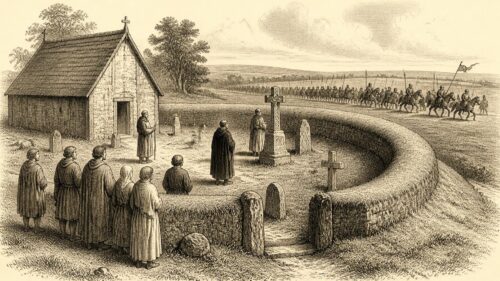
The year’s most revealing death was that of Cenn Fáelad grandson of Muichertach, king of Cashel. The Annals of Ulster add that he died peacefully after prolonged suffering. The Annals of Inisfallen and the Fragmentary Annals give an additional title of unusual importance: he was abbot of Imlech Ibuir, modern Emly, and successor of St Ailbe. In one person, therefore, lay a claim upon the kingship of Cashel and the leadership of a major Munster church.
This was not an accidental combination. In ninth-century Ireland, ecclesiastical office could carry land, dependants, learned personnel, prestige and a saint’s inherited rights. A ‘successor’ or comarba did not merely occupy a spiritual post: he held responsibility for the institutional community associated with its founding saint and could exercise very substantial temporal influence. Cenn Fáelad’s paired identities show how closely royal and ecclesiastical power could be joined in Munster. Yet they should not be mistaken for evidence that Cashel was a centrally governed capital in a modern sense. Its kingship rested on negotiation among competing dynasties, churches and regional rulers.
His background is not wholly secure. Later king-lists and genealogical material have connected him with different branches of the Eóganachta, the wider dynastic grouping that supplied many rulers of Cashel. Modern scholarship has suggested an association with Eóganacht Áine and an ‘Emly faction’, but the pedigree evidence is difficult. The responsible conclusion for 872 is simpler: Cenn Fáelad was recognised by the annalists as both king of Cashel and head of Emly’s church, and his death removed a figure who embodied both forms of authority.
No source securely records, within this calendar year, an immediate and uncontested replacement either at Cashel or Emly. That silence matters. Succession was not necessarily settled at a funeral, and the annals’ brevity should not be filled with invented coronations or crises. Still, the loss of a ruler with ecclesiastical standing must have required practical decisions over estates, tenants, tribute, hospitality, relics and the custody of books and church goods. For families attached to Emly, 872 was not simply the end of a reign; it was a change in the management of a powerful religious household.
Clonmacnoise Without Ferdomnach
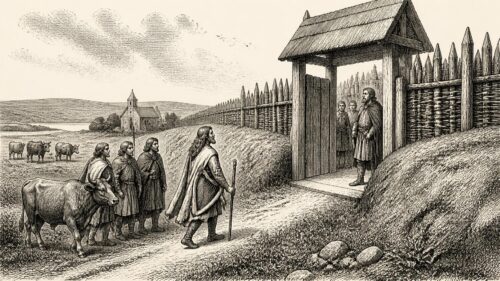
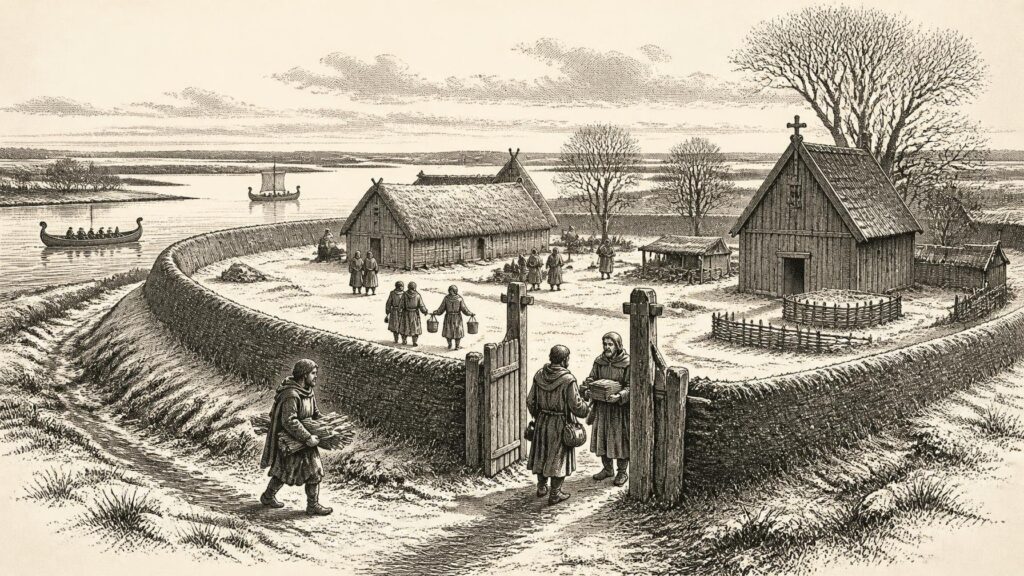
Ferdomnach, abbot of Clonmacnoise, also died in 872. The surviving notices give no story of his career, but the place makes the death significant. Clonmacnoise stood beside the Shannon, where the great north–south waterway met an east–west route along the eskers. It was a religious community, a centre of learning and craftsmanship, a place of pilgrimage and burial, and a settlement with a large lay population as well as clerics. Its timber houses, workshops, storehouses and other domestic buildings have largely vanished, but archaeology and later evidence make clear that it functioned more like a small town than an isolated monastery.
An abbot there oversaw far more than worship. The office was embedded in networks of patronage and travel, and Clonmacnoise’s position near the boundary of Connacht and Mide made it valuable to rulers on both sides of the Shannon. By the ninth century the monastery was aligned particularly with the kings of Mide, but its history and resources gave it wider importance. Ferdomnach’s death therefore touched a community whose river connections brought visitors, goods, news and potential danger through the Irish midlands.
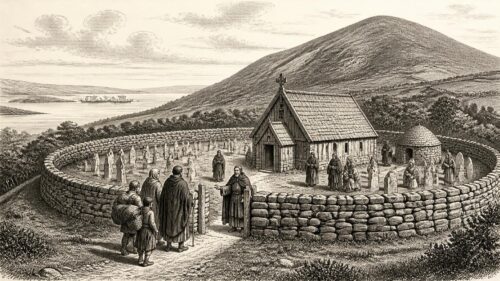
The same year saw the death of Gnia, superior of Dam Liac Cianáin, usually identified with Duleek in the Boyne valley. The annals praise him as bishop, anchorite and excellent scribe; the Fragmentary Annals preserve verses mourning him as Cianán’s successor. Such language is formulaic, but it is still revealing. A senior churchman could be remembered simultaneously for ascetic devotion, episcopal authority and literacy. ‘Scribe’ was a distinction of consequence in a society where trained readers and writers copied liturgical books, maintained legal and genealogical knowledge, and created or preserved annals.
Other obituaries reinforce the point. Loingsech son of Foillén, abbot of Cell Ausaile, and Robartach of Dairmag, described as a scribe, died in the same year. Bishop Máel Tuile, superior of Tuilén, was also commemorated. These names do not allow a detailed reconstruction of ordinary lives, but together they show an island thickly structured by churches of varying scale: communities needing food rents and labour, clerics able to read and write, and leaders whose deaths were important enough to enter historical record.
Winter Violence at Slieve Bloom
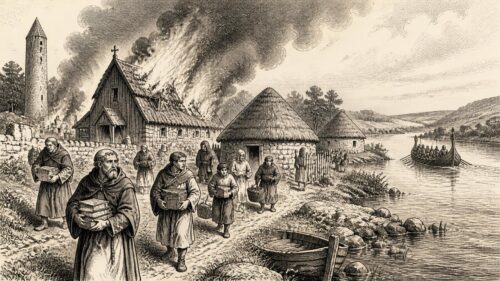
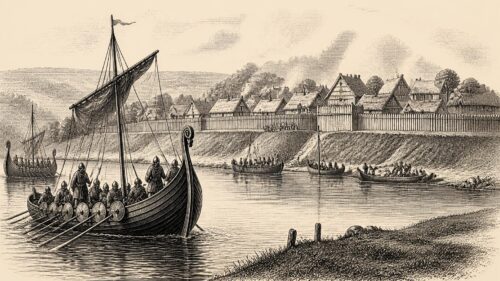
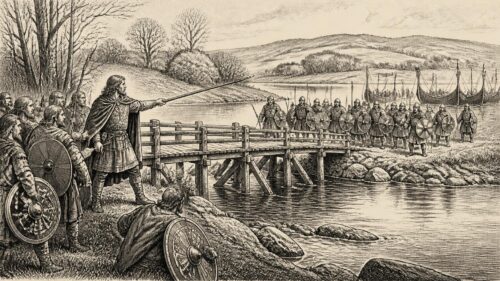
The clearest episode of conflict in 872 occurred in winter. The Fragmentary Annals record a massacre of the people of the Trí Maige and Trí Comainn, extending as far as Slíab Bladma, by the ‘kings of the foreigners’, in snow at the feast of St Brigit. Brigit’s feast falls on 1 February, so the annalist deliberately fixes the assault in a season of cold, difficult travel and short daylight. A later version in the Annals of the Four Masters uses the language of raiding rather than massacre, but both preserve an attack reaching Slieve Bloom.
The geographical names remain problematic. Trí Comainn is generally placed in the Laois region, while Trí Maige may have lain farther east, perhaps in the Carlow area; neither identification is beyond doubt. What can be said is that the raiders operated through a broad central-southern zone rather than at the coast. Slieve Bloom formed a conspicuous upland landmark between territories later associated with Laois and Offaly. The raid thus penetrated communities connected by plains, routeways and livestock economies, not an empty frontier.
The annal does not name the foreign rulers, their base, the number killed, or the precise route of their force. It would be wrong to supply any of these details. Nor does the mention of snow prove that hunger followed. But winter conditions make the attack striking. Armed ships could give Scandinavian-led forces mobility around coasts, estuaries and major rivers, yet the violence remembered here was inflicted upon inland populations. The season may also have magnified the hardship for survivors: shelter, stored food, animals and the ability to move safely all mattered more in early February than in summer.
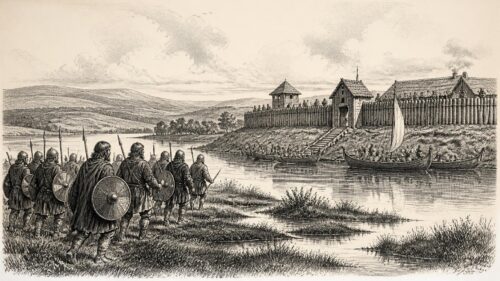
The wording ‘kings of the foreigners’ also cautions against imagining undifferentiated Viking activity. By this period, Scandinavian groups in Ireland included leaders with ships, followers and political ambitions, while Irish rulers sometimes fought them, made agreements with them or exploited rivalries among them. A nearby annalistic notice, broadly dated to 871–72, says that Ímar and a son of Amlaíb plundered from west to east and south to north. It conveys the scale of perceived insecurity, but lacks the precise chronology and local detail needed to turn it into a map of campaigns for 872. The Slieve Bloom attack is the year’s firmly localised evidence.
Connacht and the Northern Midlands
In Connacht, Mugrón son of Máel Cothaid, called one of the two kings of Connacht, died. The phrase is a reminder that provincial kingship could be shared or contested rather than monopolised by one ruler. Mugrón belonged to the Uí Briúin Síl Cathail, a leading Connacht lineage. His death altered the balance among the dynasties competing for authority in the province, but the annal gives neither a battle nor a named successor. Later king-lists make Conchobar son of Tadg Mór prominent in Connacht at this time, yet they do not justify a simple story of instantaneous succession in 872.
Another political obituary records Máel Ruanaid son of Máel Curarda, chief of the northern Uí Moccu Uais. This was not a provincial king’s death, but it shows the continued importance of local lordships. Ireland was made up not only of its largest kingdoms but of many kindreds whose control of people, pasture, churches and routes shaped everyday security. Annalists generally recorded those at the top of such networks; the farmers, craftspeople, clients and religious dependants beneath them remain largely unnamed.
A Year of Vulnerable Institutions
872 is best understood as a year of exposed connections. Cenn Fáelad’s death linked Cashel to Emly; Ferdomnach’s linked Clonmacnoise’s religious life to the Shannon crossroads; Gnia’s linked Duleek’s saintly inheritance to scribal culture. The raid at Slieve Bloom exposed the human cost of wider military mobility. These were not separate worlds. Churches held wealth and learning, kings sought their legitimacy, and inland communities could be drawn into conflicts driven by rulers whose power depended on ships, tribute and armed followings.
The sources leave major silences. They do not tell us what Cenn Fáelad’s illness was, how Ferdomnach’s community selected its next abbot, how many people died in the snowy raid, or how households rebuilt afterwards. They nevertheless preserve a coherent impression: Ireland in 872 was politically plural, ecclesiastically organised and culturally literate, but vulnerable to abrupt violence. In a year without a celebrated pitched battle, the deaths of churchmen and kings, and one winter massacre in the central uplands, reveal the institutions on which Irish society depended.
Primary Sources
- The Annals of Ulster: Year U872
- Chronicon Scotorum: Annal CS872
- Annals of Inisfallen
- Fragmentary Annals of Ireland: Annals FA 401–420
- Annals of the Kingdom of Ireland by the Four Masters
- Vikings in Irish Chronicles, 794–902: Data
- Vikings in Ireland and Scotland
- The Vikings in Ninth-Century Ireland: Sources and Settlements
- The Practice of Irish Kingship in the Central Middle Ages
- Clonmacnoise Visitor Guide
- Clonmacnoise, County Offaly
- Clonmacnoise Monastic Site Highlights
- High Crosses
- Irish School of Illumination
- County Meath Urban Archaeological Survey: Duleek
- The Annals of Ulster
- Chronicon Scotorum
- Fragmentary Annals of Ireland
- Annals of the Four Masters
- Annals of Inisfallen: Bibliographical Details
- Genealogies from Rawlinson B 502
- Cenn-Fáelad