Cell Ua nDaigri868 CE
In 868, Áed Findliath, king of Tara, defeated a coalition of Brega, Leinster and Scandinavian fighters at Cell Ua nDaigri, probably near Killineer. Dated to 6 September by Chronicon Scotorum, the battle killed Flann of Brega and many allies, while Áed’s forces also suffered serious losses. It demonstrated both Tara’s contested authority and Vikings’ role as participants in Irish dynastic politics. Annals also recorded deaths of abbots and scribes, including leaders at Clonmacnoise, Glendalough and Tallaght, revealing monastic institutions’ importance. A water event in Sliab Cualann and a Martinmas windstorm completed a year marked by conflict, ecclesiastical change and uncertainty.
Dateline
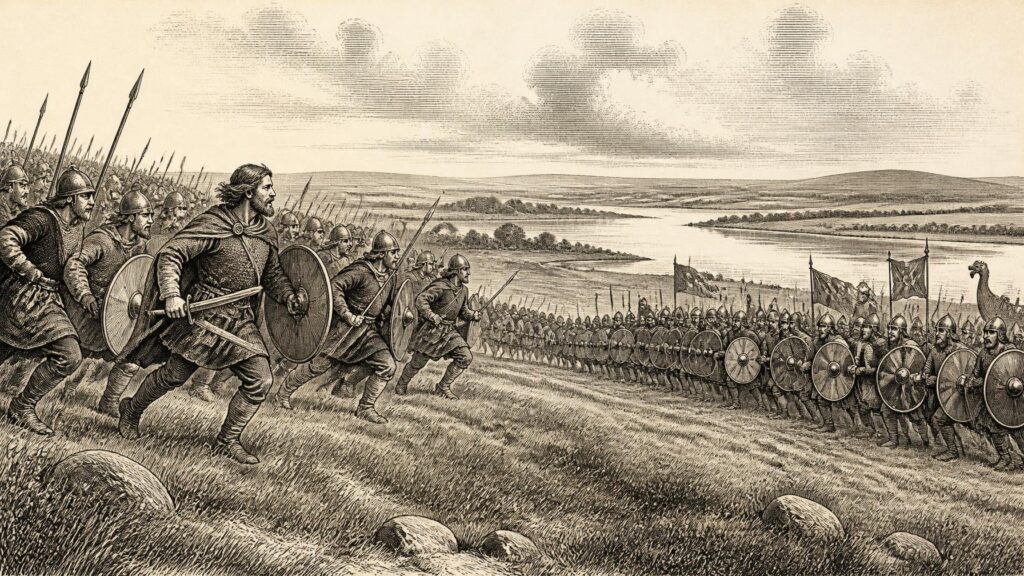
The decisive Irish event securely assignable to 868 was a battle at Cell Ua nDaigri, probably near modern Killineer on the approaches to Drogheda. It was not a simple contest between ‘Irish’ and ‘Vikings’. Rather, it brought together rival Irish dynasties and a Scandinavian contingent in an alliance against Áed Findliath, king of Tara. The battle shows how ninth-century Ireland worked: power was local and personal, political loyalties could cross the Irish Sea, and control of the rich eastern midlands mattered intensely.
A Battle Firmly Dated
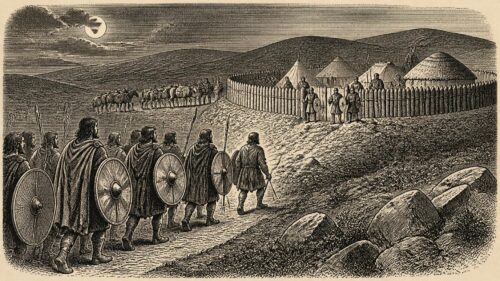
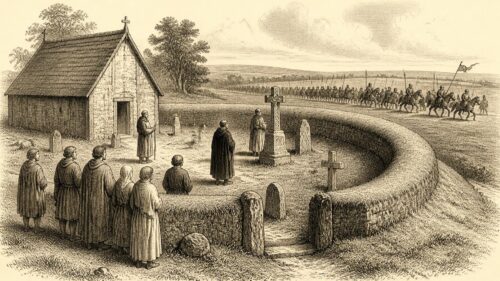
Chronicon Scotorum gives the clearest date: the battle occurred on the eighth day before the Ides of September, that is 6 September 868. Áed son of Niall, known as Áed Findliath, fought alongside Conchobor son of Tadc, king of Connacht. Their opponents were the Uí Néill of Brega, the Laigin of Leinster and a substantial force of Gall, or foreigners. The annal says that there were 300 Vikings or more. It also gives striking army totals of 5,000 with Flann son of Conaing and 1,000 with Áed; these figures should be treated as annalistic estimates rather than modern headcounts, but they convey the scale claimed for the encounter.
The battle is also entered under the year 868 in Chronicon Scotorum and the Annals of Ulster. Medieval Irish annals do not always align perfectly with modern calendar dating: the Ulster compilation itself displays an offset in this section, while the later Annals of the Four Masters puts the battle under 866. The explicit September date in Chronicon Scotorum, supported by modern chronological scholarship, permits the battle to be placed in 868 CE. Other events recorded under discrepant annal headings should not be transferred casually into this year.
Áed’s Coalition
Áed Findliath’s victory came at a sensitive point in his reign. He had succeeded Máel Sechnaill mac Máele Ruanaid as king of Tara in 862. ‘King of Tara’ was an ambitious and prestigious kingship, often styled the kingship of Ireland in contemporary and later sources, but it did not make its holder a ruler in the modern territorial sense. His authority depended on military success, the collection of tribute, dynastic connections, and the willingness—or inability—of regional rulers to resist him.
Brega was central to that contest. The kingdom stretched across the fertile Boyne plain and its tributaries, including routes towards the Irish Sea and the ceremonial landscape around Tara. Flann son of Conaing, described as king of all Brega, was therefore no minor opponent. His alliance with Leinster and the foreigners brought together forces that had strong reasons to curb the northern Uí Néill king’s influence in the east. Conchobor of Connacht’s presence beside Áed demonstrates the counter-alliance: western kings could gain from supporting a powerful Tara king against rivals in Brega and Leinster.
The fighting was costly on both sides. Flann was killed, as was Diarmait son of Etarscéle, king of Loch Gabor, the royal lake-centred territory associated with Lagore in modern County Meath. The annals add that many of the foreigners died. Áed’s side also lost Fachtna son of Máel Dúin, designated heir of the North, in the counter-attack, along with many unnamed men. A battle could produce victory without immunity from grief, weakened kindreds or difficult succession disputes.
A later annalistic version names Carlus, said to be a son of Amlaíb, ruler of the foreigners of Dublin, among the dead. That detail is not present in the terse earliest accounts, and should be treated accordingly. Even without it, the sources make clear that a Viking force fought with Flann’s coalition. The Scandinavians of Dublin were not merely raiders arriving from outside a unified Ireland. They could supply armed men to Irish allies, pursue their own interests through local politics, and suffer heavy losses in an Irish dynastic war.
Vikings as Allies, Not the Whole Story
That distinction matters. Áed had already campaigned fiercely against Scandinavian strongholds in the north, and his reputation as a successful opponent of the foreigners was well established. Yet the 868 battle was chiefly about the balance of power between Irish kings. The Viking contingent was important enough for every principal account to mention it, but it was one element within Flann’s larger coalition of Brega and Leinster.
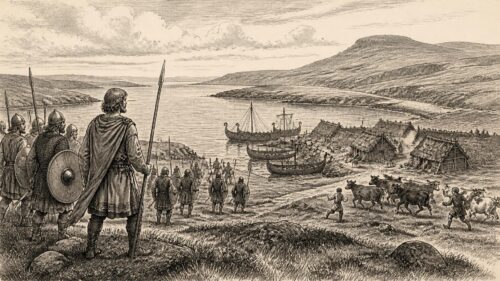
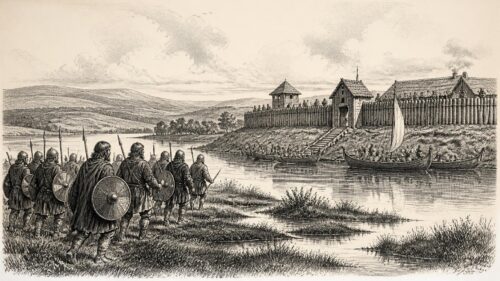
Dublin nonetheless formed a powerful maritime base in this period. Its rulers and warbands had access to ships, Irish Sea routes, booty, captives and mercenary service. Such resources made them valuable and dangerous partners. Norse and Norse-Gaelic settlement was still developing rather than fixed: fortified riverine or coastal bases, known in Irish as longphuirt, could function as defended camps, harbours, centres of exchange and bases for farming as well as raiding. The events at Cell Ua nDaigri therefore belong to the history of early Dublin, but they should not be reduced to a story of a foreign town fighting an Irish countryside.
Áed’s success improved his immediate position, removing a formidable king of Brega and breaking a hostile field alliance. It did not end conflict in Leinster, Brega or Dublin, nor did it settle the place of the foreigners in Irish politics. The very need for a coalition in 868 reveals the limits of high-kingship. A king of Tara could win a major battle, but the island remained a landscape of competing overkings, regional dynasties, church communities and armed followings.
A Year of Ecclesiastical Loss
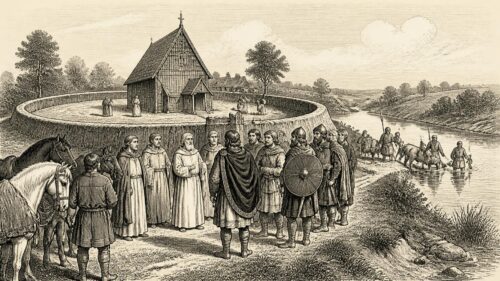
The political drama shares the annals with a quieter but revealing sequence of deaths in religious communities. On the night of 1 January, Connmach, abbot of Clonmacnoise, died. The date is unusually precise. Chronicon Scotorum says that he belonged to Cenél nÉchach Gall, while the Annals of Ulster records his death in Christian formula: he ‘fell asleep in Christ’. Connmach’s passing mattered well beyond one clerical household. Clonmacnoise stood on the Shannon at a major crossing of north–south water traffic and east–west land routes; it was a religious centre, a place of learning and writing, a market-connected settlement, and a focus of patronage.
Other recorded deaths underline the breadth of the ecclesiastical network. Cellach son of Cumuscach, abbot of Fobar, was remembered as learned and exceptionally talented despite being young. Daniél, abbot of Glendalough and Tallaght, died, as did Caemán son of Dálach, abbot of Damliag. Fergus of Ros Ailithir, identified as a scribe in Chronicon Scotorum, also died. Congal son of Fíadach, abbot and scribe of Cell Delga, and Rechtabra son of Murchad, abbot of Cork, are named in the Annals of Ulster.
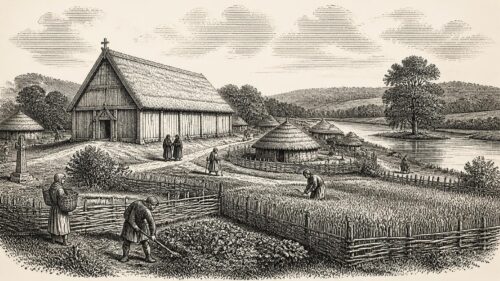
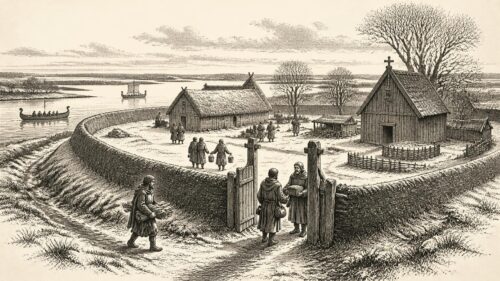
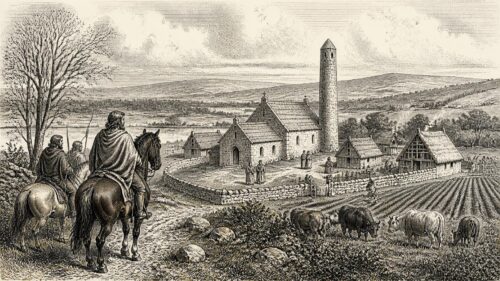
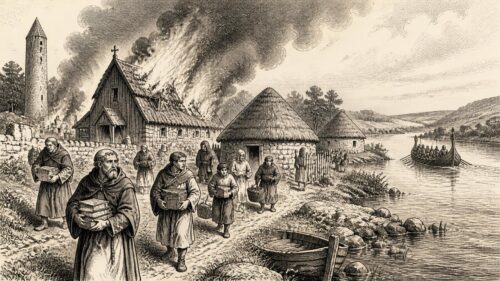
These notices do not give personal biographies, but their concentration is meaningful. Irish monasteries were not isolated retreats occupied only by contemplatives. They were communities of clergy, scholars, craftsmen, tenants, dependants and travellers. Their churches, schools, food-producing lands, livestock and portable treasures made them important institutions in local economies. Their leaders could be scribes and teachers as well as managers of substantial estates. The annalists’ attention to abbots, anchorites and learned men reflects the place of such communities in how educated contemporaries understood the country.
Glendalough, in the Wicklow mountains, and Clonmacnoise, on the Shannon, were very different landscapes, yet both connected rural society to wider networks of pilgrimage, literacy and exchange. Their communities relied on farming households and skilled labour; texts and religious objects circulated alongside people and goods. In 868, deaths at these centres were therefore changes in institutional leadership as well as moments of religious commemoration.
Water, Fish and Wind
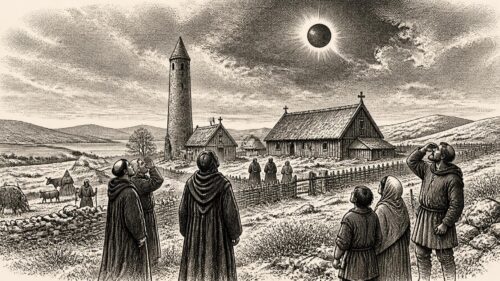
The annals also noticed the natural world. They report a remarkable outflow of water from Sliab Cualann, the upland region of south County Dublin and north Wicklow, containing small black fish. No reliable modern diagnosis can be made from the brief wording. It may record an unusual spring, flood, fish movement or another local phenomenon, but the responsible conclusion is simply that it was memorable enough to enter the chronicle.
One event has a firm feast-day date: a great windstorm occurred on Martinmas, 11 November. Such a storm would have affected sea passages, fishing, river travel, roofs, crops awaiting storage and the safety of timber buildings. The annalist does not describe the damage, so none should be invented. Its inclusion nevertheless reminds us that political plans, harvest routines and journeys in early medieval Ireland were exposed to sudden weather.
After the Field
By the end of 868, Áed Findliath could count Cell Ua nDaigri among the strongest demonstrations of his rule. The battle had killed Flann of Brega, damaged an alliance joining Brega, Leinster and Scandinavians, and advertised Áed’s ability to draw Connacht into his cause. But its aftermath was not a national settlement. Ireland’s political map remained plural, and the Dublin leadership retained the capacity to intervene forcefully. The church communities that supplied learning, record-keeping and local authority also faced fresh vacancies among their leading men.
For that reason, 868 is best remembered not as a year in which Ireland defeated outsiders, but as a year in which a major Irish king prevailed in a complex Irish Sea world. At Cell Ua nDaigri, regional rivalry, Scandinavian military service, the strategic Boyne corridor and the contested prestige of Tara met in one hard-fought September battle.
Primary Sources
- The Annals of Ulster: Year U868
- Chronicon Scotorum: Annal CS868
- Annals of Inisfallen
- Annals of the Four Masters
- Fragmentary Annals of Ireland: FA 387
- Vikings in Ireland and Scotland
- General Vikings in Ireland
- Vikings in Irish Chronicles, 794–902: Data
- The Vikings in Ninth-Century Ireland: Sources and Settlements
- Early Medieval Ireland and the World of the Crannog
- Viking Activity in Ireland by County in the Annals
- CELT Project: The Annals of Ulster
- CELT Project: Chronicon Scotorum
- CELT Project: Annals of Inisfallen
- CELT Project: Fragmentary Annals of Ireland
- Exploring the Irish Annals
- Clonmacnoise Visitor Guide
- Clonmacnoise Monastic Site
- Glendalough Monastic Site and Visitor Centre
- Early Christian Monasteries
- Churches and Ecclesiastical Enclosures
- High Crosses
- Ordinary People in Early Christian Ireland
- Early Irish Monasticism