Amlaíb’s Clonard Reckoning864 CE
In 864, Ireland’s fragmented politics were marked by coercion, shifting alliances and Scandinavian involvement. Áed Findliath consolidated authority by blinding Lorcán of Mide, while Amlaíb of Dublin drowned Conchobor at Clonard, demonstrating foreign rulers’ influence in inland dynastic struggles. Áed and Flann of Brega defeated the Ulaid, whereas Cerball of Osraige pursued raids, devastation, cattle seizures and hostages across Leinster and Munster. Annals also record ecclesiastical deaths and appointments at Louth, Terryglass and Kildare, alongside a Clare king’s death. Differing annal dates and partisan later narratives require caution, but collectively portray interconnected regional powers, churches and communities vulnerable to warfare.
Dateline
The events conventionally assigned to 864 reveal an Ireland in which authority was exercised through sharp, local acts of coercion: blinding a rival king, drowning another, taking hostages, seizing cattle and winning a battle that compelled submission. No single power governed the island in a modern sense. Áed Findliath, of the northern Uí Néill, had succeeded to the kingship of Tara after the death of Máel Sechnaill in 862, but his position depended upon alliances, campaigning and the acknowledgement of many lesser rulers. The annals for this year record just how precarious that supremacy could be.
There is a dating caution at the outset. The events appear under U864 in the Annals of Ulster and under 864 in Chronicon Scotorum, the convention followed here. The surviving Ulster annal heading also carries an AD 863 label, while the much later Annals of the Four Masters places several of the same events under 862. These discrepancies arise from differing medieval chronological systems and transmission, not from evidence for separate incidents. The annals securely preserve a sequence of events within their own year-notices; they rarely supply a modern calendar date or enough detail to establish a precise order within the year.
Mide’s Brutal Settlement
The most consequential notices concern Mide, the central kingdom around Tara. The Annals of Ulster state that Áed blinded Lorcán son of Cathal, described as king of Mide. Blinding was not simply personal vengeance. A ruler whose body was damaged could be disqualified from kingship, since early Irish political ideas closely connected fitness to rule with physical integrity. The act therefore removed Lorcán from contention while advertising Áed’s capacity to intervene at the heart of the midlands.
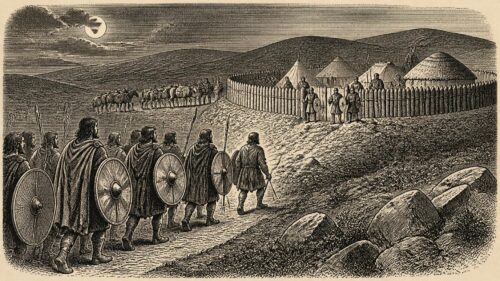
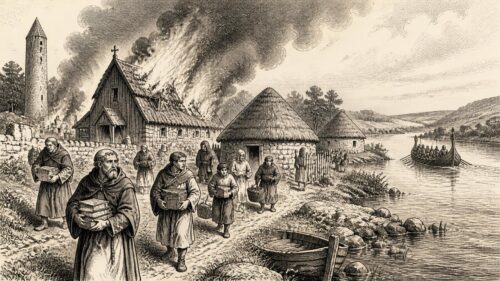
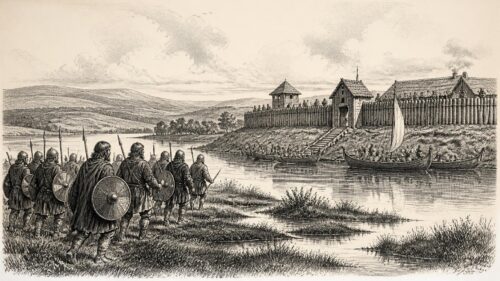
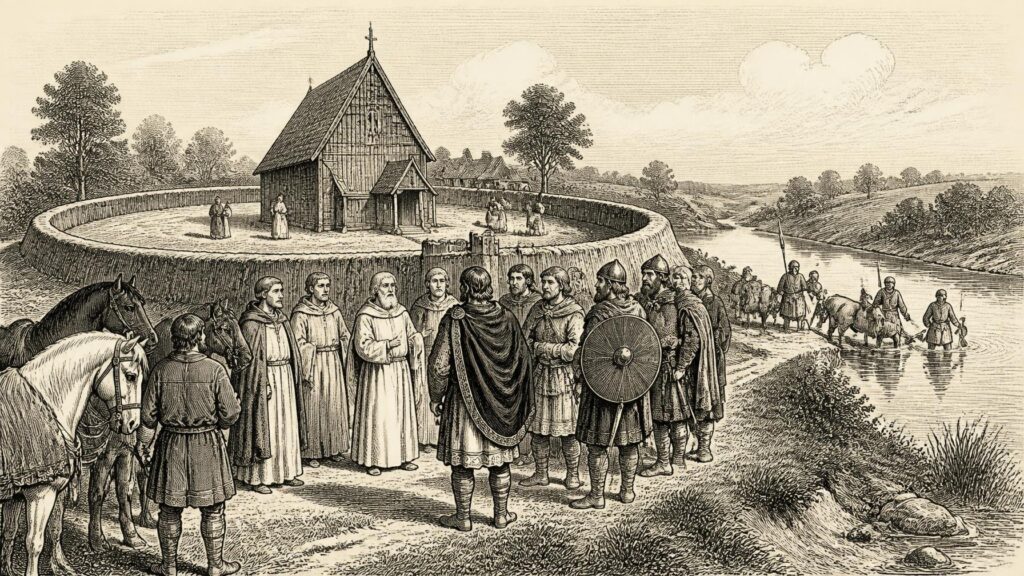
A second Mide ruler met an equally deliberate end. Conchobor son of Donnchad, called one of the two kings of Mide, was “put to death in water” at Cluain Iraird, now Clonard, by Amlaíb, king of the foreigners. The wording is stark and important. It identifies Amlaíb not as a passing raider but as a ruler able to impose lethal force far inland, at a major ecclesiastical settlement on routes through Mide. It also shows that Scandinavian power based at Dublin was woven into Irish dynastic disputes.
The background makes the violence more intelligible, though it should not be mistaken for an exact explanation supplied by the 864 entries themselves. In the preceding annal-year Lorcán had joined Amlaíb, Ímar and Auisle in plundering the lands of Flann son of Conaing in Brega. Áed, meanwhile, had previously been allied with Amlaíb through marriage: the Fragmentary Annals say that Amlaíb married Áed’s daughter. Such connections did not create fixed blocs. Marriage, fosterage, tribute and joint expeditions could bind rulers together, but political needs changed rapidly. The events at Clonard demonstrate that Dublin’s leaders and Irish kings could be allies in one setting and pursue separate interests in another.
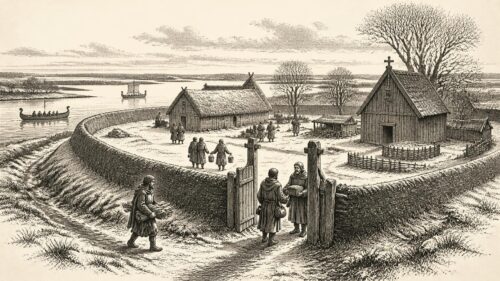
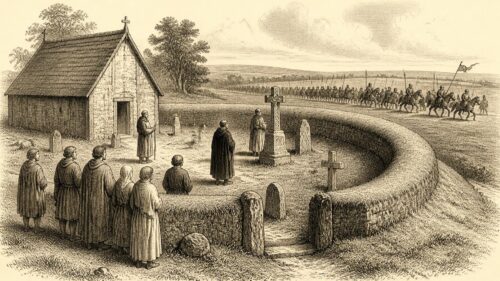
For ordinary inhabitants of Mide, struggles at this level were not remote court politics. Hosts needed food, animals, boats, guides and labour. A lord’s success could mean exactions from dependent communities; his defeat could expose them to plunder. Clonard itself was an ecclesiastical community with lands, tenants, learning and sacred prestige. The annal does not say that its church was attacked, and it should not be treated as a Viking raid on the monastery. Yet the killing beside or within its district shows how little sanctuary and politics could be separated when rival kings contested the region.
Áed and Flann Against Ulaid
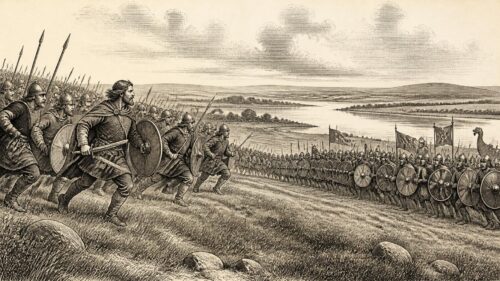
Áed’s authority was also tested to the north-east. He and Flann son of Conaing won what the Annals of Ulster calls a “great victory” over Ainbíth son of Áed and the Ulaid, in the territory of the descendants of Conall the Craftsman. The place-name is generally associated with Conaille in the north-eastern zone, but the annal gives no battle narrative: no date, numbers, tactics or list of dead. Its description as a great victory nonetheless signals more than a skirmish. Áed had defeated a leading Ulster rival, while Flann of Brega appeared at his side.
This was politically revealing. The Ulaid were a powerful regional people, and Cenél nÉogain, Áed’s own northern Uí Néill kindred, had long competed with them. Flann’s participation shows the usefulness of cross-regional alliances. It also underlines the instability of such arrangements: Flann was a valuable partner in 864, but would later become Áed’s enemy. Kingship was not a settled chain of command. It was an active process of securing military followings, exchanging guarantees and punishing defection.
The battle also cautions against imagining ninth-century Ireland as divided only between Irish and Viking. The major contest recorded here was between Irish rulers. Amlaíb’s intervention in Mide and the Norse participation in conflicts elsewhere were significant, but foreign war-bands operated within an already competitive political landscape. The annals’ frequent term “foreigners” marks outsiders in language and origin; it does not mean that they stood apart from Irish affairs.
Cerball’s Southern Counterstroke
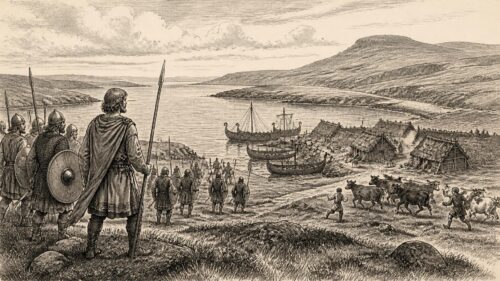
The fullest southern narrative for 864 comes from the Fragmentary Annals of Ireland. It says that Cerball son of Dúngal, king of Osraige, raided Leinster. The Leinstermen then joined with people termed Norwegians and struck back into Osraige. Refugees who fled south into Munster were, according to this account, killed by the Eóganachta, Munster’s dominant royal grouping. Cerball responded by gathering Irish and Scandinavian forces, devastating neighbouring territories, laying waste Mag Fhéimín and Fir Maige, and taking hostages from many peoples. A separate notice records his raid into the Déisi and the devastation of Uí Óengusa.
The broad pattern is supported by the Annals of the Four Masters, which preserves notices of reciprocal cattle-raiding between Osraige and Leinster, of Cerball’s plundering in Munster and of hostages taken there. But the extended account deserves careful handling. The Fragmentary Annals was compiled much later and gives Cerball unusually vivid, favourable treatment; modern scholarship recognises strong Osraige dynastic interests in its presentation. Its report is valuable, but Cerball’s supposed thoughts and the polished moral commentary around the episode cannot be treated as verbatim testimony from 864.
Even so, the events illuminate the workings of power. A “prey” was often cattle, the most mobile and socially important form of wealth in early medieval Ireland. Cattle provided dairy produce, hides, manure, traction and status; they also served in compensation and political exchange. Hostages, meanwhile, were living securities for obedience, not merely captives taken for ransom. Cerball’s campaigning therefore aimed not only to destroy but to reorder obligations: to demonstrate that communities in Leinster and Munster could be made to yield goods, people and recognition.
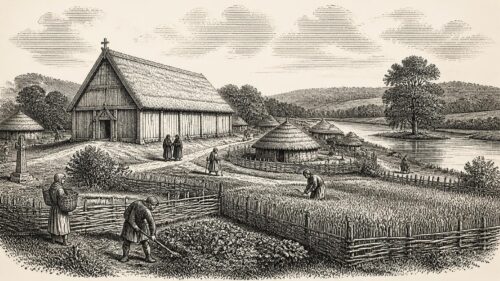
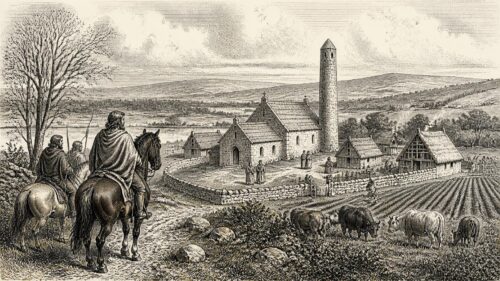
For farming households, this could be ruinous. Livestock losses affected milk, winter food, breeding stock and a family’s capacity to meet dues. Crops and dwellings might be damaged as armies passed, while displaced people could face violence from groups with whom their ruler had previously dealt. The annals do not provide a general survey of hunger, weather or harvest in 864, so none should be invented. They do, however, preserve enough to show that warfare reached deeply into a rural economy organised around livestock, cultivated land and dispersed settlements.
Churches, Offices and Learning
Amid killings and campaigns, the annals also note changes in ecclesiastical leadership. Muiredach son of Niall, abbot of Lugmad, modern Louth, and of other churches, died. His title points to the reach of major churches beyond a single enclosure: ecclesiastical leaders could oversee networks of churches, estates and dependants. The succession to the abbacy of Tír dá Glas, at Terryglass, is also assigned to this annal-year, when Máel Pettair took office. Such appointments mattered spiritually, economically and politically, since churches controlled land and commanded patronage as well as prayer.
The death of Aedgen the Briton, bishop of Kildare, is especially striking. The annals call him bishop, scribe, anchorite and an elder “almost 116 years” old. The reported age is best understood as an annalist’s exceptional claim rather than a securely verifiable biography. His combined titles are more revealing: Kildare valued him as a churchman, a practitioner of ascetic devotion and a man of writing. His designation as Briton also records continuing connections across the Irish Sea. Mobility of clerics, manuscripts and ideas remained part of Irish Christian life despite warfare.
In the south, the Annals of Inisfallen record the death of Cermait son of Cathrannach, king of Corcu Baiscinn, in what is now north Clare. Chronicon Scotorum adds that he was killed by foreigners, while Inisfallen simply records his death. The difference is a reminder that annals are selective records, not complete chronicles. Together, these notices show a country of many political scales: Tara and Mide mattered, but so did kingships in Clare, Osraige, Leinster, Brega and Ulster, and church communities from Kildare to Louth and Terryglass.
A Year of Coercive Connections
In 864, Ireland’s regional kingdoms were neither isolated nor absorbed into a unified state. Routes through Mide connected Tara, Clonard and Dublin’s military reach; northern alliances carried conflict into the territory of the Ulaid; and Cerball’s reprisals linked Osraige, Leinster and Munster. Monasteries remained centres of literacy and authority, but they existed inside this political world rather than outside it. The year’s surviving notices are brief, uneven and sometimes shaped by later writers’ loyalties. Read critically, they offer a vivid picture of how power worked: through bodies, cattle, hostages, churches, alliances and the ever-present possibility that today’s ally might become tomorrow’s rival.
Primary Sources
- The Annals of Ulster: Year U864
- The Annals of Ulster: Year U863
- Chronicon Scotorum: Annal CS864
- Fragmentary Annals of Ireland: Annals FA 301–320
- Fragmentary Annals of Ireland: Annals FA 281–300
- Annals of the Four Masters: Annals M847–M866
- Annals of Inisfallen: Annals AI860–AI869
- Chronicon Scotorum: Electronic Edition Details
- List of Published Texts at CELT
- Exploring the Irish Annals
- Áed Findliath
- Cerball
- Ímar (Ívaar)
- Vikings in Ireland: Afterthoughts
- The Vikings in Scotland and Ireland in the Ninth Century
- Viking Activity in Ireland by County in the Annals
- Mobility in the Early Middle Ages, and Beyond
- Changing Human-Cattle Relationships in Ireland: A 6000-Year Isotopic Perspective
- Kingship, Society, and Sacrality: Rank, Power, and Ideology in Early Medieval Ireland
- Religion and Society in Ireland
- How Did Early Church Sites Differ from One Another? A Comparative Approach within the Kingdom of Fir Maige, Ireland
- Monasticism and its Limits: Rematerialising Monastic Space in Early Medieval Ireland