Lagore’s Burned Crannóg850 CE
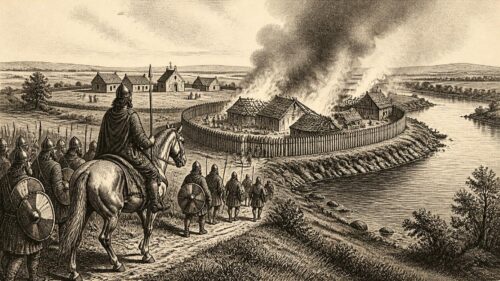
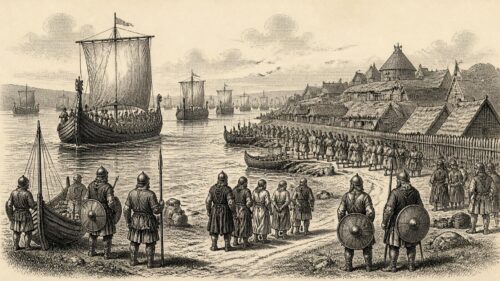
In 850, Irish annals record Cináed son of Conaing, king of Cianachta, rebelling against Máel Sechnaill, king of Tara, with overseas warriors described as foreigners. His forces devastated Uí Néill territories from the Shannon to the sea, attacking churches and secular lordships. They captured and destroyed Loch Gabair, identified with Lagore crannóg, a politically significant elite residence in southern Brega. Nearby oratories at Treóit and possibly Nuarrach were burned, causing casualties. Obituaries and local killings reveal ecclesiastical and regional politics. A notice of Loch Laig draining highlights environmental change. The year depicts rural Ireland under pressure, interconnected yet politically fragmented.
Dateline
An Annalistic Year
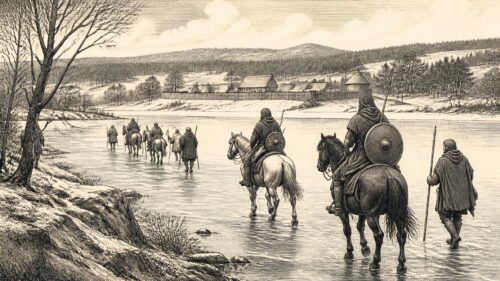
The surviving Irish chronicles make 850 a year of sharp local conflict in the midlands, not a year in which a single ruler or invading force controlled the island. Their most substantial notice concerns Cináed son of Conaing, king of Cianachta in northern Brega, who rebelled against Máel Sechnaill son of Máel Ruanaid, king of Tara. With the backing of a force described as foreigners, Cináed carried warfare across the Southern Uí Néill heartlands from the Shannon to the sea. Churches and lay territories alike were plundered, and the assault culminated in the destruction of the island stronghold at Loch Gabair, now Lagore, near modern Dunshaughlin in County Meath.
The evidence requires care. Irish annals were compiled and recopied over centuries; their year headings do not always align perfectly when converted to the modern calendar. The principal notices are conventionally placed in 850, but they do not give a day, season or sequence of operations. Nor should the terms used for the Scandinavian allies be treated as a precise statement of nationality. What can be said firmly is that an Irish dynastic revolt, assisted by overseas warriors, brought devastating violence to Brega and Mide in the year conventionally called 850.
Cináed’s Revolt
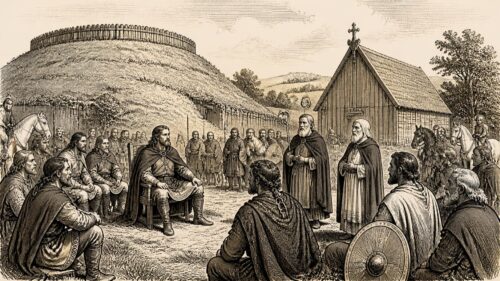
Cináed belonged to a powerful branch of the Síl nÁedo Sláine, itself part of the wider Uí Néill political world. His father, Conaing, had recently ruled Brega, and Cináed inherited a position from which he could challenge Máel Sechnaill’s growing authority. Máel Sechnaill, of Clann Cholmáin in Mide, had become king of Tara after the death of Niall Caille in 846. The title did not mean that he governed Ireland through a unified state. It expressed a claim to supremacy over other rulers, maintained through alliances, military progress, tribute and the taking of hostages. Such supremacy was always contestable, especially in Brega, the rich and politically divided country north of Tara.
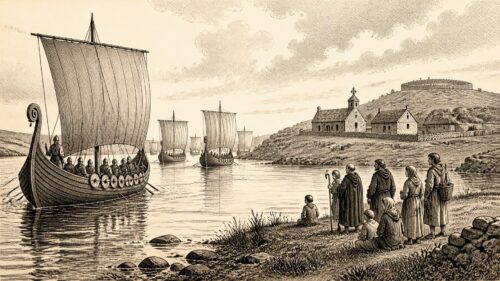
The annalists present Cináed’s rising as a rebellion against Máel Sechnaill made possible “through the power of the foreigners”. That phrase matters. Scandinavian groups had been active in Ireland for decades, but they were not merely external raiders appearing at the coast and vanishing again. Their ships, armed followings and riverine mobility had become assets in Irish political competition. An alliance with them could turn a regional feud into a campaign of unusual reach. Cináed’s action was therefore both an attack upon Máel Sechnaill’s overlordship and an attempt to reorder power within Brega.
The annals’ geographical formula is stark: the raiders devastated the Uí Néill lands “from the Shannon to the sea”, attacking both cella, ecclesiastical settlements, and tuatha, the territories and peoples of secular lordships. This should not be read as a measured description of every place struck. It is an annalistic statement of wide-ranging destruction. Yet it shows why the rising was serious. The Shannon gave access into the midlands; routes, rivers and lakes linked royal estates, church lands and settlements towards the Irish Sea. Warfare could damage the productive resources on which kingship rested: cattle, grain, food stores, labourers, rents and the protected status of church communities.
The Fall of Loch Gabair
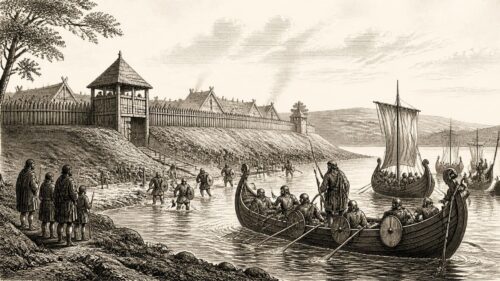
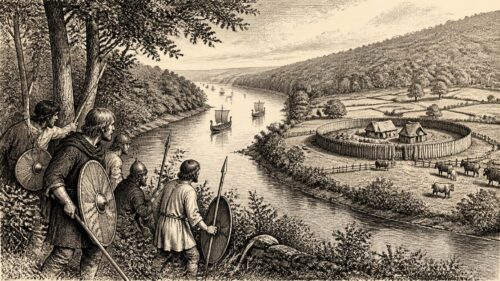
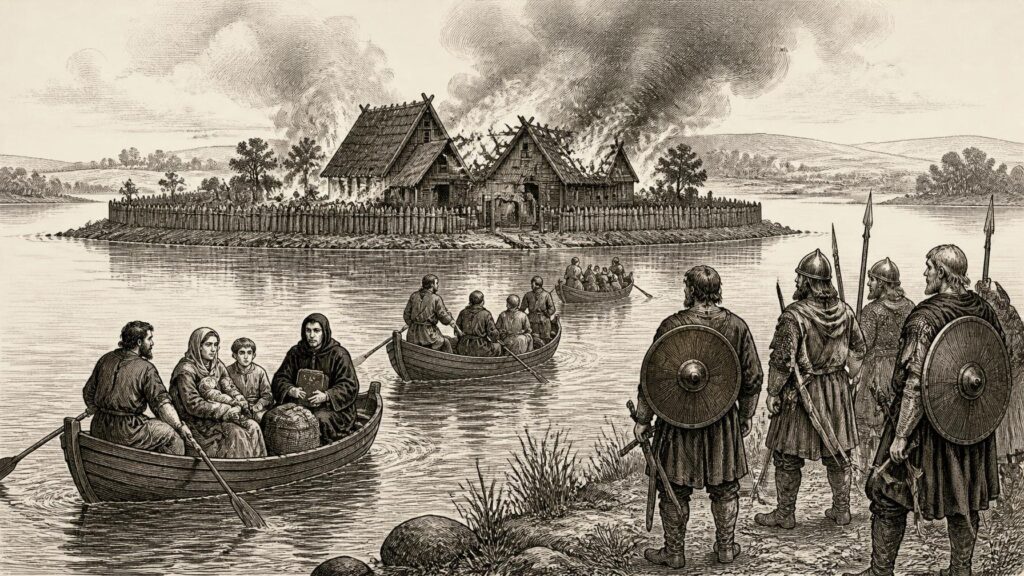
The most memorable episode was the attack on the island of Loch Gabair. The place is generally identified with Lagore crannóg, an artificial island settlement in a former lake near Dunshaughlin. Crannógs were not romantic refuges beyond ordinary politics. They could be elite residences, stores of wealth, places of assembly and defensible nodes in a densely inhabited landscape. Lagore had long associations with rival dynasties in southern Brega. Its destruction was thus a calculated political act: an assault on a residence, a symbol of lordship and an opponent’s local base.
The Annals of Ulster say that Cináed took the island “in deceit” and reduced it level with the ground. The wording implies surprise or treachery, but does not permit a reconstruction of the tactic. There is no responsibly recoverable scene of boats, gates or hand-to-hand fighting. What is clear is the intended finality of the report. A fortified island could be captured and wrecked despite its water defences when attackers possessed local knowledge, manpower and perhaps ships or boats suitable for lake and river travel.
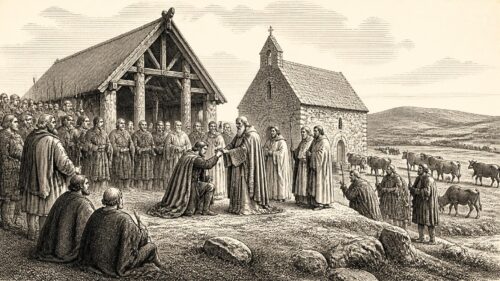
The destruction reached nearby churches. The Ulster annal records the burning of the oratory of Treóit, usually identified with Trevet in County Meath, and gives seventy people there. Chronicon Scotorum, preserving a fuller but not necessarily more secure version, reports 260 people at Treóit and adds the burning of the oratory of Nuarrach with sixty people. The discrepancy is too large to smooth away. The numbers may have been corrupted in transmission, may include different categories of people, or may have been shaped by the moral force of the narrative. The responsible conclusion is not a precise death toll, but that the assault on religious sites caused a major and remembered human catastrophe.
Churches were vulnerable because they were also wealthy and populous institutions. Their lands supported clergy, dependants, tenants and craftspeople; their precincts sheltered books, relics, food, livestock and portable metalwork. But it would be misleading to separate an attack on a church from secular politics. In 850, the burning of Treóit and Nuarrach was part of Cináed’s campaign against the political order represented by Máel Sechnaill and his allies. The perpetrators named by the chronicles were an Irish king and his foreign supporters, a reminder that violence against churches in early medieval Ireland was not confined to Scandinavian raiders.
Church Leadership and Loss
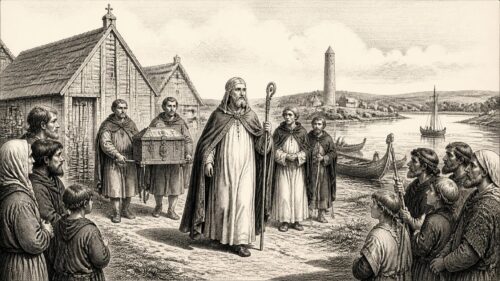
The year’s obituary notices reveal the continued reach of the ecclesiastical network even amid conflict. Cétadach, abbot of Clonmacnoise, died, along with Tuathal son of Feradach, abbot of Rechru and Dairmag, and Ferchar son of Muiredach, superior of Lann Léire. These were not interchangeable clerical offices. An abbot or superior governed communities that held land, received food renders, educated clergy and maintained relations with kings and local elites. Their deaths created practical as well as spiritual transitions, requiring successors to protect property, organise worship and sustain the community’s connections.
Clonmacnoise was particularly significant. Situated beside the Shannon at a major crossing of routes, it was a religious centre but also a settlement with a substantial lay population, agricultural resources, craftsmen and political importance. Its abbot’s death in 850 does not imply that the monastery was attacked that year; the annal simply records his passing. Nevertheless, it gives a glimpse of the institutional world that Cináed’s campaign endangered. The great churches of Ireland were centres of learning and manuscript production, but they were also embedded in the rural economy and the rivalries of kings.
The deaths of leaders should not obscure the continuities beneath them. Religious life continued through daily prayer, teaching, hospitality, the management of estates and the copying or preservation of texts. Major book production by the ninth century was concentrated in powerful centres, including places such as Armagh, Kildare and Clonmacnoise. Yet the ordinary work sustaining such communities depended upon farming households and dependent labour. Clerics and their clients lived in a world where fields, dairying, grain processing and food storage mattered as much as the learning for which monasteries are now celebrated.
Power at the Edges
Another brief notice records that Áengus son of Suibne, king of Mugdorna, was killed by Gairbíth son of Máel Brígte. Mugdorna lay in the north-east, in or near the modern Monaghan–Louth region. The entry gives no motive, battle-site or explanation, but its very terseness is revealing. Kingship in Ireland was dispersed among many small and medium-sized polities. A killing in Mugdorna could reshape a local succession without appearing connected to the great midland revolt. Ireland in 850 was not a chessboard moved solely by Tara and Viking fleets; political life was simultaneously local, regional and interregional.
The Fragmentary Annals also place an unusual environmental notice under 850: Loch Laig in Umail, modern Umma or Umhall in western County Mayo, “flowed away”. The entry may refer to a lake draining or a marked alteration in its waters, but offers no explanation. It should not be inflated into evidence for an island-wide climatic crisis. Its value lies elsewhere. It preserves a reminder that water, wetlands and shorelines were active elements in early medieval life. Lakes furnished fish, transport, pasture margins and defensible islands; a dramatic change in one could affect neighbouring communities and their memory of place.
A Rural Society Under Pressure
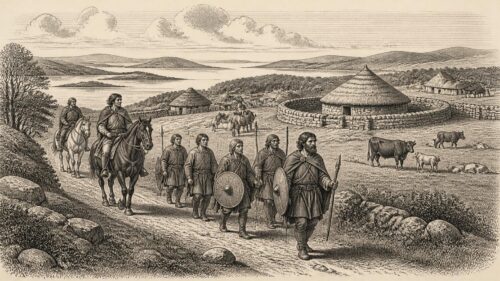
For most people, 850 was experienced not through royal titles but through work and obligations. Ireland remained overwhelmingly rural. Households in ringforts, unenclosed farmsteads, crannógs and church settlements tended cattle, sheep and pigs; processed milk; prepared grain; repaired boundaries; spun wool; and stored food for winter. Cattle remained a principal measure of wealth and a means by which lords rewarded followers or extracted rents, while cereal cultivation had become increasingly important. Watermills and grain-drying facilities demonstrate that arable production was more substantial than an older image of an exclusively pastoral Ireland suggests.
That background gives the events of 850 their full weight. A raid was not simply a clash between warriors. Burning an oratory, emptying a store, seizing livestock or frightening labourers could disrupt the cycle of cultivation and food preparation long after an armed party moved on. Destruction at Lagore and Trevet therefore belonged to a wider struggle for resources and allegiance. Conversely, the ability of Cináed to assemble allies, including foreign fighters, indicates that Irish rulers could still mobilise considerable wealth and patronage even during a period of Scandinavian pressure.
The year ends without a recorded settlement. Máel Sechnaill’s authority had been openly challenged; a royal crannóg had been destroyed; churches had been burned; and local rulers continued to fight beyond the central plain. The annals do not provide a neat national conclusion because none existed. What 850 exposes is a connected but fractured Ireland: one in which waterways bound regions together, monasteries were major social institutions, and foreign military power had become entangled with the ambitions of Irish dynasties.
Primary Sources
- The Annals of Ulster, Year U850
- Chronicon Scotorum
- Fragmentary Annals of Ireland
- Annals of the Four Masters, Volume 1
- Vikings in Irish Chronicles, 794–902: Data
- Cináed
- Máel-Sechnaill
- Vikings in Ireland
- Vikings in Scotland and Ireland in the Ninth Century
- The Vikings in Ninth-Century Ireland: Sources and Settlements
- Early Medieval Ireland: Investigating Social, Economic and Settlement Change, AD 400–1100
- Early Medieval Dwellings and Settlements in Ireland, AD 400–1100, Volume 1: Text
- The Economy of Early Medieval Ireland
- Agriculture, Settlement and Society in Early Medieval Ireland
- Clonmacnoise Visitor Guide
- Clonmacnoise Monastic Site
- High Crosses
- Irish School of Illumination, c. 650–1100
- Lagore Crannóg
- Dunshaughlin Town Centre First Plan
- Early Medieval Ireland 400–1200
- Vikings in Early Medieval Ireland: Church-Raiding, Politics and Kingship