Dúnadach’s Southern Victory834 CE
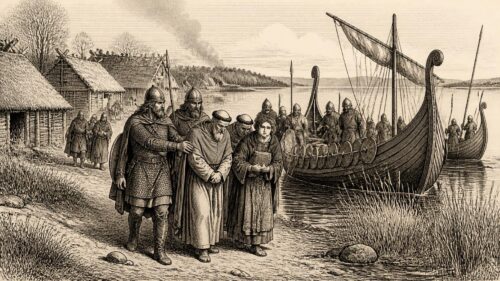
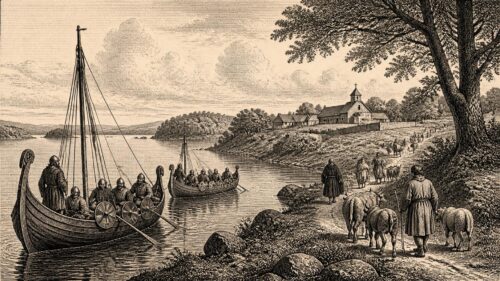
In 834, Irish annals recorded Scandinavian raids, local resistance, political killings, ecclesiastical deaths and a destructive fire, though their chronology and detail remain uncertain. Dúnadach son of Scannlán, king of Uí Fidgenti, defeated foreigners, demonstrating that Munster rulers could repel raiders. Glendalough, Slane and Finnabair Abha were plundered, illustrating the vulnerability of wealthy church communities across Ireland. Much of Clonmacnoise burned, but the cause is unknown. Deaths of Leinster’s king Cellach and other rulers altered local politics, while leading clerics died. Fragmentary records portray overlapping violence, instability and institutional continuity rather than a simple Viking conquest of Ireland in 834.
Dateline
The Irish annals conventionally place a cluster of raids, a local victory over Scandinavian raiders, political deaths and a major fire in 834. They do not supply months, days or a continuous narrative. Instead, they preserve terse notices, copied and reshaped in later manuscripts, which must be read cautiously. Even so, they show an island in which the effects of seaborne raiding were increasingly widespread, but where local rulers still had the capacity to fight back. They also reveal that the gravest threats to churches and communities did not come from overseas alone: dynastic killing, competition between kings, and accidental or hostile fire remained enduring facts of life.
A Year Recorded in Fragments
The principal contemporary-style record is the Annals of Ulster. Its entry for this year is corroborated in important respects by Chronicon Scotorum and, with a one-year chronological displacement, by the later Annals of the Four Masters. Such variation matters. The events discussed here belong responsibly to 834 in the modern conventional chronology used for the Annals of Ulster, but the sources do not permit a reconstruction of their precise order or season.
What emerges is not a single national campaign. Ireland was divided among numerous kingdoms, overkingdoms and ecclesiastical lordships. Niall Caille of Cenél nÉogain had recently succeeded to the kingship of Tara, while Feidlimid mac Crimthainn of Cashel remained an exceptionally forceful ruler in Munster. Neither king is explicitly credited with the principal events recorded for 834. The annals instead bring smaller political communities, monasteries and local leaders into unusually sharp focus.
Dúnadach’s Battle
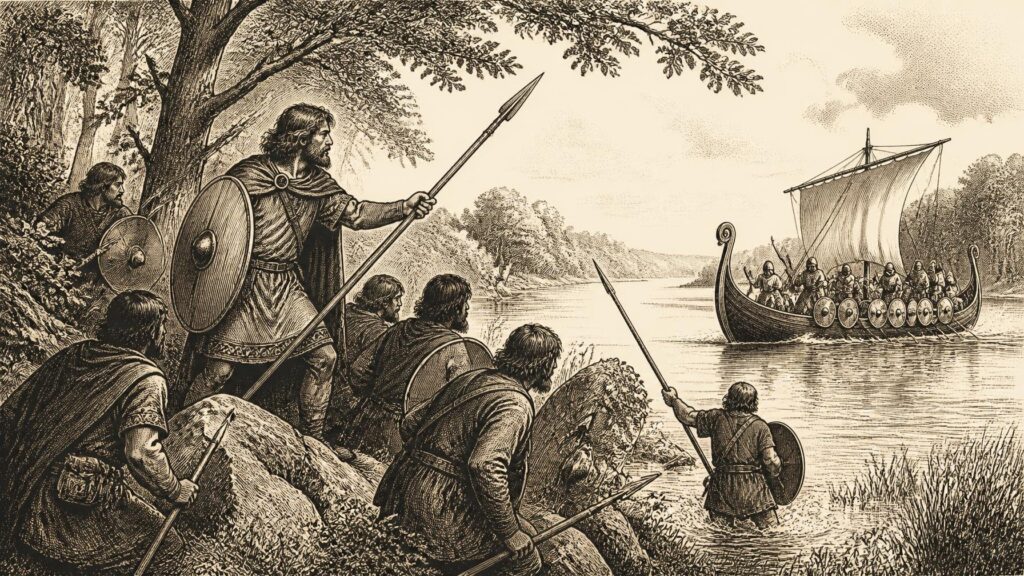
The clearest military event was a victory by Dúnadach son of Scannlán, king of Uí Fidgenti, over gentti, the annalists’ term for heathens or foreigners. Both the Annals of Ulster and Chronicon Scotorum say that many fell. The enemy is not named by ethnicity in the Irish text, but the term is used in this period for Scandinavian raiders, and the later Four Masters calls them Danes.
The record is gratifyingly firm about the result but silent on almost everything else. It does not name the battlefield, say whether the raiders had landed on the coast or travelled inland, or identify the numbers and social rank of the dead. It is therefore unsafe to picture a large set-piece battle, or to connect Dúnadach’s success directly with any particular raid recorded elsewhere in the year. Yet the notice is significant precisely because it names an Irish victor. Uí Fidgenti, a Munster people, could mobilise a force able to defeat a raiding party. The Scandinavian presence was dangerous, but not irresistible.
This was not an isolated pattern. Earlier ninth-century annals contain victories by regional Irish forces against raiders, as well as devastating foreign attacks. The military balance depended on local intelligence, geography, speed of assembly and the ability of a ruler to command followers. Dúnadach’s victory belongs to that unsettled world of short expeditions, opportunistic attacks and determined local resistance, rather than to a settled Scandinavian conquest of southern Ireland.
Three Ecclesiastical Raids
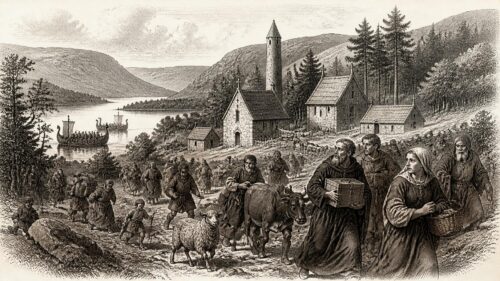
Elsewhere, the annals report that foreigners plundered Glendalough, Slane and Finnabair Abha. The three sites were not interchangeable targets. Glendalough lay in a mountain valley in Leinster and was an important ecclesiastical settlement associated with St Kevin. Slane stood on the Boyne in the northern part of Leinster’s political world, close to the rich and contested landscape of Brega. Finnabair Abha is less securely identifiable today, a useful reminder that the written record preserves names more readily than it preserves exact landscapes.
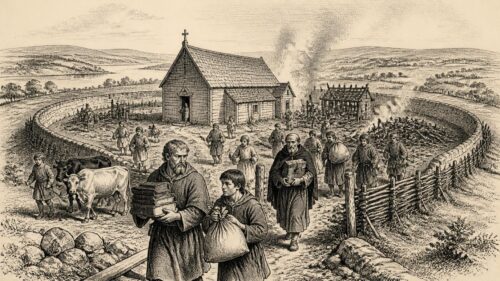
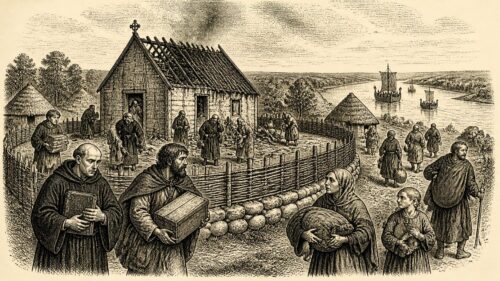
To call these places “monasteries” should not conjure images of isolated groups of monks behind stone walls. Major Irish churches were religious communities, but also estates and settlements. They possessed land, livestock, food stores, workshops, books, metalwork, dependants and ties to aristocratic patrons. Their churches and cemeteries drew pilgrims, tenants and visitors. Their wealth, mobility and ritual prestige made them conspicuous targets. A raid could mean theft, intimidation, damage to buildings and disruption of the people who cultivated surrounding land or maintained religious life; the annals, however, do not specify which of those things happened at each site in 834.
The notices also do not prove that one fleet struck all three places, still less that the same raiders faced Dúnadach in Munster. Their value lies in their geographical spread. In one annal-year, violence attributed to foreigners reached a celebrated inland Leinster foundation, an important Boyne church and another named ecclesiastical community. Raiding had become a recurring hazard across networks of river, coast and road.
Fire at Clonmacnoise
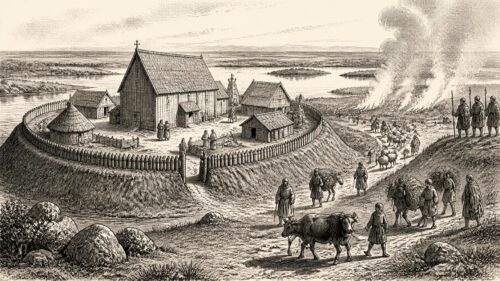
The year’s most troubling ecclesiastical notice concerns Clonmacnoise. The Annals of Ulster record that much of the great Shannon-side settlement was burned. Crucially, the annalist does not identify the people responsible. It must not therefore be presented as a Viking attack. Fire was an ever-present danger in settlements where timber buildings, thatch, stored fuel and closely occupied enclosures were common; deliberate burning in conflict was also familiar. The source simply does not decide between accident, feud or attack.
The loss mattered. Clonmacnoise occupied a strategic position beside the Shannon, close to the east–west route later known as the Esker Riada. It was a religious centre, a place of learning and craftsmanship, and a meeting point between different regions. A serious fire could disrupt worship, accommodation, food preparation, storage, writing and the reception of travellers. The surviving stone ruins should not mislead: much of the ninth-century settlement would have been built of more vulnerable materials. The annal’s brevity leaves the human cost unknown, but its decision to record the blaze indicates damage on a memorable scale.
Deaths and Political Change
Several deaths registered in 834 show how closely kingship, kinship and church office were woven together. Cellach son of Bran, king of Leinster, died. He had ruled from 829 and belonged to the Uí Muiredaig branch of the dominant Uí Dúnlainge dynasty. His death opened a question of succession at a time when Leinster was exposed both to Scandinavian raiding and to pressure from stronger neighbouring rulers. The sources do not date the succession within the year, and they should not be used to turn Cellach’s death into a simple explanation for every subsequent event.
The annals also record the death of Cináed son of Conaing, styled king of Tethba in the Annals of Ulster; later annalistic wording differs over his territorial designation. This is a small but telling example of the limits of the evidence. Titles in the annals signal real political standing, but they can be compressed, inconsistent or shaped by later editorial traditions. In the north-east and midlands, Suibne son of Artrach, king of all Mugdorna, was killed by his own brothers, while Conchobur son of Ailill was killed by brothers. Such notices expose the instability within ruling kindreds: family was the basis of power, but also its most immediate danger.
Congalach son of Óengus, king of the Uí Laegaire, also died. These losses did not redraw Ireland at a stroke, yet each created opportunities for rivals, altered obligations among client peoples and affected control of land, tribute and military followings. The political history of 834 was not confined to famous kings at Tara or Cashel. It was made in these smaller lordships as well.
Church, Learning and Continuity
Ecclesiastical offices were equally important. Eógan Mainistrech, abbot of both Armagh and Clonard, died, as did Affraic, abbess of Kildare. Tuathchar, bishop and scribe of Kildare, died too. Their obits demonstrate that women could hold leading institutional office and that scribal learning was important enough to be preserved as part of an ecclesiastic’s public identity. They also underline the breadth of the great churches’ influence: Armagh, Clonard and Kildare were not merely local places of worship, but powerful centres within networks of patronage, education and landholding.
For ordinary people attached to such communities, the year’s shocks would have had practical consequences. Kings and their followers required food renders, accommodation and service. Churches managed crops, cattle and crafts, while households supplied labour and maintained local obligations. Raids and fire threatened movable wealth, harvest stores and security; the death of a king or abbot could unsettle the arrangements on which dependants relied. Yet the annals’ very survival also points to continuity. Clerics continued to write, communities continued to commemorate their dead, and the institutions damaged in 834 endured.
Thus 834 should not be reduced to a simple story of Vikings against Irish people. Dúnadach’s victory, the plundering of named churches, the burning at Clonmacnoise, and deaths among kings, abbots, an abbess and a scribe together reveal a society facing several overlapping pressures. Ireland’s religious settlements were wealthy cultural centres and vulnerable places of refuge; its kings were defenders, rivals and sometimes threats to their own neighbours. The surviving evidence is fragmentary, but it preserves a year in which local resilience and local fragility stood side by side.
Primary Sources
- The Annals of Ulster: Year U834
- TEI Header for The Annals of Ulster
- Chronicon Scotorum
- CELT Project: Chronicon Scotorum
- Annals of the Four Masters
- CELT Project: Annals of the Four Masters
- Vikings in Irish Chronicles, 794–902: Data
- The Vikings in Ninth-Century Ireland: Sources and Settlements
- The Chronology and Sources of the Early Irish Annals
- Exploring the Irish Annals
- Fedelmid (Feidlimid)
- Niall Caille
- Bran Ardchenn
- Forannán
- Glendalough, County Wicklow
- Hill of Slane
- Clonmacnoise Monastic Site
- Clonmacnoise Monastic Site Highlights
- High Crosses
- Irish School of Illumination, c. 650–1100
- Early Christian Monasteries
- Archaeological Survey