Blathmac and Bread Famine825 CE
Conventionally dated 825, though annalistic chronologies vary, this cluster of Irish events records pestilence, famine and bread scarcity affecting vulnerable people across Ireland. Raiders plundered Downpatrick, Movilla and Inis Daimle, but Ulaid defeated them at Mag Inis; elsewhere raiders routed Osraige. Blathmac son of Flann was killed on Iona, later commemorated as a martyr. Numerous prominent clerics and several kings died, highlighting fragile religious and political networks. Armagh’s bishop Artrí extended Patrick’s law over Connacht, asserting ecclesiastical authority. The notices do not describe a unified national crisis but reveal overlapping hardship, violence, leadership losses and competing regional authority within Ireland.
Dateline
The year conventionally labelled 825 in the Irish annals brought an unusually concentrated record of suffering. A severe pestilence and famine were reported across Ireland; raiders struck religious centres in the north-east and defeated Osraige; a Columban cleric, Blathmac son of Flann, was killed on Iona; and Armagh’s bishop Artrí extended the authority of Patrick’s law across Connacht. These were not parts of one coordinated national crisis: early medieval Ireland had no single government, and the annals preserve separate notices rather than a continuous narrative. Yet read together, they show communities coping with sickness, hunger, violence and contested authority in the same annalistic year.
Dating a Difficult Year
There is an important caution at the outset. The principal Irish chronicles do not align perfectly. The Annals of Ulster and Chronicon Scotorum place the central cluster of events under 825, while the seventeenth-century Annals of the Four Masters, drawing on related earlier material, assigns much of it to 823. The heading of the Ulster annal itself also reflects a one-year discrepancy in its internal chronology. It is therefore responsible to treat 825 as the conventional modern label for this group of events, rather than to claim that each happened on a known day, or even necessarily within the same modern calendar year.
The annals are terse records, compiled and copied long after many ninth-century events. They identify deaths, raids, defeats and ecclesiastical acts, but seldom explain causes, numbers, motives or consequences. Their silences matter. What follows distinguishes their explicit testimony from the broader context needed to understand why those short notices carried such weight.
Pestilence and Lack of Bread
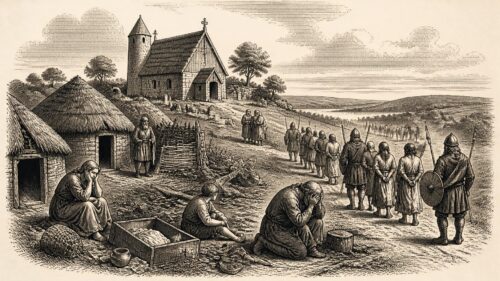
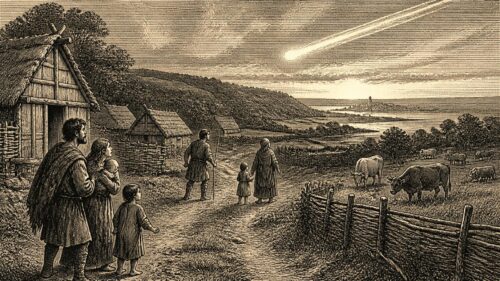
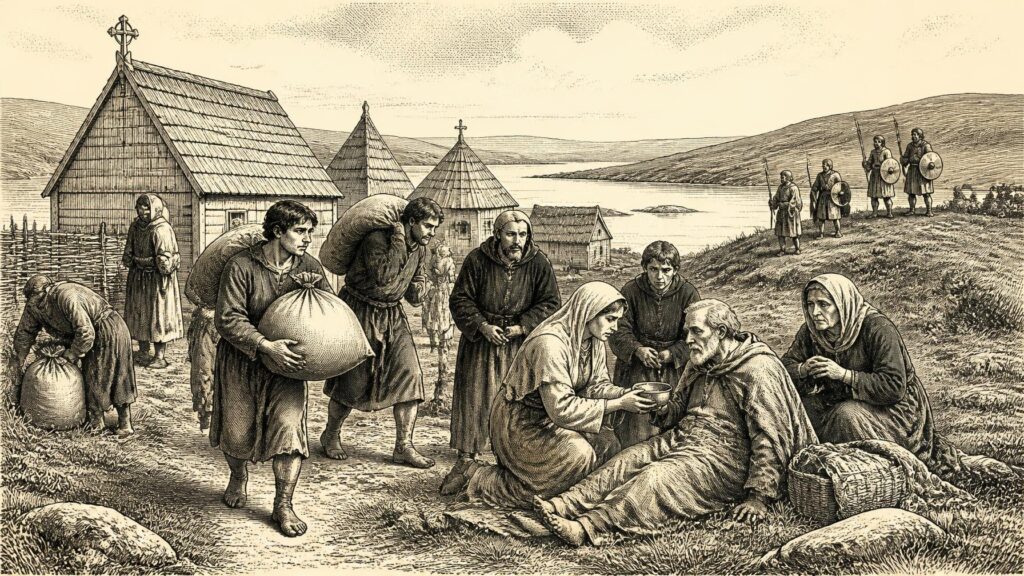
The most sweeping entry is also the most troubling. The Annals of Ulster report “a great pestilence in the island of Ireland”, affecting the old, children and the weak, followed by great famine and a shortage of bread. Chronicon Scotorum similarly records pestilence, great hunger and scarcity of bread. The wording offers no diagnosis: it cannot securely be identified as any particular disease, nor can a failed harvest, weather event or warfare be assigned as its cause. Nor should the phrase be treated as a modern statistical account of mortality.
Even so, the selection of those thought most exposed is revealing. Infants and children, elderly people and those already frail were understood to be especially vulnerable when illness and inadequate food overlapped. “Bread” need not imply that every household lived chiefly on wheaten loaves; it is the annalists’ shorthand for a grave failure in the food supply. In a largely rural society dependent on grain, livestock, dairying and local labour, such scarcity would have tested households, tenants, dependants, religious communities and travelling poor alike. It could also weaken the capacity of local rulers to feed followers, dispense hospitality and protect their territories.
The sources do not permit a map of the famine’s intensity or duration. Their claim that it affected Ireland is best read as an island-wide judgement by the chroniclers, not proof that every district suffered in the same way. Nonetheless, it is exceptional for the annals to pair epidemic disease so directly with a shortage of bread. The entry gives 825 its strongest claim to be remembered as a year of social distress rather than merely another sequence of elite deaths and raids.
Raids Along the Coasts
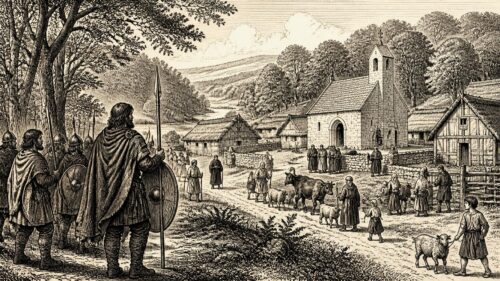
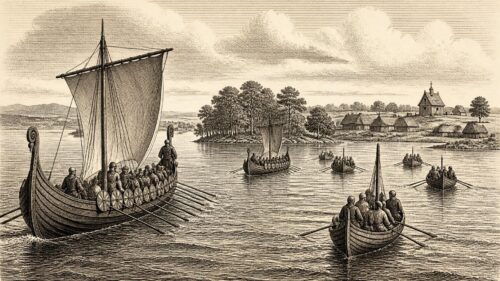
Against this background, raiders described by the Irish chronicles as gentiles, or heathens, attacked a series of places. Dún Lethglaise, the important ecclesiastical settlement at modern Downpatrick, was plundered. Mag Bile, generally identified with Movilla near Strangford Lough, was burned with its oratories or subsidiary churches. Inis Daimle was also plundered. These entries show that monasteries and churches were exposed not simply as isolated sacred sites but as communities possessing food, metalwork, books, livestock, vessels, stores and people who could be robbed or taken.
It would be misleading, however, to imagine a single Viking army methodically conquering Ireland. The annals do not name a leader, fleet, homeland or permanent base for these attacks. Their language labels the attackers by religion and outsider status, not with the precision modern readers might want. In 825, raiding was still the clearest recorded form of Scandinavian pressure in Ireland. The evidence does not show a settled Norse town, a kingdom or an enduring longphort being founded that year.
Local resistance was real. The Ulaid inflicted a rout on the raiders at Mag Inis; the Four Masters specifies Mag Inis in Lecale, south-east of modern Downpatrick, and says that many attackers were killed. This was a significant counterstroke in precisely the region where Dún Lethglaise and Mag Bile had been struck. But it did not make the coast secure. In the same annalistic cluster, the raiders inflicted a rout on Osraige, the powerful kingdom spanning much of present-day Kilkenny and nearby districts. The juxtaposition is a useful corrective to any simple story of either helpless victims or uniformly successful defenders.
Blathmac at Iona
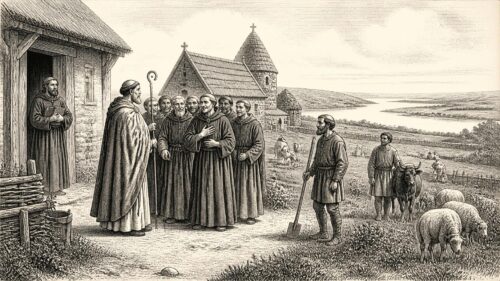
The year’s best-known death occurred beyond Ireland’s modern shores but belongs directly to Irish history. Both the Annals of Ulster and Chronicon Scotorum record the martyrdom of Blathmac son of Flann at Í Coluim Chille, Iona. Iona lay in the western sea off present-day Scotland, but it was a foundation of Colum Cille and a central house of a religious familia linking Ireland, western Britain and the Continent. Its vulnerability therefore resonated deeply in Irish ecclesiastical life.
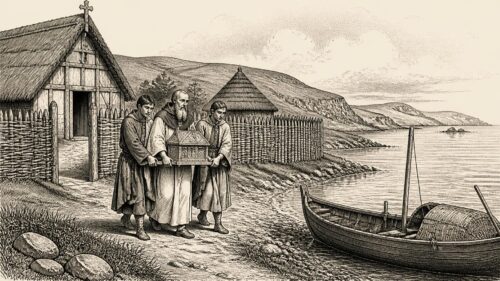
A Latin verse life of Blathmac, composed some years later by the continental scholar Walahfrid Strabo, expands the bare annalistic notice. It presents Blathmac as a high-born monk who remained when others fled, concealed Colum Cille’s shrine and was killed after refusing to reveal it. That moving account should not be read as a neutral eyewitness report: it is a martyr narrative, shaped by religious ideals and the conventions of hagiography. Yet its relatively early date and its detailed concern with the Columban shrine make it important evidence that news from this Irish-Scottish monastic world travelled as far as the Frankish realm.
Whether every detail of the poem is accepted or not, the annals firmly preserve the core fact that Blathmac died violently at Iona at the hands of raiders. His death made material loss, religious memory and personal sanctity inseparable. A raid could destroy buildings and seize valuables; the commemoration of a martyr transformed it into a story about safeguarding a saint’s presence and a community’s identity.
Churches, Learning and Authority
825 was also marked by an imposing list of ecclesiastical deaths. Cuanu of Lugmad was remembered as both scholar and bishop. Diarmait grandson of Áed Róin was called an anchorite and “teacher of religion for all Ireland”, a formula of exceptional esteem. Cuimnech of Finglas, Áedán of Tallaght, Flannabra of Mag Bile and Flann son of Fairchellach of Lismore were among the heads of prominent religious communities who died. The annals do not tell us how their successors were chosen or how far illness contributed to these deaths, but their accumulation points to a year in which networks of learning, worship, landholding and lordship lost experienced leaders.
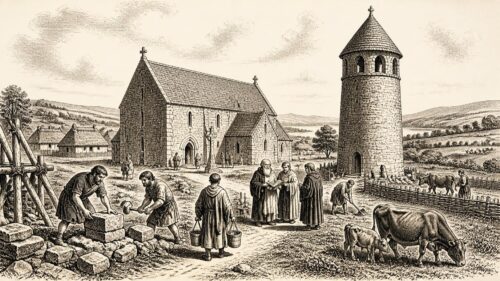
Colmán son of Ailill, abbot of Sláine and of other monasteries in Ireland and Francia, is particularly striking. The wording does not prove that he personally travelled between every house named or that he governed them in a modern administrative sense. It does, however, preserve a valuable reminder that Irish ecclesiastical careers could be connected to Frankish religious worlds. Monasteries were places of prayer and scholarship, but also centres with estates, clients, craftworkers, visitors and political patrons. Their leaders mattered far beyond the church enclosure.
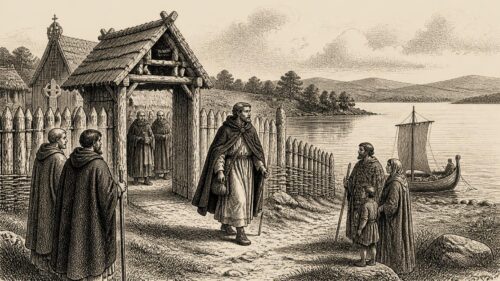
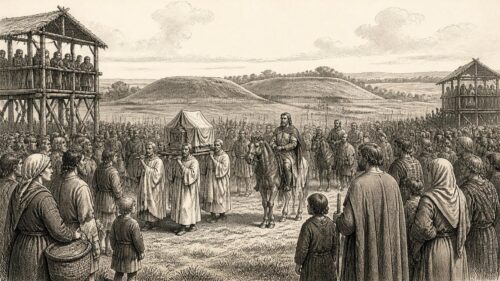
At the same time, Artrí son of Conchobor, bishop of Armagh, imposed Patrick’s law on the three Connachta. The annal does not provide the text of the law or describe a public assembly. Elsewhere, Patrick’s law is associated with protection for clergy and churches and with the collection of dues or tribute in support of Armagh, enforced through the prestige of Patrick and his relics. Its promulgation in Connacht was therefore an exercise in both religious and political authority: Armagh was asserting that the saint’s protection, and the obligations attached to it, extended westward across several major populations.
Local Kingship, Uncertain Succession
Several secular rulers died: Fergal son of Cathrannach, king of Loch Riach; Máel Bresail son of Ailill of Cúib, king of Dál Araidi; and Áengus son of Máel Dúin, king of Loch Gabor. No successor is supplied in the 825 notices. Such deaths did not automatically produce a stable hereditary transfer. Kingship within Irish dynasties was competitive, and changes of ruler could alter alliances, tribute, military followings and relations with nearby churches. The killing of Fallomon son of Fogartach by his own kinsman, Cellach, offers a further stark indication that kinship was a field of rivalry as well as solidarity.
There is no securely dated grand battle between the leading Irish overkings in this annalistic year. Its politics are instead visible in smaller but consequential acts: local rulers died, a man was killed within his kindred, churches suffered attacks, Ulaid fighters won a battle, and Armagh extended Patrick’s law. Ireland in 825 was not a passive island awaiting external transformation. Its many kingdoms and church federations were already active, competitive and deeply interconnected.
A Year of Overlapping Pressures
The evidence does not warrant calling 825 a decisive national turning point. It does show a year in which ordinary survival was likely harder for many people, while religious institutions and regional rulers faced immediate threats. Hunger and pestilence exposed physical vulnerability; raiding exposed coastal and island communities; the deaths of abbots and kings exposed the fragility of leadership; and the extension of Patrick’s law showed Armagh seeking to turn sacred prestige into practical authority. The annals’ compressed notices leave much unknown, but they preserve enough to make this a vividly difficult year in early medieval Ireland.
Primary Sources
- The Annals of Ulster: Year U825
- Chronicon Scotorum: Annal CS825
- Annals of the Four Masters: Annal M823
- Vikings in Irish Chronicles, 794–902: Data
- The Annals of Ulster
- Chronicon Scotorum
- Annals of Tigernach
- Annals of Inisfallen
- CELT: List of Published Texts
- Exploring the Irish Annals
- Blathmac
- Patrick (Patricius, Pátraic, Pádraig)
- Iona in the Kingdom of the Picts: A Note
- Vikings in Ireland
- Vikings in Scotland and Ireland
- History and Stories: Iona Abbey
- St Mary's Abbey, Iona, Monastic Settlement
- Annals of Inisfallen to Go on Public Display in University College Cork
- Annála Ríoghachta Éireann III–VI
- Royal Irish Academy Abbreviations List
- Recreating the Book of Kells
- Iona Abbey: Large Print Audio Guide Script