Ice Roads and Brega822 CE
In 822, Irish annals recorded an exceptional frost that froze seas, lakes and rivers, enabling herds, horses and laden traffic to cross waterways. Political conflict centred on Brega, where Murchad of Cenél nEógain gained secret submissions before Conchobor of Clann Cholmáin reasserted control through devastation and coercion. Warfare also killed rulers and nobles in Connacht, Bréifne, Ard Ciannachta and the midlands. Ecclesiastical leaders died at Birr, Achad Bó Cainnig and Lugbad, illustrating churches’ roles. Chronicon Scotorum reports raids on Daiminis and Corcach. These notices portray a Ireland shaped by environmental change, dynastic rivalry, local warfare, religious institutions and seaborne vulnerability.
Dateline
The year conventionally cited as 822 in the Irish annals was remembered for two very different kinds of movement. One was extraordinary and environmental: a hard freeze bound seas, lakes and rivers in ice, allowing livestock and laden traffic to cross where water normally obstructed them. The other was political and violent: armies moved into Brega, rival branches of the Uí Néill contested authority, and local kings and peoples across Connacht, Bréifne and the midlands fought costly conflicts. These reports do not describe a single national story. They reveal an Ireland of many lordships, ecclesiastical centres and kin-groups, linked by roads, rivers, obligations and competition.
There is a necessary caution about dating. The principal sequence is conventionally referenced as the Annals of Ulster’s annal for 822, although its surviving chronological heading has a one-year offset. Modern historians normally discuss the events below under 822, while the single precisely dated military notice within the entry is placed on 1 November. Chronicon Scotorum independently places the exceptional frost, the death of Eochu of Lugbad and raids on southern churches in its annal for 822. Such agreement is valuable, but the annals remain terse records compiled and copied over generations, not eyewitness diaries.
A Winter That Changed Routes
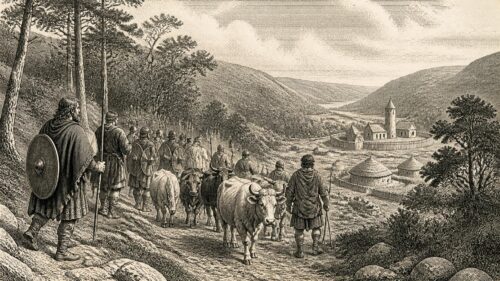
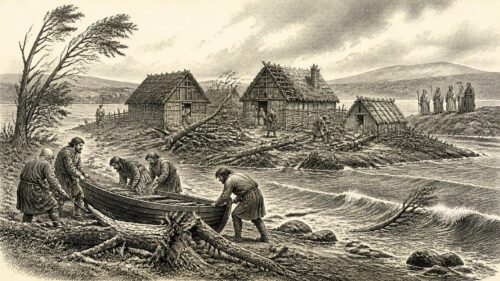
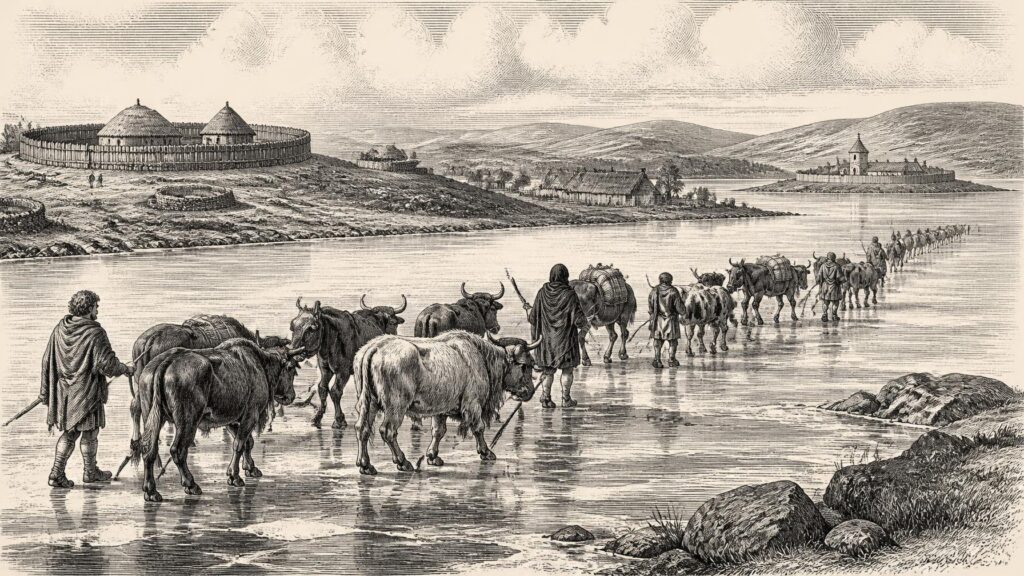
The Annals of Ulster report “abnormal ice”: sea, lakes and rivers froze, and herds of horses and cattle, together with loads, were brought across them. Chronicon Scotorum similarly describes a great frost in which seas and lakes froze and horses and burdens travelled over them. The wording is striking because it registers not merely cold weather but a transformed landscape. Waterways that ordinarily divided territories and dictated journeys became temporary roads.
The record should not be expanded into claims of island-wide famine, crop failure or a known death toll; none is supplied. Nor can it tell us how long the freeze lasted. Yet the specific mention of animals and freight gives a glimpse of daily economic realities. Cattle and horses were essential stores of wealth and labour, while loads imply the movement of food, fuel, produce, equipment or tribute. In a society where most people lived in dispersed rural settlements and depended on mixed farming, an exceptional freeze could ease some journeys while endangering fodder, animals and people. The annalist’s interest lay in the marvel of frozen water, but the disruption and opportunity it created would have been widely felt.
Frozen routes had military implications as well. Armies usually depended on roads, fords, boats and local supplies; winter ice might alter the practical geography of a campaign. There is no source stating that the conflicts of 822 were enabled by the frost, and it would be unsafe to make that connection. But the juxtaposition reminds us that political power was exercised in a physical landscape whose rivers, wetlands and estuaries could either limit or accelerate travel.
Murchad’s Advance into Brega
The most consequential political episode recorded for the year concerned Murchad son of Máel Dúin, leader of Cenél nEógain among the northern Uí Néill. The Uí Néill were not a single unified government: northern and southern branches contained competing dynasties, and senior kings depended on the shifting allegiance of lesser rulers. Since 819, Conchobor son of Donnchad of Clann Cholmáin had held the pre-eminent kingship claimed over the Uí Néill, while Murchad was a formidable northern rival.
In 822 Murchad led “the men of the North” south to Ard Brecáin, an important place in the Boyne region of modern County Meath. The destination mattered. Brega was a wealthy and politically resonant plain, associated with Tara and with branches of the southern Uí Néill. An army reaching Ard Brecáin was therefore not simply raiding distant land: it was making a claim in the contested heartland of royal authority.
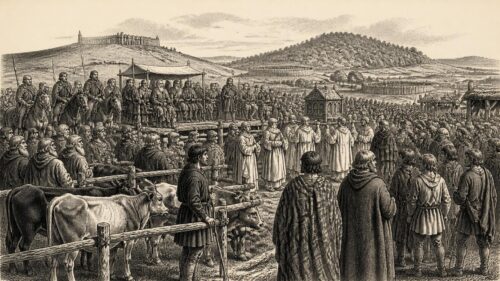
The annal says that men of Brega, specifically Diarmait son of Niall and the descendants of Áed Sláine, secretly went over to Murchad and submitted to him at Druim Fergusa. This was a dramatic, if evidently fragile, gain. Submission was the language of hierarchy, but it did not necessarily mean permanent conquest. It could involve recognition, service, hostages, tribute or support in a particular crisis; the annal does not specify its terms. Its emphasis on secrecy suggests that the men of Brega were negotiating under dangerous pressure, perhaps testing whether Murchad’s northern advance could overturn the existing balance.
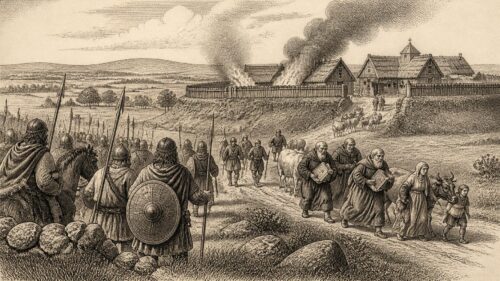
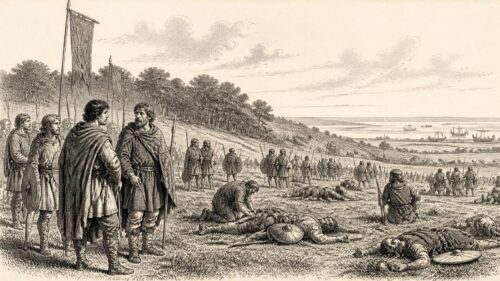
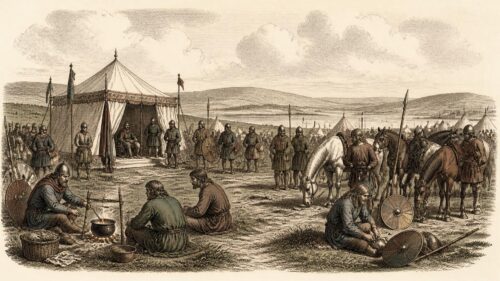
Conchobor answered forcefully. He entered Brega, made camp at Gualu, and returned to devastate southern Brega. On 1 November, the annalist says, a very great number of southern Brega’s men fell before him, and the Uí Chernaig submitted “under compulsion”. The phrase makes the political outcome plain: Conchobor restored obedience through armed coercion. The immediate winner was not necessarily secure for long, but Murchad’s attempt to build support in Brega had been checked.
Another entry underlines the severity of the contest. Cumuscach son of Tuathal, king of Ard Ciannachta, was killed by Murchad. Ard Ciannachta lay in the wider Brega area, and its ruler’s death shows how the rivalry between major Uí Néill leaders reached into smaller kingdoms. The annals do not explain the circumstances, so it should not be labelled an assassination or retaliation. What can be said is that the struggle for influence was conducted not only through great hostings and public submissions but also through the removal of local rulers.
Wars Beyond the Boyne
Conflict was no less intense elsewhere. At Tarbga, the Connachta fought one another. The Uí Briúin were defeated, and many nobles died, including Dúnchad son of Maenach and Gormgal son of Dúnchad. The victors were the Uí Maine and Diarmait son of Tomaltach. This was not a clash between a simple Connacht kingdom and an outsider. It was an internal contest among powerful kindreds, showing that regional names in the annals often conceal competing centres of power.
Further north-east, Cenél Feidilmthe inflicted a slaughter on the men of Bréifne, killing their king, Máel Dúin son of Échtgal. Another battle saw Cumuscach son of Congalach rout the men of Ard Ciannachta; Eudus son of Tigernach and many others fell. Finally, the Uí Garbáin, Cuircne and Felle together defeated the Delbna. These brief notices offer few tactical details, but their accumulation is meaningful. Early medieval political life was not dominated solely by distant overkings. Local confederacies, neighbouring peoples and dynastic branches could mobilise, raid, defend territory and kill rulers in struggles whose consequences were immediate for farming communities obliged to provide food, animals and fighting men.
The deaths of named nobles also demonstrate what the annals valued. They rarely count ordinary casualties, but they preserve the names of kings and leading men because lordship rested on personal networks. A defeated ruler could mean a reordering of tribute, clientship, landholding and protection. The violence of 822 was therefore more than a sequence of battles: it was a mechanism through which political relationships were remade.
Churches, Learning and Vulnerability
Ecclesiastical notices offer a quieter but equally revealing view of the year. Mac Riaguil grandson of Magléne died as scribe, bishop and abbot of Birr. The combination of offices is important. Birr was not merely a place of worship: its abbot could be a religious leader, a manager of estates and people, and, in Mac Riaguil’s case, a scribe associated with learning and written culture. The notice preserves a world in which scholarship, ecclesiastical authority and local power could converge in one person.
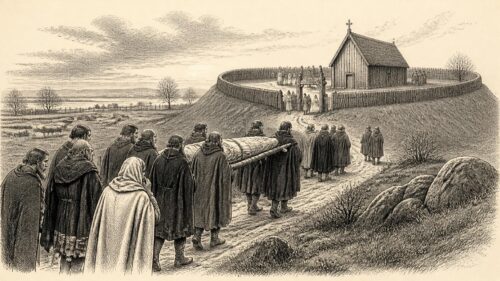
Forbasach, abbot of Achad Bó Cainnig, also died. Eochu grandson of Tuathal, described as anchorite, bishop and abbot of Lugbad, “fell asleep”, the conventional monastic language for death. Lugbad, modern Louth, was an established church settlement in the north-east. Eochu’s titles suggest a career joining solitary religious prestige with the leadership of a community and episcopal standing. These entries cannot tell us what each man wrote, built or taught, but they demonstrate the density of organised religious life and the administrative importance of churches across Ireland.
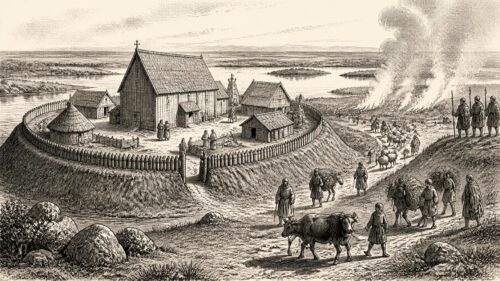
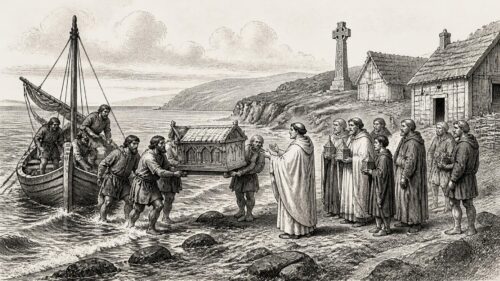
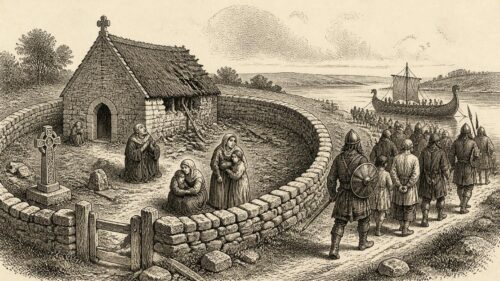
Chronicon Scotorum adds a darker southern notice: Daiminis and Corcach were plundered by heathens. Daiminis, on the Shannon estuary, and Corcach, Cork, were ecclesiastical communities with access to waterways. The Annals of Ulster do not repeat this report for 822, so it is best treated as a record particular to Chronicon Scotorum rather than as independently confirmed detail. Even so, it fits the wider early ninth-century pattern in which seaborne raiders targeted wealthy religious sites. It would be premature to describe 822 as the beginning of permanent Scandinavian urban settlement in Ireland; the longphuirt associated with later sustained Viking occupation belong to a subsequent phase. In this year’s evidence, the immediate reality is plunder and vulnerability, not a documented town foundation.
A Fragmented Island in Motion
By the close of 822, no single development had settled Ireland’s political order. Conchobor had imposed a harsh response in Brega, but Murchad had shown that northern power could reach deeply into the southern Uí Néill sphere. Connacht and Bréifne had endured their own lethal contests. Churches mourned prominent abbots and bishops while some coastal communities faced foreign raiding. Above all, the annals preserve the memory of frozen waters crossed by herds and burdens: an exceptional natural event set beside the familiar movement of armies, clerics and raiders. Ireland in 822 was not static or isolated. It was a landscape of routes—some newly opened by ice, others enforced by kings—and of communities whose fortunes could change with a submission, a battle or a crossing.
Primary Sources
- The Annals of Ulster, Year U822 (English translation)
- The Annals of Ulster, Year U822 (Irish and Latin text)
- Chronicon Scotorum, Annal CS822 (English translation)
- Chronicon Scotorum, Annal CS822 (Irish and Latin text)
- The Annals of Ulster: Corpus of Electronic Texts edition
- Chronicon Scotorum: Corpus of Electronic Texts edition
- Annals of the Four Masters: Corpus of Electronic Texts edition
- Annals of Inisfallen: Corpus of Electronic Texts edition
- Annála Connacht
- Vikings in Irish Chronicles, 794–902: Data
- The Vikings in Ninth-Century Ireland: Sources and Settlements
- The Origins and Rise of the Uí Néill
- Kingship, Society, and Sacrality: Rank, Power, and Ideology in Early Medieval Ireland
- Ordinary People in Early Christian Ireland
- Early Christian Monasteries
- Ringforts / Ráthanna
- The Beginning of the Viking Age in the West
- Vikings in Early Medieval Ireland: Church-Raiding and Politics in the Era of Amlaíb and Ímar
- Early Christian Ireland: extract on Brega, Tara and Uí Néill kingship
- Farming and Archaeology
- Brú na Bóinne Research Framework
- Early Medieval Ireland, c.400–c.1100: map extract