Loch Éirne’s Ice Road817 CE
In 817, severe frost and snow transformed Ireland’s rivers and lakes into temporary routes. People crossed the Boyne dry-shod, hunted and moved livestock on Lough Neagh, and carried oratory materials across frozen Lough Erne. Áed Oirdnide, high king of Tara, imposed a partition of Leinster, while violence there dishonoured and killed church officers. Religious authority travelled: Cuanu took Mochta’s shrine to Munster, and Artrí brought Patrick’s shrine to Connacht. In the west, Uí Briúin rulers defeated Uí Maine at Forath, killing King Cathal and nobles. Fire destroyed a third of Clonmacnoise, emphasising ecclesiastical vulnerability and reconstruction during this extraordinary year.
Dateline
The Irish annals make 817 unusually vivid. Their most striking notice is neither a coronation nor a battle, but a winter so severe that rivers and lakes became routes. The Annals of Ulster, whose entry is headed U818 but explicitly assigns the material to AD 817, reports abnormal ice and heavy snow from Epiphany until Shrovetide. This is the chronological framework followed here. Other annal compilations arrange some nearby events differently, a useful warning against treating every medieval annal-heading as a modern calendar date. Yet the Ulster record gives firm grounds for seeing 817 as a year in which extreme weather, royal intervention, ecclesiastical mobility and regional warfare all pressed upon ordinary communities.
A Winter That Reordered Travel
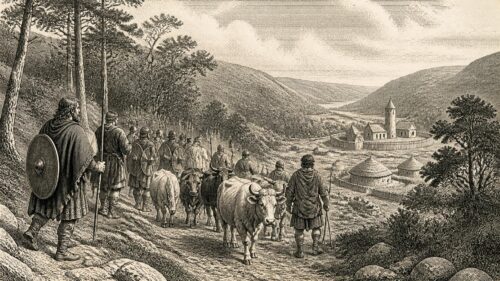
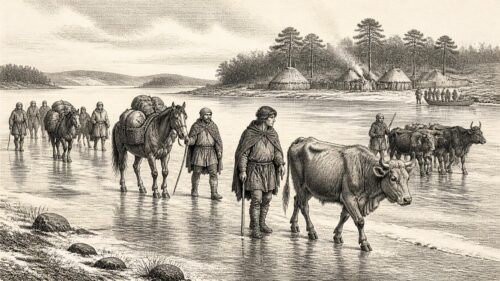
From 6 January until the approach of Lent, according to the annalist, the Bóinn or Boyne and other rivers could be crossed dry-footed. Lakes froze as well. The language is purposeful: this was not merely a cold spell but an inversion of the normal Irish landscape, in which waterways were usually barriers, channels for boats, sources of fish, and boundaries between territories. On Loch nEchach, modern Lough Neagh, herds were taken on to the ice and hunting parties pursued wild deer. The entry preserves a rare glimpse of practical activity rather than elite politics alone: livestock were moved, people travelled in groups, and hunting took advantage of an extraordinary surface.
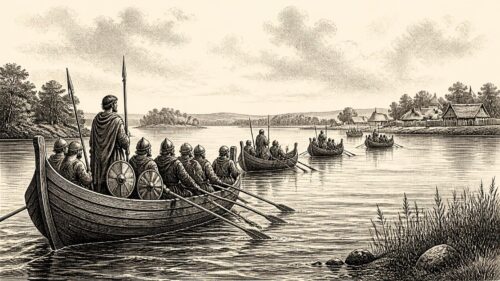
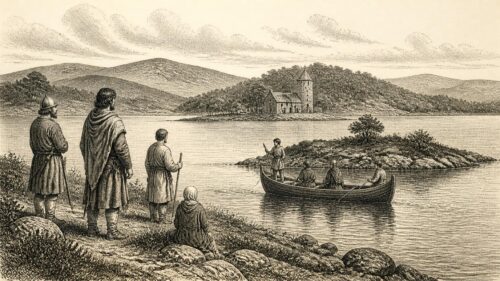
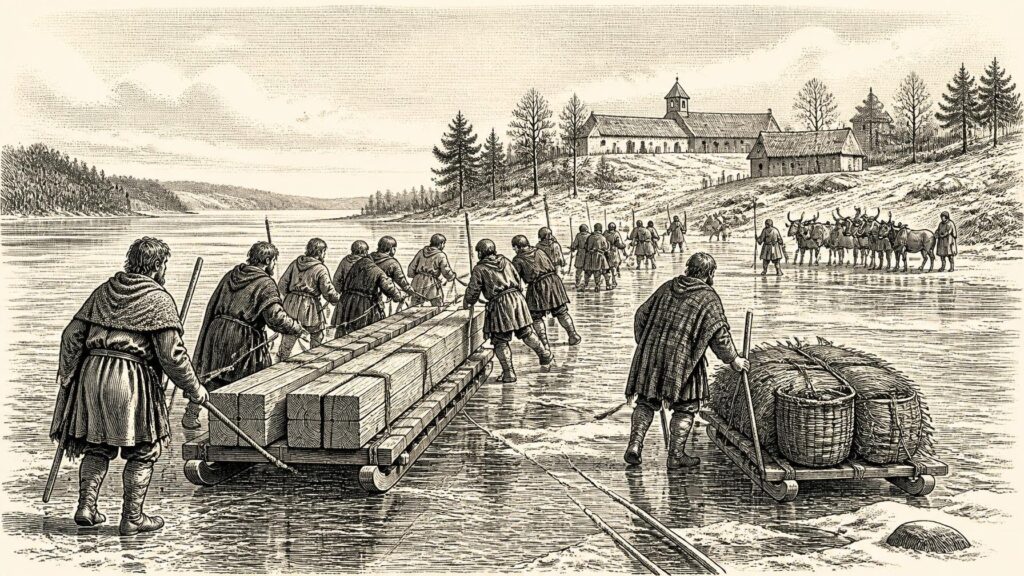
The most remarkable consequence lay farther west. A large company carried materials for an oratory from Connacht across Upper and Lower Loch Éirne, the two expanses of Lough Erne, into Tír Ua Crimthainn. The annalist is uncertain about one detail of the labour force, but not about the feat itself. Timber, stone or other building materials that would ordinarily have required difficult transport around shorelines or by water could temporarily be moved over the frozen lakes. We should not imagine a modern road or a safely engineered crossing: the source records an exceptional improvisation in frost and hail. Nevertheless, it demonstrates both organised labour and a religious building project able to command it.
The episode also corrects any simplistic picture of early medieval Ireland as isolated settlements separated by impassable terrain. Most travel was arduous and local, but people, animals, goods and ecclesiastical resources already moved through connected regions. The freeze made those connections startlingly visible. It did not create the networks between Connacht, Lough Erne and the northern interior; it temporarily altered their cost, direction and speed. For households dependent on cattle, stored grain, fuel and local exchange, however, the same weather may have been deeply disruptive. The annals do not report famine for 817, so hardship should not be assumed as a fact, but the duration of the freeze makes its effects on work and provisioning difficult to dismiss.
Áed Oirdnide and Leinster
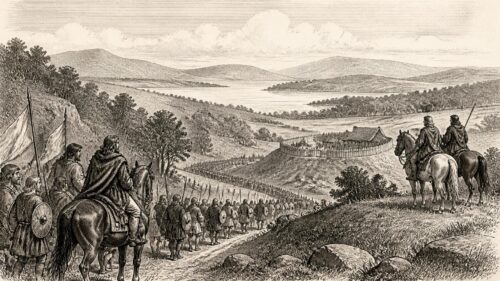
The year also exposed the limits of Leinster’s independence. Muiredach son of Bran, described as one of two kings of Laigin, died. In the same annual sequence Áed son of Niall, better known as Áed Oirdnide, marched with forces to Dún Cuair and divided Leinster between two grandsons of Bran. Dún Cuair is generally identified with Rathcore in present-day County Meath, a place well suited to a meeting at the edge of the midlands rather than a neutral assembly in Leinster itself. The detail that Áed came with forces matters. This was an imposed settlement, backed by the military reach of the king of Tara, not simply an act of arbitration among willing partners.
Áed belonged to the northern Cenél nÉogain branch of the Uí Néill and had held the paramount kingship since 797. His dealings with Leinster were part of a longer pattern, but only the division at Dún Cuair can securely be placed in 817. The annals do not tell us what each grandson received, how long the arrangement endured, or whether local communities accepted it. They do show that the political map of Leinster could be redrawn by an outside ruler. Kingship in this period was not a single, settled national office. It rested on personal dominance, hostings, negotiated submission, dynastic claims and the capacity to distribute or recognise authority among subordinate rulers.
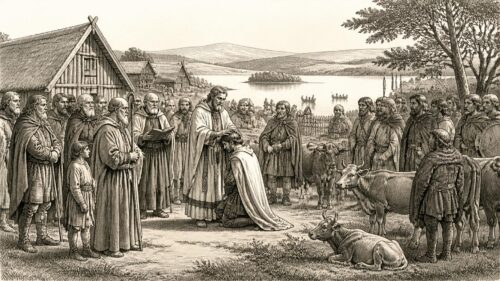
That intervention was shadowed by violence involving churchmen and Leinster men. The superior of Cell Mór Enir was dishonoured, while its prior, Dub Innrecht, was killed by the Laigin despite being under their protection. Medieval Irish sources often treat the breach of protection as a particularly serious wrong; the brief entry therefore conveys more than an isolated killing. Its precise local setting remains uncertain, as several early churches bore similar names, and the annalist supplies no motive. What can be said is that a religious community’s officers were caught in a conflict where obligations of safety failed. Ecclesiastical standing offered influence, but it did not remove clergy from political danger.
Shrines on the Move
Religious life in 817 was notably mobile. Cuanu, abbot of Lugmad, went into exile in Munster carrying the shrine of Mochta. Lugmad is Louth, associated with St Mochta, and the shrine was no passive devotional object. A saint’s relics embodied the identity, prestige and legal claims of a church community; taking them south ensured that the community’s patronal presence travelled with its displaced leader. The annal does not explain why Cuanu left, nor does it say whether his whole community accompanied him. Exile should therefore not be embellished into a known expulsion or raid. It is enough to recognise a significant act of removal across provincial boundaries.
Artrí, superior of Armagh, likewise travelled to Connacht with the shrine of Patrick. This was a circuit of a different scale. Armagh’s claim to Patrick’s heritage was a foundation of its authority, and the shrine brought that authority physically into another province. Such journeys could bind churches and rulers through ritual, hospitality, gifts and the public acknowledgement of saintly protection, although none of those individual transactions is recorded for this particular progress. Artrí was already a prominent figure in Armagh’s leadership and would become abbot there later. In 817, the annal allows a more careful conclusion: the Patrician community actively projected itself westward rather than remaining confined to its northern base.
These two movements, one into Munster with Mochta’s shrine and another into Connacht with Patrick’s, make the island’s religious geography more dynamic than modern maps suggest. Churches were landholders, employers, centres of learning and custodians of sacred objects, but they were also institutions whose people and treasures travelled. The oratory materials carried over frozen Lough Erne belong in the same wider picture. Religious communities required buildings, labour, transport and protection; their spiritual standing worked through very material means.
War in the West
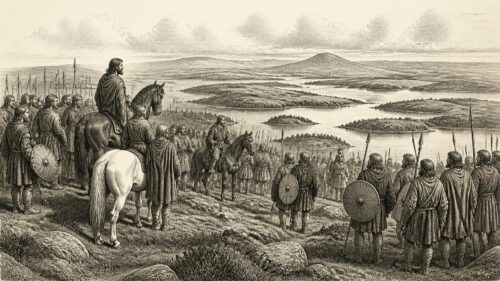
In the territory of Delbna Nuadat, the battle of Forath brought a decisive defeat for the Uí Maine. Their king Cathal son of Murchad fell, along with “very many” nobles, while Diarmait son of Tommaltach and Máel Cothaid son of Fogartach, kings of the Uí Briúin, were victorious. The formula is concise, but its political consequences were substantial. A king and leading men were lost together, weakening one regional confederation while enhancing rival Uí Briúin rulers. The entry does not turn this into a conquest of all Connacht, and it would be misleading to do so. It records a localised but elite-heavy victory in the contested west-central zone.
The battle belongs beside Artrí’s Patrician circuit, not because the sources connect them directly, but because together they show Connacht as an arena of both armed competition and ecclesiastical engagement. Political power was dispersed among dynasties and lesser kingdoms; no provincial label erased those rivalries. Clerical visitors and relics could make claims of authority across such divisions, while kings fought over land, clients and precedence within them.
Loss and Recovery at Clonmacnoise
On 21 October, a third part of Cluain Moccu Nóis, Clonmacnoise, was burned again. The wording indicates that fire had already affected the great Shannon-side monastery, but does not identify the cause of this latest destruction. There is no warrant for calling it a raid, accident or deliberate arson. What is secure is the scale: one third of a major ecclesiastical settlement was damaged. In an age when many structures were timber-built and roofs readily combustible, fire could erase dwellings, workshops, stores and church buildings with alarming speed.
Clonmacnoise’s loss underlines why the winter transport of oratory materials is so important. Building and rebuilding were persistent realities of Irish religious life, not exceptional adornments to an otherwise static world. In 817 communities faced weather severe enough to transform lakes into thoroughfares, rulers capable of partitioning a neighbouring province, shrine-bearing churchmen crossing Ireland, and fire in one of its foremost monasteries. The annals preserve only flashes, chiefly where power, property and sacred institutions were involved. Even so, they reveal a society whose everyday labour and long-distance connections were inseparable from the contests of kings and churches.
Later tradition and some later annalistic arrangements associate Áed Oirdnide with further devastation in Leinster and with his death near Áth Dá Ferta, but these developments belong after 817 in modern historical dating and should not be folded into this year’s record. The significance of 817 lies instead in what its securely dated notices disclose: Ireland’s landscape could suddenly become an ice-bound transport network, while authority continued to be negotiated by armed assembly, dynastic division, relic procession and communal reconstruction.
Primary Sources
- The Annals of Ulster, Year U818 (AD 817)
- Annals of the Four Masters, Annal M817
- The Annals of Ulster (to AD 1201)
- Annals of Tigernach
- Chronicon Scotorum
- Annals of Inisfallen
- The Martyrology of Oengus the Culdee
- Áed Oirdnide
- Artrí
- Conchobar
- Áed Oirdnide mac Néill: (d. 819), high-king of Ireland
- The Economy of Early Medieval Ireland
- The Archaeology of Livestock and Cereal Production in Early Medieval Ireland, AD 400-1100
- Early Medieval Ireland: Archaeological Excavations, 1930-2009
- Early Medieval Dwellings and Settlements in Ireland, AD 400-1100. Vol. 1: Text
- Glendalough: History
- Glendalough, County Wicklow
- Aspects of Leinster Archaeology and Landscape: XX INQUA Congress Field Guide
- Early Irish Monasteries and their Dynastic Connections
- Traveling Monastic Paths: Mobility and Religion at Medieval Irish Monasteries
- Literacy and Identity in Early Medieval Ireland
- Early Christian Ireland: Introduction to the Sources