Half of Clonmacnoise816 CE
Events conventionally assigned to 816 reveal both chronological uncertainty in Irish annals and disruption. Almost half of Clonmacnoise, a timber-built Shannon monastery and centre, burned; no source identifies the cause. Thirty days later its abbot, Suibne son of Cuanu, died, compounding pressures on recovery and leadership. In Connacht, following overking Muirgius’s death, Diarmait son of Tommaltach fought Uí Fhiachrach, burning and plundering Foibrén and killing many common people; Cathal son of Ailill died. A battle involving Uí Maine is linked to conflicts but variously dated 816 or 818. Other notices record ecclesiastical deaths and burning, underscoring churches’ vulnerability amid warfare.
Dateline
The year conventionally called 816 is most clearly illuminated by a calamity at Clonmacnoise, the great Shannon-side church settlement, and by a hardening contest for power in Connacht. Yet it is also a year that demands care from the historian. The Irish annals preserve the events in related but differently dated sequences. Their headings do not always correspond neatly to a modern calendar year. Rather than pretending that every entry can be fixed to a particular day in 816, it is safer to distinguish the evidence itself from the later labels attached to it.
A Year with Unsteady Dates
The principal record is the entry headed U816 in the Annals of Ulster. Its surviving chronological apparatus, however, places that annal under AD 815. Chronicon Scotorum, another member of the same broad annalistic tradition, places the burning of Clonmacnoise and the death of its abbot in its entry for 816. The seventeenth-century Annals of the Four Masters assigns a major Connacht battle to 816 which Chronicon Scotorum places under 818. These differences are not trivial copying errors: they are a warning that Irish annalists organised inherited material through chronological systems that could drift apart.
Accordingly, the events discussed here belong securely to the annalistic horizon conventionally associated with 816, but not all can responsibly be claimed as occurrences of the modern calendar year alone. The most securely dated detail in the relevant Annals of Ulster entry is a great windstorm on 1 November. Even there, the entry’s relationship to an absolute AD year remains complicated. What survives is nevertheless unusually vivid: a riverside religious community was badly burned; its abbot died soon afterwards; and Connacht’s political order was being violently remade after the death of a dominant king.
Fire on the Shannon
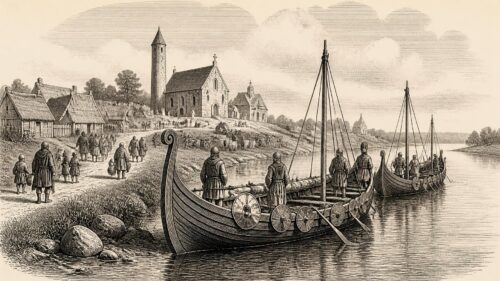
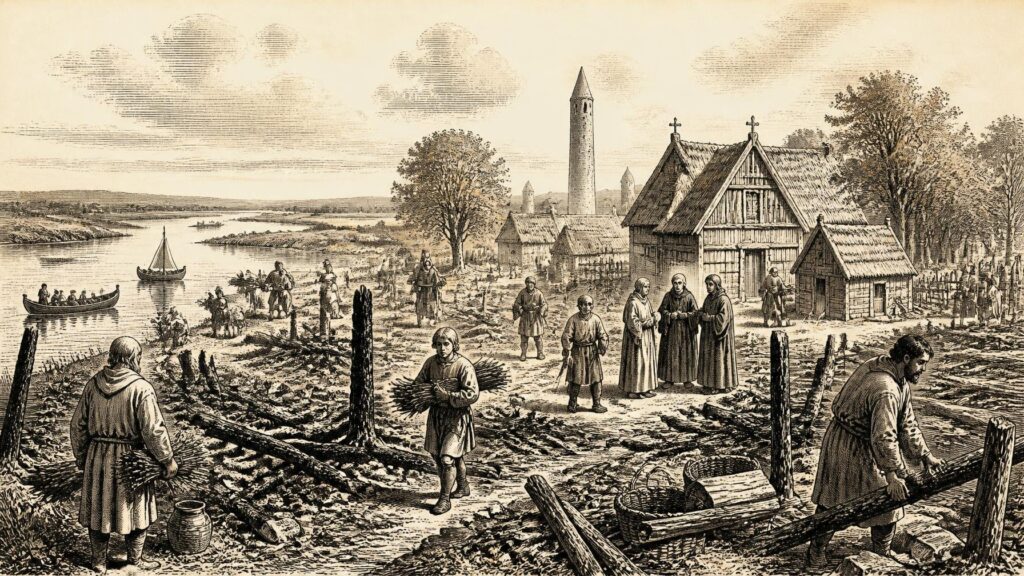
The annalist’s starkest notice is that “almost half” of Cluain Moccu Nóis, Clonmacnoise, was burned. The wording does not identify an attacker, an accident, or a precise season. It should therefore not be turned into a Viking raid, nor should the November storm be assumed to have caused the fire. Neither claim is made by the source. What the notice does establish is the scale of the destruction. This was not the loss of one isolated building, but a disaster affecting a substantial portion of an important ecclesiastical settlement.
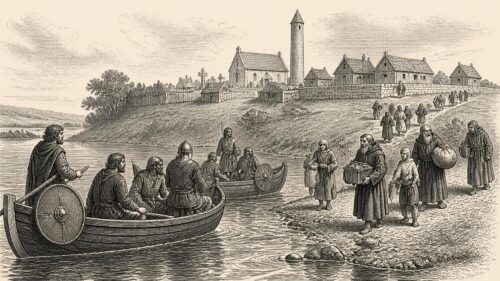
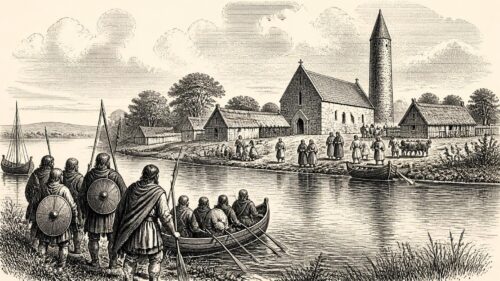
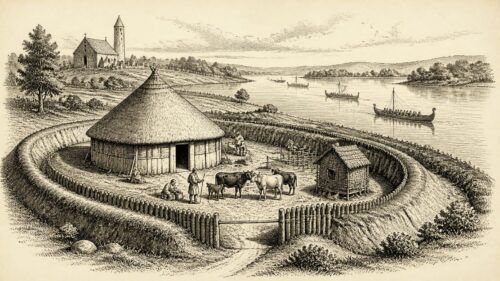
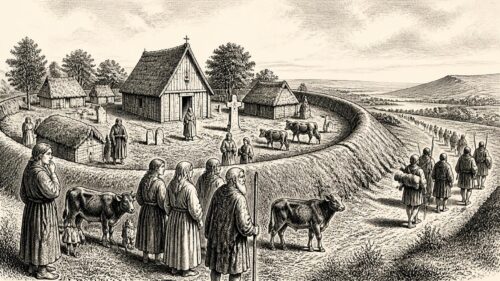
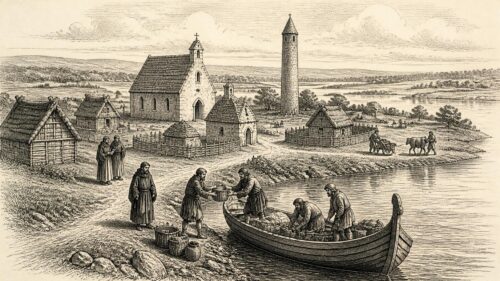
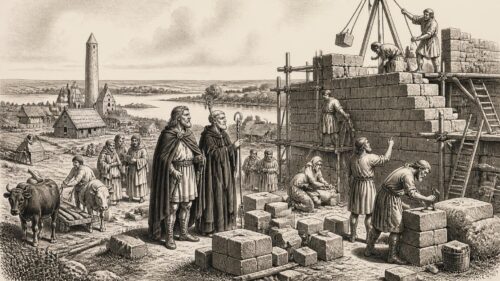
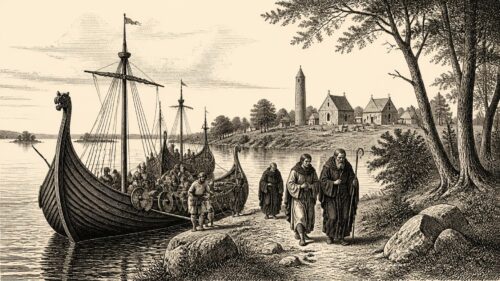
Clonmacnoise stood on the eastern bank of the Shannon, where river movement and overland routes met. Its position made it a place of exceptional connection between Connacht, Mide and wider Ireland. The modern stone churches and monumental crosses visible there mostly belong to later centuries; they must not be projected unchanged into 816. In the early ninth century, much of the inhabited enclosure, its domestic structures, workshops, storehouses and probably many ecclesiastical buildings would have been built of timber. Such a settlement was productive and populous, but timber construction made a spreading fire especially destructive.
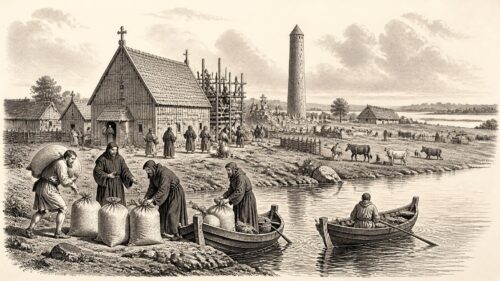
The loss would have reached far beyond a religious congregation. A major monastery depended upon cultivators, herders, tenants, servants, craftspeople, guests and travellers as well as clerics. It required food, fuel, vessels, books, clothing and livestock; it received gifts and rendered hospitality. Fire could destroy working spaces and sleeping quarters, reserves of grain or fodder, tools and portable valuables, while disrupting the routines of worship, teaching and administration. The annals do not list those losses, so their scale cannot be measured. But “almost half” indicates a blow to a community that functioned as both a sacred centre and a regional economic hub.
Suibne’s Final Month
Thirty days after the burning, according to Chronicon Scotorum, Suibne son of Cuanu, abbot of Clonmacnoise, died. The sequence gives his death an immediate human setting without proving that the fire caused it. Suibne was identified as belonging to Uí Briúin Seóla, a Connacht dynasty centred west of the Shannon. His abbacy thus illustrates an important feature of Irish ecclesiastical life: leading churches were not detached from kinship and political networks. Their heads could be learned religious figures, but they also came from families able to provide influence, protection and resources.
An abbot’s death after a major fire posed practical as well as spiritual problems. The community needed to secure its stores and relics, organise rebuilding, preserve its authority over dependent churches and lands, and agree upon a successor. No surviving source tells us who took charge immediately or how reconstruction proceeded. What can be said is that Clonmacnoise endured. Its later reputation for scholarship, craftsmanship and long-distance connections rested partly on the resilience of generations who rebuilt after recurrent crises.
Connacht After Muirgius
The fire occurred amid a change in Connacht’s political balance. Muirgius son of Tommaltach, overking of Connacht, had died in 815. He had spent decades extending the influence of his Uí Briúin Aí kindred from Mag Aí, around modern north Roscommon and north-east Galway, against rival dynasties and subordinate peoples. His brother Diarmait emerged as a principal claimant to the provincial kingship. The entries associated with 816 show that succession was not settled merely by genealogy.
The Annals of Ulster report that Diarmait defeated the Uí Fhiachrach of Muirisc, a powerful Connacht grouping associated with the north-west, and that Foibrén in the territory of Grecraige was burned and plundered. The annalist adds a socially revealing phrase: “very many common people” were killed. Early medieval Irish records frequently name kings, abbots and aristocratic casualties; here, unusually, the suffering of non-elite people is made explicit. Raiding and punitive warfare struck households whose names the record did not preserve, bringing death, displacement and the seizure or destruction of food, cattle and property.
Cathal son of Ailill, king of Uí Fhiachrach, is recorded as dead in the same annalistic cluster. The sources do not expressly say that he died in the battle, so the two notices should not be merged into a single certainty. Together, however, they show the pressure placed upon Uí Fhiachrach leadership during Diarmait’s rise. This was not conflict between a national state and rebellious provinces. Connacht consisted of overlapping dynasties, client peoples and church interests, in which authority had to be repeatedly asserted through alliances, hostings, raids and negotiated submission.
The Disputed Battle of Foráth
A second Connacht conflict has often been attached to 816. The Annals of the Four Masters place a battle at Rath Fhearadh in Delbna Nuadat, between the Suck and the Shannon, in that year. Diarmait and Máel Cothaid son of Fogartach, leaders of Uí Briúin, defeated Cathal son of Murchad, king of Uí Maine, with many nobles killed. Chronicon Scotorum records substantially the same event as the battle of Foráth, but under 818. Because the sources disagree, it is best treated as a conflict closely connected with the unsettled years following Muirgius’s death, rather than as a securely calendar-dated event of 816.
Its setting remains significant. Delbna Nuadat was within the orbit of Uí Maine, whose lands lay across parts of modern east Galway and south Roscommon. Victory there represented more than battlefield prestige: it offered the Uí Briúin leverage over routes, clients and resources in southern Connacht. The participation of both Diarmait and Máel Cothaid also cautions against imagining one uncontested successor. Rival Uí Briúin branches could cooperate when confronting Uí Maine while retaining their own claims within Connacht.
Church, Learning and Everyday Resilience
Elsewhere in the annalistic entry, Ioseph, a scribe of Roscommon, died; Tibraide, abbot of Clonfert, is named by Chronicon Scotorum; and an oratory at Fobar was burned. These compact notices reveal a landscape thick with religious institutions. Scribes mattered because written texts underpinned liturgy, legal memory, saints’ cults, genealogy and the keeping of annals themselves. Their work was not a separate world of quiet scholarship: churches held land, depended upon lay patrons and could become targets or casualties in local rivalries.
Irish religious culture in this period also remained creative and organised. The martyrological tradition associated with Óengus and Tallaght, compiled within a generation or so of these events, reflects a world attentive to saints’ feasts, disciplined worship and learned Latin and Irish composition. Clonmacnoise’s disaster did not extinguish that wider culture. Rather, it shows its material vulnerability. Books, buildings and communities relied on skilled labour, agricultural surplus, patronage and protection. A fire, an abbot’s death or a regional war could put all four under strain.
Thus the year’s surviving evidence is not a tale of inevitable Viking transformation or of a unified Ireland. It is a tighter, more local story: a strategically placed monastery badly burned; a community losing its abbot soon afterwards; and Connacht rulers using force to reshape fragile hierarchies. The sources preserve only fragments, and their dates do not wholly agree. Even so, those fragments bring 816’s world into focus: connected by rivers and churches, governed through kinship and lordship, and repeatedly exposed to the destructive consequences of fire and war.
Primary Sources
- The Annals of Ulster, Year U816
- Chronicon Scotorum, Annals CS815–CS819
- Annals of the Four Masters
- Chronological Synchronisation of the Irish Annals
- The Chronology and Sources of the Early Irish Annals
- Muirgius
- Áed Oirdnide
- Clonmacnoise, County Offaly
- Clonmacnoise Monastic Site
- Early Irish Monasticism
- High Crosses
- National Monuments in State Care: County Offaly
- Archaeological Survey
- Vikings in Irish Chronicles, 794–902: Introduction
- Vikings in Irish Chronicles, 794–902: Data
- The Martyrology of Oengus the Culdee
- The Martyrology of Oengus the Culdee: Text and Commentary
- Annals of Inisfallen
- Book of Leinster, formerly Lebar na Núachongbála
- Exploring the Irish Annals
- Irish School of Illumination, c. 650–1100
- GASAITAR na hÉireann