Lough Erne1435 CE
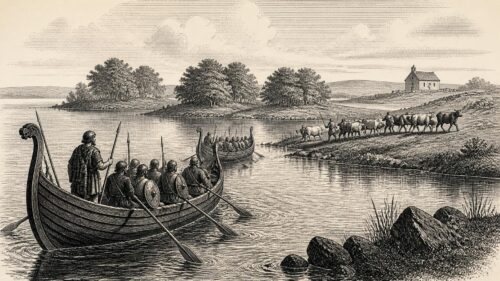
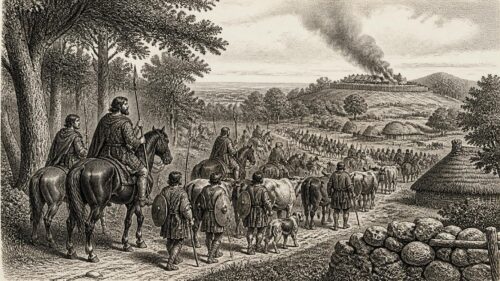
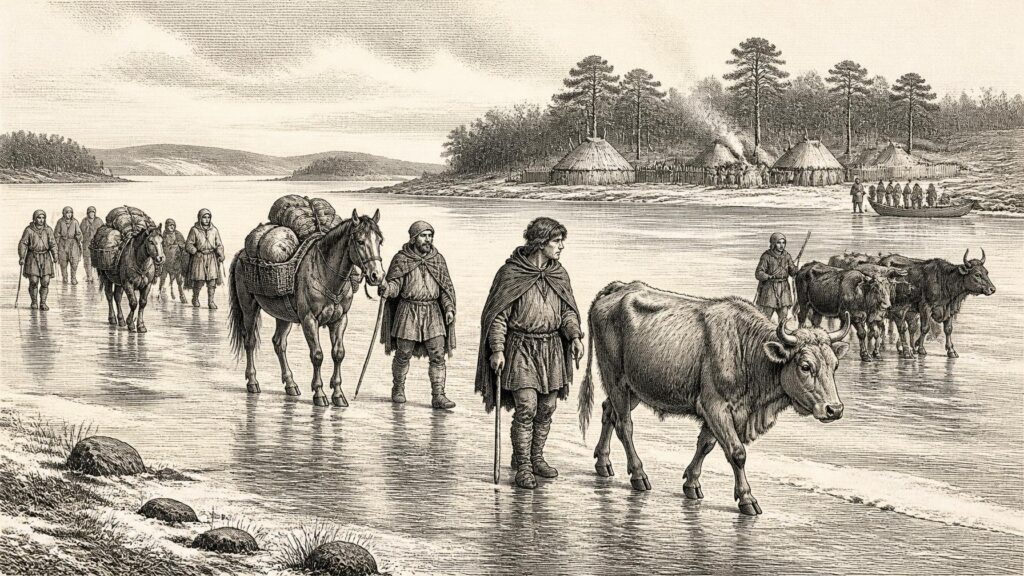
For Ireland, 1435 opened in a landscape temporarily remade by cold. The annals call it an exceptional frost: lakes and rivers were hard enough to be crossed on solid ice. The Annals of Ulster add an unusually vivid detail from Fermanagh. When Eóghan Ó Néill entered the region with an army, the people of Fir Manach moved cattle, horses carrying loads and other portable goods westward across Lough Erne—not in boats, but over the frozen lake. This was not merely a picturesque curiosity. It changed the practical geography of a frontier lordship.
Dateline
A Winter Made Passable
For Ireland, 1435 opened in a landscape temporarily remade by cold. The annals call it an exceptional frost: lakes and rivers were hard enough to be crossed on solid ice. The Annals of Ulster add an unusually vivid detail from Fermanagh. When Eóghan Ó Néill entered the region with an army, the people of Fir Manach moved cattle, horses carrying loads and other portable goods westward across Lough Erne—not in boats, but over the frozen lake. This was not merely a picturesque curiosity. It changed the practical geography of a frontier lordship. Water that normally protected communities, complicated movement and channelled travel became, for a short season, a road.
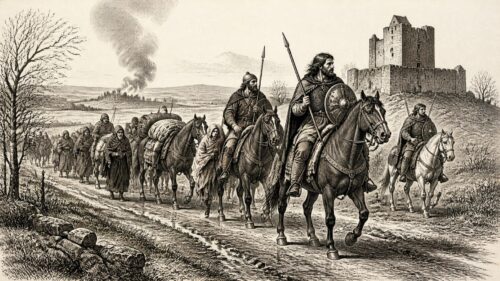
The severe weather was connected to a longer freeze which one annalistic account says had begun late in 1434, five weeks before Christmas, and continued for seven weeks after it. Its effects therefore belong to both years. The chroniclers noted damage to birds during the frost, while the Fermanagh episode shows the danger and opportunity that hard ice presented to people dependent on livestock. Families facing an approaching army could save cattle and household goods; an invading host could move through a country whose normal barriers had become negotiable. The sources do not permit a confident reconstruction of every hardship endured by ordinary households, but they do show that weather affected decisions about security, property and movement in the opening weeks of 1435.
Ó Néill’s Northern Offensive
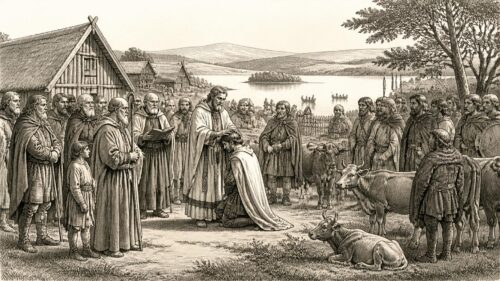
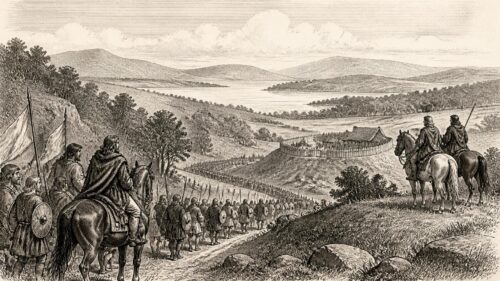
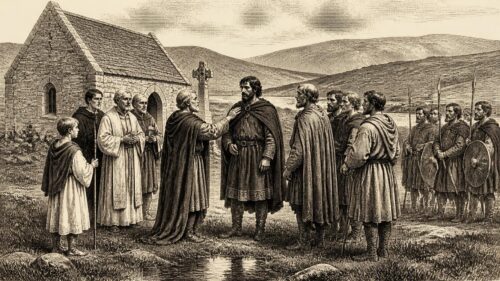
Eóghan Ó Néill, ruler in Tír Eógain, was one of the principal beneficiaries of the altered conditions. His incursion into Fermanagh ended not in a pitched battle but in negotiation. The Maguires assembled a substantial force against him, yet a peace was made and Mag Uidhir came to meet Ó Néill. The agreement was immediately useful to the Tyrone lord: he moved onwards into Tír Chonaill, the O’Donnell lordship in north-west Ulster. There his men carried out burnings and plundering, and John, son of Domhnall Ó Domhnaill, was killed by an arrow. The annal’s language of triumph reflects Ó Néill’s return home after the expedition, but it also records the destructive character of lordship warfare: livestock, stores, dwellings and the ability to compel submission were at stake.
This campaign belonged to an intense struggle for predominance in Ulster rather than to a unified Irish conflict. Ó Néill’s authority rested on his own kindred, dependent lords, alliances and a mobile military following. Tír Chonaill was weakened by divisions within the Ó Domhnaill dynasty, whose members had recently contended with Ó Néill pressure and with wider Irish Sea politics. The campaign through Fermanagh shows that rivalry did not prevent diplomacy. Maguire resistance turned into a meeting and peace; thereafter, the route west was open. Such shifts were characteristic of fifteenth-century politics, in which a lord could be enemy, ally or necessary neighbour according to immediate circumstances.
The Night Fight at the Rása
The most dramatic northern action recorded for 1435 followed an alliance between Brian Óg Ó Néill, a rival within the wider Ó Néill kindred, and Neachtan Ó Domhnaill. They opposed Eóghan Ó Néill and his sons, Énrí and Aodh. Eóghan’s force entered Cenél Moen and formed camp at the Rása. Brian Óg and Neachtan then launched a night assault which drove the Tyrone party from its encampment. For a moment, the attackers held the camp and appeared to have reversed Ó Néill’s advance.
The reversal came swiftly. Énrí urged a counter-attack, and the displaced force returned silently into the darkness. The annalists describe close combat in which men could not distinguish friend from foe, a reminder that such literary accounts should not be read as verbatim battlefield reporting. Yet their central outcome is clear: Aodh Ó Néill wounded Brian Óg with a spear, Neachtan and Brian withdrew, and their gallowglass contingent was left exposed. Mac Suibhne of Fanad attempted to cover the retreat, but was pursued towards Sliabh Truim, defeated and taken prisoner with many followers. The victory strengthened Eóghan and his sons, especially the young Aodh, whose military prominence in the annals begins to emerge at this point.
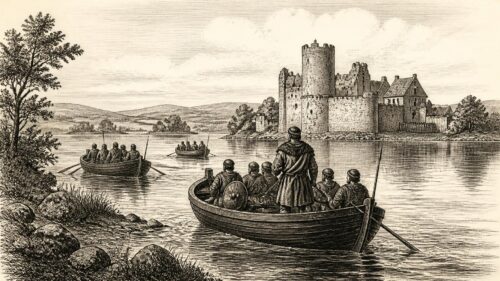
The aftermath was savage. Neachtan had granted Brian Óg the castle of Áth Seanaigh, usually identified with Ballyshannon, in return for military assistance. Brian then changed sides again, leaving his warders in the castle. Eóghan captured him and ordered the removal of a hand and foot; two of Brian’s sons were likewise mutilated, one dying. Medieval Irish annals report such punishments without the explanatory detail a modern reader would want. They nevertheless reveal the political purpose: bodily mutilation could make a defeated aristocratic rival unfit to lead and serve as a warning against betrayal. The episode should not be mistaken for routine justice, but for a calculated act within a contest for lordship.
Niall Garbh’s Captivity
Another crisis shadowed the conflict in Tír Chonaill. Niall Garbh Ó Domhnaill, the lord whose regional power had once extended far beyond Donegal, was carried by the English into England in 1435; the Annals of the Four Masters specify London. Modern historical reconstruction places his capture during a campaign in Meath and Louth late in 1434, when he and his son Toirdhealbhach became separated from the main Ó Néill force. Toirdhealbhach was killed, while Niall Garbh was taken first to Dublin and then conveyed across the Irish Sea. The difference between the date of capture and the date of removal helps explain why annals connect the episode with 1435.
His imprisonment had consequences well beyond the fate of one man. Niall Garbh’s brother Neachtan governed Tír Chonaill during his absence, while Eóghan and Énrí Ó Néill sought to extend their influence there. The alliance of Neachtan and Brian Óg at the Rása may be understood against this instability, but it should not be reduced to a simple contest between two fixed blocs. Kinship, hostages, castles and temporary military need all altered the choices available. Niall Garbh would remain in captivity until his death in 1439, and the division between his descendants and those of Neachtan would trouble Tír Chonaill for decades. In 1435, however, that future was not settled: the immediate reality was an absent lord, a vulnerable dynasty and an ambitious neighbour.
Connacht’s Uneasy Peace
Events in the north reverberated through Connacht. The Annals of Connacht state that the whole province made peace with Ó Néill, an indication of his temporary standing after the campaign. The same source reports a major war across Connacht, with killings, the burning of Mac Diarmata’s stronghold and later peace between Mac Diarmata and Ó Conchobair. Ballintober was also burned by Ó Cellaig and his allies. These notices do not establish a single province-wide war with one cause or one front. Rather, they expose a political landscape of overlapping local conflicts in which fortifications, cattle-raiding, allies and negotiations were integral to authority.
The death of Robert Barrett, Mac Wattin, lord of Tír Amhalghaidh in north Mayo, was another loss among Connacht’s lordly families. The Annals of the Four Masters praise him as charitable, hospitable and able to protect his inherited territory despite pressure from the English of Connacht. Such commemorative language was conventional, but it points to expectations placed upon a lord: defence, generosity, the maintenance of followers and the capacity to preserve a territorial inheritance. Hospitality was not simply private virtue. It helped sustain political networks of clients, learned people, churchmen and travellers.
Church, Patronage and Loss
Religion appears in 1435 not as a world apart from politics but as one embedded in lordship and local society. Donn, son of Cú Chonnacht Mag Uidhir, died after entering the Augustinian canons at Clones. The annals praise his hospitality and prowess before describing his withdrawal from secular life for the love of God. His career illustrates the continued connection between leading families and religious houses, which offered prayer, burial, learning and prestige as well as a setting for renunciation.
Other deaths marked the year. The Red Bishop Ó hEaghra of Achonry died. John Mór Mac Craith of Termon St Davog was remembered as keeper of a general guest-house, while Domhnall Ó Fearghail, chief of Annaly, and the gallowglass captain Toirdhealbhach Mac Domhnaill also died. In Munster, Domhnall, son of Eóghan Mac Carthaigh, was killed by Tadhg Mac Carthaigh; the Annals of Ulster acclaimed him as a notable protector. Mary Burke, countess of Desmond and wife of James FitzGerald, seventh earl of Desmond, died as well. These brief notices range from bishop to countess, religious host to soldier, but together they show the institutions through which status endured: churches, dynasties, households and military followings.
A Year of Frozen Routes
It would be misleading to turn 1435 into a story of inevitable Ó Néill conquest. Eóghan gained prestige, inflicted damage in Tír Chonaill and overcame a dangerous coalition, but his influence depended on fragile bargains. Fermanagh made peace rather than submission; Tír Chonaill remained divided rather than conquered; Connacht’s peace with Ó Néill stood beside its own local wars. English authority, meanwhile, was sufficiently real to hold Niall Garbh and send him to London, yet too limited to dictate the politics of Ulster’s lordships.
The year is best remembered through the image preserved at Lough Erne: cattle, laden horses and people making their way over the ice while armed forces moved nearby. It brings climate, household survival and high politics into the same frame. A rare frost opened routes across water; those routes enabled flight, negotiation and campaigning; and the conflicts fought along them reshaped relationships from Fermanagh to Donegal, Connacht and beyond.
Source References
Hover over a number to see the source. Select it to open the source.

- [1] The Annals of Ulster: Year U1435
- [2] The Annals of Ulster
- [3] TEI Header for The Annals of Ulster
- [4] Annala Uladh: Annals of Ulster Otherwise Annala Senait, Annals of Senat
- [5] Annals of the Four Masters, Part 7
- [6] CELT Project: Annals of the Four Masters
- [7] Annála Connacht
- [8] Annála Connacht: Bibliographical and Editorial Information
- [9] O'Donnell (Ó Domhnaill), Niall Garbh
- [10] O'Donnell (Ó Domhnaill), Neachtan
- [11] O'Neill (Ó Néill), Eóghan
- [12] O'Neill (Ó Néill), Aodh
- [13] O'Neill (Ó Néill), Enrí
- [14] O'Donnell (Ó Domhnaill), Aodh Ruadh
- [15] Swayne, John
- [16] Register of Primate John Swayne, Archbishop of Armagh
- [17] James IV, the O’Donnells of Tyrconnell and the Road to Flodden
- [18] Texts Beginning with the Letter A
- [19] Dinnseanchas, Volume IV (1970–71)
- [20] Annals of Ulster, Otherwise Annala Senait, Annals of Senat
Primary Sources
- The Annals of Ulster: Year U1435
- The Annals of Ulster
- TEI Header for The Annals of Ulster
- Annala Uladh: Annals of Ulster Otherwise Annala Senait, Annals of Senat
- Annals of the Four Masters, Part 7
- CELT Project: Annals of the Four Masters
- Annála Connacht
- Annála Connacht: Bibliographical and Editorial Information
- O'Donnell (Ó Domhnaill), Niall Garbh
- O'Donnell (Ó Domhnaill), Neachtan
- O'Neill (Ó Néill), Eóghan
- O'Neill (Ó Néill), Aodh
- O'Neill (Ó Néill), Enrí
- O'Donnell (Ó Domhnaill), Aodh Ruadh
- Swayne, John
- Register of Primate John Swayne, Archbishop of Armagh
- James IV, the O’Donnells of Tyrconnell and the Road to Flodden
- Texts Beginning with the Letter A
- Dinnseanchas, Volume IV (1970–71)
- Annals of Ulster, Otherwise Annala Senait, Annals of Senat