Three Nights at Tailtiu808 CE
Conventionally dated to 808, the annals record a short-lived Connacht–Mide challenge to Áed Oirdnide, king of Tara. Led by Conchobar of Mide with Muirgius of Connacht’s support, a force occupied Tír ind Aenaig near Tailtiu for three nights before retreating; Áed retaliated by burning Mide’s borders. The episode illustrates contested kingship, strategic assembly sites and coercion through agricultural devastation. Other notices record the death at Kildare of the deposed Leinster king Fínnechta, and deaths of leading churchmen at Armagh, Linn Duachail and Cell Achaid. They also note Cinaed’s killing in Mag Cobo, thus revealing local violence alongside wider political rivalry.
Dateline
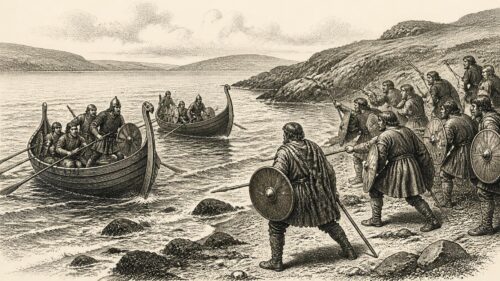
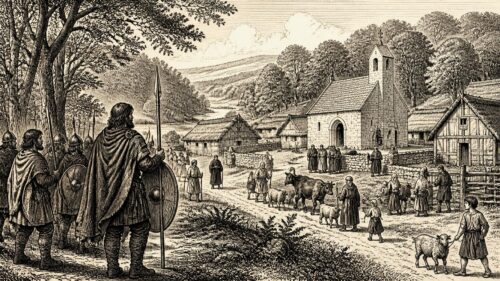
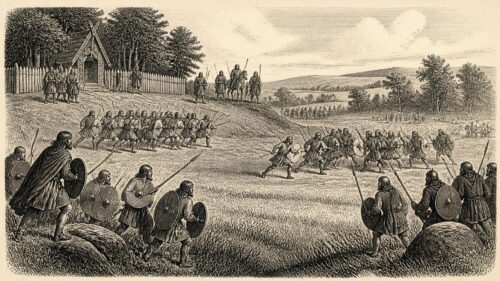
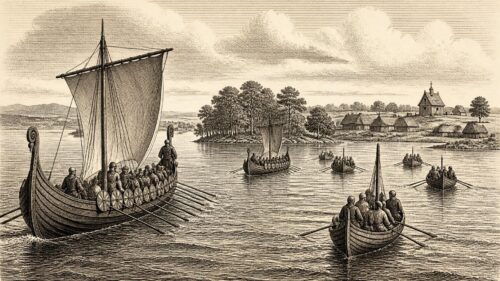
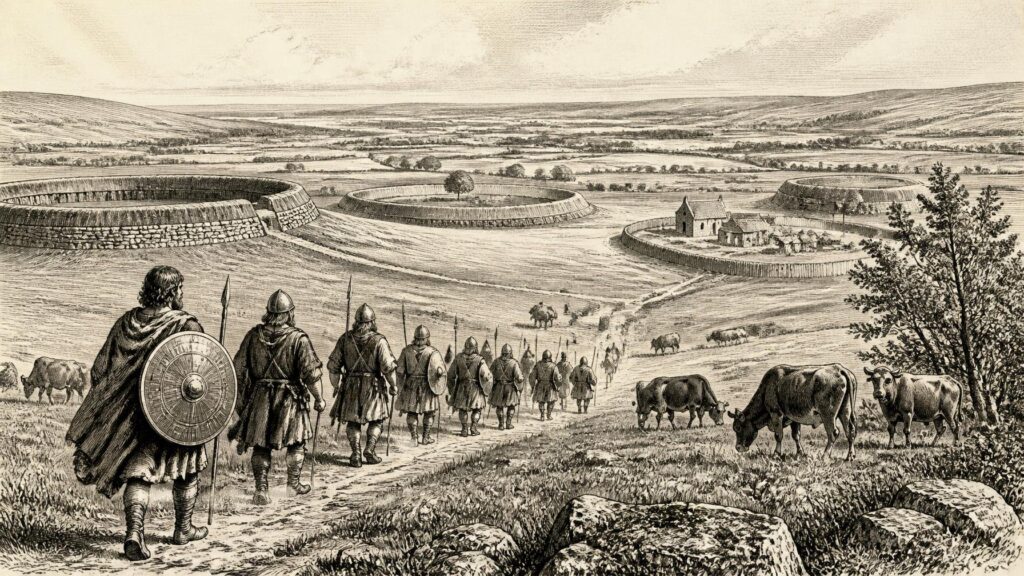
The year conventionally placed in 808 CE brought a brief but revealing confrontation to the heart of Ireland’s political landscape. A Connacht force, associated with the overking Muirgius son of Tomaltach and led by Conchobar son of Donnchad of Mide, advanced as far as Tír ind Aenaig, a place generally connected with the great assembly landscape of Tailtiu, near modern Teltown in County Meath. It remained there for only three nights before withdrawing hurriedly. Áed Oirdnide, king of Tara, moved against the threat and burned the borders of Mide. The annalist’s verdict on the retreat was contemptuous: it was likened to the scattering of goats and kids.
This is not a year that permits a full narrative of battles, treaties or settlements. The surviving annals preserve a small number of terse notices: a failed or abandoned military demonstration in the midlands, the killing of a regional nobleman, the deaths of major ecclesiastics, and the death at Kildare of a Leinster king. Yet those notices illuminate the workings of power in early ninth-century Ireland. They show kingship exercised through armed followings and territorial pressure; monasteries functioning as institutions of writing and leadership; and political legitimacy remaining contested even when a ruler had been displaced by force.
Dating a Thin Record
There is an important caution about the year itself. The relevant entry is conventionally cited as 808, but the surviving Annals of Ulster place an internal calendrical heading equivalent to 807 before its notices. Such one-year dislocations are familiar problems in early Irish annals, whose chronological systems were copied, adjusted and reconciled long after many of the events they describe. Modern reference works nevertheless discuss the Connacht–Mide challenge to Áed under 808. No season or day can responsibly be assigned to it.
Later compilations must also be used carefully. The Annals of the Four Masters have an entry numbered 808 but explicitly correct it to 813; its report of fighting in Umall against “foreigners” therefore does not belong in a secure account of calendar year 808. The safest approach is to keep the focus on the contemporary annalistic cluster conventionally dated to 808, while distinguishing its firm notices from interpretation.
A Challenge at the Assembly Land
Muirgius son of Tomaltach was overking of Connacht, a leading member of the Uí Briúin dynasty whose power was expanding within that province. Conchobar son of Donnchad belonged to Clann Cholmáin, the dominant royal kindred in Mide and a branch of the Southern Uí Néill. His father, Donnchad Midi, had been king of Tara until his death in 797. By 808 Conchobar ruled Mide, but he did so under the shadow of Áed Oirdnide, the Cenél nÉogain ruler from the Northern Uí Néill who had taken the kingship of Tara.
The annal says that an expeditionary force of Muirgius, “with the Connachtmen”, was led by Conchobar as far as Tír ind Aenaig. The wording matters. It does not describe a permanent Connacht occupation of Mide, nor does it record a pitched battle at Tailtiu. It does, however, identify a military partnership across provincial and dynastic lines. Muirgius supplied Connacht backing; Conchobar led the force into the political centre of Mide. Their target was a landscape bound up with the authority claimed by the kings of Tara.
Tailtiu was not merely an empty tract of land. Its assembly and fair were among the best-known institutions of early medieval Ireland, associated with royal gathering, exchange, law, display and public reputation. The record does not say that a fair was being held during the three nights of 808. Still, reaching this district made a statement. A force appearing there could challenge the standing of a king whose authority depended not only upon warfare but upon his capacity to command recognition at prestigious places.
Flight and Retaliation
The challenge did not endure. The Connacht–Mide force “hastened away suddenly” after three nights. Áed then marched to oppose it and burned the borders of Mide. The annal’s goat-and-kid comparison is an openly hostile piece of political language, not a neutral military report. It celebrates the humiliation of Áed’s opponents and offers no account from the Connacht or Clann Cholmáin side. Nor does it tell us whether the withdrawal resulted from fear of battle, difficulties of supply, negotiations, disagreement among allies, or a calculated decision that the demonstration had made its point.
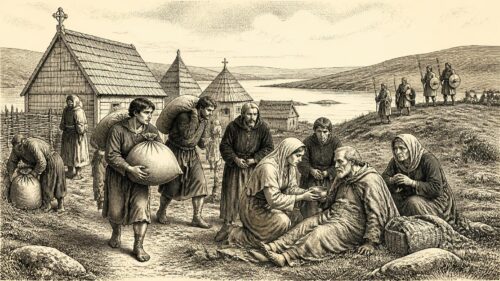
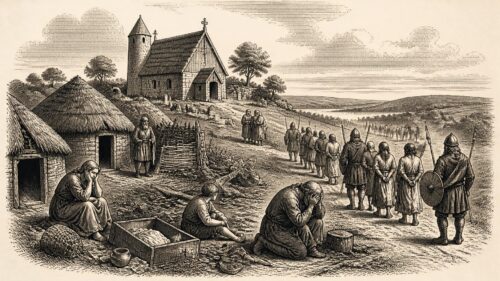
What can be said is that Áed’s response was directed at Mide, Conchobar’s immediate power-base. Burning border districts was a recognisable form of coercion. It damaged food resources, exposed dependants to danger, and announced that a ruler could punish defiance without necessarily risking a large battle. In an overwhelmingly agricultural society, where cattle, grain, dairy produce and the labour of households sustained both lordship and religious communities, such destruction carried consequences well beyond the men carrying weapons.
Mobilising a host also relied on those same resources. Warriors required food, animals and equipment; royal followers expected support and reward; roads, river crossings and familiar territories shaped the practical limits of campaigning. These details are not supplied for the expedition of 808, but they explain why a short incursion and a three-night stay could still have imposed a considerable burden on the districts through which the force travelled. The event reveals political power as something enacted through people, provisions and movement rather than through fixed state frontiers.
Áed, Conchobar and Muirgius
The episode was part of a wider contest rather than an isolated raid. Áed Oirdnide had asserted his position vigorously after becoming king of Tara in 797. He had intervened repeatedly in Mide and Leinster, and his political ambitions depended on maintaining the superiority of the Northern Uí Néill over rival royal groupings. Conchobar’s cooperation with Muirgius in 808 was therefore a direct challenge to that superiority.
For Muirgius, the expedition showed that Connacht politics reached far beyond the western province. His kingdom had its own rival lineages and frontier interests, particularly towards Bréifne, but support for Conchobar offered an opportunity to influence the balance of power in the midlands. The outcome was unimpressive in immediate military terms. Yet Áed did not make a recorded punitive invasion of Connacht in response. The failed advance thus demonstrated both Áed’s capacity to defend his position and the continuing ability of other overkings to test it.
Conchobar’s later career gives the incident added significance. He survived the setback and, after Áed’s death in 819, gained the kingship of Tara himself. That later result should not be read back as a victory in 808: the annals portray the venture as a retreat. But it does show that early medieval political reverses were rarely final. Kingship was negotiated repeatedly among related dynasties, client rulers, church communities and armed households.
Leinster’s Dead King
The same annal records the death of Fínnechta son of Cellach, described as king of Leinster, at Cell Dara, modern Kildare. It adds a strikingly physical detail: he died from haemorrhoids. The notice is unusually blunt, but it reminds us that royal succession could be altered by illness as well as warfare. No exact date is given.
Fínnechta’s title is politically revealing. Áed had deposed him in 805 and divided Leinster between two rival claimants, Muiredach son of Bran and Muiredach son of Ruaidrí. Nevertheless, the annalist still called Fínnechta “king of Leinster” at his death. Titles in the annals could preserve dynastic claims, remembered status or a contested legitimacy; they should not automatically be treated as a map of uncontested control. His death at Kildare also draws attention to the importance of ecclesiastical centres in royal life. Kildare was not a remote religious retreat but a place with land, dependants, learning, hospitality and connections to Leinster’s ruling families.
Armagh, Writing and Continuity
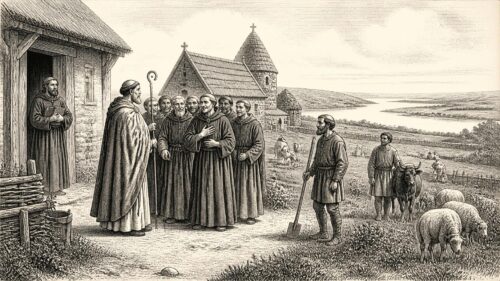
Three ecclesiastical deaths broaden the picture of 808. Torbach, also called Calbhach, died as scribe and abbot of Armagh. Tomás, bishop, scribe and abbot of Linn Duachail, also died. Faelgus, superior of Cell Achaid, was recorded as having “fallen asleep”, the conventional Christian language for death. The clustering of offices is notable. A single man might be a community’s senior leader, a learned writer and, in Tomás’s case, a bishop. These were not narrowly separated careers.
Armagh’s abbot stood at the head of an institution that claimed the inheritance of Patrick and exercised influence far beyond its immediate settlement. Calling Torbach a scribe identifies literacy as part of high ecclesiastical authority. Writing was essential to the copying of religious texts, the preservation of genealogies and legal claims, the administration of church lands, and the production of the annals themselves. Tomás’s comparable combination of offices at Linn Duachail demonstrates that this learned leadership was not confined to Armagh alone.
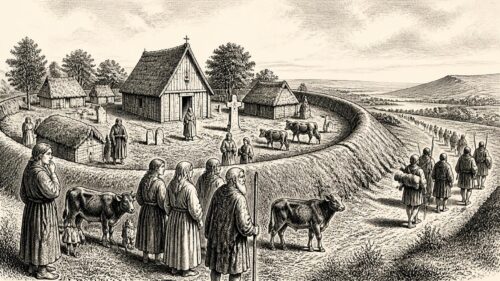
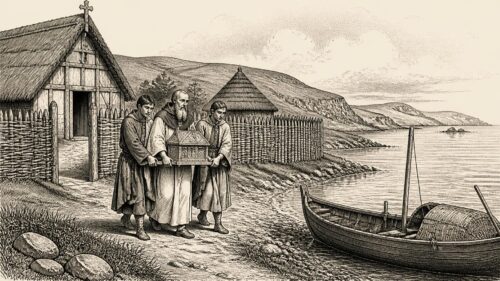
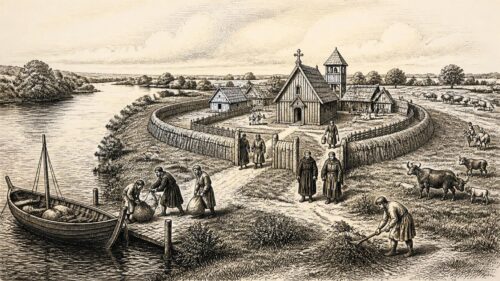
The notices do not allow us to reconstruct daily life in either community during 808. They do, however, show that monasteries were durable centres of authority amid political uncertainty. Their inhabitants included clergy, scholars, craftsmen, tenants, visitors and people seeking protection or hospitality. The succession of an abbot or bishop mattered to local communities and to powerful patrons, because churches possessed land, prestige and networks of obligation as well as sacred status.
Local Violence and a Limited Year
One final secular notice records the killing of Cinaed son of Conchobor in Mag Cobo by the Cruithin. The entry gives no motive, no battle and no consequence. It should not be inflated into a provincial war. Its value lies in its reminder that Ireland’s political world was made up of many regions and peoples whose conflicts did not always reach the level of a king of Tara or an overking of Connacht.
Accordingly, 808 is best remembered not for a decisive battle but for a fleeting occupation of politically charged ground. Three nights at Tír ind Aenaig exposed the fragility of Áed Oirdnide’s supremacy, even as the rapid retreat and burning of Mide displayed his capacity to retaliate. Around that confrontation, deaths at Armagh, Linn Duachail, Kildare and Cell Achaid marked the steady renewal of religious and royal leadership. The surviving record is sparse, but it captures an Ireland in which authority was constantly tested: at assembly sites, along vulnerable borders, in monasteries, and in the succession to kingship itself.
Primary Sources
- The Annals of Ulster, Year U808
- The Annals of Ulster: Editorial and Bibliographical Information
- Chronicon Scotorum, Annals CS804–CS813
- Chronicon Scotorum, Part 77
- Chronicon Scotorum, Part 78
- Annals of the Four Masters, Annal M808
- Annals of Inisfallen: Editorial and Bibliographical Information
- Muirgius, Dictionary of Irish Biography
- Áed Oirdnide, Dictionary of Irish Biography
- Conchobar, Dictionary of Irish Biography
- Fínshnechtae Cetharderc, Dictionary of Irish Biography
- Dúnlaing, Dictionary of Irish Biography
- Artrí, Dictionary of Irish Biography
- A Poem on the Kings of Connacht
- The Annals of Ulster, Year U805
- The Annals of Ulster, Year U812
- The Powers of Kings, in Early Christian Ireland
- Kingship, Society, and Sacrality: Rank, Power, and Ideology in Early Medieval Ireland
- Religion and Society in Ireland
- Money in Early Christian Ireland According to the Irish Laws
- The Idea of the Three Orders of Society and Social Stratification in Early Medieval Ireland
- Reassessing the Irish ‘Monastic Town’
- Early Monastic Settlements, Monastic Ireland
- Gazetteer of Ireland