Tailtiu’s Defeated Challenger790 CE
In 790, recorded in the Annals of Ulster under a chronologically disputed heading, Donnchad Midi of Clann Cholmáin defeated Áed Ingor of Cenél nÉogain at Tailtiu, the prestigious Uí Néill assembly site. Allies from Uí Chremthainn died with Áed’s force, demonstrating complex political connections. Diarmait of Tethba was killed at Ard Ablae, while regional kings of Uí Maine and Airthir also died. Obituaries marked leading clerics’ deaths across major churches, and Connacht’s king Artgal died at Iona. Rural farming, ecclesiastical estates and assemblies underpinned society. No securely dated Viking raid belongs to this year; indigenous rivalry dominated political life throughout.
Dateline
The evidence for 790 is unusually revealing but needs careful handling. The Annals of Ulster place a cluster of events beneath an entry whose calendar formula identifies it as AD 790, although historians conventionally cite that annal as AU 791; such discrepancies arise from the annals’ inherited systems of year-numbering and later chronological adjustment. The events should therefore be treated as securely belonging to the annal’s sequence around 790, rather than assigned invented days or months. Other annals preserve only part of the same picture. What emerges is an Ireland of competing regional kingships, ecclesiastical communities linked across the Irish Sea, and political authority tested at one of the island’s most important public meeting places.
A Clash at Tailtiu
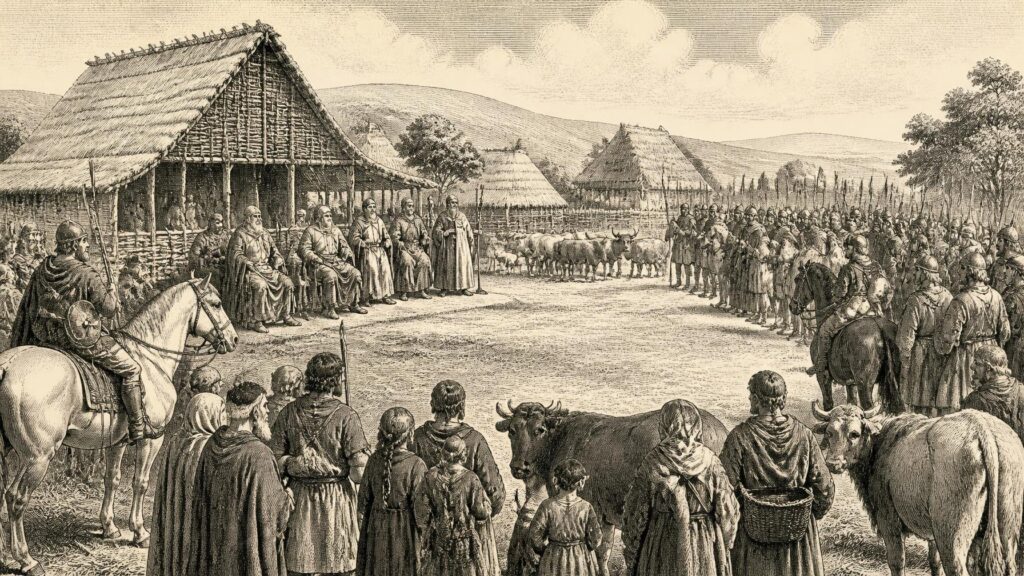
The largest political event recorded in the relevant annal was a defeat inflicted by Donnchad Midi, king of Tara, upon Áed Ingor at Tailtiu. Donnchad belonged to Clann Cholmáin, the dominant Southern Uí Néill dynasty of the midlands. Áed, later remembered as Áed Oirdnide, was a leading ruler of Cenél nÉogain in the north. The annalist calls him Ingor, a byname conventionally rendered “the undutiful” or “the unfilial”, but does not explain it. Later scholarly interpretation connects the confrontation with Áed’s challenge to Donnchad’s authority; that is plausible, but the surviving notice itself gives no speech, treaty, declared claim or full campaign narrative.
Tailtiu, near modern Teltown in County Meath, was no ordinary battlefield. It was the site of the óenach, a major assembly associated with the Uí Néill kingship. Such gatherings combined political ceremony with legal business, athletic competition, exchange and social display. Control of the assembly, or the capacity to disrupt it, mattered because it made hierarchy visible before a large and mixed audience. A conflict there was consequently more than a clash between warbands. It touched the public machinery through which a king of Tara demonstrated influence in the central plain.
Donnchad’s victory came at considerable cost. The annal names Cathall son of Echaid, king of Uí Chremthainn, Máel Fothartaig son of Artri, and Domnall son of Colgu among the dead. Uí Chremthainn was an Airgíalla people of the north, in the broad region of modern counties Monaghan, Fermanagh and Tyrone. Their appearance among Áed’s losses shows that the struggle at Tailtiu drew in allies beyond the immediate territories of Donnchad and Áed. It also indicates the limits of any simple north-versus-south interpretation: early Irish politics worked through overlapping kindreds, client peoples, marriage ties and local interests as well as through large dynastic labels.
Donnchad remained the stronger figure in this encounter. Yet the defeat did not remove Áed from politics. He was already an important northern king and, after Donnchad’s death in 797, would obtain the kingship of Tara himself. That later outcome should not be read backwards as though success in 790 were inevitable. At this moment, the annal records the opposite: Áed’s force was overthrown at the symbolic heart of Donnchad’s midland power.
Death and Conflict in the Midlands
A second battle, at Ard Ablae, brought down Diarmait son of Béc, king of Tethba; Fergus son of Ailgal was victorious. Tethba lay across parts of the central midlands, broadly west of the Boyne and Shannon watershed, and was divided among smaller peoples and ruling lineages. The report is characteristically spare. It does not identify the cause of the fighting, describe the followers of either man, or say whether Fergus took Diarmait’s kingship. Those absences matter. The event demonstrates violence within the political landscape of the midlands, but it cannot responsibly be expanded into a known war of conquest.
Nevertheless, the death of a king was a destabilising fact. Irish kingship was not normally transmitted by automatic primogeniture. Eligible adult men of a ruling kin-group could compete, negotiate or fight for succession, while neighbouring rulers might intervene where advantage offered. The killing of Diarmait therefore opened a local political question even if the sources do not tell us how it was settled. Fergus himself remained active in Tethba in later annalistic notices, but that later survival is not proof that the battle immediately made him sole ruler.
Two further royal deaths recorded in the same annual context underline the scale of political turnover. Amalgaid, king of Uí Maine, died in Connacht. Donngal son of Buachaill, king of the Airthir, also died. These were not provincial kings commanding the whole west or north-east, but rulers of substantial regional peoples. Their obituaries remind us that Ireland was a patchwork of many tuatha and dynasties. The title “king” could belong to men whose authority was local, tributary or contested, as well as to an overking such as Donnchad.
Churches and Far-Flung Connections
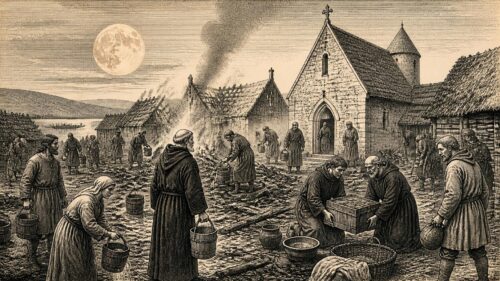
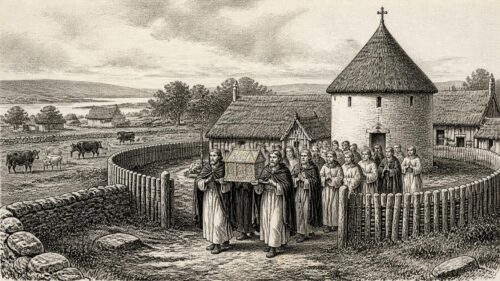
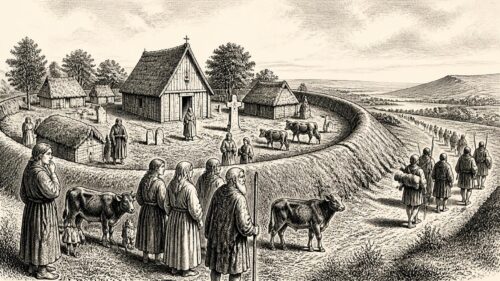
The year’s obituaries are especially rich in ecclesiastical names. Cú Dínisc son of Cú Ásaig, abbot of Armagh, died, as did Frecmarc, bishop of Lusk, and Muiredach son of Óengus, abbot of the same north Dublin church. Saerberg, abbot of Clonmacnoise, Caínchomrac, bishop of Finglas, and Sirne, abbot of Bangor, are also listed. The density of these notices reflects the importance of churches as landed institutions, centres of learning, custodians of relics and places where powerful families sought influence. An abbot could be a spiritual superior, estate manager, political broker and member of a major kindred at once.
Armagh’s abbot headed the foremost Patrician church, while Clonmacnoise occupied a strategic position beside the Shannon crossing and Bangor was among the great ecclesiastical foundations of the north-east. Lusk and Finglas were smaller in scale but stood within a closely settled Leinster landscape where church sites, farming communities and royal territories intersected. The deaths do not tell us the size of their populations or the state of individual buildings in 790. They do, however, show institutions important enough for their leaders’ passing to be entered in a chronicle concerned above all with rulers and public affairs.
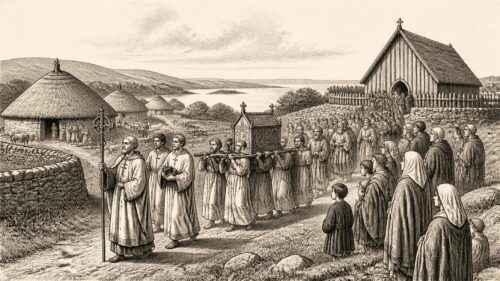
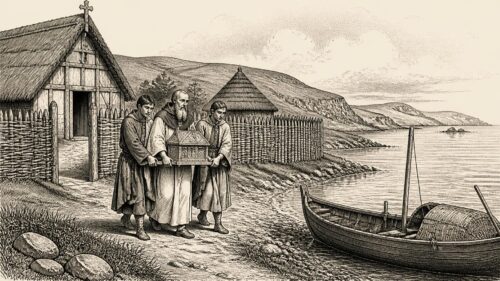
One notice stretches the horizon beyond Ireland. Artgal son of Cathal, king of Connacht, died “in Í”: Iona, the Columban island monastery off the west coast of Scotland. The entry does not say why he was there. He may have travelled for devotion, diplomacy, study, refuge or illness; choosing one explanation would go beyond the evidence. What can be said is that an Irish king’s death at Iona illustrates the continuing Irish Sea world of the Columban churches. Sea crossings connected political and religious elites, and Iona was still a place where an Irish ruler might be present and remembered.
The final religious notice records the death of Dínertach son of Mogadach, described as an anchorite. An anchorite pursued a particularly austere religious vocation, often marked by withdrawal, prayer and penitence. Yet isolation was relative. Such holy figures remained embedded in ecclesiastical networks that preserved their names and reputations. Dínertach’s brief obituary is a small indication that the institutional church and more solitary forms of devotion existed side by side.
Life Beyond the Chronicle
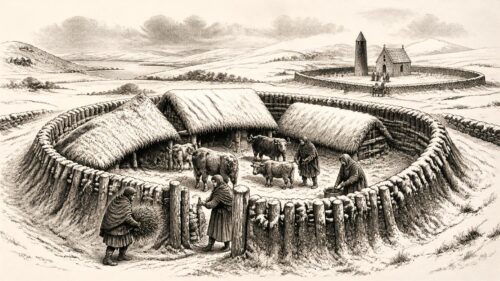
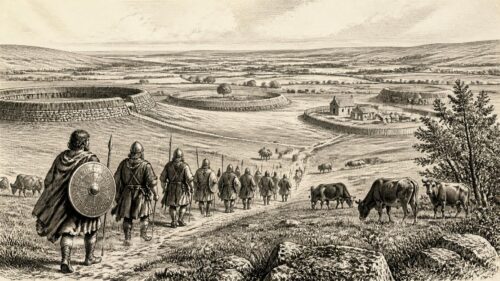
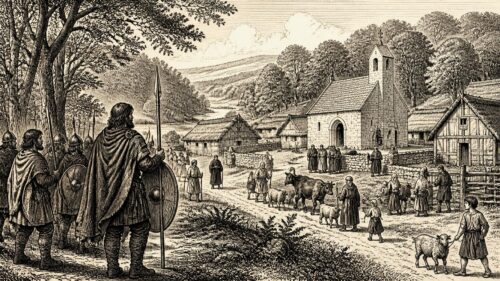
The annals focus on exceptional deaths and conflicts, not on ordinary work. Archaeology provides the wider setting. Most people in Ireland around 790 lived in rural settlements, often in enclosed farmsteads now known as ringforts, raths, duns or stone cashels. Houses were generally timber, wattle-and-daub or, in stonier districts, dry-stone structures; hearths, animal pens, storage spaces, corn-drying and craft activity formed part of domestic life. Cattle carried particular social and economic value, but farming also depended on cereals, dairying, pigs, sheep, labour obligations and seasonal cooperation.
These were not towns in the later medieval sense. Ireland had no urban network comparable to Roman or Carolingian Europe, although major churches were large and economically significant centres. They drew food-renders and labour from dependent lands, employed skilled workers, and participated in regional exchange. Goods, livestock, grain, metalwork and prestige objects circulated through tribute, gift-giving, legal payments and markets or assembly gatherings. Tailtiu’s importance therefore had an economic dimension as well as a royal one: a great assembly could bring people, animals, goods and information into the same landscape.
There is no securely dated Irish Viking raid to insert into this year. The better-known attacks on island and coastal churches belong to the mid-790s in the surviving Irish record. It would be misleading to let later trauma dominate 790 merely because it lies close by. For now, the evidence points instead to indigenous contests for authority, to the vulnerability of lesser kings, and to ecclesiastical institutions that remained central to political and social life.
An Unsettled Balance
In 790, Donnchad Midi could still defeat a northern challenger at Tailtiu and defend the prestige of the kingship centred on Tara. But the battle also revealed that Áed Ingor possessed allies willing to fight far from their own northern territories. In Tethba, the death of Diarmait son of Béc showed how quickly local rule could be overturned. Across the island, the recorded deaths of kings, abbots and bishops marked changes in leadership at communities whose influence rested on land, learning, kinship and sacred reputation.
The year is thus best understood not as a prelude to later Viking history, nor as an age of unified national government, but as a moment of contested Irish power. At Tailtiu, the public arena of Uí Néill authority became a battlefield. The victory was Donnchad’s; the longer struggle for supremacy was not yet over.
Primary Sources
- The Annals of Ulster: Year U791
- CELT Project: The Annals of Ulster
- The Annals of Ulster: Year U790
- Annals of Inisfallen: Annal AI790
- CELT Project: Annals of Inisfallen
- Annals of the Four Masters
- CELT Project: Annals of Tigernach
- Áed Oirdnide
- Donnchad Midi
- The Fair of Tailtiu and the Feast of Tara
- Early Medieval Ireland: Archaeological Excavations, 1930–2009
- The Economy of Early Medieval Ireland
- Early Medieval Farmsteads
- Earthen Banks and Broken Walls
- Religion and Society in Ireland
- Ireland To 1170
- Reassessing the Irish ‘Monastic Town’
- Money in Early Christian Ireland According to the Irish Laws
- Ways of Death: Cremation and Belief in First-Millennium AD Ireland
- Vikings in Ireland and Scotland
- Vikings in Irish Chronicles, 794–902: Data
- Early Viking Church Raiders and the Emergence of Political Purpose