

Bridge Ballad
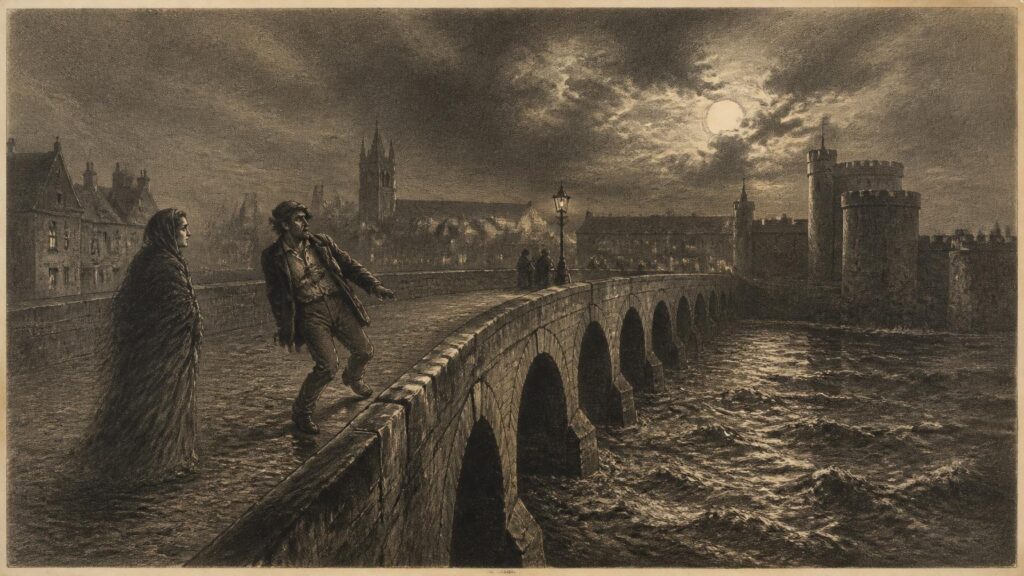
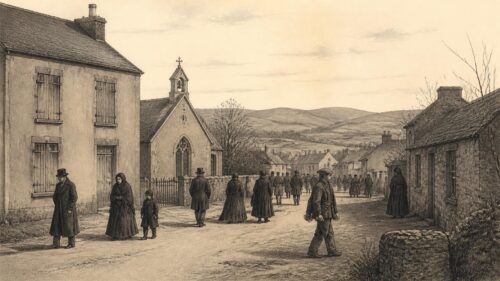
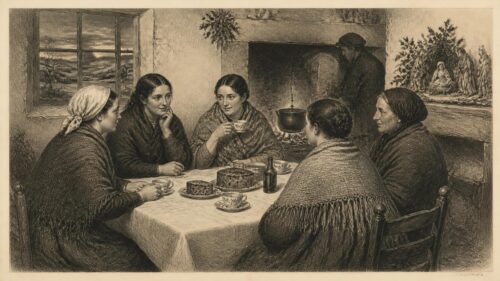
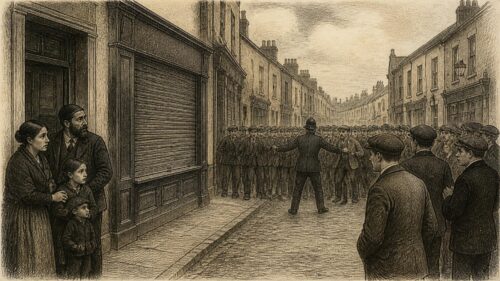
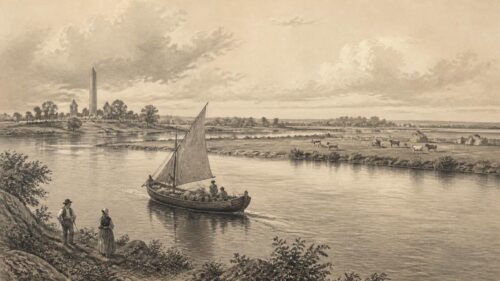
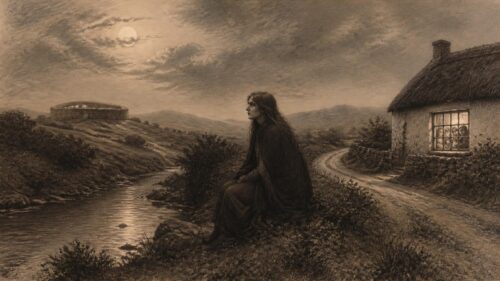
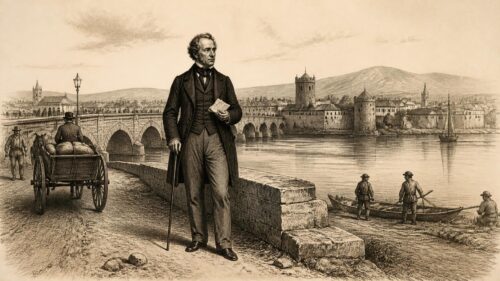
AI generated historical illustration, not a contemporary photograph.
At a Glance
Drunken Thady is not securely recoverable as an historical individual. He is, rather, the unruly central figure of a Limerick narrative poem which fused a real cityscape, comic moralism, anti-respectable humour and supernatural legend so effectively that later listeners often treated its inventions as inherited local fact. Michael Hogan, the nineteenth-century “Bard of Thomond”, made Thomond Bridge the stage for a drunken man’s encounter with a feared female apparition. In doing so he created one of Limerick’s most durable urban tales.
Elusive Thady
The name “Drunken Thady” survives with an air of familiarity, as though it belonged to a neighbour, relation or notorious old offender whose deeds had been entered in some municipal register. That impression is part of the ballad’s achievement. Yet the available documentary evidence does not establish a particular eighteenth-century or early nineteenth-century man named Thady as the source of the character. Claims that he was born about 1725 and died in 1822, sometimes repeated in later retellings, occur in folklore material collected long after the supposed events. They should therefore be read as tradition, not biography.
The secure starting-point is Michael Hogan’s poem Drunken Thady and the Bishop’s Lady, also styled The Drunken Thady and the Bishop’s Lady. Hogan, born at Thomond Gate, Limerick, in 1832 and dead in the city in 1899, was a popular poet, pamphleteer and satirist who called himself the Bard of Thomond. His work drew repeatedly on local places, historical associations, gossip, nationalist feeling and the speech of ordinary Limerick people. The National Library of Ireland records a later separate edition of the Thady work as “a legend of Thomond Bridge”; this is an important description, because it identifies the piece as literary legend rather than as an archival account of an actual criminal case.
That distinction need not lessen its historical value. Folklore and popular verse reveal what communities found memorable, laughable, frightening or useful to say about themselves. They are evidence of culture even where they are not evidence of events. Thady is historically significant because generations of Limerick people have remembered him, recited his story, located it on an actual bridge and attached visible features of the bridge to the narrative. The question is not simply whether he existed. It is why a comic drunk, a ghostly bishop’s wife and a bridge over the Shannon became such an effective local drama.
The answer begins with the poem’s deliberate mixture of recognisable and improbable things. Its routes, public houses, bridge, river and neighbourhoods belong to Limerick. Its tone belongs to a world in which street reputation, drink, fights, religion and authority were matters of public observation. Its supernatural antagonist belongs to the older repertory of ghost stories. Hogan made the fictional action feel local by placing it in a landscape known intimately to his audience. A listener did not need to believe that every episode had happened to understand where, socially as well as geographically, it was meant to happen.
River Crossing
Thomond Bridge was especially suited to such a tale. It is a crossing with practical, symbolic and historical weight: a route between the old city and the northern approaches, close to King John’s Castle, the Bishop’s Palace, the Shannon and the streets of Englishtown. For many centuries a bridge at this point represented access, surveillance, commerce and vulnerability. A person travelling after dark across it moved from one jurisdiction of street life into another, exposed to wind, river, soldiers, watchmen and rumour.
The present seven-arch limestone road bridge was completed in 1840. Limerick City and County Council’s walking guide notes that it was once the only bridge connecting the old walled city to County Clare. The bridge in Hogan’s poem, therefore, was not some remote antiquarian ruin. It was part of the lived nineteenth-century city, used by workers, traders, soldiers, clergy, families and those leaving public houses late at night. Its setting made it plausible as a place where an encounter might be witnessed, embellished and retold.
Bridges commonly gather legends because they are thresholds. They are neither fully land nor river, and they oblige travellers to pass through a constrained space. In Irish and wider European folklore, crossings are frequent sites of supernatural contact, dangerous meetings and tests of courage. Such associations should not be treated as proof that a particular ghost story is ancient. They do, however, help explain why a bridge could readily acquire a reputation. Hogan inherited a setting predisposed to narrative.
The physical bridge also encouraged later material explanations. Local tradition identifies scratches or marks in its stonework as the Bishop’s Lady’s finger marks, allegedly left as she struggled after the encounter with Thady. This is classic place-lore: a mundane surface feature is made meaningful through story. There is no reason to regard the marks as forensic evidence of a spectral struggle, but neither should the tradition be dismissed as merely foolish. It records an imaginative way of reading a familiar public structure. Stone becomes a memory device, and a story becomes inseparable from the route across the river.
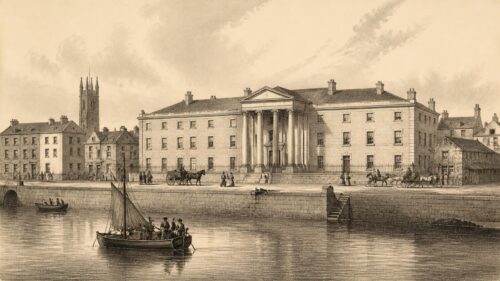
Hogan’s Limerick was a city of concentrated landmarks. Castle, cathedral, episcopal residence, bridge and river lay within a short walk of crowded housing and commercial activity. Such proximity created fertile ground for local satire. Powerful institutions were visible from ordinary streets; their inhabitants could be imagined, discussed and mocked. The poem’s topography brings grand and lowly worlds into uncomfortable contact. A bishop’s lady and a habitual drunk meet not in a drawing room but on a public bridge, late at night, in the realm of rumour and danger.
Hogan’s World
Michael Hogan’s documented life helps explain why he could make this city speak. The Dictionary of Irish Biography identifies him as the son of Arthur Hogan, a wheelwright, cabinetmaker and carpenter, and places his birth at Thomond Gate on 1 November 1832. He received local education, worked briefly at wheelwrighting, then as a labourer in a mill. Those details matter. Hogan was neither a detached visitor nor a gentleman antiquary writing down quaint tales from above. His literary career grew from the working city, its labour, its jokes and its antagonisms.
His first pamphlet, The Light of Munster, appeared in 1852. By his own account, he travelled through market towns selling copies. He went on to issue volumes and pamphlets of nationalist verse, local satire and folklore-inflected poetry, and he contributed to journals including the Nation, the Celt and the Irishman. The method was practical as well as literary: write for an audience that recognised the people and places in the verse, print cheaply, sell directly, recite where possible and allow notoriety to assist circulation.
His best-known collection, Lays and Legends of Thomond, appeared in nineteenth-century editions. The National Library of Ireland catalogues a Limerick edition printed at the Munster News office in 1865, while later accounts refer to earlier or enlarged issues. Bibliographical variation is unsurprising in the career of a poet who revised, republished and issued work in small editions. What can be said with confidence is that Hogan used “Thomond” as both a regional inheritance and a literary brand. The name invoked the historic territory north of the Shannon while rooting his authorship in Limerick.
Hogan’s popular standing did not make him socially secure. His writings lampooned prominent figures, and the comic energy that attracted readers could provoke resentment. He was overtly nationalist and associated with John Daly, the Limerick Fenian. In 1886 he emigrated to New York, where poor eyesight and financial hardship made his position difficult. He returned to Limerick in 1889 with local assistance and later held nominal employment with the corporation. He died in 1899 and was buried in Mount Saint Lawrence Cemetery.
This biography should not be turned into a simplistic key to the poem. Thady is not simply Hogan in disguise, and the Bishop’s Lady cannot responsibly be identified with a named episcopal spouse on the basis of the surviving evidence. But the poem clearly comes from a writer accustomed to the friction between respectable authority and popular speech. Its laughter is not neutral. Hogan knew that a city could possess official histories and unofficial versions at once, and that verse could offer the latter a memorable form.
Printed Legend
The poem survives as a substantial printed work, not merely as a vague oral anecdote. Limerick Local Studies preserves a digitised Limerick Chronicle item from 18 February 1978 featuring its words, while the National Library of Ireland records Críostóir Ó Floinn’s 1977 edited edition of the work. Limerick City and County Council describes the verse as running to 445 lines. These facts correct a frequent misunderstanding: “Drunken Thady” is not only the name of a ghost story. It is the title shorthand by which people remember a long comic narrative poem.
The ballad form is crucial. Long narrative verse can be read silently, but it is designed also for the voice. Its rhyme, repeated character tags, sudden dialogue and escalating situations support recitation. The poem could be performed in a kitchen, bar, club, schoolroom or at a gathering where listeners supplied recognition and laughter. A poem of hundreds of lines asks for patience, but it repays memory. A skilled teller may abridge it, dwell on a favourite scene or deliver familiar phrases with an audience already anticipating the next turn.
Print gave Hogan’s tale a fixed authorial structure; performance gave it mobility. That relationship explains why versions differ in emphasis. A printed poem may portray Thady as a violent, irresponsible man whose conduct deserves rebuke. A local retelling may turn him into a harmless rogue. One narrator may stress the Bishop’s Lady’s wickedness before death; another may make her primarily a banshee-like menace. Some accounts celebrate Thady’s survival, while others focus on the marks supposedly left on the bridge. None of these later choices necessarily reproduces Hogan’s wording, but all show how printed literature entered local oral culture.
The category “ballad” should also be used carefully. In everyday Irish usage it can mean a song, a broadside, a comic narrative, a poem for recitation or a story in verse. Hogan’s work has affinities with all of these. It uses the popular accessibility of the ballad, but it is more expansive than a short street song. Its literary texture includes character sketch, local history, moral commentary, theatrical dialogue and gothic incident. Calling it merely a “folk tale” obscures the named author’s craft; calling it merely a “poem” obscures the collective life it subsequently acquired.
The survival of editions matters because it places a limit on romantic claims about pure oral antiquity. Hogan did not simply transcribe an immemorial legend intact. He shaped and publicised a Limerick story in nineteenth-century print. There may well have been earlier rumours, tales or bridge traditions, but the available evidence does not allow their exact age, wording or circulation to be reconstructed. The durable form known today is Hogan’s. Folklore then worked upon that form, rather than existing wholly before it.
Comic Vice
Thady enters the narrative as a figure of excess. He drinks, gambles, fights and repeatedly collides with domestic and civic order. The poem does not present intoxication as a harmless ornament of Irish sociability. It makes drink the condition in which Thady becomes boastful, vulnerable and ridiculous. His name itself functions as a label, much like the names assigned to comic types in popular literature. He is not introduced with a full genealogy or a credible occupation because his role is moral and theatrical: he is the man who has gone too far.
That moral pattern needs qualification. Hogan’s judgement is not the serene judgement of an official sermon. The poem delights in the very disorder it condemns. Thady’s rows, bravado and disreputable companions supply much of its comic momentum. The reader is invited to laugh at him before being invited to see his fright and repentance. Such double movement was common in popular comic writing. Vice generates entertainment, then entertainment is turned towards an exemplary ending.
There is also a social dimension. Public drunkenness in nineteenth-century towns was regulated by police, courts, employers, churches and household discipline. It could bring violence, poverty and imprisonment. Yet working-class drinking culture was also a space of fellowship, storytelling, wagers and resistance to respectability. A character like Thady can therefore carry contradictory meanings. He is an object lesson against drunken conduct, but he also speaks for the noisy, irreverent street against those who claim refinement.
It would be unsafe to read every line as a direct report on actual drinking habits in Limerick. Satire enlarges. Hogan wants an audience to picture the worst possible Thady: a man so habitually intoxicated that danger itself cannot sober him until the final crisis. Exaggeration is the machinery of the tale. Nevertheless, the poem’s confidence in its setting indicates that public houses, night-time disorder and conflict with authority were intelligible elements of urban life to its audience.
The eventual change in Thady’s behaviour gives the narrative its moral resolution. Faced with an apparently supernatural threat and the possibility of death, he appeals for mercy and vows amendment. His reformation is necessary to the structure: without it, the piece would be only a grotesque episode. With it, the comic rogue becomes a converted survivor. Whether listeners regarded the change as sincere, humorous or both is impossible to know. The ending is best understood as literary closure, not proof that an historical man abandoned drink after falling into the Shannon.
Female Spectre
The Bishop’s Lady is even less securely historical than Thady. In later tradition she is sometimes given a maiden name, often said to have been Brady or O’Grady, and is described as a woman who lived a morally disreputable life before returning after death to haunt the bridge. No reliable documentary chain has been established connecting these details to a particular woman. They belong to the legend’s afterlife and should not be used to identify, accuse or retrospectively scandalise any real bishop’s household.
As a literary figure, however, she is powerful. Her title places her adjacent to spiritual and social authority, while her conduct transgresses the ideals conventionally associated with that position. This creates a satirical charge. The ghost is not a peasant victim from the margins but a woman marked by clerical prestige, illicit pleasure and public menace. Her apparent respectability and alleged hidden vice make her an especially useful target for popular comedy.
That does not mean the poem offers a straightforward attack on one church or one clergy. The Bishop’s Palace beside the bridge was historically the residence of Protestant bishops, and the setting would have been familiar to Limerick audiences. Yet the Bishop’s Lady in the poem is not a carefully documented portrait of an Anglican bishop’s wife. She is a grotesque invention assembled from anti-hypocrisy satire, ghost-lore and sensational storytelling. Interpreting her as a coded factual allegation goes beyond the evidence.
The figure also participates in a longer tradition of dangerous female spirits. Irish folklore contains many supernatural women: the banshee, the bean sí, fairy women, revenants and place-specific apparitions. They are not interchangeable. The Bishop’s Lady is not simply a banshee in another dress, and the surviving poem should not be used to flatten distinct traditions into one generic “Irish ghost”. Yet a late-night female apparition who terrifies travellers would have been legible within a culture accustomed to stories of uncanny women and perilous encounters after dark.
Her violence reverses expected hierarchies. Thady, already a rough and aggressive male character, meets a woman more frightening than he is. The encounter lets the poem stage male panic without surrendering its comic tone. It also produces a lurid fantasy of punishment: the drinker and brawler is defeated by what he fears, but the supernatural woman is herself bound to an earlier story of vice and posthumous punishment. Both principal figures are morally compromised. Their battle is not between pure good and pure evil but between two forms of disorder.
Folklore Layers
The National Folklore Collection’s Schools’ Collection preserves a Limerick account in which “drunken Thady” is said to have lived and died in the city and to have confronted the Bishop’s Lady on Thomond Bridge during a Christmas night. The account is valuable because it demonstrates that school-age collectors and their informants knew the story as local tradition. It is not, however, a contemporary witness statement to events alleged to have occurred more than a century earlier. The collection records twentieth-century remembrance, not eighteenth-century fact.
This distinction is central to historical method. Folklore items may contain exact years, personal names and confident detail. Such precision can be part of storytelling rather than independent verification. A tradition that names 1725 as a birth year and 1822 as a death year may create a persuasive past, but dates alone do not establish identity. To test them, a historian would need corroborating civil, church, burial, newspaper, legal or municipal evidence linking an identifiable individual to the story. No such corroboration is presently available in the sources consulted.
Folklore also changes in response to the needs of its carriers. In the school collection version, the ghost’s reputation works as a warning against crossing the bridge after a particular hour. In tourist retellings, the tale may become a pleasingly macabre stop on a walk through medieval Limerick. In family storytelling, it may become a childhood fright. In pub recitation, it can become comic local theatre. These are not necessarily corruptions of an original; they are the ways a narrative remains useful.
The phrase “Bishop’s white lady”, used in collected tradition, shows another layer of adaptation. White ladies are familiar figures in European ghost lore, often connected with houses, castles, bridges or tragic aristocratic women. The phrase gives the Limerick ghost an instantly recognisable spectral form. Hogan’s more elaborate narrative supplies character, motive and action; folklore reduces, heightens and relocates those features according to circumstance.
It is possible that some bridge haunting circulated before Hogan. It is also possible that the poem created or decisively reshaped the association. The evidence presently accessible does not permit a final judgement. The safest conclusion is that print and oral tradition reinforced each other. Hogan’s poem gave the tale a memorable public version; later speakers treated its places and characters as part of local inheritance; visible bridge marks and the proximity of the Bishop’s Palace helped keep the story grounded in the city.
Satirical City
Hogan’s satire belongs to a nineteenth-century Limerick in which municipal life, religious difference, class tension and nationalism were intensely felt. His writings did not merely celebrate the past; they took aim at local personalities and institutions. The Dictionary of Irish Biography notes his long-running satire Shawn-a-scoob, his political verse and his connections with nationalist circles. That background makes it reasonable to interpret Drunken Thady as more than a scare story.
Interpretation must still stop short of claims the evidence cannot bear. The poem may express popular suspicion of clerical or elite hypocrisy, but it does not supply a decoded list of real scandals. It may ridicule authority by putting the Bishop’s Lady into a morally disordered nocturnal world, but it is not a court record. It may invite working people to laugh at grandeur, but it also asks them to laugh at Thady, who is one of their own social types. The satire is broad, local and theatrical rather than narrowly documentary.
Its localness is among its strengths. City satire becomes potent when its audience knows the street names, buildings and habits being invoked. A Limerick listener could picture the bridge, understand the implied distance from a drinking place to Thomond Gate, and recognise the contrast between the castle precinct and a drunken late-night homeward journey. The city is not backdrop. It is a participant in the joke.
There is an important difference between satire and libel. Hogan’s comic inventions allowed him to approach delicate matters indirectly. The Bishop’s Lady is a title rather than a personal name; Thady is a type rather than a fully documented citizen. Such figures provide enough distance for laughter while retaining enough proximity to provoke recognition. In a small city, that balance was valuable. Audiences could speculate without the poet having to make a plainly verifiable accusation.
The poem also demonstrates how local history is made through selective memory. Limerick is often represented through siege, treaty, castle, cathedral and civic institutions. Hogan’s legend introduces the less official city: late drinking, gambling, quarrels, fear of patrols, sexual rumour and the power of neighbourhood storytelling. It does not replace formal history, but it complicates it. A city is remembered not only through what happened in council chambers and on battlefields, but through the stories told on the way home.
Religious Tensions
Religion is present everywhere in the ballad’s imaginative world: in the Bishop’s Lady’s title, in ideas of sin and repentance, in fear of hell and in the final possibility of reform. This is not unusual for nineteenth-century Irish popular literature. Religious language offered a shared vocabulary through which moral disorder could be named dramatically. It also supplied a contrast between public piety and private misconduct, a contrast well suited to satire.
The physical setting intensifies the religious dimension. The Bishop’s Palace stands near Thomond Bridge, and St Mary’s Cathedral is close by in the historic core of the city. These buildings lent the poem an institutional geography. Yet it would be an error to equate the setting automatically with a sectarian message. The palace’s association with the Protestant bishops of Limerick is a matter of local history, but Hogan’s ghostly lady is an imaginative character. The poem plays with authority rather than offering reliable testimony about episcopal domestic life.
Thady’s eventual appeal for divine mercy is equally complicated. The moment can be read as a conventional moral ending: vice is brought to terror and terror produces repentance. It can also be read comically, because the hardened drinker discovers piety only when physically endangered. Popular audiences often enjoy just such reversals. The sinner’s conversion is serious enough to close the story but absurd enough to remain entertaining.
It is tempting to see in this pattern a simple lesson about temperance. There is certainly a temperance-like moral in Thady’s escape from ruin. But Hogan does not write like a dry tract distributor. His poem is too interested in noise, danger and bodily comedy. The warning is delivered through pleasurable excess of language and scene. The work depends upon the disorder it condemns.
That ambivalence accounts for part of its longevity. A strictly devotional tale might have dated quickly; a purely cynical drinking joke might have lacked a satisfying ending. By combining comic rowdiness with a recognisable moral universe, Hogan made room for different listeners. The devout could hear a warning. The irreverent could enjoy the spectacle. The local historian can see an example of how moral language and popular laughter worked together in urban Irish print culture.
Oral Afterlife
The poem’s afterlife has been sustained by performance, family memory and local reproduction. It has appeared in newspaper features, pamphlets and later editions; it has been known as a recitation; and it remains attached to walks through Limerick. The very fact that people can refer simply to “Drunken Thady” indicates how thoroughly the central character has escaped the confines of a single printed title. He has become a shorthand for a whole story-world.
Recitation changes literature. A reader with a book can check sequence, spelling and lineation. A reciter works through memory, rhythm, gesture and audience response. Long poems tend to develop favoured passages, compressed summaries and supplementary remarks. Thus a family may remember the fight but not the opening scene, the bridge marks but not the moral conclusion, or the Bishop’s Lady as a banshee even if the original wording is more particular. These are ordinary processes of oral transmission.
The Schools’ Collection account offers a snapshot of this process. It tells the story in prose, supplies biographical claims for Thady and the lady, and makes the midnight crossing central. This is not simply a defective copy of the poem. It is evidence that the tale had become independent enough to be narrated without verse. The distinction between Hogan’s authored text and later folklore is therefore not a barrier but a history of transformation.
Modern commemorative uses add another stage. The city’s official walking material places a life-sized bronze of Hogan near King John’s Castle and identifies him as best remembered for the poem. The same guide repeats the bridge-mark tradition. Such civic presentation is neither archival proof of a ghost nor merely commercial embellishment. It is contemporary heritage-making: an acknowledgement that a nineteenth-century popular poem has become part of the city’s public cultural map.
Heritage can simplify. It often turns a complex poem into a quick anecdote about a drunk, a ghost and scratch marks. Yet simplification may also lead people back to the fuller work. The existence of edited editions, library records and local studies material makes it possible to move beyond the anecdote. A responsible reading holds both things together: the story as lively local tradition and the poem as a crafted nineteenth-century artefact with a named author, a specific urban setting and a long history of reuse.
Material Memories
Three kinds of material evidence keep the legend visible. The first is the bridge itself. Its stonework, scale and position encourage people to imagine the tale in place. The second is print: editions, newspaper reproduction and library catalogues preserve the words and establish Hogan’s authorship. The third is commemoration, especially the statue of Hogan near King John’s Castle and the survival of his grave in Mount Saint Lawrence Cemetery. Together they make the poet and his creation physically present in Limerick.
Material evidence must not be asked to prove more than it can. A statue erected in 2005 proves modern commemoration, not every claim made about Hogan’s characters. A finger-like mark on a bridge proves weathering, repairs or ordinary stone damage, not the Bishop’s Lady’s final struggle. A printed edition proves that a text existed in that form at a given time, not that every person or event in it was factual. Historical confidence depends on matching claims to suitable evidence.
The same caution applies to the poet’s biography. Hogan’s recorded birth, publications, emigration, return and death make him a documentable historical subject. His private motives in every poem are less accessible. Accounts of his personality, early education and quarrels may derive partly from his own reminiscences or later recollection. They can enrich interpretation, but they should not become unquestioned fact. The strongest reading of Drunken Thady rests on what is visible: a Limerick writer, a surviving poem, a real bridge, later folklore records and an enduring civic memory.
There is something fitting about that combination. The legend survives because it is tethered to objects that resist disappearance. A bridge carries new generations across the Shannon. A library catalogue preserves titles and editions. A cemetery names the poet. A statue gives him a face and stance in public space. Meanwhile, the story remains unstable enough to invite retelling. It is fixed and fluid at once.
For historians, this makes Thady more useful than a simple answer would be. If an undisputed birth certificate for “Drunken Thady” appeared, it might settle one narrow question while diminishing the larger one. The tale’s real interest lies in its movement between fact and invention, between paper and speech, and between the physical city and the city of imagination. It is a case study in how local legend becomes historical heritage without ceasing to be legend.
Lasting Limerick
Drunken Thady endures because the tale is compact even when the poem is long. A reckless drinker walks home at night; a feared woman appears on a bridge; a fight or struggle follows; the river threatens death; repentance and survival provide an ending. The pattern is easy to remember, but the Limerick setting makes it distinctive. Thomond Bridge is not a generic haunted crossing. It sits within a dense civic landscape that Hogan knew and that subsequent generations could still recognise.
The story also offers several pleasures at once. It is frightening without being overwhelmingly tragic, moral without being solemn, local without requiring specialised learning, and comic without being entirely harmless. Its antagonists are outsized but humanly intelligible: the drinker who believes he is invincible and the respectable figure whose hidden corruption returns in monstrous form. Their conflict permits a community to laugh at vice, authority and itself.
The temptation to convert such a tale into literal history should be resisted. There is no adequate basis for presenting Thady as a verified eighteenth-century Limerick man, the Bishop’s Lady as a securely identified historical woman, or the bridge marks as physical traces of their encounter. Those assertions belong to folklore. The historical facts are different but no less interesting: Michael Hogan was a real Limerick poet; his long ballad was printed and repeatedly republished; its setting was a real bridge; and later Limerick tradition absorbed its characters into collective memory.
That boundary between fact and folklore is not a defect in the story. It is the source of its power. Hogan’s poem gave imaginative form to the anxieties and pleasures of urban life: drink, reputation, class, fear, religion and the river at night. Folklore then returned the poem to the streets, making it seem older, more anonymous and more physically embedded than any single publication could achieve.
To remember Drunken Thady properly is therefore to remember both the rogue and the writer. Thady belongs to Limerick legend; Hogan belongs to Limerick literary and civic history. Their meeting place is Thomond Bridge, where a nineteenth-century ballad continues to make stone, water and local speech carry a story far beyond the evidence from which it first arose.
Emerald Archives shows that Hogan’s printed narrative acquired an oral life in which Thomond Bridge’s physical marks became evidence within local memory. This raises an intriguing question about how communities transform authored satire into shared folklore: did audiences preserve the poem chiefly for its warning about drink and violence, its irreverence towards respectability, or its ghostly excitement? The article’s distinction between fixed print and flexible performance suggests that Thady could become either a reprehensible drunkard or an entertaining rogue, depending on the teller. How might editions, recitations, and memories help us assess which meanings Limerick audiences found compelling over time?