Ruaidrí and Ultán’s Relics785 CE
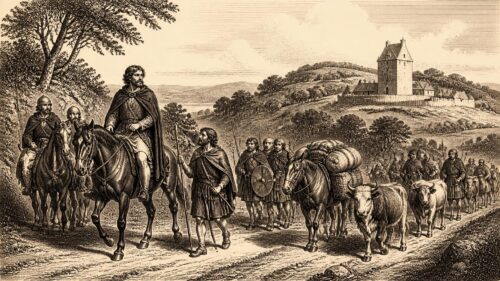
In 785, annalistic records noted political and ecclesiastical transitions across a divided, predominantly rural Ireland. Ruaidrí mac Fáeláin, Leinster overking, died, creating opportunities later exploited by Donnchad Midi and Bran Ardchenn. Máel Dúin of Loch Gabor and Dúnchad of Uí Maine also died, while Tipraite won an otherwise unexplained battle of the Muad. Relics of Ultán were carried on circuit, demonstrating mobile saintly authority and church patronage. Deaths included abbots, learned clerics, a scribe and Abbess Ellbríg. The notices reveal interconnected royal and religious networks, although they preserve little about ordinary people, chronology, motives, warfare, or material conditions in detail.
Dateline
In 785, Ireland’s political map was altered less by a single conquest than by a cluster of deaths, a limited battle and a conspicuous religious journey. The year is best approached through the terse notices conventionally numbered Annals of Ulster 785. Their surviving chronological apparatus places the entries beneath a heading equated with AD 784, an example of the familiar difficulties in converting Irish annal numbers into modern calendar years. Modern reference works nevertheless place the deaths of Ruaidrí mac Fáeláin and Máel Dúin mac Fergusa in 785. The evidence allows a firm account of what was remembered, but rarely supplies a day, a cause of death, or the personal experience behind an entry.
A Leinster King Dies
The most consequential political death was that of Ruaidrí son of Fáelán, styled king of all the Laigin. This was a claim to provincial overkingship in Leinster, not kingship of a unified Irish state. Ruaidrí belonged to Uí Fháeláin, one of the branches of the Uí Dúnlainge dynasty whose power was rooted in north Leinster. His death closed a reign conducted under the shadow of Donnchad Midi, the dominant ruler of Clann Cholmáin in Mide and king of Tara in contemporary political language.
Ruaidrí had already experienced Donnchad’s pressure. In 780 Donnchad defeated him at Óchtar Ocha, near modern Kilcock, and reasserted his authority on Leinster’s northern approaches. Thus Ruaidrí’s death in 785 was more than an obituary within one province: it created an opening in a kingdom vital to the balance of power between Mide and Leinster. Donnchad was able to support his son-in-law Bran Ardchenn in the ensuing contest for Leinster. That longer political outcome should not be mistaken for a recorded ceremony or battle in 785 itself; the annals merely record Ruaidrí’s death. Yet it explains why the passing of one provincial king mattered far beyond his own kindred.
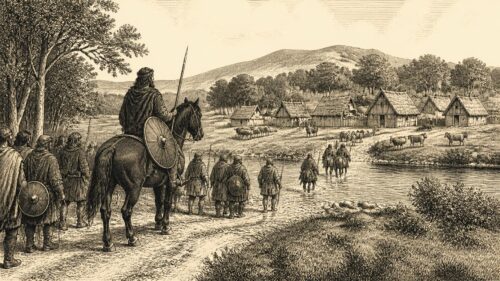
The episode also illustrates the limits of the title “high king”, often applied to Donnchad by modern historians. Ireland contained many túatha, or petty kingdoms, whose rulers retained their own territories, followers and interests. Donnchad’s authority depended on military success, alliances, hostages and recognition rather than a permanent central administration. In 785 there was no capital city or unified kingdom of Ireland. Political influence travelled through lordship, kinship and control of strategic regions such as the midlands and Leinster’s plains.
Loch Gabor and Uí Maine
Another royal obituary concerned Máel Dúin son of Fergus, called king of Loch Gabor. The designation is particularly revealing. Rather than naming Brega as a whole, it identifies a more local kingship associated with Loch Gabor, usually linked with the Lagore area in southern Brega. Máel Dúin belonged to Uí Chernaig, a branch of Síl nÁedo Sláine. His death marked a change within a dynasty whose various branches had struggled repeatedly for influence in Brega, the fertile region north of the lower Liffey and Boyne.
Dúnchad grandson of Daiméne, king of Uí Maine, also died. Uí Maine was a substantial Connacht polity, centred broadly in the lands later divided between east Galway and south Roscommon. The annal’s juxtaposition of rulers from Leinster, Brega and Uí Maine offers no proof that their deaths were related. It does, however, show the breadth of the political world being monitored: regional dynasties across the island were important enough to be entered in the same chronicle.
A battle “of the Muad” was won by Tipraite. That is all the contemporary-style annal tells us. It does not securely name the opposing force, explain the dispute, give a location beyond the name, or state the scale of casualties. It would be tempting to turn such a line into a full campaign, especially because Tipraite was a prominent name in western Irish politics, but the responsible conclusion is narrower: a victory remembered as significant occurred in 785, while its circumstances are lost. The silence is itself instructive. Annals preserve outcomes and names more readily than motives, rank-and-file participants or the burden placed on local households.
A Circuit of Relics
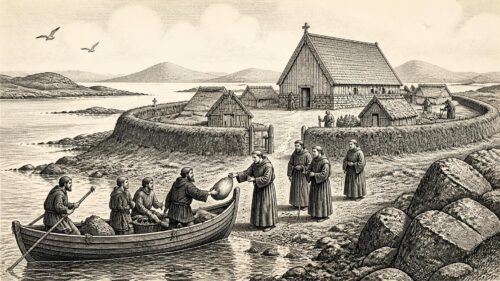
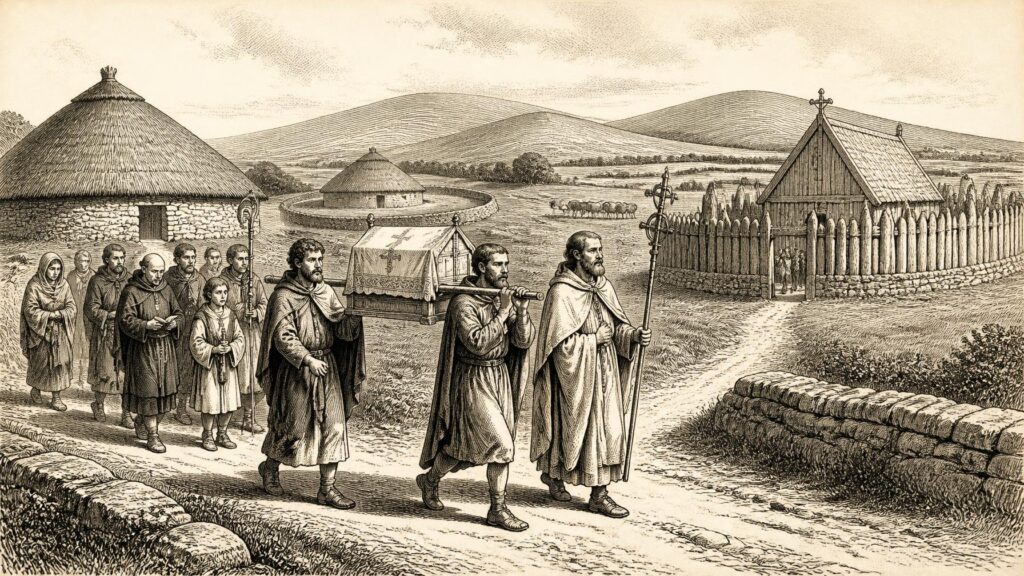
The year’s most distinctive ecclesiastical notice records the taking “on tour” of the relics of Ultán. The entry gives neither itinerary nor destination, and it does not say whether the relics consisted of bones, a shrine, a staff or another holy object. Nor should the tour be imagined as a quiet private translation. In early medieval Ireland, relics made saintly authority visible and mobile. Their movement could gather communities, mark claims of protection, strengthen relationships between churches and patrons, and attach sanctity to places along a route.
Such circuits belonged to a landscape in which churches were not merely places for worship. Major ecclesiastical settlements held land, cattle, skilled workers and dependants; their clergy and lay officers participated in the politics of surrounding kingdoms. The recorded deaths in 785 make this unusually plain. Mugthigern son of Cellach, abbot of Inis Celtra in Lough Derg, was described as “learned”. So too were Faelgus grandson of Roichlech and Ioseph grandson of Foíléne, abbot of Birr. Máel Ochtraig, abbot of Cell Chuilinn and Cell Manach, was explicitly a scribe. These titles show that scholarly reputation was worth recording alongside royal descent and ecclesiastical office.
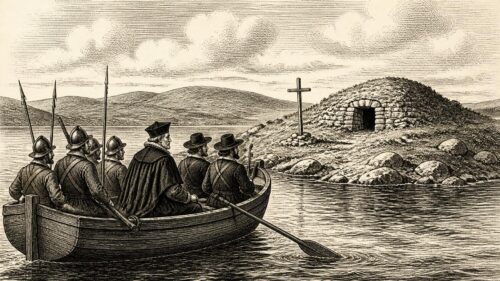
The places named were geographically varied. Inis Celtra was an island monastery on Lough Derg, while Birr lay in the midlands. The death of Echaid son of Fócartach, abbot of Fochlaid and Inis Clothrann, points towards institutions in the north-west and on Lough Ree. Ellbríg, abbess of Cluain Brónaig, is also recorded among the year’s dead. Her entry is an important reminder that women could hold recognised authority within ecclesiastical communities, even though the annal supplies no account of her career. These notices do not prove that every Irish monastery possessed the same wealth or influence; they reveal, rather, a connected ecclesiastical world whose offices, learning and holy assets were central to public memory.
Learning, Labour and Landscape
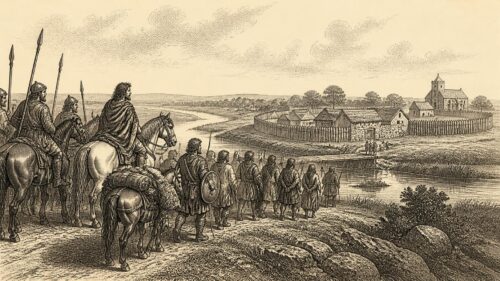
Nothing in the surviving notices permits a specific statement about the harvest, prices, disease or weather of 785. It would be false to fill that silence with a dramatic famine or natural disaster. The broader material setting is clearer. Most people lived in rural communities rather than towns. Ringforts and stone cashels commonly enclosed the farmsteads of prosperous farmers and local lords, with circular timber-and-wattle houses, hearths, animal shelters and working areas within banks, ditches or walls. Agriculture and livestock underpinned food, status and the obligations that rulers and churches could demand.
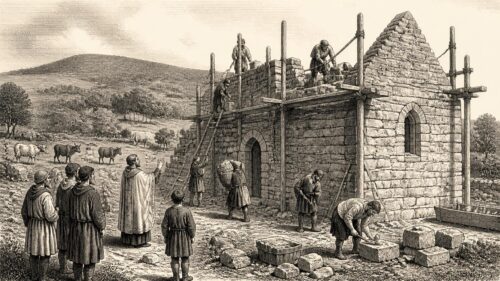
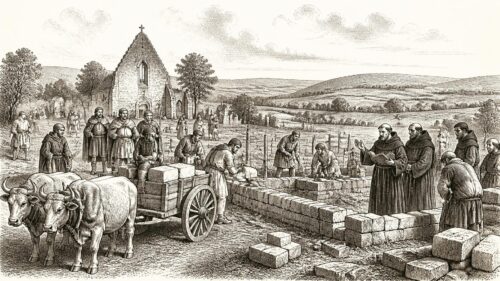
Monastic sites formed part of that same rural economy rather than an entirely separate sacred sphere. Their enclosures could include churches and burial grounds, but also houses, workshops, storehouses, grazing and cultivated land. Craftworkers made and repaired tools, fittings and prestigious objects; scribes prepared and copied texts; guests, pilgrims and dependants had to be housed and fed. The deaths of abbots and a scribe in 785 therefore mattered to communities of workers and tenants as well as to clerics. A change of abbot could affect control of land, revenues, patronage and the safeguarding of a church’s books and relics.
There is no evidence that Ireland had urban centres in 785. Nor is there a securely recorded Scandinavian attack on Ireland in this particular year. The later Viking-age image of ports, fleets and heavily raided monasteries should not be projected backwards onto it. Irish communities did have seaborne and inland connections, but 785 still belongs to a predominantly rural, politically divided island in which waterways, lakes and overland routes connected royal and ecclesiastical centres.
A Year of Transitions
The annals’ compact record of 785 can seem impersonal, but its pattern is meaningful. A Leinster overking died, changing the conditions of provincial politics. The king of Loch Gabor and the king of Uí Maine died, reopening local struggles for rank and territory. A battle was remembered only by its victor. Abbots, a scribe, learned men and an abbess passed from the record, while the relics of Ultán travelled through the living landscape. Together these entries show political power and religious authority operating side by side, often through the same networks of land, patronage and public display.
For ordinary people, the year was experienced not as an annal number but through obligations to households, churches and rulers: tending livestock, sowing and harvesting, maintaining enclosures, attending worship, hearing news at gatherings, and perhaps witnessing a royal succession or the passage of a saint’s relics. The written sources preserve almost none of those individual voices. They nevertheless allow 785 to be seen as a year when the leadership of several regions and churches changed hands, and when a moving relic collection briefly made sacred history an event in the present.
Primary Sources
- The Annals of Ulster: Year U785
- The Annals of Ulster
- The Annals of Ulster: CELT Project Record
- Annals of the Four Masters: Part 61
- Annals of the Four Masters
- The Annals of Tigernach
- Chronicon Scotorum
- Annals of Inisfallen
- Donnchad Midi
- Fáelán
- The Chronicle of Ireland: Then and Now
- Religion and Society in Ireland
- Reassessing the Irish ‘Monastic Town’
- The Organization of Exchange in Early Christian Ireland
- Money in Early Christian Ireland According to the Irish Laws
- Early Medieval Farmsteads
- National Monuments Service: Monument Class and Scope Notes
- Ringforts / Ráthanna
- Ordinary People in Early Christian Ireland
- Early Christian Monasteries
- Inishcaltra Monastic Site
- Glendalough Monastic Site and Visitor Centre
- Life in Glendalough
- Birr Town Trail & Riverbank Walks