Kilconnell’s Contested Friary1353 CE
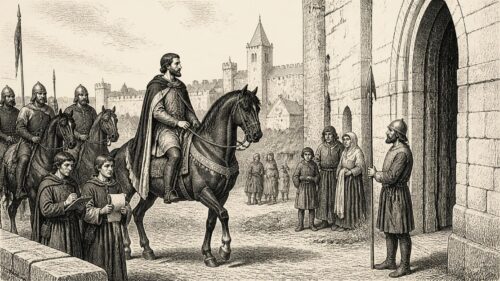
Medieval Ireland in 1353 appears through diverse, sometimes conflicting records. The Four Masters date William Buí Ó Ceallaigh’s Franciscan foundation at Kilconnell to this year, although Franciscan tradition proposes 1414 and surviving fabric reflects later patronage. The friary linked Gaelic lordship, Latin Christianity and local social life. Annals record Áed Ó Conchobair’s deposition in Connacht, other dynastic deaths and killings across the midlands and Ulster, while differing chronologies complicate dating. Pope Innocent VI reportedly settled Armagh and Dublin’s primacy dispute. Youghal received trading privileges in England and Wales. Together, these notices reveal politically fragmented yet religiously and commercially interconnected Ireland.
Dateline
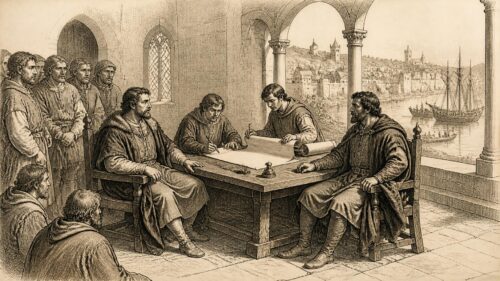
The clearest Irish landmark conventionally attached to 1353 is a religious foundation in eastern Connacht: the Franciscan friary of Kilconnell, in the lordship of Uí Maine. Yet the word conventionally matters. The Annals of the Four Masters, compiled in the seventeenth century from earlier materials, place the foundation in this year and name its patron as William Buí Ó Ceallaigh, lord of Uí Maine. Other evidence and later Franciscan tradition have produced a rival date of 1414. The surviving ruins chiefly reflect later building campaigns. Kilconnell therefore offers an unusually revealing starting point for 1353: it is an event recorded under the year, but one whose precise chronology must be handled openly rather than repeated as an unquestioned fact.
A Foundation in Uí Maine
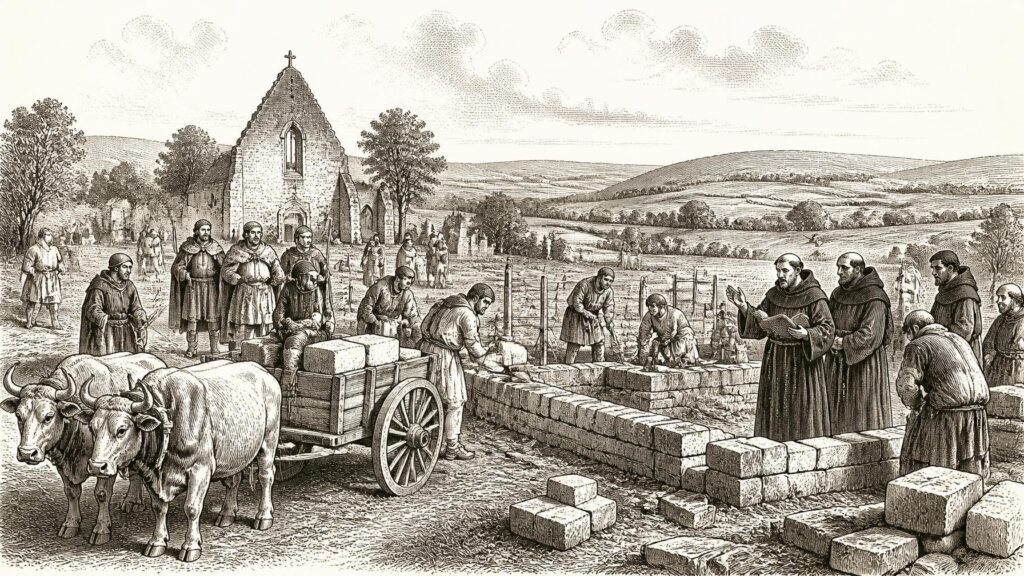
According to the Four Masters, William Buí Ó Ceallaigh founded a house at Kilconnell for Franciscan friars in the diocese of Clonfert. If the annal preserves the date correctly, the act was more than a private expression of devotion. A friary brought preaching, confession, burial, commemoration and a resident religious community into a lordship. It also made a visible statement about the patron’s standing. The Ó Ceallaighs were among the leading Gaelic dynasties of eastern Connacht, and a foundation linked their authority to a religious order with an international reach.
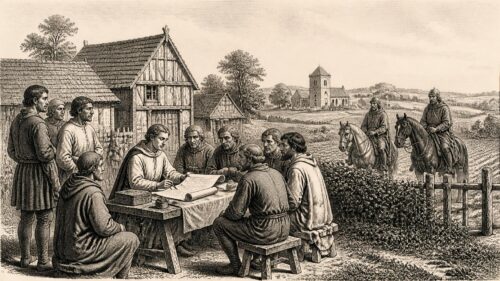
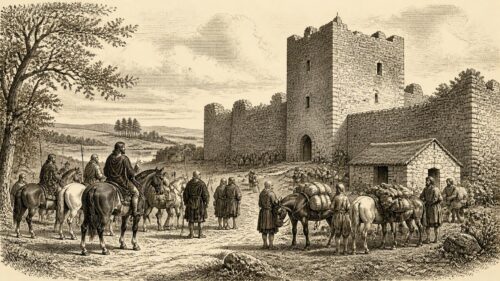
The proposed site was well chosen. Kilconnell lay within Ó Ceallaigh country, near routes connecting the Shannon crossing at Athlone with the west. An earlier ecclesiastical site was already associated with St Conall. A new Franciscan house could therefore build upon a familiar sacred landscape rather than create one from nothing. For local households, its establishment would have meant labour, food supplies, gifts, alms, worship and, in time, burial arrangements: the practical transactions through which a religious house became part of a district’s social life.
There is, however, no warrant for imagining the substantial church still standing today as complete in 1353. The tall tower, transept and other surviving features incorporate later medieval work, while recorded Ó Ceallaigh gifts and tombs show continuing patronage into the fifteenth century. Nor is the alternative date merely a modern misunderstanding. Franciscan tradition has associated Kilconnell with a papal licence of 1414, though other historians argue that document referred to another place, Killconnayanne. The responsible conclusion is narrower but valuable: 1353 is the date supplied by a major annalistic tradition for the foundation; the house’s early history and fabric show that its development was gradual and that the date remains debated.
Patronage, Poetry and Lordship
The proposed founder belonged to a milieu in which cultural patronage strengthened political power. Two years earlier, the Annals of Connacht record that William Buí invited the poetry schools of Ireland to a Christmas gathering. That earlier event cannot be turned into an occurrence of 1353, but it gives closely connected context for the man credited with Kilconnell. Such hospitality was not idle display. Professional poets preserved genealogies, celebrated victories and generosity, and helped articulate the reputations on which Gaelic dynasties relied. A lord able to sustain learned visitors and endow friars advertised both resources and legitimacy.
Franciscan patronage did not replace older Irish literary culture; it existed alongside it. Nor should it be described simply as a contrast between ‘Gaelic’ and ‘English’ Ireland. The friars’ order crossed linguistic and political frontiers, while its local houses depended on particular patrons. Kilconnell, if founded in 1353, was a Gaelic lord’s investment in a Latin Christian institution. That combination was characteristic of later medieval Ireland, where dynastic lordship, diocesan structures, monastic inheritance and international religious orders overlapped rather than occupied separate worlds.
Connacht’s Unsettled Kingship
Elsewhere in Connacht, 1353 was marked in the annals by acute instability. The Annals of Connacht report that Áed, son of Toirdelbach Ó Conchobair, was deposed and taken into custody by Mac Bráen. The Four Masters similarly state that Hugh, son of Turlough, was deposed and detained. The entries do not provide a full narrative of the coup, but they show that the title of king of Connacht did not ensure secure possession of the province. Rival branches of the Ó Conchobairs, their allies and neighbouring lordships all had interests in who could command tribute, military service and strategic places.
This is a point at which the sources demand care. The Annals of Ulster, under its entry for 1353, says that an Áed son of Toirdelbach Ó Conchobair, described as king of Connacht, was slain by the sons of Ó Ceallaigh. The same cluster of Ulster entries is assigned by the Annals of Connacht to 1356, with fuller explanations. Medieval Irish annals were copied, continued and synchronised in different centres; their year headings do not always align. It would be unsafe to state that Áed’s death occurred in calendar year 1353. What can responsibly be said is that the Connacht annals place his deposition in 1353, while another annalistic tradition preserves a later, or differently dated, account of his violent removal from the struggle.
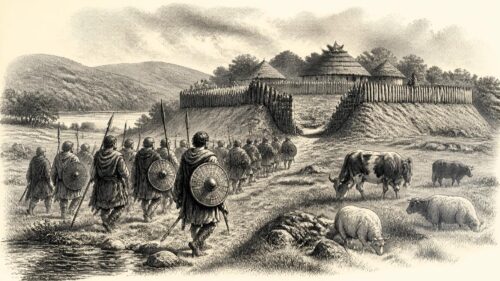
Even the more local notices convey the human scale of lordship. Tadc Mag Ragnaill, chief of Muintir Eolais in what is now south Leitrim and neighbouring parts of Longford, was killed by the sons of Sefraid Mag Ragnaill. This was not a distant royal drama. Control of a relatively small territory could depend on kinship factions, armed followers, access to cattle and the capacity to defend a residence or take refuge with allies. In Annaly, Mathgamain, son of Gilla na nAemh Ó Ferghail, died. Such notices are brief, but they identify the lords whose households and clients shaped everyday security across the midlands.
Ulster Kinship and Violence
In Ulster, the annals offer one unusually precise date. Muirchertach, son of John and descendant of Domnall, son of Brian Ó Néill, was killed by Philip Mag Uidhir on 3 March. The record does not explain the immediate cause, but its precision underlines the importance of aristocratic kinship and succession. The Ó Néills and Maguires were powerful names in the north, and a killing involving their networks could affect alliances far beyond the place where the attack occurred.
The death of Gormlaith, daughter of Ó Domhnaill and wife of Hugh Ó Néill, was recorded by both the Four Masters and the Annals of Connacht. The Four Masters praised her as a woman of exceptional name and renown. Such language is conventional, but the marriage itself indicates the political significance of elite women. Gormlaith connected the ruling families of Tír Chonaill and Tír Eógain. Marriages could create obligations, ease rivalries or furnish claims; bereavement did not dissolve those networks. Her death was consequently worth recording in chronicles otherwise often focused on male officeholders and combatants.
The same year’s notices should not be read as a complete map of violence. They are selective memorial records, preserving deaths and changes regarded as notable by their compilers. They nevertheless show a country in which political authority was dispersed. Kingship, chieftainship and lordship were negotiated in territories large and small, not administered from a single Irish capital.
Church Authority Beyond the Friary
Religious status was also contested at the highest level. Traditional accounts date to 1353 a decision by Pope Innocent VI on the long dispute between Armagh and Dublin over the primacy. Richard FitzRalph, archbishop of Armagh, and John de St Paul, archbishop of Dublin, represented sees with different claims to precedence: Armagh’s association with St Patrick and Dublin’s position as the metropolitan centre of the English lordship. The reported formula allowed both archbishops to be called primate, while distinguishing Armagh’s ‘Primate of All Ireland’ from Dublin’s ‘Primate of Ireland’.
The settlement was chiefly about rank, ceremonial authority and jurisdictional prestige, not a division of the island into two churches. Its significance lay precisely in the effort to make rival claims coexist in words. FitzRalph was an Irish-born scholar of international standing, educated at Oxford and familiar with the papal court at Avignon. His career demonstrates that Irish ecclesiastical life was connected to wider scholarly and curial worlds, even as individual dioceses and lordships retained their local interests.
At Clones, another older ecclesiastical centre near the Ulster border, the Four Masters record the death of John Ó Cairbre, coarb, or successor, of St Tigernach. The title recalled an inherited tradition of stewardship attached to an early saint’s church. In 1353, then, Irish Christianity contained several layers at once: the claims of ancient churches such as Armagh and Clones, diocesan bishops and archbishops, and the relatively newer mendicant friars proposed for Kilconnell.
Youghal and the Sea
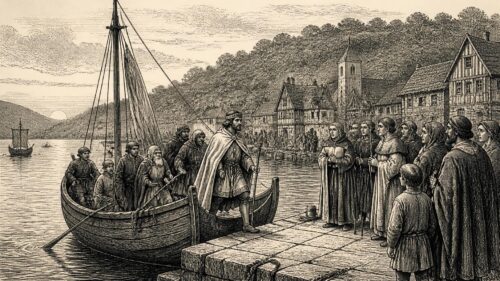
In the south-east, a civic and commercial development is also assigned to 1353. The freemen of Youghal were granted freedom to trade specified staples throughout England and Wales: wool, leather, woolfells and lead. The wording matters. These were valuable and regulated commodities, and access to markets across the Irish Sea mattered to merchants, producers and the town’s governing community. Wool and skins linked rural livestock economies to shipping, credit and urban exchange; lead connected Ireland to wider extractive and building economies.
The privilege should not be mistaken for evidence that every inhabitant prospered, nor does it reveal the volume of trade in that exact year. But it confirms Youghal’s place within the commercial framework of the English crown’s dominions. Ireland in 1353 was not solely a patchwork of contested lordships and rural strongholds. Walled ports such as Youghal connected coastal Ireland to England and Wales, while their legal privileges rested on royal authority.
Thus 1353 cannot be reduced to one national event. Its surviving evidence points instead to several overlapping histories: a disputed Franciscan foundation in Uí Maine; insecurity among Connacht and midland dynasties; a precisely dated killing in Ulster; contests over ecclesiastical precedence; and commercial rights at Youghal. Kilconnell’s uncertain foundation date is not a flaw to conceal. It is a reminder that medieval Ireland is recovered through records made in different places, for different purposes, and sometimes on different chronological systems. Used carefully, those records reveal a society whose religious, political and trading connections were at once intensely local and unmistakably international.
Primary Sources
- Annals of the Four Masters, Annals M1352–M1355
- The Annals of Ulster
- Annála Connacht
- Annales Hiberniae
- FitzRalph, Richard | Dictionary of Irish Biography
- The See of Armagh | A Topographical Dictionary of Ireland
- Kilconnell Franciscan Friary | Monastic Ireland
- Kilconnell Franciscan Friary | Heritage Ireland
- Kilconnell (Co. Galway) | Irish Franciscans
- Two Nations, One Order: The Franciscans in Medieval Ireland
- Journal of the Galway Archaeological and Historical Society
- Kilconnell | A Topographical Dictionary of Ireland
- Youghal Historical Town Map
- Exploring the Irish Annals
- CELT Project: Annals of the Four Masters
- CELT Project: Annála Connacht
- Annala Uladh: Annals of Ulster Otherwise Annala Senait
- Richard FitzRalph | Stanford Encyclopedia of Philosophy
- Richard FitzRalph and the Fourteenth-Century Poverty Controversies
- Materials for the History of the Franciscan Province of Ireland, A.D. 1230–1450
- O’Kelly Plaque, Kilconnell | Galway Community Archaeology
- The Franciscan Friary of Killconnell in the County of Galway | National Library of Ireland Sources