Sléibéne’s Columban Law757 CE
In annalistic 757, Ireland’s fragmented political and ecclesiastical landscape was marked by conflict, loss and religious assertion. At Cenn Febrat in Munster, Bodbgal, superior of Mungret, died in fighting among Munstermen, while Donn of the southern Uí Briúin was killed in Connacht. Tomaltach of Ciannachta Glinne Gaimin and several churchmen also died. Uí Chremthainn burned Cell Mór Dithraib, demonstrating religious communities’ material vulnerability. Obits recorded abbots and anchorites across Ireland. Most significantly, Sléibéne, abbot of Iona, promulgated the Law of Colum Cille, renewing Columban claims and links between ecclesiastical authority, secular protection, obligations and networks spanning Ireland and western Scotland.
Dateline
In the Irish annals, 757 is a year of terse but unusually revealing notices. The record does not describe a single national turning point. Instead, it catches violence in Munster and Connacht, a destructive attack on a church, the deaths of clerics and rulers, and the public assertion of a Columban ecclesiastical law. Taken together, these entries show an Ireland governed through many overlapping centres of authority: provincial kings, lesser dynasts, powerful monasteries and the religious networks that bound Irish communities to Iona and western Scotland.
The evidence must be handled carefully. The events are securely placed under the annalistic year conventionally numbered 757 in the Annals of Ulster and Annals of Tigernach, but the Irish chronicles were compiled and copied over centuries, and their chronological systems do not always align perfectly with a modern calendar. The Ulster annal labelled U757, for example, carries an internal AD 756 heading. No entry gives a month or day for the Irish events discussed here. It is therefore safest to treat them as belonging to the annalistic year 757, rather than assigning them invented dates within January–December.
A Battle Among Munstermen
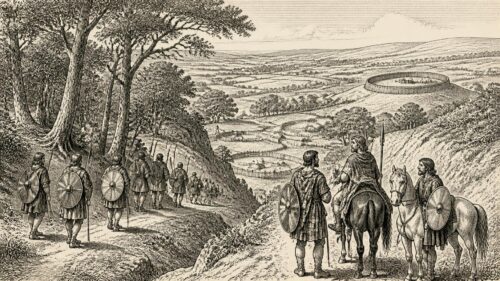
The starkest entry is the battle of Cenn Febrat: a conflict “between the Munstermen themselves” in which Bodbgal, princeps or superior of Mungairit, fell. Cenn Febrat, also called Cenn Abrat, is generally associated with the Ballyhoura–Slieve Reagh uplands in the borderland of present-day Counties Limerick and Cork. That identification is plausible rather than an excuse for false precision: the annals name the place but do not map the field, list the combatants, identify a victor or explain the immediate cause of war.
Even so, the wording is important. It does not present an outside invasion of Munster, but fighting among its own people. Munster was not a unified state with a permanent administration. Its overkingship depended on negotiation and competition among the various branches of the Éoganachta and other regional powers, while communities such as Uí Fhidgeinti, Déisi, Corcu Loígde and Éile retained substantial local importance. The decades after the death of the formidable Munster overking Cathal son of Finguine in 742 were notably unsettled. The battle at Cenn Febrat belongs securely to that wider era of contested authority, though the annals do not permit us to identify the opposing factions in 757.
Bodbgal’s death demonstrates that monasteries were not detached refuges beyond secular affairs. Mungairit, now Mungret near Limerick, was an ecclesiastical community whose head was prominent enough to be named in a provincial battle. The title princeps could carry both religious and social weight: an abbot or superior might command dependants, land, livestock, learning and political connections. His presence, whether as a participant, ally or victim caught in a wider confrontation, shows that a church leader could stand at the dangerous meeting point of local politics and armed force. It does not, however, prove that the battle was fought over Mungret itself or that Bodbgal personally led warriors.
Power Beyond Munster
The chronicle also records the killing of Donn son of Cumascach, described as king of the southern Uí Briúin. This was a Connacht dynastic designation, and the notice is frustratingly concise: it names neither killer nor location. Yet it confirms that conflict was not confined to Munster. The Uí Briúin were among the principal Connacht kindreds, but “southern” reminds us that such groupings were not monolithic. Kingship was layered, territorial and competitive. A ruler might be powerful within his own people without ruling all Connacht, still less all Ireland.
At the island-wide level, Domnall Midi of Clann Cholmáin was the dominant Uí Néill ruler and is commonly styled king of Tara. His authority rested chiefly in the midlands and in alliances, tribute relationships and military capacity rather than in a single Irish kingdom administered from Tara. Domnall had already strengthened the position of his southern Uí Néill lineage and had cultivated close Columban connections. Nothing in the annals says that he intervened at Cenn Febrat or in the killing of Donn. The proper conclusion is more modest: 757’s local conflicts unfolded within a political landscape in which Domnall’s midland power mattered, but did not eliminate provincial and regional rivalries.
Another Ulster notice records the death of Tomaltach, king of Ciannachta Glinne Gaimin, alongside Fergus son of Congal, the anchorite Cuidgal and Aildobur, abbot of Muiccert. Ciannachta Glinne Gaimin lay in the north, in the valley of the River Roe. The grouping of a king, an anchorite and an abbot in a single annalistic sentence is characteristic of the source rather than evidence that they died together. Nevertheless, it offers a useful glimpse of the record-keepers’ world: rulers and religious specialists alike were people whose deaths could alter local networks of lordship, patronage and memory.
Fire and Religious Communities
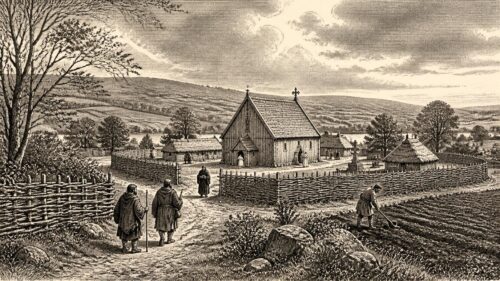
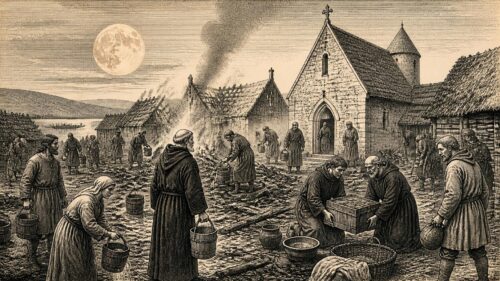
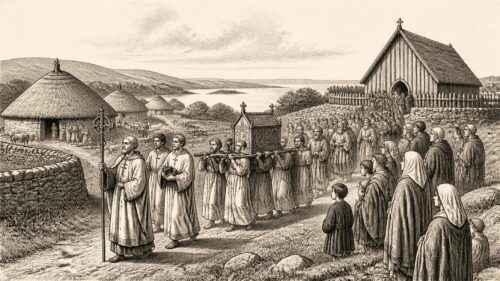
The burning of Cell Mór Dithraib by the Uí Chremthainn was another grave event. The annal gives the perpetrators but no motive. Uí Chremthainn was an Airgialla people of the north; Cell Mór Dithraib has not been securely located. We should resist treating the word “burning” as proof of a modern-style attack on a stone church. Eighth-century Irish religious settlements commonly included timber buildings, workshops, dwellings, stores and enclosures as well as places of worship. A fire could destroy buildings, food reserves, books, tools and animals, while also striking at the honour and resources of a rival community.
That vulnerability gives force to the year’s other obits. Finnchú, abbot of Les Mór, died, as did Siadal of Linn Duachail. Lismore in Munster and Linn Duachail on the coast of modern County Louth were both part of a dense landscape of churches, monasteries and associated settlements. The identification of every person and institution named in the early annals is not always certain, and an obit need not mean that a community was in crisis. Still, these notices show the importance of ecclesiastical succession. An abbot was not simply a solitary spiritual figure: he was often guardian of property, leader of a religious household, patron of craftsmen and scribes, and a link between kin groups and a saint’s cult.
The death of Fidmuine, an anchorite of Ráithin and grandson of Suanach, was remembered as a “repose”. Anchorites represented a more ascetic form of religious life, but were not necessarily socially invisible. Their reputation for prayer, wisdom and discipline could make them significant figures within ecclesiastical networks. The annals’ careful use of religious titles—anchorite, abbot, superior—shows that the Christian landscape of 757 contained varied vocations and ranks, not a single undifferentiated body of “monks”.
The Law of Colum Cille
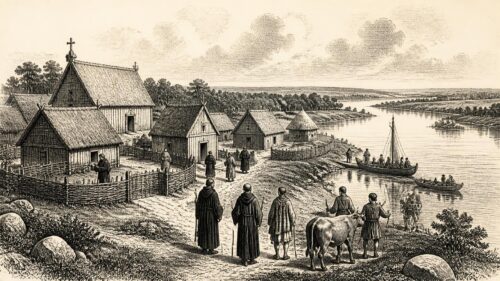
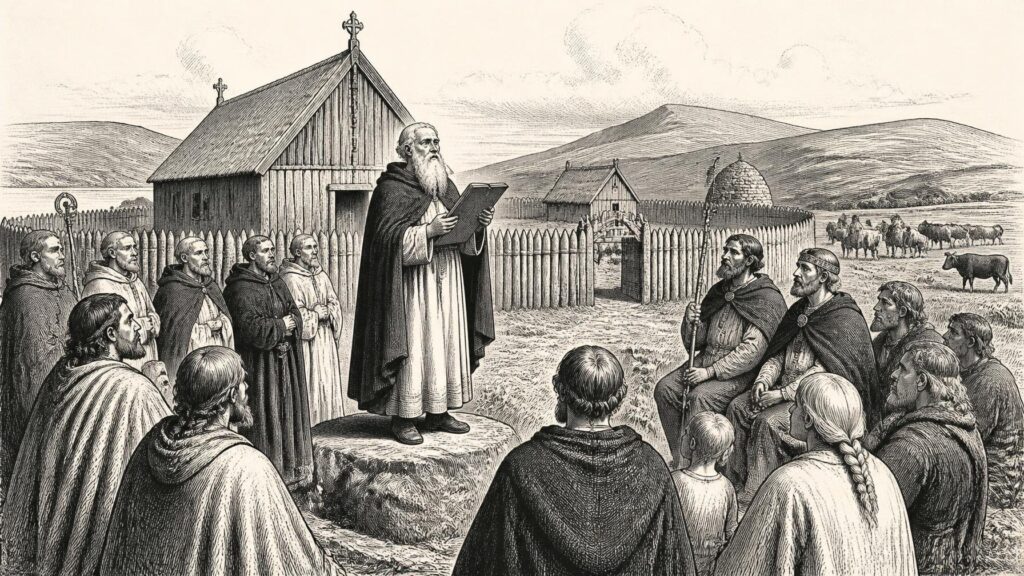
The most consequential religious notice states simply: “The law of Colum Cille [was] promulgated by Sléibéne.” Sléibéne was abbot of Iona, the island monastery founded in the sixth century by Colum Cille, or Columba. He had visited Ireland earlier in the 750s, and his appearance in the annals of 757 makes clear that Iona’s religious authority reached across the North Channel. Iona was geographically in the Hebrides, but its community and its saint belonged to a Gaelic world shared by Ireland and western Britain; its network included major Irish churches.
What exactly was the law? The entry does not preserve its clauses, so it would be wrong to describe it as a surviving statute-book or to claim certainty about its enforcement. In early Irish usage, a saint’s “law” could mean a public ecclesiastical arrangement backed by obligations, protections, dues and the authority of a religious federation. Modern scholarship reasonably connects the Law of Colum Cille with the formal assertion of Columban rights, perhaps accompanied by a circuit involving sacred objects and the collection of renders. Such reconstruction remains interpretation, not a detail supplied by the annal itself.
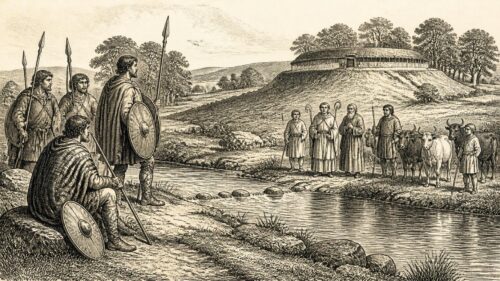
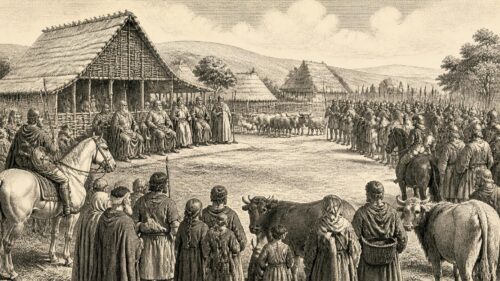
Its public promulgation nonetheless matters. An ecclesiastical law required recognition from secular society: from kings who could protect it, communities expected to honour it, and churches that benefitted from the saint’s authority. Domnall Midi had sponsored the Law of Colum Cille a few years earlier, in 753. Sléibéne’s action in 757 therefore appears not as a sudden innovation but as a renewed assertion of Columban influence in Ireland. The notice captures a form of diplomacy in which religious prestige, legal custom and political power reinforced one another.
Life in a Fragmented Island
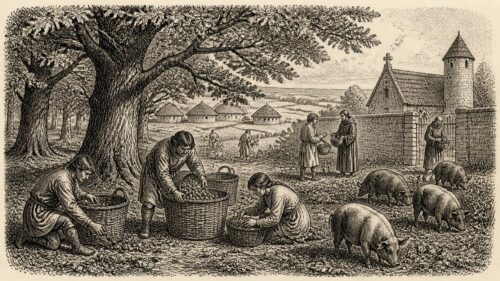
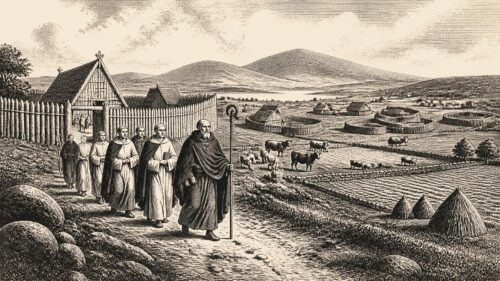
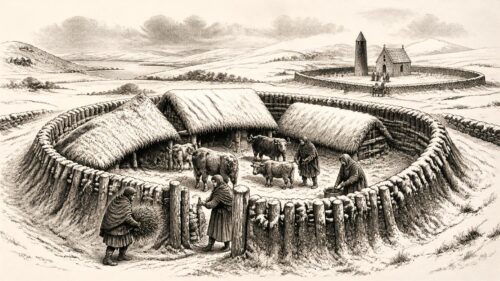
For most people, the year was lived far from named battlefields and high ecclesiastical negotiations. Ireland remained overwhelmingly rural. Households worked mixed agricultural landscapes, raising cattle and cultivating crops, while living in dispersed settlements and ringforts. Cattle were important stores of wealth and sources of food, dairy produce, traction and social payment. Churches and monasteries drew on the labour and produce of surrounding populations, and in return offered worship, burial, education, hospitality, skilled craftwork and access to wider networks.
The annals do not report a nationwide famine, epidemic, climatic disaster or foreign raid for 757. Silence cannot prove that every district enjoyed security or good harvests, but it rules out turning the year into a crisis for which there is no evidence. Nor should Ethelbald of Mercia’s recorded death be made into an Irish event. Its inclusion in the annal does, however, show that Irish chroniclers looked beyond the island and maintained an awareness of political change across the Irish Sea.
Thus 757 is best understood not as a blank interval before later Viking raids, but as a year in its own right: a Munster battle cost Mungret its superior; a Connacht ruler was killed; a church was burned by a northern people; religious leaders died across several regions; and Sléibéne proclaimed the authority of Colum Cille’s law. The notices are brief, but they reveal an energetic, connected and contested Ireland, where the fate of monasteries and the ambitions of kings were inseparable from the lives of the communities around them.
Primary Sources
- The Annals of Ulster, Year U757
- The Annals of Tigernach, Annal T757
- Annals of the Four Masters, Annal M757
- Annals of Inisfallen, Annal AI757
- Chronicon Scotorum
- Sléibíne, Dictionary of Irish Biography
- Domnall Midi, Dictionary of Irish Biography
- Iona’s Namescape: Í > Ioua > Iona
- Críchad an Chaoilli: A Medieval Territory Revealed
- Cenn Abrat or Cenn Febrat, National Library of Ireland catalogue
- Cartlann Téacsanna: Cend Abrat
- The Annals of Ulster: CELT project information
- Annals of Tigernach: CELT project information
- Annals of Inisfallen: CELT project information
- List of Published Texts at CELT
- Early Christian Monasteries
- Early Monastic Churches
- Early Irish Monasticism
- Church Island, Valentia Harbour
- Christian Ireland, Fifth to Eighth Centuries