

Burning Memory
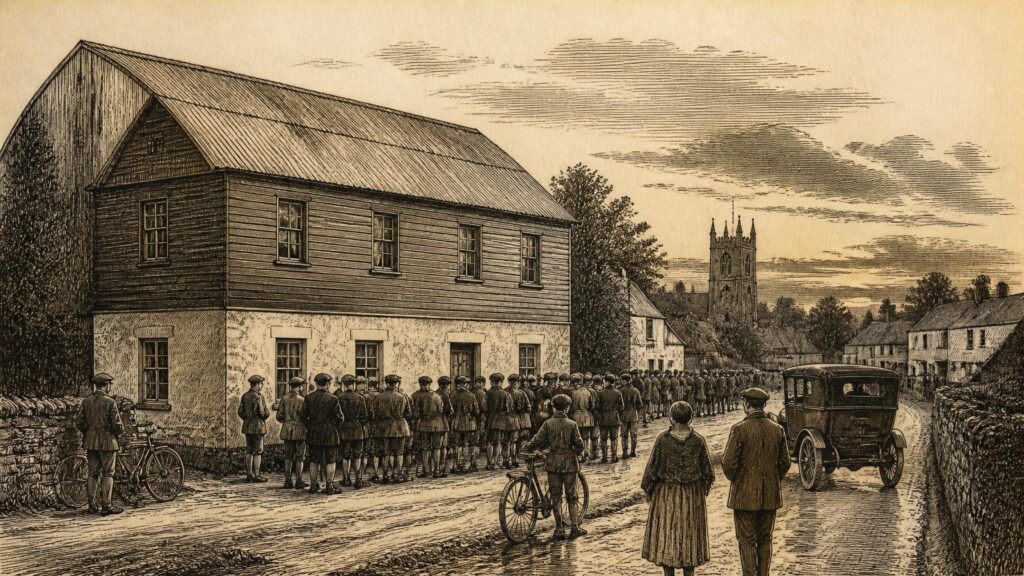
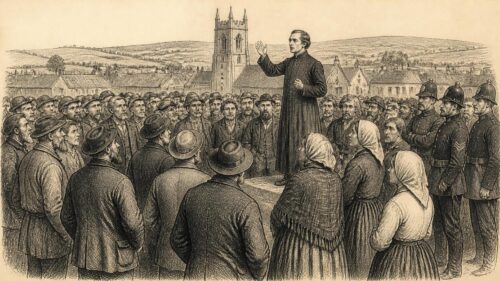
AI generated historical illustration, not a contemporary photograph.
At a Glance
On Sunday 5 September 1926, an evening intended as modest entertainment ended in one of the gravest civilian disasters of the Irish Free State. Forty-eight people died when a film show in an improvised upstairs hall at Dromcollogher, County Limerick, caught fire. The catastrophe was immediately reported across Ireland and abroad; in the village itself it became, more simply and more enduringly, ‘the Burning’. A century later, the event demands attention not only as a terrible local bereavement, but as a history of technology, regulation, communal resilience and the difficult work of remembrance.
Village Evening
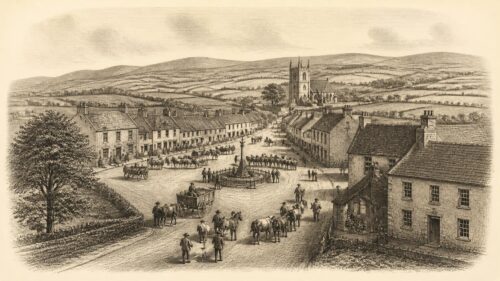
Dromcollogher, more commonly rendered locally as Dromcollogher or Drumcollogher although Dromcolliher is the official form, was a small market settlement in west County Limerick. In the census of April 1926 its town population was recorded as 442. Its monthly fairs served a substantial agricultural hinterland, and its streets contained an unusually large number of public houses whose trade was connected to fair days, country visitors and local commerce. It was not isolated from modern life, but neither was it a place in which commercial cinema had become an ordinary weekly routine.
Film was nevertheless arriving in rural Ireland. Travelling exhibitors, borrowed projectors and temporary venues brought moving pictures to villages that did not possess purpose-built picture houses. Earlier shows had already been held in Dromcollogher during 1926, chiefly in the village hall on Church Street. Those occasions had drawn audiences and demonstrated that cinema was commercially promising. The novelty of the moving image, the modest cost of admission and the sociability of a Sunday evening could make such a show an important event for people who lived in the village and throughout the surrounding countryside.
The promoter of the fatal show was William Forde, usually known as ‘Babe’ or ‘Baby’ Forde. He was thirty years old and ran a garage and hackney-car business; his mother also kept a sweetshop. Forde was neither a trained projectionist nor an experienced cinema proprietor. In the summer of 1926 he decided to enter the film business, an understandable entrepreneurial venture in a district where audiences had already shown an appetite for screenings. He contacted Patrick Downing, a projectionist employed at the Assembly Rooms cinema in Cork, who obtained a second-hand hand-cranked cinematograph and agreed to assist him.
There is a temptation, sharpened by hindsight, to reduce the story to the imprudence of one man. The documented record suggests a wider and more troubling context. Adapted village halls and stores were being used for film exhibitions, while the formal safety expectations associated with licensed cinemas were not consistently present in such premises. The Dromcollogher disaster was therefore not merely an accident in an otherwise safe system. It exposed the peril created where a new and hazardous technology was inserted into an old building, under informal arrangements, before safety practice had caught up with popular demand.
Improvised Hall
The venue stood in Church Street, near St Bartholomew’s Catholic Church. Patrick Brennan had bought it in 1920 as a store for his hardware trade. It was a large, two-storey structure used for timber and glass, with a timber-and-corrugated-zinc frontage and stone side walls. The partly floored upper level had been adapted as a hall for dances, concerts and dramatic performances. It was not constructed as a cinema, and its limitations mattered fatally on the night of the fire.
The usable auditorium was narrow. Long wooden forms were arranged in rows; other spectators sat on planks laid over boxes. A central passage, already only about two and a half feet wide, was further obstructed by extra seating. A wooden partition created a small dressing room at the far end. The upper room was reached by a single wooden ladder or stairway. Windows at the rear offered a possible alternative route, but they were barred. These conditions did not simply make the room uncomfortable. In an emergency, they transformed the crowd itself into an obstacle to escape.
The technical arrangements were equally precarious. Early cinema film was made from cellulose nitrate, a material capable of igniting fiercely and burning with exceptional rapidity. Reels ought to have been kept in protective metal containers. On the night of the show, however, several reels were out on a table, close to candles used to illuminate the entrance and collect the ninepenny admission charge. The lighting was makeshift because the available electrical equipment was inadequate. A projector, fed by a dynamo outside, stood within the audience space rather than in a fire-resistant projection box.
These facts are not later embellishments. They emerge from contemporary evidence examined at the inquest and from the subsequent prosecutions. Sergeant Long of the Gardaí had discussed fire precautions and licensing with Forde and Brennan before the performance. He later stated that he had advised the provision of sand, water and a wet blanket. That evidence does not make the Garda responsible for the event, nor does it imply official approval of the show. It does show that danger had been recognised before the disaster, even if precautions remained gravely insufficient.
Fatal Screening
The performance was announced for nine o’clock, after benediction in the nearby church. It began later, as rural entertainments often did. At least 150 people, and perhaps more, climbed to the upper hall. The audience included men, women and children from Dromcollogher, neighbouring townlands and further afield. Contemporary and later accounts agree that it was overcrowded. Many in attendance were young; the final death toll included children as young as seven.
There has been uncertainty about the films shown. Some early reports named Cecil B. DeMille’s The Ten Commandments, an assertion later disproved by evidence concerning the limited number of Irish prints then available. Research based on a later letter from William S. Spencer, the man who supplied the films to Downing, identifies the programme as the short False Alarm, followed by the principal feature The Decoy. The correction matters less than the basic truth: the audience had gathered for a routine programme of popular screen entertainment, not for an activity they could reasonably have understood as exceptionally dangerous.
During the first film, a local young man, Willie Quirke, briefly turned the crank of the projector. Downing resumed control before the main feature. As he attempted to arrange the reels, the films were laid out unprotected upon the table. At about ten minutes to ten, one reel caught fire. John O’Brien, an audience member, told the inquest that he saw a candle fall and ignite the exposed film. The jury later accepted that explanation.
The exact reason the candle toppled was never established. It had apparently been fixed to the table by its own melted grease, an inherently insecure arrangement. Other explanations circulated immediately after the fire: a spark from electrical cabling, a cigarette end, and later stories of rough behaviour or a cap striking the light. Such claims should be treated carefully. The evidence supports the conclusion that a lighted candle set the nitrate film alight; it does not securely establish the precise physical movement that knocked it over.
At first there was an opportunity to contain the blaze. Downing said that he cut the electrical current, which brought up the hall lights, and tried to smother the burning film with his hands. Sergeant Long also attempted to beat down the flames with his cap. But as people tried to extinguish the burning reel, fire spread to other exposed reels and then to the floor. Nitrate film, dry timber, wooden partitions and crowd panic formed a lethal combination. What began as a small fire became, in the recollection of survivors, an engulfing inferno within minutes.
Closing Exits
Downing called for calm and told people to remain seated. For a brief moment, some did. Then the rapid advance of flame and smoke made orderly escape impossible. Those nearest the single doorway rushed for the ladder. Many got out, though not without burns and injuries. The burning film was carried towards the exit and set the ladder alight. Others, cut off from the door, fled towards the dressing room and rear windows.
The barred windows were prised open and some people escaped through them. Outside, however, nearby hay caught fire. A person became trapped in one of the windows, obstructing the escape route. Inside, the heat, smoke and toxic fumes disorientated the audience. Guard Davis urged people to follow him through the fire towards the principal exit, but terror made such a course impossible for many to contemplate. He tried unsuccessfully to break through the internal partition. Had it fallen, those inside could have dropped to the ground floor, where people outside had forced open the lower door.
Survivor testimony gives the disaster its human scale. Charles Wall described seeing the room aflame, being pulled towards the exit by his wife, and falling down the stairs after escaping. John Gleeson, badly injured, described working at the barred window while smoke filled his eyes and mouth, helping his wife and another woman out before the burns to his hands made further rescue impossible. Such accounts are painful precisely because they show that escape, rescue and death occurred in the same constricted space within an extraordinarily short period.
People outside broke into the lower storey, forced doors, gathered ladders and tried to reach those trapped above. Their efforts were courageous but were defeated by the speed and intensity of the fire. The roof and floor collapsed. Some local men died after entering or attempting to re-enter the building in search of relatives and neighbours. William Savage, whose body was identifiable, later became the named victim in the initial manslaughter charge. Robert Ahern and Thomas Buckley were particularly remembered for efforts to save others, though public commemoration should not allow familiar heroic narratives to eclipse the forty-eight individual lives lost.
Identification was agonisingly difficult. Watches, jewellery, clothing fragments and personal effects became crucial evidence for families. James Quaid’s stopped watch was taken as corroboration of the approximate time of the fire. A shoe buckle helped identify Violet Irwin. In some instances, there could be no certainty. This grim practical reality led quickly to the decision for a communal burial.
Communal Mourning
The fire was a disaster for a whole parish rather than a collection of separate households. Forty-eight deaths represented roughly one-tenth of the village population, though the victims came from a wider area. More than half were under twenty-five. Fifteen were children. Entire family networks were ruptured. Jeremiah Buckley, a national-school teacher, died with his wife Ellen, their daughter Bridie, Ellen’s sister Kate Wall and the family’s maid, Nora Kirwan. The enormity of such losses explains why the word ‘tragedy’ can seem inadequate.
On the night after the fire, Dromcollogher kept vigil amid the ruins. Public houses were closed. The Gardaí protected Forde’s home after angry crowds broke its windows, and Forde and Downing stayed at the barracks for their own safety. The dead were placed in coffins the following day. Army supplies from Newcastle West did not provide enough coffins, and timber boxes were used for some remains. The record is stark, but its inclusion is necessary: mourning in 1926 involved not only religious ritual and public sympathy, but exhausting practical labour under conditions of shock.
A public meeting considered burial arrangements. Permission was secured for a large communal grave at St Bartholomew’s. The coffins were brought to the churchyard and remained there overnight. At the funeral Mass on Tuesday, President W. T. Cosgrave attended. Bishop David Keane performed the interment rites, and priests from the diocese and surrounding parishes joined the ceremony. Condolences arrived from King George V, church leaders, councils, trade unions and organisations across Ireland and beyond.
The memorial cross at St Bartholomew’s became the principal physical focus of grief. Forty-six victims were buried together there, while two others were buried elsewhere. The monument lists the dead by name and age; it does not assign individual dates of death because all died in the same calamity. Its inscription preserves the local phrase, ‘the calamitous burning’. The term ‘the Burning’ was used for generations, often in a tone that suggested that the event was too terrible, too familiar or too intimate to require explanation.
Religious language framed much of the immediate public response. Clergy spoke of consolation, sacrifice and reunion in heaven. Such words reflected the prevailing devotional culture and doubtless comforted some bereaved people. Yet they should not be mistaken for an adequate account of emotional experience. The surviving evidence also shows fear, anger and lifelong silence. A community can participate in solemn public ritual while carrying private trauma that is neither resolved nor easily spoken.
Public Responsibility
The inquest examined how forty-eight people had been placed in a hall with one inadequate exit, exposed nitrate film, open flames and no effective firefighting arrangements. Its verdict found that the victims had died from burning and asphyxiation after a lighted candle fell on exposed films and ignited the hall. It identified negligence by Downing in leaving the films exposed and carelessness by Forde in leaving a candle on the table. This was a definite legal finding about the immediate circumstances, not a complete moral explanation of every failure surrounding the show.
Forde and Downing were arrested for manslaughter; Brennan, as owner of the hall, was subsequently arrested as well. Proceedings began in the Dromcollogher District Court and were transferred to the Central Criminal Court in Dublin. The prosecution argued that the defendants had caused deaths through criminal neglect in managing the cinema. The defence, in different ways, tried to distribute responsibility: Forde stressed Downing’s technical role; Brennan said no one had required him to provide safety equipment or another exit; Downing’s counsel pointed to the established practice of film shows in the hall and the presence of Gardaí.
Mr Justice O’Byrne rejected the proposition that a lower standard of public safety should apply in a small village than in a town or city. He also made clear that Garda presence could not legalise what was against the law. The distinction he put to the jury was important: ordinary negligence was not enough for manslaughter; the prosecution had to prove criminal negligence, a reckless disregard for life or safety.
Brennan was acquitted. The jury could not agree in the cases of Forde and Downing. In February 1927, the State entered a nolle prosequi, ending the prosecution. Counsel stated that the public warning given by the proceedings had achieved the object of the case. This outcome was legally significant but emotionally incomplete. It offered no simple verdict of individual guilt for bereaved families, and it did not erase the reality that hazardous conditions had been allowed to exist.
Interpretation must avoid two equal errors. It would be wrong to call the men involved blameless when documented failures in safety were so serious. It would also be wrong to present the legal outcome as proof that one person alone caused the disaster. The fire arose from a chain of conditions: unsafe film handling, candles beside nitrate stock, overcrowding, deficient exits, an unsuitable building and weak regulation of temporary exhibitions. Dromcollogher is therefore a history of responsibility dispersed across people, practices and institutions.
National Relief
Immediately after the disaster, Cosgrave initiated a national relief fund. The response crossed political, religious and geographical boundaries. Contributions came from Ireland north and south, Britain, Europe and North America; they came from large firms, local organisations and children giving small sums. Limerick Local Studies records the extraordinary range of donations, from Guinness’s contribution of £500 to much smaller offerings that represented real sacrifice for their donors.
By the time distribution began in 1927, the fund had reached £16,787. Payments were made to dependants, relatives of the dead and some injured survivors. They were not exhausted quickly. Quarterly instalments and occasional lump sums continued into the 1950s, with final payments ending in 1958. The fund provides a material measure of the disaster’s long duration: the fire was not over when the ruins cooled, the graves were filled or the court case ended. Its consequences shaped household incomes and family security for decades.
The records of the relief fund, including trustees’ minutes, condolence letters and correspondence accompanying donations, are especially valuable because they enlarge the history beyond sensational reporting. They disclose a society responding through committees, subscriptions, state involvement and private appeals. They also show an Irish Free State, only a few years beyond civil war, acting publicly in the face of civilian catastrophe. National compassion did not eliminate local grief, but it linked a small Limerick community to a wider public.
Silent Years
In the years after 1926, Dromcollogher carried the disaster quietly. Forde in particular endured hostility. His family business was shunned, stones were thrown at the house, and he emigrated to Australia in 1927. He died there in 1929 after accidentally using arsenic intended for rabbit poisoning in bread-making, according to contemporary reporting traced by historian Liam Irwin. A more dramatic local version claimed suicide by poison. That latter account is folklore rather than established fact, and illustrates how catastrophe can generate stories that impose retrospective moral meaning upon an already ruined life.
Silence took other forms. The 1937–38 Schools Folklore Project did not record children’s accounts of the fire from the local school. A teacher included a short, imperfect account, but the absence of broader recollection is telling. It should not be interpreted as forgetfulness. Families remembered their dead; people marked anniversaries and placed flowers at the communal grave. Rather, silence may have been a means of living with unbearable knowledge in an era with few public languages for trauma and no culture of formal psychological support.
The former hall remained derelict for more than two decades. Eventually relatives and local people raised money to purchase the site. In 1950 they gave it to Limerick County Council for the development of a memorial library. The circular Dromcollogher Memorial Library, designed by architect Patrick J. Sheehan, opened in 1953. A stone from the destroyed hall was incorporated into the building, and a plaque marked the place where many bodies had been found.
This choice was profound. A place associated with dangerous amusement and sudden death was remade as a place of learning, civic use and collective memory. The library was not an attempt to erase the fire. It was an act of transformation, converting a ruin into a public resource while retaining a material connection to the lost building. The decision also challenges any assumption that mourning must always take the form of a cemetery or monument. In Dromcollogher, remembrance entered the daily life of the village.
Centenary Meaning
The centenary in 2026 brought renewed public attention to the disaster. Limerick City and County Library created an online archive drawing together local studies materials, digitised newspaper coverage, relief-fund information, National Archives material and the known surviving newsreel footage of the aftermath. The National Library of Ireland highlighted its photographs and newspapers, allowing the fire to be studied through images of the ruins, coffins, procession, grave and stunned community.
Commemoration also took physical form. A renewed Memorial Garden at the library was opened in September 2026. Its design includes seating bearing the names of those who died, an outdoor screen recalling the cinema and a space that can serve both remembrance and community events. This is not historical re-enactment. It is a careful acknowledgement that the site remains part of living local geography and that its story belongs to descendants, neighbours and future visitors as well as to historians.
A centenary should resist the temptation to turn calamity into a neatly concluded lesson. Dromcollogher did help expose the consequences of treating public safety as negotiable in small or improvised venues. It also reveals the particular hazards of nitrate film and the inadequacy of buildings never designed for crowded cinema audiences. But its deepest significance lies in the names on the cross, the households altered by a single evening and the generations who lived with the event’s shadow.
The historical record permits certainty on central facts: forty-eight people died on 5 September 1926 after exposed nitrate film caught fire in a crowded upstairs hall with inadequate escape. It permits more guarded conclusions about individual decisions and contested memories. It also leaves room for the local language of grief: ‘the Burning’. That phrase endures because it names more than flames. It names a wound in a community, and the long, patient effort to remember the dead without allowing their lives to disappear into the scale of the disaster.
Burning Memory demonstrates that Dromcollogher’s fire emerged from an interlocking set of failures: nitrate film, open flames, overcrowding, barred windows, inadequate exits and weak oversight. The article usefully resists reducing responsibility to one individual, even though the legal proceedings left no final criminal verdict. Its account of prolonged relief payments and enduring memorialisation also suggests that loss continued long after the fire. This raises an important question about public memory and prevention: how might Dromcollogher’s experience inform our understanding of whether commemorating disaster should emphasise personal accountability, structural safety failures, or the community’s recovery and its continuing effects on families?