

Neutrality Tested
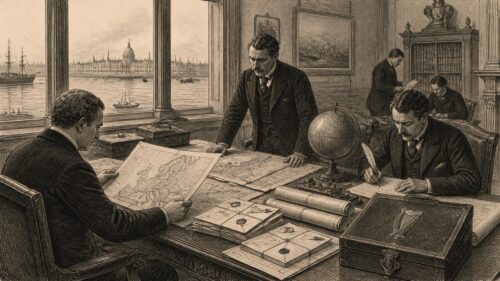
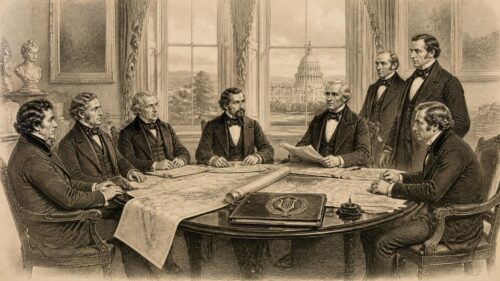
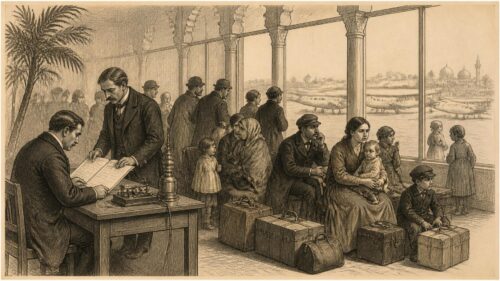
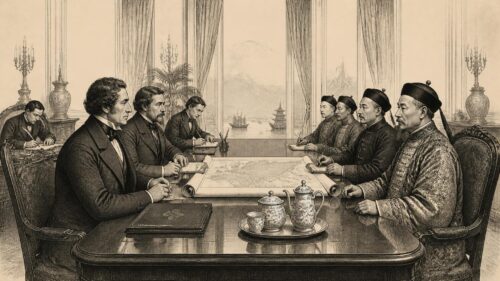
AI generated historical illustration, not a contemporary photograph.
At a Glance
Ireland’s response to Russia’s full-scale invasion of Ukraine has made an old national principle newly contentious. The State has remained outside military alliances, yet has condemned the invasion, applied sanctions with European partners, received large numbers of people fleeing the war, contributed to European support measures and authorised Irish Defence Forces personnel to train Ukrainian troops in defined non-combat fields. Ukraine therefore did not simply pose a question of whether Ireland was neutral. It exposed the deeper historical question of what Irish neutrality has meant, whom it was intended to protect, and how far a small European state may act against aggression without surrendering its independence of judgement.
Historic Origins
Irish neutrality belongs to the history of state formation rather than to an ancient or immutable national inheritance. Before independence, Ireland had no separate foreign policy through which it could declare neutrality. Irish men and women served in British forces, and Irish ports, territory and resources formed part of the United Kingdom’s strategic system. The First World War, the 1916 Rising, the War of Independence and the Civil War left a political landscape in which association with British war aims was profoundly disputed. Partition remained unresolved after the establishment of the Irish Free State in 1922. These experiences gave sovereignty a practical and emotional importance that later discussions of neutrality have never entirely lost.
The new state entered the League of Nations and developed a small diplomatic service. That did not make it isolationist. On the contrary, it sought recognition and a voice in international institutions precisely because those bodies offered smaller states some protection against domination by greater powers. Yet the Free State also wished to preserve room for an independent judgement in crises. Neutrality became attractive because it appeared to combine two ambitions: distance from the military priorities of Britain and participation in an international order based, at least in aspiration, on law and collective security.
This origin matters when later generations speak of neutrality as though it had one settled definition. It did not. In interwar Europe, legal neutrality during a war, permanent neutrality, non-alignment and a general preference for peace were related but distinct ideas. Irish governments drew selectively on each. They were concerned with legal rights and obligations, but also with sovereignty, domestic cohesion, constitutional development, relations with Britain and the danger that external war might revive internal division. The policy that emerged was therefore national and contingent. It was not copied whole from Switzerland, Sweden or any other European state.
The documentary record assembled in the official Documents on Irish Foreign Policy series shows that, by the late 1930s, neutrality had become a serious object of state planning. The 1938 Anglo-Irish Agreement returned the Treaty Ports to Irish control. That development strengthened the State’s capacity to decide its position in a European war, even as it increased the strategic consequences of that decision for Britain. On 31 August 1939, Éamon de Valera informed Neville Chamberlain that Ireland intended to remain neutral if war came. The following day Germany invaded Poland; on 3 September Britain and France declared war. Ireland’s choice was then transformed from aspiration into policy under severe pressure.
Emergency Lessons
The Second World War, known in the State as the Emergency, became the defining episode in Irish neutrality’s public memory. Ireland remained formally neutral from 1939 until 1945. The Government invoked emergency powers, expanded the Defence Forces and tried to prevent its territory becoming a theatre of war. De Valera presented the decision partly as a consequence of Irish history and partition, but also as the course available to a small and militarily weak state. The policy asserted that Ireland would resist violation of its territory from any side. Neutrality was thus not intended to mean helplessness, though Ireland’s military resources were limited.
It would nevertheless be misleading to picture the Emergency as a period of perfect detachment. The official diplomatic papers demonstrate a more complicated reality. The State faced fears of both German and British invasion. It maintained diplomatic relations with belligerents, enforced censorship, endured shortages and aerial attacks, and managed constant pressure from London and Washington. Its security officials shared intelligence with Britain in important cases. Allied aircraft used the Donegal Corridor under arrangements that remained discreet. Weather information and maritime intelligence also had strategic importance. These facts do not erase the formal policy, but they show that neutrality was practised through compromises made in conditions of danger.
The difference between formal neutrality and moral equivalence was also visible during the war itself. Irish officials and citizens were not uniformly indifferent to Nazi Germany, British imperial power, the Allied cause or the fate of occupied Europe. Thousands from the twenty-six counties enlisted in British forces, while others served in merchant shipping. Public opinion was divided and changing. Government policy aimed above all to preserve the State’s autonomy and avoid a renewed domestic crisis. It did not claim that every belligerent acted alike, nor did it eliminate personal sympathy or private assistance.
Later controversy has often made the Emergency seem simpler than it was. One persistent story holds that Irish neutrality was either an honourable and wholly independent resistance to imperial pressure or a shameful exercise in selfishness and evasion. Neither formula is adequate history. It ignores the limited capacity of the young state, the presence of British forces in Northern Ireland, the fear of invasion, the legacy of partition and the reality of discreet assistance to the Allies. It also ignores the costs of emergency rule, including censorship and restrictions on civil liberties. Historical evidence supports a policy that was neither pure isolation nor covert belligerency, but a guarded and adaptable attempt to preserve sovereignty.
Legal Meanings
Much confusion in the Ukraine debate has arisen because the word neutrality is used in several senses at once. In the strictest legal sense, a neutral state in an international armed conflict must observe duties of impartiality between belligerents and prevent the use of its territory for warlike purposes. A peacetime policy of military neutrality is different. It is a chosen approach to security, often defined by remaining outside military alliances and mutual-defence obligations. A state can pursue such a policy while taking strong diplomatic positions, joining economic sanctions, participating in international organisations and contributing to peacekeeping.
The Irish Government’s modern description is deliberately narrow. It characterises military neutrality by non-membership of military alliances and non-participation in common or mutual defence arrangements. Ireland is not a member of NATO. It has participated in NATO’s Partnership for Peace since 1999, but that programme does not impose NATO’s collective-defence guarantee. Ireland has also joined European Union security and defence cooperation while retaining legal and political safeguards concerning common defence. The State’s position has therefore never been that it avoids every security relationship. Rather, it rejects an automatic obligation to fight alongside allies in a war.
This distinction is important because Irish neutrality is not permanently codified in the manner of Austrian neutrality, nor does the Constitution contain a general declaration that Ireland shall be neutral. Bunreacht na hÉireann does affirm devotion to peace and friendly cooperation founded on international justice and morality, and adherence to the pacific settlement of disputes. It also requires Dáil assent before the State can participate in a war. Constitutional provisions associated with European treaties protect Ireland from being committed to an EU common defence without a further decision. But the wider policy rests largely on repeated governmental practice, legislation, public expectation and political convention.
The so-called triple lock is another important, though sometimes overstated, part of this framework. Under the system long applied to overseas deployments of more than twelve Defence Forces personnel, a Government decision, Dáil approval and a United Nations mandate have been required. Its symbolism has often exceeded its technical scope. It governs particular deployments; it does not alone define all neutrality. Yet supporters rightly see it as a restraint against participation in wars chosen by larger powers. Critics argue that a Security Council veto can obstruct useful peace operations. The argument over Ukraine has revived this older disagreement over whether restraint is best guaranteed through law, parliamentary control or political judgement.
International Engagement
The decades after 1945 demonstrate why it is inaccurate to treat Irish neutrality as withdrawal from the world. Ireland joined the United Nations in 1955. It became closely identified with UN peacekeeping, beginning with service in the Middle East in 1958 and continuing through missions in the Congo, Cyprus, Lebanon, the Balkans, Africa and elsewhere. Such service became central to the State’s international identity. It offered a way to deploy military personnel overseas without entering a military alliance or joining a war of national conquest.
Peacekeeping also shaped popular understandings of neutrality. Many Irish people came to associate it not simply with staying out of wars but with a positive international role: mediation, humanitarian assistance, arms control, development cooperation and UN-authorised operations. That understanding is historically understandable, but it should not be turned into folklore. Peacekeeping itself has changed repeatedly. Some missions have involved serious danger and robust rules of engagement. UN operations are not automatically impartial in the everyday sense, and their mandates depend on political circumstances. The Irish record is substantial and honourable, but it has always required choices about force, legitimacy and international partnership.
Irish diplomacy similarly developed a reputation for work on decolonisation, human rights, disarmament and multilateral law. The State’s small size made international rules especially valuable. An order in which borders could be changed by force, or powerful states could ignore treaties without consequence, was plainly unfavourable to Ireland. This concern did not arise in 2022. It had been embedded in Irish participation in the League of Nations, the United Nations and European institutions for generations. The language used by Irish leaders about Ukraine—sovereignty, territorial integrity, civilian protection and the UN Charter—belongs to that longer diplomatic tradition.
That tradition contains a tension. A state which regards international law as its safeguard may believe it has a duty to oppose unlawful aggression. Yet a state that values military neutrality may hesitate before measures that appear to bring it closer to one belligerent. There is no formula that makes this tension disappear. It has instead been managed through a distinction between military alliances and collective diplomatic action. Ireland’s response to Ukraine is best understood as a forceful expression of that distinction rather than as an abrupt abandonment of all earlier policy.
European Change
Membership of the European Economic Community from 1973, later the European Union, altered the setting in which neutrality operated. Ireland gained influence and prosperity through European integration, but it also accepted that foreign policy would increasingly be coordinated with partners. The development of European Political Cooperation, the Common Foreign and Security Policy and, later, the EU’s security and defence structures gave practical form to this change. Ireland did not become a military ally of other member states, but it no longer conceived foreign policy solely through bilateral independence.
The referendums on European treaties repeatedly revealed anxiety that integration might erode neutrality. The first Nice Treaty referendum was defeated in June 2001, with neutrality among the concerns voiced in public debate. Before the second referendum in October 2002, the Government secured declarations concerning military neutrality and reiterated that Ireland would not join a common defence. The resulting assurances did not end argument, but they showed that neutrality had become a democratic as well as diplomatic issue. It was no longer merely a cabinet policy inherited from 1939; it was a principle many voters believed required explicit protection.
European security cooperation has consequently proceeded with qualifications. Ireland has participated in civilian and military crisis-management missions and in Permanent Structured Cooperation projects, but insists that participation must accord with national policy. The Government has generally argued that cooperation improves capacity for peacekeeping, maritime security, cyber resilience and humanitarian response without creating a mutual-defence obligation. Opponents have often replied that individual projects can cumulatively weaken neutrality even without a formal treaty change. Both positions identify a real feature of modern policy: neutrality is not a fixed wall but a contested boundary, negotiated through decisions that may appear technical at the time.
The European Peace Facility brought that boundary into unusually sharp view. Established outside the ordinary EU budget, it can fund assistance in military and defence fields. After Russia’s invasion, it became a major instrument for European support to Ukraine, including assistance that could encompass lethal equipment. Ireland’s participation in EU decision-making and financial arrangements prompted criticism from those who regarded any association with arms provision as inconsistent with neutrality. Government ministers answered that Ireland did not supply lethal weapons and remained outside military alliances. The dispute was not merely semantic: it concerned whether pooled European action should be judged by the whole purpose of the fund or by the particular national contribution.
Russian Invasion
Russia’s full-scale invasion of Ukraine on 24 February 2022 created a crisis in which these accumulated ambiguities could no longer remain academic. Ireland immediately condemned the invasion as a grave breach of international law and the UN Charter. It supported European Union sanctions, diplomatic isolation of Russia, accountability mechanisms and Ukraine’s closer relationship with the European Union. In April 2022, addressing President Volodymyr Zelenskyy after his virtual address to a joint sitting of the Oireachtas, Taoiseach Micheál Martin expressed the formula that became central to official policy: Ireland was militarily neutral but not politically neutral in the face of war crimes.
That statement represented continuity in one sense and change in another. It was continuous with a long Irish insistence that neutrality does not mean indifference to the conduct of states. It was a change in tone because the Government expressed solidarity with one side in an ongoing European war with exceptional clarity. The language of moral and political non-neutrality sought to distinguish condemnation of aggression from military participation. Whether the distinction convinces every critic is another matter, but it was not invented to avoid a difficult question. It reflected the policy’s established separation between alliance commitments and diplomatic judgement.
Ukraine’s position has been especially resonant in Ireland because public rhetoric often places its struggle for sovereignty beside Ireland’s own history of colonial rule and independence. Such comparison can illuminate a general sympathy for smaller nations defending political autonomy. It can also mislead when pressed too far. Ireland’s history and Ukraine’s history are not interchangeable; their geography, constitutional development, imperial experiences and military circumstances differ profoundly. Responsible historical comparison should avoid treating one nation’s past as a ready-made explanation for another’s present. The relevant connection is not identity of experience but a shared language of self-determination, sovereignty and resistance to domination.
The war also undermined the comforting assumption that European conflict was remote from Ireland. It affected energy prices, food markets, cyber-security discussions, undersea infrastructure and the wider security of Europe’s maritime approaches. Ireland’s position at the western edge of Europe did not remove it from these consequences. Nor did military neutrality confer immunity from hostile activity below the threshold of war. The Ukrainian conflict therefore encouraged a broader Irish debate about defence capability. That debate was often confused with a debate about joining NATO, although the two questions are not identical. A state can seek better surveillance, naval capacity and cyber defence while remaining non-aligned.
Public Solidarity
The most visible Irish response was not military. It was humanitarian and civic. The European Union activated the Temporary Protection Directive for the first time in March 2022, giving people fleeing Ukraine a rapid route to residence, work, education, welfare and other supports. Ireland participated fully. Communities, voluntary organisations, local authorities, religious bodies and private householders offered accommodation and assistance. The scale of arrivals placed extraordinary pressure on housing, public services and State accommodation, but it also demonstrated that Irish engagement with Ukraine was lived in towns and neighbourhoods, not only in ministerial statements.
By the end of 2025, more than 120,000 people fleeing the war had been granted temporary protection in Ireland. That figure should be read carefully. It records grants of status, not a fixed number permanently resident in the State at one moment; people move, return, travel and make different housing choices. Still, it establishes the magnitude of the response. For a country of Ireland’s population, the arrival was historically significant. It created new Ukrainian communities and placed practical questions of schooling, employment, language, healthcare and accommodation alongside the abstract language of neutrality.
This humanitarian policy complicates claims that neutrality necessarily means standing apart. Ireland did not send combat forces, but it accepted substantial responsibilities arising from the war. The Temporary Protection system allowed many displaced people to enter the labour market immediately. It also revealed the limits of goodwill when accommodation was scarce. Government policies changed over time as emergency hotel use, pledged homes, recognition payments and dedicated centres came under financial and logistical strain. These difficulties should not be used to diminish the generosity of the initial response. They show instead that solidarity has material costs, and that historic decisions about foreign policy can alter domestic life.
It is also important not to romanticise public opinion. Support for Ukrainians coexisted with concern about housing and public capacity. Some voices linked the arrival of refugees to wider arguments about migration; others warned against doing so. Such controversy is familiar in Irish history, where humanitarian ideals and local resources have often pulled in different directions. The evidence supports neither the claim that Ireland welcomed everyone without difficulty nor the claim that public sympathy was insignificant. Both welcome and strain were real, and both form part of the country’s historical encounter with the war.
Material Assistance
Ireland’s official support for Ukraine has included humanitarian relief, development assistance, diplomatic action and non-lethal material support. Medical supplies, food, shelter, protective equipment, demining assistance and support for civilian infrastructure fit readily within the older language of humanitarian neutrality, although their scale and political setting are new. Ireland has also contributed through multilateral bodies, including UN agencies, the International Committee of the Red Cross and European mechanisms. Such support rests on a judgement that a state may take practical action to aid victims of aggression without becoming a belligerent.
The distinction between lethal and non-lethal aid has been central. Irish governments have maintained that the State does not provide weapons to Ukraine. Critics have argued that this line can become blurred when money enters common European funds that support wider military assistance. Ministers have responded that Ireland’s policy must be assessed by its own decisions: it remains outside alliances and does not transfer lethal arms. Historians should resist settling this dispute through labels alone. The important evidence lies in the actual measures adopted, the legal arrangements used and the changing public explanation offered for them.
Demining offers a revealing example. Landmines and unexploded ordnance threaten civilians long after front lines move. Irish support for mine-clearance equipment and training can be understood as a humanitarian measure aimed at civilian safety and recovery. Yet demining is also relevant to military mobility and the restoration of territory. Modern war rarely permits perfectly separate categories. Medical care may return soldiers to service; communications equipment may have civilian and military uses; infrastructure repair may support both everyday life and defence. The challenge for neutral policy is not to pretend such overlap does not exist, but to establish transparent limits and submit them to democratic scrutiny.
Ireland’s backing for sanctions similarly demonstrates that neutrality is not economic passivity. Sanctions impose political and commercial costs in the hope of changing behaviour or limiting a state’s capacity to continue aggression. They are coercive, though not military. During the Emergency, a smaller and poorer Ireland had little comparable leverage. As an EU member, it has acted collectively in measures of a scope unavailable to earlier governments. This is one reason why direct analogies with 1939 can be misleading. The institutional world of 2022 was radically different, even though sovereignty and security remained recognisable concerns.
Training Questions
The most sensitive development has been Irish participation in training related to Ukrainian forces. Ireland has provided training in areas including demining, combat casualty care and drill instruction through cooperation with European partners. The Government has described these roles as compatible with military neutrality because Irish personnel are not entering the war, joining an alliance or supplying lethal force. Opponents argue that training troops of one belligerent is materially different from humanitarian relief and is inconsistent with the impartiality traditionally expected of a neutral state.
The disagreement turns partly on legal categories and partly on political judgement. Ireland’s policy of military neutrality in peacetime is not identical to a declaration of legal neutrality in a conflict. Government sources stress this distinction. Yet critics are correct to observe that the closer assistance comes to the military effectiveness of a combatant, the harder it becomes to present neutrality in everyday language as simple non-involvement. The historical value of the controversy lies in making this boundary visible. It forces citizens to ask whether neutrality is defined primarily by alliance status, by conduct during wars, by public consent or by a combination of all three.
No historical account should suggest that the debate is between supporters of Ukraine and defenders of Russia. Irish parliamentarians and activists who oppose weapons transfers or military training have often condemned the invasion and supported humanitarian help, sanctions or refugee protection. Equally, those who favour deeper assistance frequently insist that they do not seek NATO membership or abandonment of neutrality. The real disagreement concerns the means by which Ireland should oppose aggression and contribute to a just peace. Reducing it to a contest between courage and cowardice repeats the least useful rhetoric of earlier neutrality disputes.
There is a further institutional question. The Defence Forces have long served abroad under a framework that emphasises UN authorisation, Government decision and parliamentary approval. Ukraine-related training has encouraged closer examination of how that framework applies to assistance conducted outside conventional peacekeeping missions. Such scrutiny is healthy. Neutrality has retained public legitimacy partly because Irish governments have been expected to explain foreign deployments and seek democratic authority. If policy evolves, historical experience suggests that clarity, parliamentary debate and candour about risks matter more than assurances that nothing has changed.
Political Argument
The war has sharpened three broad positions in Irish political life. The first is the governmental view that military neutrality remains intact while Ireland should work actively with the EU, the UN and other partners to support Ukraine’s sovereignty and defend international law. The second seeks a more expansive European security role, arguing that neutrality should not prevent Ireland from sharing burdens in a continent under threat. The third favours a stricter interpretation, warning that European defence integration, military funding and training risk hollowing out neutrality in practice.
Each position draws selectively from history. Advocates of the governmental line point to the Emergency’s pragmatic flexibility, Ireland’s long multilateralism and its refusal to join military alliances. Those favouring deeper engagement note that a rules-based order cannot survive if states decline meaningful support when it is attacked. Strict neutralists emphasise the anti-imperial and independence traditions associated with sovereignty, the democratic importance of the Nice Treaty assurances and the danger of gradual commitments made without popular mandate. History cannot mechanically decide among them. It can, however, expose where each account simplifies the past.
For example, it is inaccurate to say that Ireland has always been politically impartial. Irish diplomats have repeatedly taken positions on colonialism, apartheid, nuclear weapons, human rights and international aggression. It is equally inaccurate to say that neutrality has always been merely a disposable convenience. It has been a persistent policy preference, reinforced by public attachment and institutional practice, for more than eight decades. Its endurance owes much to the belief that Ireland should not be drawn automatically into wars of great powers. Ukraine tests that belief because Russia’s invasion is widely viewed in Ireland not as a remote quarrel but as an assault on principles essential to smaller states.
The phrase “active neutrality” is often used to reconcile these perspectives. It suggests a policy that avoids alliances and war fighting while energetically promoting peace, disarmament, mediation and international law. It is a useful aspiration, but not a solution in itself. Activity can take many forms, from diplomacy and aid to sanctions and training. Every form has implications. The phrase should therefore be treated as a programme requiring definition, not as a historical fact that ends disagreement. Its popularity demonstrates the continuing desire to make neutrality purposeful rather than passive.
Popular Memory
Public arguments over Ukraine often summon the Emergency, but historical memory can turn a complex experience into a moral fable. One fable depicts Ireland as a small nation that bravely refused every external demand and preserved absolute independence. Another depicts it as a country that looked away while Europe suffered. Both flatten the record. Wartime Ireland sought autonomy but cooperated selectively with the Allies. It maintained formal equality between belligerents but faced Nazi and Allied pressures very differently. Its leaders acted from principle, prudence, fear and domestic calculation at the same time.
Folklore has played a role in this simplification. Stories of unblemished neutrality, total secret collaboration or singular diplomatic gestures are frequently repeated without their documentary setting. Some are based on a fragment of truth; others exaggerate isolated incidents into explanations for an entire policy. The relevant lesson for Ukraine is methodological. Claims about neutrality should be tested against official decisions, parliamentary records, diplomatic papers and the practical consequences of policy. National memory deserves respect, but it is not itself proof.
There is also a recurring tendency to treat Irish history as giving Ireland a uniquely authoritative voice on every question of occupation or independence. Irish experience may foster empathy and a caution about military blocs, but it does not exempt the State from difficult choices or confer infallibility. The strongest historical contribution Ireland can make is not analogy for its own sake. It is an insistence that sovereignty, civilian protection, humanitarian law and negotiation matter precisely because small states know what it is to live beside larger powers.
Ukraine has therefore made Irish neutrality a subject of living history. It has connected family hosting, local schools, energy bills, parliamentary debates, Defence Forces policy and European diplomacy to a principle formed under very different conditions in 1939. That connection explains both the intensity of the discussion and the impossibility of resolving it with a slogan. The past supplies traditions and warnings. It does not remove responsibility from the present.
Historical Judgement
The historical evidence supports a restrained conclusion. Irish neutrality has never meant moral silence, political indifference or isolation from international institutions. It emerged from the needs of a newly independent state, was tested under the exceptional conditions of the Emergency, and evolved through UN peacekeeping and European integration. Its enduring core has been independence from military alliances and common-defence obligations, together with a preference for international law and multilateral action. That core has been interpreted differently by successive governments and citizens, but it has not been meaningless.
Russia’s invasion of Ukraine did not end that tradition. It tested its adequacy. Ireland has chosen solidarity with Ukraine through diplomacy, sanctions, refugee protection, humanitarian assistance, European cooperation and specified training. It has refused to join NATO and has maintained that it will not supply lethal weapons. These choices are evidence of a policy adapting under pressure, not proof that all boundaries remain uncontested. The closer Ireland’s assistance comes to military activity, the more urgently those boundaries require public explanation and parliamentary examination.
For historians, the central point is not whether neutrality is sacred or obsolete. It is that neutrality has always been an argument about sovereignty, responsibility and power. In 1939, the question was whether a young state could keep out of a catastrophic war while preserving its independence. After 2022, the question became whether that same state could defend an international order threatened by invasion without accepting alliance obligations or entering the conflict itself. The answers will continue to be debated. What the record already shows is that Irish neutrality has survived not through stillness, but through repeated and often uncomfortable adaptation.

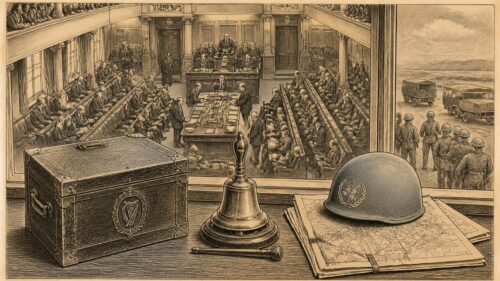

Ireland’s response to Ukraine shows that neutrality can involve more than abstaining from alliances: it may combine independent judgement with sanctions, humanitarian protection and support for international law. The article usefully contrasts Ireland’s Emergency-era compromises with today’s European cooperation, suggesting that neutrality has always been adaptive rather than entirely detached. Yet the European Peace Facility and non-combat training raise a difficult interpretative question: should national neutrality be assessed by Ireland’s direct military actions, or by its participation in wider collective arrangements? How might Ireland preserve confidence in military neutrality while responding credibly to aggression, cyber threats and insecurity affecting Europe?