

Protection Debated
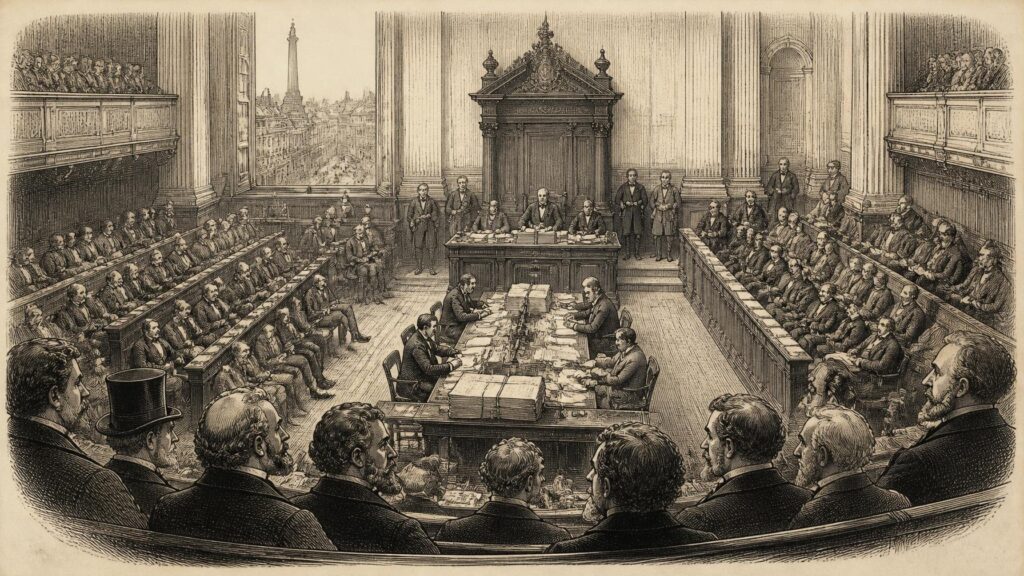
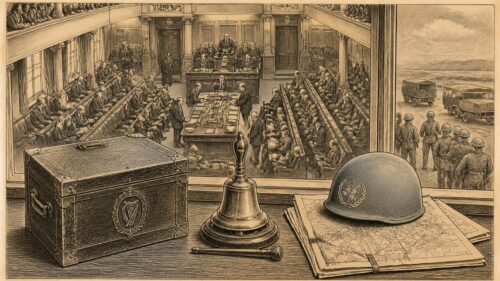
AI generated historical illustration, not a contemporary photograph.
At a Glance
Ireland’s International Protection Act 2015 was not simply a technical revision of immigration law. It was the product of a long change in how the State understood asylum, refugee status, administrative delay and its duties towards people seeking safety. Its central promise was procedural: one integrated examination of a claim rather than a succession of separate applications. Yet the Act entered a much wider argument, for the law governing a claim could not be separated in practice from the conditions in which claimants waited, lived, worked and kept contact with their families.
Historical Setting
The debate surrounding the International Protection Act belongs to the comparatively recent history of Ireland as a country of immigration. For much of the nineteenth and twentieth centuries, Irish public memory was dominated by emigration: departure prompted by poverty, political conditions, famine, war, work and family connection. That memory has often been invoked in modern discussions of refugees. It can be a humane point of reference, but it should not be treated as evidence that the experience of Irish emigrants and that of people seeking asylum in Ireland were identical. They arose in different legal systems and historical circumstances. The documented history of Irish refugee law is clearer: by the 1990s, rising numbers of protection claims required the State to establish more formal institutions and procedures.
The Refugee Act 1996 was an important landmark. Contemporary material from the United Nations High Commissioner for Refugees recorded that Ireland registered 1,179 asylum claims in 1996, a marked increase on the preceding year, while the administrative system struggled with a growing backlog. The Act supplied a statutory framework for refugee protection, though its implementation was gradual. In 1997, UNHCR noted that provisions concerning the refugee definition, non-refoulement and the Dublin Convention had commenced, while more complete procedural arrangements remained to be developed. These details matter because the later Act of 2015 did not emerge from a blank page. It was part of a prolonged effort to reconcile domestic administration with the Refugee Convention, European arrangements and constitutional standards.
“International protection” became the preferred legislative language because refugee status did not exhaust the forms of protection Ireland was required to consider. A person might satisfy the 1951 Refugee Convention definition because of a well-founded fear of persecution for a Convention reason. Another might not meet that definition but still face a real risk of serious harm if returned, and could therefore be eligible for subsidiary protection. A further category concerned permission to remain, a discretionary humanitarian assessment undertaken when the principal protection grounds did not succeed. The legal distinctions were real, but they created a procedural problem when considered one after another. Applicants could wait while one route was determined before another began.
The historical importance of the 2015 Act lies in its attempt to organise those overlapping obligations into a single statutory process. It also reveals a recurring feature of Irish administrative history: reforms designed to make decision-making faster are often judged not only by their formal architecture, but by whether they alter lived conditions. That tension shaped the political debate from the beginning.
Refugee Framework
Ireland’s protection law was shaped by international commitments rather than solely by domestic policy. The 1951 Convention relating to the Status of Refugees and its 1967 Protocol form the basic international framework. The Convention’s central protection against return to persecution, generally known by the French term non-refoulement, has had particular importance. European Union measures added rules on qualification, asylum procedures, reception and responsibility for examining claims. The Dublin system, for example, was intended to identify one participating state responsible for considering a protection application, rather than permitting claims to circulate indefinitely between states.
These systems did not remove national discretion, but they placed Ireland within a dense field of legal obligations. The long title of the International Protection Act expressly connected the new legislation with European directives, the Refugee Convention and earlier Irish immigration enactments. Such wording can appear remote from daily experience, yet it conveys the Act’s character. The Oireachtas was not legislating only about border control. It was restating rules concerning entry and presence for persons who said that return to another country would expose them to persecution or serious harm.
The terminology also requires care. An applicant for international protection is not automatically a recognised refugee. The person has made a claim requiring examination. Nor is every migrant an asylum seeker, and not every person displaced by war or poverty falls within the Convention definition. These distinctions were sometimes blurred in public debate, where broad claims about migration could obscure the narrower legal question before a protection decision-maker. The 2015 legislation attempted to place the relevant categories in a common process without pretending that they were identical.
Historical interpretation should also avoid a misleading picture of Ireland as a passive recipient of law made elsewhere. Irish governments chose how to transpose, administer and fund their obligations. The Oireachtas decided the language of the statute. Irish courts interpreted constitutional rights. Civil-society organisations, legal practitioners, residents of accommodation centres, churches and community groups challenged the consequences of policy. International rules formed the setting; domestic institutions made the decisions under debate.
Separate Procedures
Before the 2015 Act’s principal procedural reforms took effect, the protection system was commonly described as sequential. A person generally sought refugee status first. If unsuccessful, the person might then seek subsidiary protection. If that too failed, the Minister could consider permission to remain. Each stage involved its own documentation, decisions and potential litigation. In an area where country information, personal testimony and legal representation were already complex, the arrangement could create extensive delay.
The Government’s argument for change was direct. In the Dáil debate of 10 December 2015, the Minister for Justice and Equality described the Bill’s principal purpose as the introduction of a single application procedure. The stated aim was to reduce the time an applicant spent in the determination system and, consequently, in Direct Provision. This was not merely a promise of administrative tidiness. Delay had material effects: people waited for decisions while their capacity to plan family life, employment, education and settlement remained limited.
Supporters of reform therefore treated the single procedure as a practical remedy for a system in which an applicant could have substantially similar personal circumstances examined in separate legal compartments. Under the integrated approach, the State could consider refugee status, subsidiary protection and permission to remain together, with a single first-instance process and a more consolidated appeal structure. The logic was that a negative finding in one category should not require a person to return to the starting line for another.
Critics did not necessarily dispute the value of reducing delay. Their concern was that speed alone could not measure fairness. An accelerated or unified process still required careful interviewing, competent interpretation, access to legal advice, reliable country-of-origin information and meaningful appeal rights. The need to decide cases efficiently could sit uneasily beside the need to assess traumatic and complicated experiences with adequate care. The historical record of the debate is therefore not a simple contest between reformers and opponents. Many participants supported procedural consolidation but differed sharply over safeguards, resources and the consequences of adverse decisions.
Legislative Passage
The International Protection Bill was developed during 2015, a year in which refugee protection had become highly visible across Europe. Ireland’s legislative process included pre-legislative scrutiny by the Joint Oireachtas Committee on Justice, Defence and Equality. The Minister acknowledged that scrutiny during the Dáil’s Second Stage debate, noting that the committee had heard submissions from interested parties. This was significant because the Bill concerned a field in which specialist knowledge was distributed widely: public officials knew the administrative system, but lawyers, advocates, refugee organisations and people with direct experience identified difficulties that formal departmental accounts might not fully capture.
The Bill was introduced in Seanad Éireann in early December 2015 and debated in Dáil Éireann on 10 December. Its passage took place late in the life of the thirty-first Dáil, which contributed to criticism that scrutiny was constrained by time. Parliamentary records show both support for the goal of a single procedure and anxiety about the compressed legislative timetable. Such criticism did not mean that every objector rejected the Bill’s principle. Rather, it reflected a familiar parliamentary question: whether a major revision of protection law, with consequences for people at risk of removal, could receive sufficient detailed examination before enactment.
The Act was signed into law on 30 December 2015. Commencement was phased. Certain provisions began on 11 January 2016, while the principal operative framework came into force later, in December 2016. This distinction is useful historically. Statutes are often spoken of as if enactment immediately transforms administration. In fact, implementation requires regulations, trained decision-makers, institutional arrangements, transitional rules and practical capacity. The public debate continued after Royal assent precisely because the success of a statute depended upon its operation.
The final Act repealed or amended significant parts of the older framework while preserving the broad purpose of protection assessment. It established the International Protection Office and the International Protection Appeals Tribunal within the new structure. It set out how applications could be made, examined and appealed, and it provided for matters including declarations, permissions and family reunification. The statutory text was extensive, but its central historical innovation remained the effort to replace sequence with simultaneity.
Single Procedure
The single procedure was the Act’s defining institutional idea. An adult at the frontier or already in the State could make an application for international protection. The statute provided for preliminary and substantive stages, the gathering of relevant information, a personal interview in ordinary circumstances, an examination by an international protection officer and routes of appeal. It also made provision for child applicants and for applicants with particular vulnerabilities. These elements reflected the fact that protection decisions turn on individual accounts, legal definitions and evidence about conditions beyond Ireland.
At first instance, the system was intended to produce an integrated assessment rather than a succession of isolated decisions. The applicant’s eligibility for refugee status and subsidiary protection could be considered, alongside the information relevant to permission to remain. The Act thereby sought to reduce duplication. It also enabled a more coherent appeal path through the International Protection Appeals Tribunal, rather than leaving an applicant to navigate several discrete determinations over a prolonged period.
There was, however, an unavoidable tension in the structure. The process relied heavily on administrative officers operating within the executive branch, while the consequences of error could be grave. Parliamentarians and advocates consequently focused on independence, access to legal assistance and the quality of decision-making. Supporters could say that a streamlined procedure avoided needless repetition; critics could answer that streamlining must not compress the opportunity to explain an experience of persecution, violence or displacement.
The Act did not abolish legal complexity. It contained provisions on exclusion from refugee status, cessation, inadmissibility, safe countries, appeals, deportation-related matters and judicial review. It also had to coexist with constitutional law, European law and the courts’ supervisory role. Yet it altered the sequence in which the State considered claims. That procedural change was substantial enough that the Oireachtas Library and Research Service later associated its implementation with shorter periods spent in Direct Provision. Association is not proof that the Act alone caused the change: staffing, caseloads, policy adjustments and other circumstances may also have mattered. Still, the reduction of delay was an explicit objective against which the reform could be measured.
Family Unity
Family reunification became one of the most contested parts of the Act. Section 56 allowed a recognised refugee or person granted subsidiary protection, described as a qualified person, to apply for permission for defined family members to enter and reside in the State. The provision established a twelve-month period from the relevant protection declaration in which an application could be made. It specified spouses, civil partners, minor children and, in the case of an unmarried minor sponsor, parents and minor siblings within the statutory definition of family.
To supporters, precise definitions and time limits offered an administratively intelligible system. The State had to verify identity, relationships and domestic circumstances, and it retained powers to refuse in specified cases, including grounds connected with public policy, security, exclusion clauses and misrepresentation. In a difficult area involving conflict zones, fragmented records and the risk of exploitation, advocates of a tightly framed scheme argued that clear rules were necessary.
Critics saw a different problem. They argued that the statutory family definition was narrower than the realities of displacement. Extended relatives, adult dependent children, siblings and other household members may have formed a genuine family unit before flight, particularly where conflict, disability, age or bereavement made dependency acute. The one-year deadline was also criticised as unrealistic where people were separated by war, had no reliable communication, or needed time to trace relatives and collect documents. UNHCR’s Irish material later observed that the Act had curtailed some reunification possibilities available under the previous legal regime.
The disagreement illustrates a broader historical theme. Immigration law often turns human relationships into defined legal categories. That is not inherently improper; statutes must identify who is eligible. But every definition includes some relationships and excludes others. In the International Protection Act debate, the issue was whether the balance struck by the Oireachtas gave sufficient weight to family life in the aftermath of forced displacement. The answer depended not only on legal principle but also on competing views of state responsibility, evidence and fairness.
Reception Debate
Direct Provision was the system most closely associated in public memory with the Act, though it is important not to confuse the two. Direct Provision was a reception and accommodation system rather than the creation of the 2015 Act. It had been introduced in 2000, initially on the assumption that applicants would remain in accommodation only briefly while their claims were decided. The International Protection Act governed the determination process; it did not itself establish the Direct Provision regime. Nevertheless, the two were entwined because a slower determination process generally meant a longer period in accommodation.
This relationship explains the political force of the single-procedure promise. The Minister’s 2015 statement linked a faster system directly to reducing time in Direct Provision. Critics accepted that delay was harmful but argued that the reception system raised issues that legislation on decision-making could not solve on its own. Residents and advocates described institutional living, restricted autonomy, unsuitable family accommodation, isolation from services, limited privacy and difficulty participating fully in ordinary community life. These were claims about daily existence rather than only about case files.
The McMahon Working Group, established to report on improvements to the protection process, Direct Provision and supports for asylum seekers, represented an official acknowledgement that reception conditions demanded examination. Its remit combined dignity, quality of life, process improvement and public expenditure. That combination was revealing. Irish policy makers were asked to improve treatment while retaining workable border procedures and controlling cost. The resulting debate was therefore not only moral or legal; it was also administrative and financial.
Evidence submitted to the Oireachtas in 2019, including a detailed legal analysis by University College Dublin scholar Liam Thornton, argued that Direct Provision had become a prolonged system rather than the short-term arrangement originally envisaged. The Oireachtas Library and Research Service similarly noted that long stays could damage children, families and individuals because of the institutional character of accommodation. Such evidence should not be overstated. It does not mean that every centre or every resident’s experience was identical. It does show that the critique was grounded in documented submissions, official reviews and recurring testimony rather than merely in political rhetoric.
Work Rights
The question of employment exposed another boundary between protection procedure and human dignity. Under the earlier Refugee Act 1996, applicants were subject to an absolute prohibition on seeking or entering employment while their claims remained unresolved. The rule became increasingly difficult to defend when applicants experienced lengthy delays. A system that required people to wait for years while denying them work risked producing dependency and social exclusion, irrespective of the eventual outcome of their cases.
The Supreme Court’s decision in N.V.H. v Minister for Justice and Equality, delivered in May 2017, was a decisive event. The case concerned an applicant from Myanmar who challenged the work prohibition after years in the asylum system. The Court held that an absolute ban, combined with no maximum period for determination, was contrary to the constitutional right to seek employment. The judgment did not create an unrestricted entitlement to work for every non-citizen in every circumstance. It recognised that the State could impose proportionate conditions. Its historical importance was that it rejected the complete exclusion of an applicant from the labour market during an indeterminate wait.
The case came after the 2015 Act had been enacted but during the wider transition in protection law. It demonstrates why the Act cannot be understood only through parliamentary text. Courts, too, shaped the practical meaning of protection policy. The decision required the executive and legislature to devise a new arrangement, and access to employment was subsequently addressed through the European Communities Reception Conditions Regulations 2018 and related schemes.
For defenders of controlled access, the issue involved labour-market regulation, the integrity of the protection system and the need to distinguish applicants from persons granted status. For critics, work was central to dignity, self-sufficiency and integration. The constitutional judgment did not settle every policy question, but it changed the terms of debate. It made clear that administrative delay could transform a restriction intended as temporary into a constitutional wrong.
Competing Claims
The International Protection Act debate is sometimes retold as a stark clash between compassion and control. That is too simple. The documented parliamentary and policy record shows several overlapping claims. Governments emphasised the need for an orderly system that could decide applications promptly, comply with international obligations, prevent abuse and retain public confidence. They also presented the single procedure as beneficial to applicants because it removed sequential delay. Those were not trivial objectives.
Rights advocates accepted the importance of timely and reliable decisions but challenged the assumption that procedural efficiency was sufficient. They sought stronger safeguards in interviews and appeals, broader family reunification, improved reception conditions, meaningful access to work and a system that treated applicants as members of communities rather than as people to be held apart until a final decision. Their arguments drew upon constitutional values, international human-rights standards and the lived experience of people in accommodation centres.
The language used by both sides also mattered. Phrases such as “pull factor”, “welfare tourism” and “soft touch” appeared in the wider history of asylum policy and carried assumptions about why people travelled to Ireland. Critics objected that such language could turn people seeking protection into suspected opportunists before their claims were examined. Supporters of stricter administration maintained that states must be able to identify unfounded claims and regulate entry. Historical writing should record both positions without adopting either as settled fact. The causes of migration are various, and no single slogan can explain an individual protection claim.
It is equally important to distinguish evidence from interpretation. It is documented that the Act created a single procedure and that its implementation coincided with a reduction in very long stays in Direct Provision. It is an interpretation that this represented a complete solution to the reception crisis; substantial evidence and later policy reviews point against that conclusion. It is documented that family reunification was defined and time-limited by statute. It is an interpretation that the limits were either a necessary safeguard or an unjust narrowing of family life. The historical task is to make those distinctions visible.
Later Reckoning
By 2020, the debate had moved beyond whether Direct Provision should merely be improved. The Advisory Group on Direct Provision concluded that the existing system was not fit for purpose and should end. In February 2021, the Government published its White Paper on ending Direct Provision and establishing a new International Protection Support Service. The plan envisaged a different accommodation approach, greater emphasis on integration and support from the beginning of the protection process, and a move towards a not-for-profit model.
The White Paper did not erase the history of the 2015 Act. Rather, it confirmed the limits of procedural reform when reception remains unsettled. The Act’s single procedure had addressed a genuine defect in the old sequence of refugee, subsidiary-protection and permission-to-remain decisions. The Oireachtas Library and Research Service recorded that in 2015, 43.5 per cent of people in Direct Provision had been in the system for five years or more, whereas the corresponding figure cited for 2019 was 2 per cent. The improvement was meaningful, though the same research recorded an average stay of twenty-one months in November 2019. A shorter wait was not the same as a short wait, and nor did it answer every question about accommodation quality.
The later reckoning also shows the importance of institutional memory. Major reforms are often announced as clean breaks, yet they inherit decisions made years earlier: the design of offices, the availability of housing, the legacy of legal backlogs, the structure of social supports and public attitudes towards migration. The 2015 Act was one such inheritance and one such intervention. It consolidated a fragmented legal process, but it could not by itself resolve the broader conflict between a system of managed reception and an aspiration to full social inclusion.
Historical Meaning
In Irish history, the International Protection Act 2015 marks a transition from a visibly sequential asylum framework to an integrated protection procedure. Its significance lies in both its ambition and its incompleteness. The ambition was to ensure that a person’s entitlement to refugee status, subsidiary protection and permission to remain could be considered together, reducing avoidable repetition and delay. The incompleteness was that the law operated within a larger system of accommodation, welfare, family separation, employment restriction and administrative capacity.
It would be wrong to describe the Act simply as either a humanitarian advance or a restrictive measure. It had elements that could reduce delay and make the legal route less fragmented. It also contained rules on family eligibility and deadlines that provoked sustained criticism. It was praised as a long-awaited modernisation and criticised for being enacted too quickly and for not reaching the foundations of Direct Provision. These apparently conflicting descriptions are not mutually exclusive. They reflect the fact that legislation can improve one feature of a system while leaving another intact.
No reliable historical account should rest on folklore about an uncomplicated Irish welcome, nor on the opposite folklore that Irish policy was indifferent to protection. The evidence instead shows a State attempting, under legal and political pressure, to build a more coherent asylum process; a legislature debating the safeguards and limits appropriate to that process; courts insisting that delay had constitutional consequences; and advocates persistently demonstrating that procedural rights and everyday conditions could not be separated.
The lasting lesson is not that procedure is unimportant. Procedure determines whether protection is recognised in time to matter. It is that procedure must be judged alongside the social reality of waiting for a decision. In that respect, the International Protection Act debate remains a revealing chapter in modern Ireland: a debate about who the State is obliged to protect, how it should make that judgment, and what dignity requires while judgment is still pending.


The article highlights a tension: the single procedure promised shorter waits and less time in Direct Provision, yet efficiency could undermine fairness if interviews, interpretation, legal advice and appeals were inadequately resourced. It also distinguishes determination reform from Direct Provision itself, suggesting that faster decisions alone cannot resolve concerns about dignity, autonomy and family life. The debate over family reunification reinforces this issue, since fixed definitions and deadlines may affect people separated by conflict or lacking documentation differently. How should Ireland assess whether an integrated protection process has improved outcomes through decision times, appeal quality, reception conditions and family unity?