

Sacred Bells
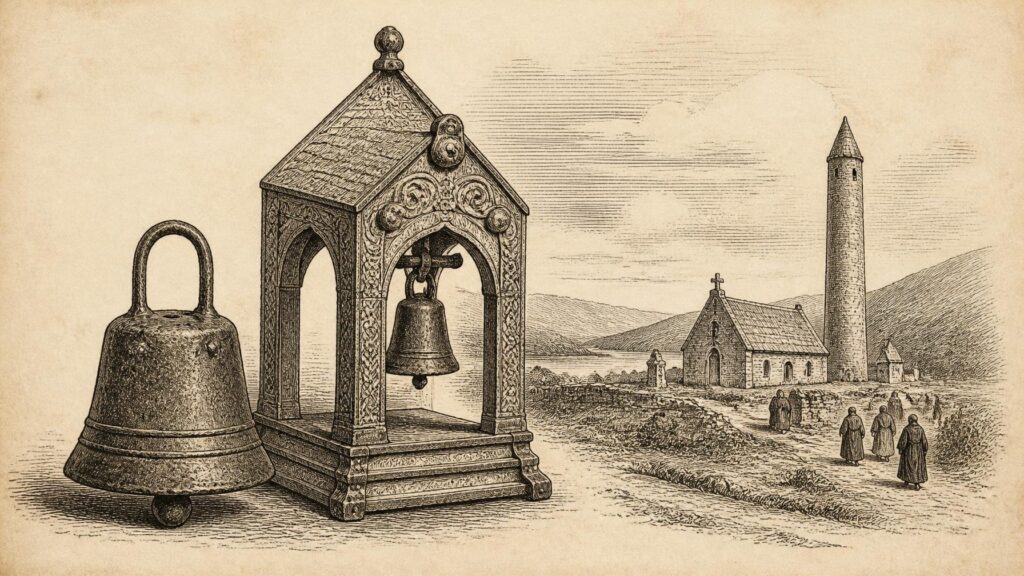
AI generated historical illustration, not a contemporary photograph.
At a Glance
In Ireland, the bell was never merely an instrument for making a noise. It ordered prayer, work and memory; it could signify a saint’s presence, a monastery’s authority or a community’s peril; and, when enclosed in a precious shrine, it became an object whose material survival mattered as much as its sound. The many surviving Irish handbells, their elaborate containers and the few later tower bells spared recasting offer an unusually vivid record of religious practice, craftsmanship and local devotion.
Sounding Time
The history of bells in Ireland begins not with a single invention or an easily dated national custom, but with the gradual establishment of Christianity and its institutions during the early medieval centuries. Christian communities required ways of regulating collective life. Prayer was not simply private observance: it took place at appointed intervals, in churches, monastic settlements and places of pilgrimage. A bell was practical in such circumstances. Its sound travelled farther than a voice, required little equipment and could summon those working, studying, receiving visitors or living at a distance from the principal church.
That practical role must be kept in view. The National Museum of Ireland describes early handbells as objects used to call people to prayer, and the major modern survey by Cormac Bourke places handbells among the characteristic objects of early Christianity in Ireland and neighbouring parts of Britain. Their importance is therefore not reducible to legend. They were working things: made to be held, rung and heard. The clapper inside a surviving bell, the worn surfaces of metal, or the plainness of an otherwise celebrated object all point towards use before later generations transformed particular bells into relics.
Yet the sound itself was more than functional. A bell separated sacred time from ordinary time. It gave an audible form to the day’s religious rhythm and made the monastery perceptible beyond the walls of its church. For a dispersed rural population, the bell could also be a recurring public declaration that an ecclesiastical community was present, organised and entitled to obedience. In this sense, bells belonged to the landscape as much as to a treasury. They were portable at first, later sometimes suspended, but always capable of carrying institutional authority through sound.
Written sources and later tradition assign a wider range of functions to Irish bells. They might mark the canonical hours, announce feast days, accompany processions, warn of danger or signal death. Accounts also attribute protective, curative and punitive powers to them. Such testimony is historically valuable, but it does not all bear the same evidential weight. A surviving bell can demonstrate that a particular object existed and was made in a particular manner; an inscription can name patrons or craftsmen; a medieval text can preserve a belief. None of these, however, automatically proves every miraculous action later attached to the object. Irish bell history is strongest when archaeology, workmanship, inscription and written record are allowed to speak in their distinct voices.
Early Handbells
Early Irish handbells are among the most recognisable artefacts of Insular Christianity. Their form is strikingly different from the familiar round, cast church bell of later centuries. Many are small and quadrangular or trapezoidal, with a handle rising from the top and a clapper suspended inside. Some were constructed from iron sheets joined by rivets and then given a copper-alloy or bronze coating. Their silhouettes can appear severe beside the richness of Irish manuscripts, brooches and reliquaries, but that severity should not be mistaken for insignificance. The simplest bell was suited to immediate use, easy transport and a religious culture in which saints and clerics travelled between churches, islands and communities.
The surviving corpus also matters because Ireland possesses an unusually large concentration of such bells. This does not mean that every bell was made locally, nor that all belonged to famous saints. The evidence instead suggests an extensive and durable tradition in which objects of a broadly shared ecclesiastical type acquired particularly deep roots in Irish religious life. Some handbells came through contacts with Roman Britain, Scotland, Wales, northern England or the wider Christian world. Christianity itself was not isolated within Ireland, and neither were the tools of Christian observance.
Modern scholarship has accordingly resisted a simple story of wholly native invention. The National Museum notes that Christianity reached Ireland mainly through Roman Britain during the fifth century. The relationship between Ireland and Britain was one of movement, exchange and adaptation. Bells should be understood within that setting. Their forms have analogues elsewhere, while their later careers in Ireland—especially their preservation as saintly relics and the creation of ornate bell shrines—give them a distinctive place in Irish material culture.
Dating early handbells is rarely as straightforward as it might appear in popular accounts. Some bells lack secure archaeological contexts. Others have been associated with saints whose traditional lifetimes precede the likely manufacture of the surviving metal object. The widely repeated assertion that a bell “belonged” to an early saint may preserve a medieval cultic claim rather than a contemporary record. It can indicate that a community believed a bell embodied a saint’s authority, perhaps as the heirloom of his church, without establishing that the saint physically rang the surviving object.
This distinction is not an attempt to diminish the objects. It is essential to understanding why they endured. A bell attributed to a saint became valuable not because an antiquarian could certify its personal ownership, but because a church, kin-group or locality treated it as the saint’s continuing possession. Its authority could thus be social, devotional and political at once. The history of an early bell may have begun with metalworking and daily observance, but its later history was shaped by the people who guarded, decorated, invoked and remembered it.
Crafted Metal
The manufacture of a handbell required knowledge of ironwork, joining techniques and acoustic effect. An iron bell made from separate sheets had to be formed into a body, fastened securely and fitted with a handle and clapper. Copper alloy applied to its surface could add protection and appearance. These were modest-scale objects compared with monumental sculpture, but they were not casual productions. A bell had to hold its shape and sound when struck; a failure in the seam, handle or clapper would make it useless in the very role for which it had been fashioned.
Irish early medieval metalworking is often celebrated through prestigious objects such as the Ardagh Chalice, the Derrynaflan Chalice and Paten, or the great brooches. Bells belong to the same broader world of technical accomplishment, though they illuminate a different aspect of it. A chalice served sacramental ritual; a brooch could express personal status; a handbell regulated common life. Its comparative plainness brings the working church into view. It reminds us that religious art was not confined to spectacular display but included sturdy tools for creating order and communication.
There was no fixed division between utility and reverence. Once a bell was linked with a founder saint, its material body could be treated as sacred even if it remained visually simple. This helps explain the later development of the bell shrine. The shrine did not necessarily replace the bell’s significance; rather, it declared and intensified it. By enclosing the bell in costly metalwork, patrons made visible a belief that the object carried spiritual and institutional value. The container gave the relic a new public presence while protecting an older, often plainer core.
Inscribed shrines are particularly valuable because they can preserve names otherwise lost. They reveal commissions, workshops and the relationships between rulers, clerics and custodians. Such evidence is firmer than later storytelling, though it still requires careful reading. An inscription records the circumstances in which a shrine was made; it does not always reveal the entire earlier life of the bell inside it. Nevertheless, it shows that the object had become important enough to attract expensive patronage and commemorative writing. That alone demonstrates a remarkable continuity between early ecclesiastical practice and later medieval political culture.
Patrick Relic
No Irish bell is better known than the small iron handbell traditionally associated with Patrick. The bell is made from two sheets of iron riveted together and coated with bronze. The National Museum of Ireland dates the bell itself to the eighth or ninth century, while the shrine made to house it belongs to about 1100. Those dates are central. Patrick is conventionally placed in the fifth century, so the physical bell now preserved cannot securely be identified as an object personally handled by him. The Museum itself has made clear that such personal use is unlikely.
This does not make the Patrick association historically empty. It tells us about the growth of Armagh’s prestige and about the formation of a relic tradition. The bell was regarded as one of Ireland’s principal relics and was invoked to strengthen Armagh’s claim to pre-eminence. In medieval Ireland, authority was not expressed only through landholdings, church offices or royal alliances. It was also articulated through possession of objects linked to revered founders. A relic connected to Patrick, the island’s most prominent saint, was a powerful statement of institutional inheritance.
The shrine offers more securely dated evidence. Its inscription records that it was commissioned by Domhnall Ua Lochlainn, King of Ireland from 1094 to 1121, and names Cathalan Ua Maelchallain as keeper. It also names the craftsman and his sons. This is a remarkable conjunction of royal patronage, hereditary custody and skilled workmanship. The bell was enclosed not in an anonymous casket but in a designed object of bronze, silver-gilt, gold filigree and decorative panels. The shrine’s ringed-cross arrangement, animal ornament and interlace belong to the visual language of high-status Irish metalwork at the turn of the twelfth century.
Its decoration should not be treated merely as ornament. Precious materials and intricate workmanship converted the bell into a visible focus of devotion. The shrine’s surface presented the relic to those who could see it; its inscription anchored the commission in named human relationships. The result was an object that joined saintly memory to contemporary authority. Domhnall Ua Lochlainn’s patronage associated royal power with Patrick’s cult, while the named keeper affirmed that the relic’s security and ritual standing depended upon a continuing human office.
The later history of hereditary keepership is equally revealing. According to the National Museum, the shrine remained in the possession of the keeper’s family until the end of the nineteenth century. Such long custody complicates modern assumptions about museum objects. Before its eventual public collection history, the bell belonged to a system in which a family acted as guardian of a holy possession. The office brought responsibility, local standing and, perhaps, access to the relic’s perceived powers. In this way, the survival of the bell was tied not only to church structures but also to household and kinship traditions.
Folklore accumulated around Patrick’s bell, as it did around many saintly objects. The historian need not dismiss folklore as worthless, but must identify it accurately. Stories of Patrick’s personal possession belong to a devotional and cultural tradition; the bell’s metal construction and museum dating belong to archaeological assessment; the shrine’s inscription belongs to primary medieval evidence. Together they explain why the object is compelling. It is at once a surviving handbell, a medieval political relic, a masterpiece of metalwork and a focus for centuries of belief.
Relics Authority
The Patrick bell was not unique in becoming a relic. Across Ireland, bells associated with saints could acquire names, stories and ceremonial functions. Their survival was often owed to this elevation from useful implement to sacred heirloom. A bell that had ceased to regulate monastic routine could still be treasured because it was believed to carry a founder’s blessing, a church’s identity or a community’s defence. Such objects could be brought out for oaths, blessings, cures or processions, although the evidence for individual practices varies greatly from place to place.
It is important not to picture the cult of relics as an uncomplicated survival from an imagined “Celtic Church”. Medieval Irish Christianity was connected to wider European patterns of reverence for saints and holy objects, while retaining local institutions, languages and artistic forms. The making of shrines for books, croziers, bells and bodily relics has close conceptual parallels elsewhere in Christian Europe. What is especially conspicuous in Ireland is the richness of the surviving ensemble and the long afterlife of certain objects in local custody.
Bells were suited to relic status because they had voices. A book could be read by the learned; a crozier could be recognised as an emblem of ecclesiastical office; a bell could be heard by anyone nearby. When a bell was said to be that of a saint, the act of ringing it could make the saint’s authority seem newly present. The sound, rather than a purely visual encounter, allowed the relic to participate in collective experience. This is an interpretation, but it is grounded in the bell’s obvious practical purpose and in the documented religious importance of sound and ritual gathering.
Such authority could be contested or strategically deployed. The National Museum describes Patrick’s bell as a political tool used to legitimise Armagh’s position. This is not an anachronistic reading. Medieval churches competed for influence, endowments, pilgrims and recognition. A relic of Patrick could support claims of continuity and precedence. Its shrine, enriched by a king’s patronage, made that claim materially impressive. The bell’s holiness was therefore not separate from worldly institutions; it helped constitute them.
Glendalough Echoes
Glendalough in County Wicklow offers a different but complementary perspective. The monastic valley is famous for its round tower, churches and associations with Kevin, yet its bell evidence demonstrates that Irish religious soundscapes changed over time. The National Museum identifies a late eleventh- or early twelfth-century bronze bell from Glendalough as the earliest dated bell in Ireland used for rope-ringing in a belfry. It was probably imported from north-western Europe. This object points beyond the earlier handbell tradition towards a bell designed to hang and be rung from below.
The distinction is significant. A handbell can be carried by an individual; a belfry bell is attached to a building and requires a different relationship between sound, architecture and community. Its ringing may have projected over a wider area and marked a more fixed ceremonial centre. The transition should not be overstated as a sudden replacement. Older forms and practices could endure, while new types were adopted through ecclesiastical contacts. But the Glendalough bell shows that Irish churches participated in broader changes in medieval bell technology.
The bell also illustrates the value of archaeological caution. The Museum describes it as an import, probably from north-western Europe. That qualified wording is better historical practice than a confident but unsupported claim of local manufacture. Ireland’s medieval religious culture was shaped by exchange: pilgrims, clerics, books, artistic styles, metals and manufactured objects crossed the Irish Sea and travelled farther afield. An imported bell at Glendalough is not evidence of dependency or cultural lack; it is evidence that the monastery was connected to wider networks.
Glendalough’s evidence broadens the meaning of the bell. It was not only a personal relic or a monastic hand instrument. It could be part of the built fabric of worship, transforming a valley’s acoustic character. A belfry bell rang above a church and asserted the presence of an organised religious community within the landscape. In a place of pilgrimage, this public sound may have helped orient travellers as well as residents, though the precise experience of individual pilgrims cannot now be recovered.
Howth Voices
The surviving bells from St Mary’s Abbey at Howth bring the story into the later Middle Ages. Three cast bronze bells, donated to the National Museum of Ireland in 2022, probably date to the fifteenth century and formerly hung in the abbey’s bellcote. Unlike the early handbells so closely associated with saints, these were architectural bells. Their documented functions included sounding the canonical hours, marking a death in the community, warning of incoming storms and celebrating feast days such as Christmas and the New Year.
Those functions reveal a broad social reach. Bells regulated religious observance, but they also responded to weather, danger and communal mourning. In a coastal settlement such as Howth, a warning bell possessed obvious practical force. The sound joined spiritual and temporal life: it could call worshippers to prayer, announce grief, or alert people to conditions threatening those at sea. The medieval church’s soundscape was therefore woven into everyday security and seasonal celebration.
The Howth bells are also rare survivors. The National Museum observes that late medieval bells once rang from bellcotes and towers throughout Ireland, but few have survived because many were recast or melted down. Bronze had durable value. When a bell cracked, changed hands, became unfashionable or was vulnerable during political and religious upheaval, its metal could be reused. The survival of three related bells from one abbey is consequently exceptional, not because bells were once scarce, but because survival was precarious.
Latin inscriptions identify dedications to Mary, Jesus Christ and Nicholas. The Museum reports that the Nicholas bell may refer to Sir Nicholas St Lawrence, third Baron of Howth, who died in 1526, and suggests that he may have paid for its casting. This is a plausible interpretation rather than a certainty. The importance lies in the pattern it reveals: aristocratic patronage, monastic commemoration and sacred dedication could meet in a single bell. A bell’s voice could carry names and intentions far beyond the moment of its casting.
Changing Worship
The Reformation, political transformation and later denominational changes altered Ireland’s religious landscape, but they did not silence bells. Parish churches, cathedrals, chapels and civic buildings continued to use them in changing settings. The sound of a bell could be claimed by different confessional communities, while older bells and shrines could be hidden, transferred, recast or preserved by private guardians. The patchy survival of medieval objects is itself part of the history. What remains is not a complete inventory of past sound, but a selection shaped by loss, reverence, reuse and collecting.
In the nineteenth century, antiquarian study and national cultural revival gave ancient Irish objects new meanings. The Patrick bell shrine, for example, inspired later replicas in a Neo-Celtic style. Such copies did not simply reproduce an old form; they used medieval ornament to express modern ideas about Ireland’s artistic inheritance. The National Museum notes a nineteenth-century replica made by Edmond Johnson’s firm and exhibited in Chicago in 1893. This afterlife shows how a medieval relic could become a model for revivalist design and international display.
Modern museums have added another chapter. Conservation, cataloguing and public exhibition make fragile objects available for study while removing them from earlier patterns of ritual custody. This shift has advantages: scientific examination can clarify materials, constructions and later alterations; objects can be compared with related examples; and wider audiences can encounter them. But museum display can also make a bell appear fixed and silent. To understand it historically, viewers must imagine not only its decorated surface but its handling, ringing, processional movement and local reputation.
The work of museums and scholars has also corrected overconfident claims. The dating of Patrick’s bell, the imported character of the Glendalough belfry bell and the rarity of surviving late medieval bells all demonstrate why evidence matters. Historical interpretation does not drain these objects of wonder. On the contrary, it makes their endurance more remarkable. Their stories are not weakened when folklore is separated from proof; they become more intelligible as records of how successive Irish communities created, heard, protected and reimagined sacred things.
Living Memory
Bells continue to possess emotional force because they engage more than sight. A manuscript may require literacy; a shrine may require close inspection; a bell announces itself immediately through sound. This sensory quality helps explain why traditions concerning bells lasted so long. A bell could be rung in a ceremony, carried to a sick person, guarded by a family, shown to visitors or recalled in a local story. Its material identity could be reinforced each time it sounded.
Still, the past should not be romanticised. We cannot recover the exact sound of every early bell, nor can we assume that all were continuously used from their making until the present. Some were altered, repaired, enshrined or removed from use. Some saintly attributions may have developed long after the object’s manufacture. Others rest on traditions that cannot now be tested. The proper response is neither credulity nor dismissal. It is to recognise levels of knowledge: physical evidence, medieval inscription, documentary record, institutional memory and folklore each contribute different kinds of historical testimony.
Viewed in that way, the bell becomes a concise history of Ireland itself. It connects the arrival and growth of Christianity with Irish Sea contacts; rural monastic life with royal patronage; skilled metalwork with the formation of relic cults; medieval abbeys with modern museums; and local stories with national symbols. The early handbell and the great church bell performed different tasks, but both gave sound to community. Their histories demonstrate that material culture was not an ornament to Irish religious life. It was one of the means through which belief, authority and memory were made public.
The surviving bells are therefore not mute antiquities. Their actual sounds may now be carefully restricted for conservation, and many no longer occupy the buildings or landscapes for which they were made. Yet their forms, inscriptions and histories still communicate. They tell of hands that shaped iron and bronze, of congregations summoned across fields and streets, of rulers who endowed shrines, of families who guarded relics and of later scholars who learned to distinguish evidence from inheritance. In Ireland, the bell’s most enduring note is this fusion of use and remembrance.










Most striking is the article’s distinction between a bell’s physical date and later traditions linking it to a saint. Patrick’s bell, for example, gained significance not through demonstrable personal ownership, but through Armagh’s relic culture, royal patronage, craftsmanship and hereditary custody. This suggests that authenticity in medieval devotion could rest on communal recognition as much as direct historical connection. The comparison with Glendalough’s imported belfry bell further reveals changing technologies, networks and soundscapes. How should we interpret the relationship between material evidence and inherited belief when considering how Irish bells shaped religious authority, local identity and memory across successive centuries?