Crach’s Fortified Island725 CE
In 725, Irish annals record dispersed events rather than a single national turning point. Cináed son of Írgalach caused the Ulaid to flee, indicating temporary northern reach after his victory in 724, but not conquest. A fortified or constructed island associated with Crach’s son suggests investment in defended wetland settlement, though its site and purpose remain unknown. Obituaries commemorated scribes, teachers and abbots linked to Armagh, Kildare, Munster and communities, demonstrating ecclesiastical learning and institutional influence. Simul son of Drust was imprisoned in northern Britain. Divergent annalistic chronologies require caution, yet these notices reveal organised power, construction and intellectual networks.
Dateline
In 725 CE, the Irish annals record no single island-wide battle, assembly or royal settlement that can safely stand as the year’s defining public event. Instead, their notices preserve a revealing combination: a new or renewed fortified island associated with Crach’s son; the deaths of several named ecclesiastics and scribes; the imprisonment of Simul son of Drust; and the flight of the Ulaid before Cináed son of Írgalach. Taken together, these short entries offer an unusually clear glimpse of the structures that mattered in early medieval Ireland: contested kingship, defended settlements, and a church whose learned personnel linked regional communities through writing.
A Year of Sparse but Valuable Evidence
Care is essential with a year such as this. The surviving Irish annals are not diaries, and the manuscripts that preserve them are later than the events they record. Their chronology also differs between compilations. The Annals of Tigernach place the central cluster of notices under 725. The Annals of Ulster preserve closely related material under their entry U725, but that entry’s internal dating points to AD 724. The Fragmentary Annals, compiled much later from earlier material, independently preserve the deaths of Colmán Uamach of Armagh and Colmán Banbán of Kildare in 725. This convergence makes the deaths secure enough to discuss, while the discrepancies caution against attaching every associated notice to a precise modern calendar date without qualification.
The annals’ brevity is itself instructive. They were interested above all in people and happenings considered memorable by ecclesiastical and political elites: rulers, churchmen, killings, construction, celestial phenomena and changes of status. They do not tell us what ordinary households ate in 725, how a harvest fared, or whether trade was unusually active. Silence is not evidence that such matters were unimportant. It means that they were not what this kind of record was designed to preserve.
Cináed and the Ulaid
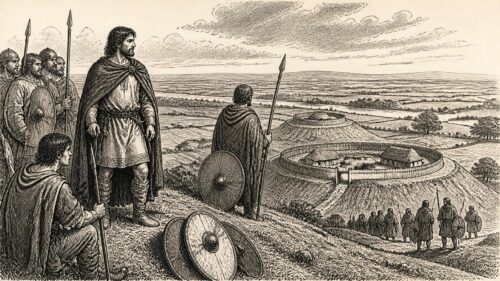
The most consequential political entry is the “flight of the Ulaid before Cináed son of Írgalach”. The wording records an outcome but supplies neither a battle-site nor a list of dead, nor does it explain whether the Ulaid were routed in open fighting, forced to withdraw after a raid, or yielded ground in the face of a larger host. It should not therefore be expanded into an invented campaign. What can responsibly be said is that Cináed’s power was felt in the north-east, among peoples grouped by the annals as the Ulaid.
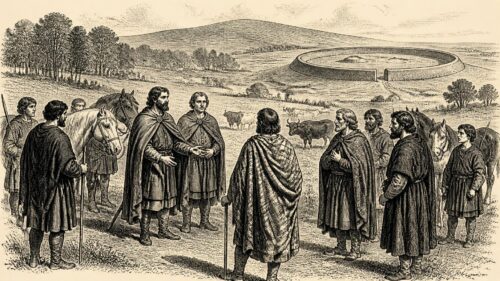
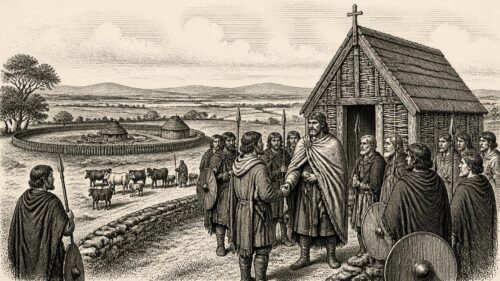
Cináed had emerged dramatically in the immediately preceding year. The Annals of Tigernach date the battle of Cenn Delgden to 9 October 724, where Fogartach grandson of Cernach was killed and Cináed was victor; the notice subsequently styles him king of Ireland. That claim was not a description of a centrally governed nation-state. In eighth-century Ireland, kingship was layered and negotiated: local dynasties held territories, powerful provincial rulers sought dominance over neighbours, and an overking’s authority depended on military capacity, alliances, hostage-taking, tribute and recognition. The flight of the Ulaid in 725 is thus best understood as evidence that Cináed was attempting, and at least temporarily achieving, reach beyond his own Brega-based political world.
The entry also exposes a limitation of the evidence. No diplomatic agreement follows it, no tribute is named, and no permanent conquest is reported. The Ulaid were neither erased nor absorbed. Their flight marks a moment of pressure in a continuing contest among regional powers. It would be misleading to treat 725 as the annexation of Ulster, or to assume that a single victory settled the relationship between Cináed and northern kingdoms.
The Island of Crach’s Son
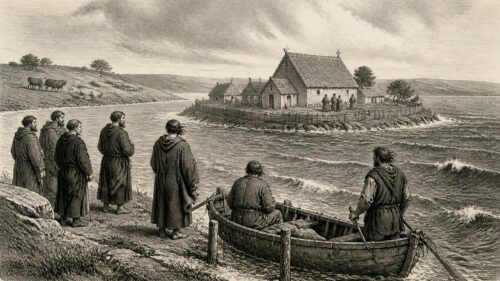
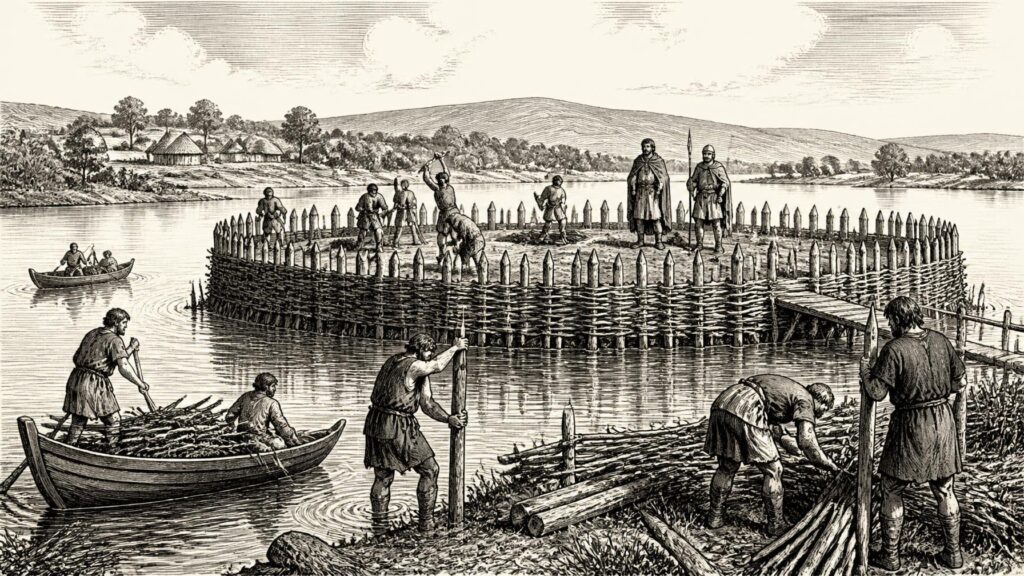
The year’s most tangible notice is stark: “Mac Craich’s island is built” in the English translation of the Annals of Tigernach. The parallel Annals of Ulster calls it Ailen m[aic] Craich. Scholarship on the Old Irish word ailén supports the cautious translation “island”, and modern translators have rendered the place as the “fortified island of Crach’s son”. Its location is unknown. Nor can the terse verb “constructed” tell us whether a wholly new site was raised, an older artificial island was rebuilt, or defences were added to an existing settlement.
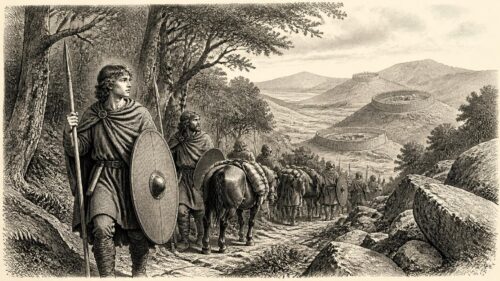
The strongest interpretation is therefore modest but important. The notice probably concerns the creation or substantial construction of a defended island settlement, of a kind later commonly described as a crannóg. Crannógs were small artificial or modified islands in lakes and wetlands, often built up with timber, brushwood, stone and lake deposits, and sometimes encircled by palisades. Their watery setting could make access controllable and offered security for a household, a lordly residence, stores or livestock. Yet the annal does not identify the builder, its inhabitants, its lake, or its purpose. It should not be presented as a royal fortress, a monastery, or a refuge from Cináed’s attack without evidence.
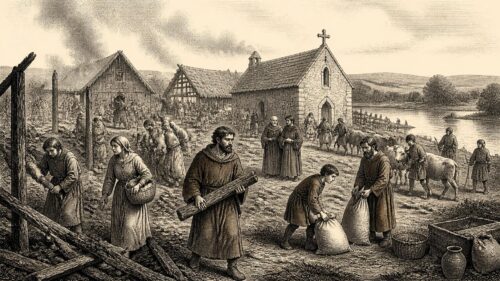
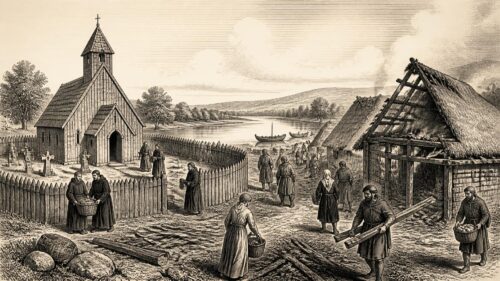
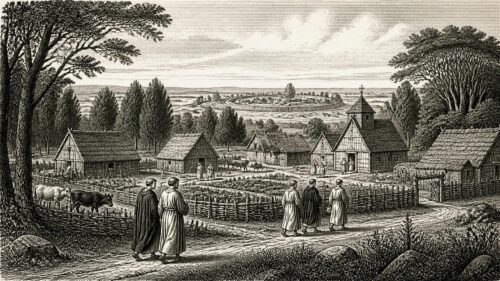
Even so, construction on this scale had social meaning. An island stronghold required the direction of labour, access to wood and stone, and the ability to organise transport and food for workers. It points to a community with resources worth protecting and leaders able to command effort. It is a reminder that settlement in 725 was not confined to open farmsteads and ecclesiastical enclosures. Wetlands and lakeshores were part of the inhabited, managed landscape, not empty margins beyond society.
Losses Among the Learned
The fullest 725 entry is an obituary list of scholars and scribes. Colmán Uamach is described as a “professor of writing” at Armagh. Ruibín, son of Connad, is called a scribe of Munster. The unnamed son of Broccán, from Tech Telle, was remembered as a good master of Christ’s Gospel. Colmán Banbán was a scribe. The annal says that all “fell asleep”, conventional Christian language for death. The Fragmentary Annals separately describe Colmán Uamach as a learned man of Armagh and Colmán Banbán as a learned man of Kildare, confirming how later record-keepers valued their intellectual standing.
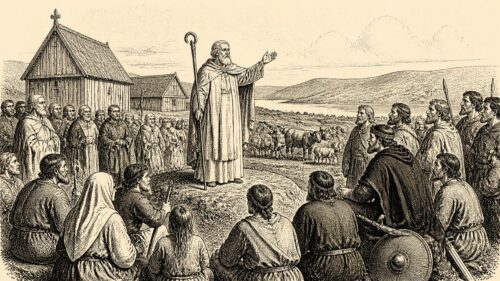
This is unusually revealing language. These men were not merely clerics in a broad sense. Their descriptions distinguish specialised work: copying and producing texts, teaching, and interpreting the Gospel. Armagh and Kildare were already major ecclesiastical centres, while “scribe of Munster” signals a learned network extending across a large southern region. Tech Telle, although harder to locate securely in the surviving evidence, was sufficiently recognised for the annalist to name it as the teacher’s home. The entry therefore maps learning through persons and institutions rather than through abstract claims about a golden age.
We cannot identify manuscripts written by these particular men, and should not assign them surviving books. Nevertheless, the evidence fits the wider material record of the period. Ireland’s eighth-century churches supported communities trained in Latin and Irish writing, manuscript production and biblical study. Gospel books such as the Book of Mulling, made in the second half of the eighth century, demonstrate the high level of scribal and artistic expertise available in Ireland. Such books required prepared vellum, inks, tools, exemplars, literacy and sustained patronage. The annal’s named scribes give that otherwise anonymous world individual human presence.
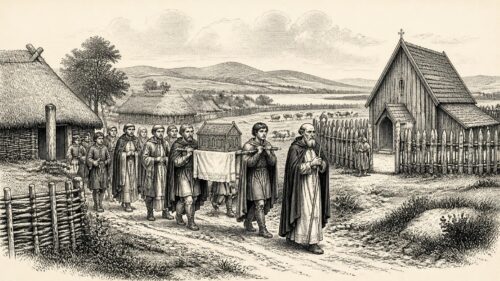
The deaths also show that ecclesiastical institutions were woven into politics rather than separated from it. Churches held land and dependants, fostered learning, maintained relationships with dynasties and preserved reputations across generations. A prestigious scribe or teacher enhanced a community’s authority. Recording his death was therefore more than private remembrance: it marked a loss to an institution and its network.
Churches, Communities and Uncertainty
Another 725 notice in the Annals of Tigernach records Cilline, grandson of Colla, abbot of Athan Mór. The parallel Ulster notice gives Cillenéne grandson of Colla, abbot of Othain, and adds the death of Aldchú of Dám Liag. The variation in names and place-forms is a useful warning against overconfident identification. The existence of an abbot named Cilline is clear; the precise location and institutional history behind the variants are less so. What matters for the year’s wider pattern is that abbots remained prominent enough for their deaths to enter annalistic memory alongside kings and scribes.
A further entry states that Simul son of Drust was “constrained” or imprisoned. This belongs to the interconnected political world of northern Britain rather than to an event located in Ireland. It is relevant because Irish chroniclers followed affairs across the North Channel, particularly where Gaelic, Pictish and ecclesiastical networks overlapped. But it offers no warrant to claim Irish involvement in Simul’s detention. The notice should stand as evidence of the annals’ horizon, not as proof of an Irish expedition or alliance.
What 725 Can and Cannot Show
For everyday life, 725 remains largely unrecorded. Most people lived in rural households whose work revolved around cattle, crops, seasonal labour and obligations owed to kin-groups, churches or rulers. The construction at Crach’s island makes the practical demands of building and defence visible; the scribal obituaries reveal the educational and devotional labour of church communities. Beyond that, the year provides no firm evidence for a famine, epidemic, exceptional weather, commercial boom or island-wide religious reform.
Nor should a striking astronomical notice in the Annals of Ulster—a dark, blood-red moon—be casually assigned to 725 CE. It appears in the annal’s U725 grouping, whose internal chronology is associated with AD 724. It illustrates precisely why the early annals must be read with chronological care. The responsible history of 725 is consequently not a tale padded with dramatic certainties. It is a close view of a political advance against the Ulaid, a defensible island under construction, and a learned ecclesiastical world mourning skilled writers and teachers. Those fragments are small, but they are enough to show Ireland as a landscape of organised power, material investment and active intellectual life.
Primary Sources
- The Annals of Tigernach, Part 12
- The Annals of Tigernach, Irish and Latin Text
- The Annals of Ulster, Part 295
- The Annals of Ulster, Irish and Latin Text, Part 295
- Fragmentary Annals of Ireland, Part 10
- Fragmentary Annals of Ireland, Irish Text, Part 10
- Annals of the Four Masters, Volume 1
- Annals of Inisfallen, Part 28
- Annals of Tigernach: CELT Project Bibliographical and Manuscript Information
- The Chronology and Sources of the Early Irish Annals
- Chronological Synchronisation of the Irish Annals
- Home Page for Dr Daniel P. McCarthy
- The Question of the Etymology of Dunadd, a Fortress of the Dalriadic Scots
- Irish Field Monuments
- High Crosses
- The Early Irish Manuscripts Project
- Early Irish Hands: The Development of Writing in Early Ireland
- Medieval and Early-Modern Irish Language Manuscripts
- The Literature of Medieval Ireland to c. 800: St Patrick to the Vikings
- Changing Patterns of Monastic Literacy c. 800–1000
- Ireland in the Middle Ages
- Colmán