

Green Legacy
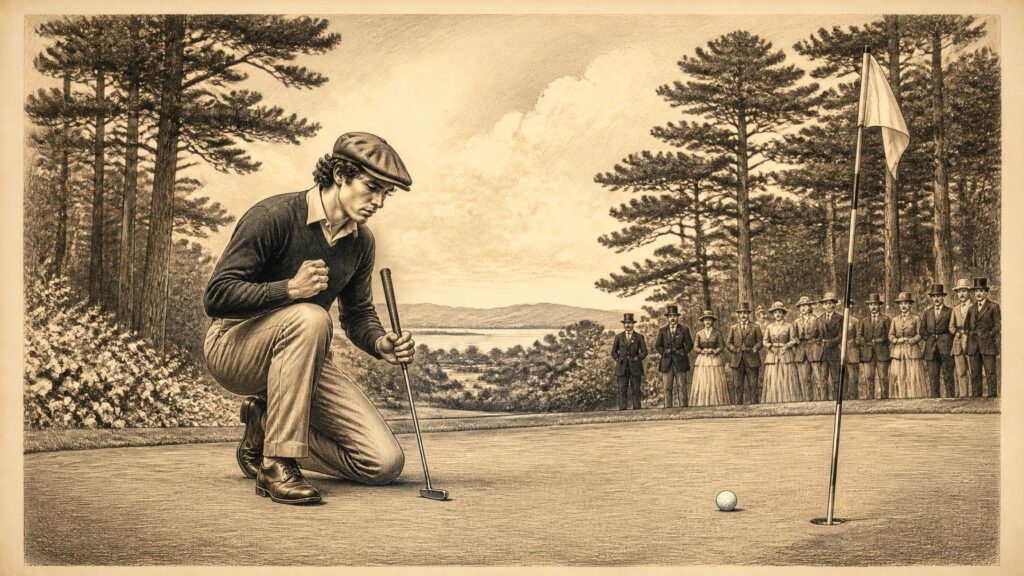
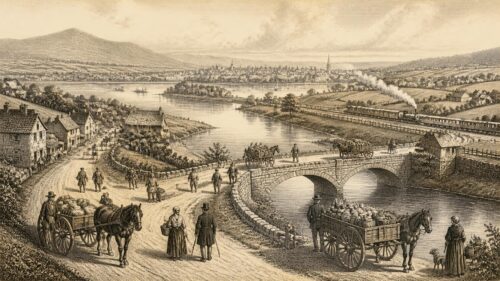
AI generated historical illustration, not a contemporary photograph.
At a Glance
Rory McIlroy’s Masters victories belong to Augusta National’s history, but they cannot be understood apart from Holywood, County Down, and the older all-island culture of golf that formed him. His green jackets became symbols of an individual achievement of rare scale, yet their meaning in Ireland rested upon clubs, family labour, amateur competition and a public accustomed to negotiating several overlapping identities.
Holywood Beginnings
Rory McIlroy was born in 1989 and grew up in Holywood, the County Down town on Belfast Lough. The place matters because sporting biographies are often flattened into tales of isolated genius. McIlroy plainly possessed extraordinary natural ability, but the historical record shows a more ordinary and more persuasive setting around it: a family prepared to organise its life around a child’s ambition; a local golf club that gave a young member access to the course; and a Northern Irish golfing environment in which ambition could be tested against adults and peers alike.
His father, Gerry McIlroy, was a capable amateur golfer, while his mother, Rosie, and father made sustained financial sacrifices to support his development. Accounts published by The Open have described the long hours worked by his parents and the centrality of tournament travel to family life. Such details should not be treated as sentimental decoration. They explain an important feature of McIlroy’s later public image: even after he became a global professional, he remained closely associated with a modest town and a club culture rather than with an academy manufactured solely for elite sport.
Holywood Golf Club was the formative institution. McIlroy joined as a child and received coaching from Michael Bannon, then the club professional. The arrangement was not unusual in the history of Irish golf. Local clubs have long been places where junior players could encounter demanding competition, practical instruction and a cross-generational sporting world. What was unusual was the speed at which McIlroy outgrew ordinary expectations. By his middle teens he was already producing scores and shots that attracted notice far beyond County Down.
The celebrated round of 61 at Royal Portrush in 2005, achieved when he was sixteen, acquired almost mythic status afterwards. It is tempting to present it as prophecy: the boy from Holywood announcing a destiny that would culminate at Augusta. History is usually less tidy. The score was nevertheless documented, remarkable, and revealing. It showed that McIlroy could carry his game from his home club to one of Ireland’s most formidable courses. It also linked him early to Royal Portrush, a venue that would later become inseparable from the modern international image of Northern Irish golf.
Folklore has naturally accumulated around a player who became famous so young. Stories of the boy who could reproduce swings from television and who astonished adults on the course tell something true about the impression he made, but they should be read as recollection rather than as a substitute for evidence. The firmer evidence lies in his junior results, his membership of Holywood, his amateur selection, and the observable technical quality that soon placed him among the outstanding young players of his generation.
Irish Framework
McIlroy’s rise took place within a distinctive golfing geography. Golf on the island of Ireland has often been organised on an all-island basis, notwithstanding the constitutional division of the island since the early twentieth century. The Golfing Union of Ireland, founded in 1891, was the world’s first national golfing union and governed men’s amateur golf across Ireland for generations. Its later successor, Golf Ireland, was established in 2021 as a unified governing body for golf throughout the island, joining the former men’s and women’s unions.
This history is essential to understanding why McIlroy can be accurately described in several ways without those descriptions being interchangeable. He is from Northern Ireland, which is part of the United Kingdom. He is also a golfer formed in Irish institutions and an amateur who represented Ireland internationally. In other sporting settings he has represented Great Britain and Ireland. Journalists, supporters and political commentators have sometimes tried to force a single national label upon him. The better historical approach is to recognise that the structures of golf themselves made his sporting identity layered.
McIlroy represented Ireland at the 2006 Eisenhower Trophy, the world amateur team championship, and was part of the Great Britain and Ireland side in the 2007 Walker Cup at Royal County Down. The latter occasion is particularly evocative. Royal County Down lies only a short distance from Holywood, yet the team title under which he competed expressed a wider sporting arrangement connecting players from across Britain and Ireland. He won his Sunday singles match, although the American side narrowly won the contest overall.
That mixture of locality, Irish representation and British-and-Irish team sport is not an anomaly created for McIlroy. It is part of golf’s institutional inheritance. It also helps explain the breadth of public feeling when he won the Masters. His success was celebrated in Holywood, across Northern Ireland and throughout the Republic, but the responses did not require a false resolution of the region’s constitutional history. Sporting pride could be local, Irish, Northern Irish and British in varying proportions, sometimes within the same household.
Golf’s older infrastructure gave this achievement further depth. Ireland’s courses have supplied not merely scenery for tourism but a network of competitive opportunity: links venues, inland clubs, provincial championships and national amateur events. McIlroy’s later professional fame should not obscure the role of that framework. He emerged from it, and his eventual victories gave it unprecedented global visibility.
Amateur Passage
Before Augusta became the stage of his most scrutinised drama, McIlroy established himself through amateur golf. He won the West of Ireland Championship at County Sligo in 2005 and retained it in 2006. Those successes were not simply junior curiosities. The West of Ireland is a demanding championship with a long place in the amateur calendar, and victory against older competitors demonstrated that McIlroy could convert talent into match-play resilience.
At the 2007 Open Championship at Carnoustie, he was the leading amateur and received the Silver Medal after finishing tied for forty-second. This was an important bridge between local promise and international recognition. Carnoustie’s stern conditions exposed young players who relied upon flair alone. McIlroy’s performance suggested that he possessed not merely length and attractive ball striking, but the capacity to compete through a major championship week.
The following months closed one chapter. He turned professional in 2007, while still a teenager. Modern professional golf makes such transitions appear routine, but they are consequential historical moments. An amateur career is conducted through clubs, selectors and representative teams; professional life makes the player a travelling worker in a worldwide commercial sport, subject to rankings, sponsors, broadcasters and an audience that expects immediate proof.
McIlroy did provide that proof. His first major championship victory came at the 2011 United States Open at Congressional, where he won by eight strokes. The scale of the victory announced more than a promising career. At twenty-two, he had become the youngest United States Open champion since Bobby Jones in 1923. He followed it with the 2012 PGA Championship, again by eight strokes, and later added the 2014 Open Championship at Royal Liverpool and the 2014 PGA Championship at Valhalla.
By the end of 2014, the outline of an exceptional career seemed clear. He had four major titles, had reached world number one, and had won each of the majors except the Masters. Yet the apparently missing piece was the tournament with which his career was most emotionally entangled. The Masters was not merely another opportunity. It was the site of his most painful early reversal, and therefore the one event through which critics and admirers alike came to measure the gap between achievement and completion.
Augusta Lessons
McIlroy first played the Masters in 2009. Augusta National’s strategic demands have always rewarded a particular mixture of flighted iron play, imaginative recovery, calculated aggression and nerve on fast, sloping greens. His powerful high ball flight gave him obvious advantages on a course designed to invite dramatic approaches to elevated targets. Yet familiarity with a course does not abolish pressure, and his Masters history soon became defined by a single Sunday.
In April 2011, McIlroy began the final round with a four-shot lead. He was twenty-one, already regarded as a future giant of the game, and close to claiming a first major in the most theatrical setting golf could provide. He shot 80. A wayward tee shot at the tenth hole led to a sequence of errors from which he did not recover, and Charl Schwartzel won the championship.
That collapse became part of McIlroy’s public biography because of its visibility, not because it uniquely exposed weakness. Golf records defeats with peculiar cruelty: every misjudged club, missed putt and loose drive is available for inspection, while the player must continue before the crowd. It is nevertheless fair to say that 2011 created an image that followed him for years. Augusta was where promise had appeared to buckle beneath its own expectation.
The immediate historical point is often missed. McIlroy responded two months later by winning the United States Open in overwhelming fashion. He did not disappear, nor did the Masters result prevent him becoming one of the dominant players of the next decade. But it did leave a scar in the narrative. Later near-misses at Augusta were read through 2011, and each April renewed the question of whether he could win the one major needed to complete the career Grand Slam.
His Masters performances supplied reasons for hope and caution. In 2015 he finished fourth. In 2018 he began the final round in the final pairing with Patrick Reed but could not mount the charge required. In 2022 he surged to second place with a closing 64, including a spectacular holed bunker shot at the last, but Scottie Scheffler had already built the decisive advantage. These were not failures in any ordinary sporting sense. They were high finishes at the most difficult level. In the peculiar economy of a Grand Slam pursuit, however, they were treated as evidence of incompletion.
The interval after his 2014 PGA Championship was also long enough to alter public perceptions. McIlroy continued to win major regular-season events, to contend in majors, and to remain among golf’s principal figures. Yet he went more than a decade without another major title. In that period his game was debated with unusual intensity: whether he had become too cautious, whether equipment or scheduling mattered, whether his role in golf’s institutional disputes distracted him, and whether the old Augusta disappointment still governed his responses under pressure.
Such explanations should be handled carefully. They are interpretations, not settled facts. Major championships are designed to make victory rare, and a player may perform at an elite level without winning one. Still, the record is clear that the Masters came to represent the final obstacle in a pursuit begun when he had already won three of the four principal men’s championships by age twenty-five.
Sunday Reckoning
The 2025 Masters, played from 10 to 13 April, finally turned that old narrative. McIlroy began the tournament badly, making two double bogeys in an opening 72, but recovered with rounds of 66 and 66 to take a two-shot lead into Sunday. His final score of 277, eleven under par, placed him level with Justin Rose after a final round that was less a procession than an ordeal.
The final day revisited almost every anxiety attached to McIlroy’s Augusta history. He made double bogey at the first and later found Rae’s Creek at the par-five thirteenth, producing another double bogey at a moment when control seemed essential. Rose, who had begun the week with a 65, played strongly enough to force a playoff. McIlroy then missed a short putt at the eighteenth in regulation that would have won the green jacket outright.
It is easy, after the result, to arrange these incidents as a redemptive script. Contemporary reporting quite understandably did so: the young man haunted by a final-round unraveling returning fourteen years later to survive a new version of the same examination. But the actual sporting event was more contingent. McIlroy did not win because fate decreed balance. He won because, after the errors and the missed opportunity, he played the eighteenth again in sudden death and struck a wedge approach close enough to make birdie. Rose could not match it.
That distinction matters. Redemption is an interpretation; the birdie in the playoff is the documented fact. The interpretation remains powerful because it rests on recognisable evidence: McIlroy had endured the public memory of 2011, carried an eleven-year major drought since 2014, and still produced the decisive shot when another disappointment was immediately possible.
The victory made him the sixth man to complete the men’s career Grand Slam, after Gene Sarazen, Ben Hogan, Gary Player, Jack Nicklaus and Tiger Woods. It gave him a fifth major championship and made him the first golfer from Ireland to win the Masters. The latter formulation is significant, though it needs the care already noted. McIlroy is a Northern Irish golfer whose amateur career included Ireland representation and whose achievement was celebrated across the island. It does not erase the constitutional distinction between Northern Ireland and the Republic, nor should it be used to enlist him into a political argument he has not chosen.
His reaction on the eighteenth green was striking because it appeared to release a long accumulation of pressure. Yet one should resist the modern appetite for instant psychological certainty. No spectator can know the full content of another person’s feeling. What can be said is that McIlroy himself later spoke of releasing years of disappointment and frustration. The image of him falling to his knees became the visual conclusion to a sporting story that had been sustained, sometimes unfairly, for more than a decade.
The 2025 result also altered the historical status of his earlier defeats. They did not cease to be painful or important. Rather, they became part of a longer record of persistence. The 2011 Masters could no longer be presented as a permanent verdict on his capacity to close a major championship. It became the beginning of a fourteen-year arc whose end, at least in one sense, was a green jacket.
Island Response
The response in Ireland illustrated the peculiar reach of golf as a shared all-island sport. Ards and North Down Borough Council publicly congratulated McIlroy and noted his place on Holywood’s welcome signage and local wall of fame. Golf Ireland celebrated the result as a landmark for Irish golf. In Holywood, the victory had the character of a homecoming even before any formal civic event could be planned: a world-famous athlete remained, in local memory, the child who had learned the game nearby.
That response was not reducible to civic promotion. It reflected a genuine sense that McIlroy’s story had grown from recognisable local structures. The town, club, coach and family were not invented retrospectively to adorn a global champion. They were already part of the record. Augusta gave them an enormous audience, but did not create their importance.
There was, however, a wider cultural significance. Northern Ireland’s public life has frequently made sport a site where identity can be expressed, softened or contested. Golf has its own traditions and social history, including periods in which access and class mattered sharply. By the twenty-first century, McIlroy’s career had become evidence of a more open junior pathway at club level, though no single success should be mistaken for proof that all barriers have vanished.
His achievement also joined a notable modern sequence of Irish major champions. Pádraig Harrington’s Open victories in 2007 and 2008, Graeme McDowell’s United States Open in 2010, Darren Clarke’s Open in 2011, and Shane Lowry’s Open victory at Royal Portrush in 2019 had already made Irish golf unusually visible. McIlroy’s Masters completed a different category: it attached the island to the tournament that, through American broadcasting and ceremony, carries perhaps the greatest international aura in men’s professional golf.
The public language around this achievement requires restraint. Phrases such as national hero or universal symbol make attractive headlines, but they conceal differences in affiliation and experience. It is more accurate to say that McIlroy’s win offered an uncommon point of shared sporting recognition. A Northern Irish player, competing after an Irish amateur formation, had attained a title that players from across the island could reasonably regard as part of their sporting history.
Second Jacket
Historical perspective changed again at the 2026 Masters. On 12 April 2026, McIlroy successfully defended the title, winning his second green jacket by one stroke from Scottie Scheffler. The defence matters because it prevents the 2025 victory from being treated only as an answer to old pain. It confirmed that Augusta had become a place of mastery as well as memory.
He became only the fourth player to win the Masters in consecutive years, following Jack Nicklaus, Nick Faldo and Tiger Woods. Such comparisons should not be stretched into premature rankings. Different eras possess different fields, equipment, travel patterns and competitive pressures. Yet the fact of consecutive victories is indisputable, and the company is extraordinary.
The two wins also change the texture of the 2011 story. That difficult Sunday will always remain in accounts of McIlroy’s career because it was so public and so formative. But after 2025 and 2026 it is no longer the defining Augusta image. The stronger historical image is now of continuity: an early collapse, a long pursuit, a playoff victory, and then a successful defence.
Lasting Measure
McIlroy’s Masters legacy should not be confined to numbers, though the numbers are formidable: two green jackets, six major championships by April 2026, and a completed career Grand Slam. Its deeper interest lies in the route by which those results were made meaningful. Holywood was not merely a birthplace; it was a sporting apprenticeship. Irish golf was not merely a label; it was an institutional and representative world in which he learned to compete. Augusta was not merely the final major he required; it was the arena in which public failure and public resilience became inseparable.
There is a temptation in sporting history to turn a champion’s career into a moral fable. McIlroy’s story does support a modest conclusion about endurance: a damaging defeat need not establish a permanent limit, and excellence may require return rather than escape. Beyond that, caution is wise. His success emerged from talent, opportunity, family support, coaching, institutional access and immense work, as well as from the uncertainties that no golfer can command.
For Ireland, the green jackets are therefore more than imported trophies brought home from Georgia. They are markers of a relationship between a small northern town and an international sport; between an island-wide golfing inheritance and a player with several legitimate affiliations; and between remembered disappointment and documented achievement. That is why Rory McIlroy’s Masters victories will endure not simply as wins, but as a chapter in Irish sporting history.


McIlroy’s Masters triumphs illuminate how sporting achievement can acquire several meanings at once: personal resilience after Augusta setbacks, recognition of Holywood’s club culture, and celebration within golf’s all-island institutions. The article rightly resists reducing this layered background to a single national label, while showing why the 2025 victory resonated across Ireland. His 2026 defence may further test whether a green jacket becomes a lasting shared cultural reference rather than simply an individual milestone. How should historians and supporters interpret McIlroy’s Masters legacy alongside those of Harrington, McDowell, Clarke and Lowry, particularly when local, Northern Irish, Irish and British affiliations overlap?