Bangor and the September Gale691 CE
The annals conventionally associate 691 with the death of Crónán, abbot of Bangor, and Fidchellach son of Flann, king of Uí Maine. They also record a raid by Dál Riata on the Cruithin and Ulaid, illustrating the military importance of Irish Sea routes. On 16 September, a severe windstorm drowned about six members of Iona’s community, highlighting the dangers faced by coastal religious settlements. Together these sparse notices reveal interconnected yet fragmented political and ecclesiastical worlds, shaped by local kingship, influential monasteries, maritime travel and environmental hazards. The dating of some entries remains uncertain.
Dateline
In 691 CE, the surviving Irish annals preserve a small but revealing cluster of notices: the death of Crónán moccu Cuailne, abbot of Bangor; a raid by Dál Riata upon the Cruithin and Ulaid; the death of Fidchellach son of Flann, king of Uí Maine; and a violent windstorm which drowned about six members of Iona’s community on 16 September. These entries do not amount to a continuous narrative of the year, and they should not be made to do so. Yet, set beside the political and ecclesiastical landscape of the late seventh century, they show an Ireland joined to western Scotland by sea routes, contested local lordships and powerful religious houses. There is a chronological caution: the Annals of Ulster places the sequence under its annal 691 while also printing an AD 690 calibration, whereas the Annals of Tigernach has the relevant notices under 691. This account therefore treats them as the events conventionally associated with 691 in the Irish annalistic record, without pretending that every occurrence can be fixed to a modern calendar year with equal certainty.
A Bangor Abbot Dies
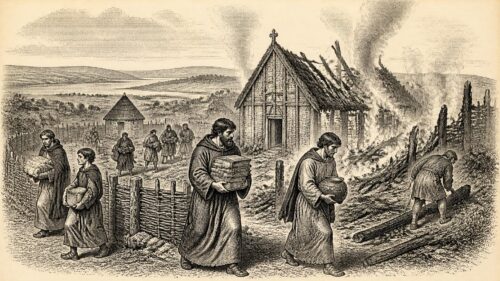
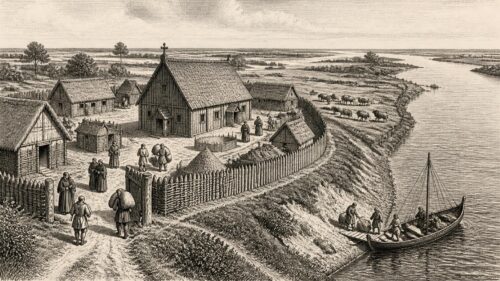
The clearest Irish ecclesiastical notice is Crónán’s death. Both the Annals of Ulster and the Annals of Tigernach call him abbot of Bennchor, modern Bangor in County Down. The title matters. Bangor was not a quiet, isolated chapel but one of the foremost monastic centres of northern Ireland, associated with the sixth-century founder Comgall and with an exacting reputation for communal discipline, worship and learning. Its influence travelled far beyond its immediate shoreline through clerics, pupils, books, prayers and connections between religious communities.
Crónán’s obituary is terse: it does not state his age, the length of his abbacy, the cause of death or the identity of his successor. It would be wrong to supply any of those missing details. Nor does the entry justify a claim that Bangor’s life altered abruptly on his death. Monastic communities were corporate institutions, sustained by lands, dependent households, churches, patrons and accumulated prestige as well as by an individual abbot. But the recording of Crónán among the year’s notable deaths demonstrates that his office was considered important enough for annalists to preserve.
The period around 690 is also closely connected with the Antiphonary of Bangor, a manuscript or compilation traditionally associated with the community and containing Latin hymns, canticles and prayers. Its precise date and stages of composition remain subjects for scholarly caution; it should not be represented as a book demonstrably produced in 691. Even so, it provides valuable near-contemporary context for what a major Irish monastery could be: a place where a Latin liturgical culture was cultivated with distinctive local confidence. Crónán’s death came within a religious world in which chant, memorised prayer, manuscript writing and the disciplined ordering of communal time were central forms of labour.
Raiders in Northern Waters
The year’s starkest political notice says simply that Dál Riata “despoiled” the Cruithin and the Ulaid. The wording records plunder, not a named battle. It does not tell us where the raiders landed, who led them, how long the expedition lasted, whether a fort was stormed, or how many people suffered. Those omissions matter. A modern account cannot turn one annalistic sentence into a full-scale war narrative.
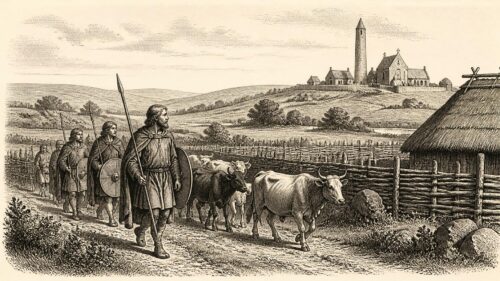
Nevertheless, the raid is highly significant. Dál Riata was a Gaelic polity whose interests extended across the North Channel, encompassing territory in north-east Ireland and, above all, the western seaboard of what is now Scotland. In north-eastern Ireland its neighbours included groups described in the annals as Cruithin, especially those later and more specifically associated with Dál nAraide, and the Ulaid, a term which could denote both the wider provincial world and particular ruling peoples such as Dál Fiatach. These labels should not be treated as tidy national identities. They were political and genealogical categories, liable to overlap, change in meaning and be sharpened by later writers.
The entry nevertheless captures a real feature of life around the Irish Sea: water connected as much as it divided. Narrow seas enabled the movement of boats, livestock, retainers, messengers, churchmen and raiding parties. A raid could seek cattle, foodstuffs, valuables, hostages or political submission; the annal does not identify the booty in this case. Its inclusion indicates that the attack was noteworthy at a wider level than a private theft. It also reminds us that coastal communities of Ulster lived within a maritime military zone, not on the edge of an island sealed off from Britain.
A King of Uí Maine
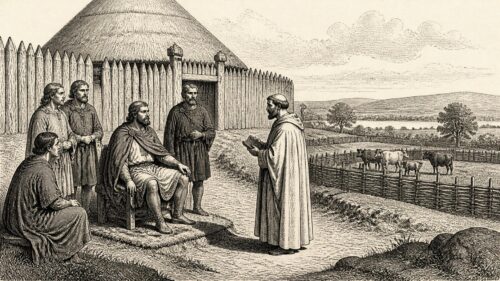
Far to the west, the annals record the death of Fidchellach son of Flann, king of Uí Maine. Uí Maine was an important Connacht overkingdom, spanning areas later associated chiefly with east Galway and south Roscommon. The death of its ruler is the only firmly recorded political development for that region in the annalistic dossier for 691. It tells us that political authority in Ireland was exercised at several levels: not by one uniform state, but through a patchwork of kingships, kin-groups, client relationships and church interests.
Fidchellach’s notice is also a useful warning against letting better-documented dynasties monopolise the story. The great northern and southern Uí Néill branches, Munster rulers and leading monasteries are often more visible in later history, but the annals of 691 give a Connacht kingdom its due place. A king’s death could create an immediate question of succession, alliance and tribute. Yet the sources do not state that Fidchellach’s death caused a dispute, nor do they securely name a successor in the same notice. The responsible conclusion is narrower: a recognised ruler of Uí Maine died, and that loss would have mattered within his kingdom’s political network.
The Storm at Í
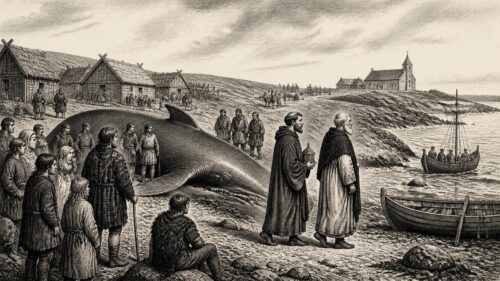
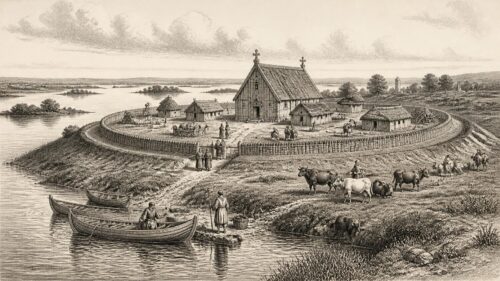
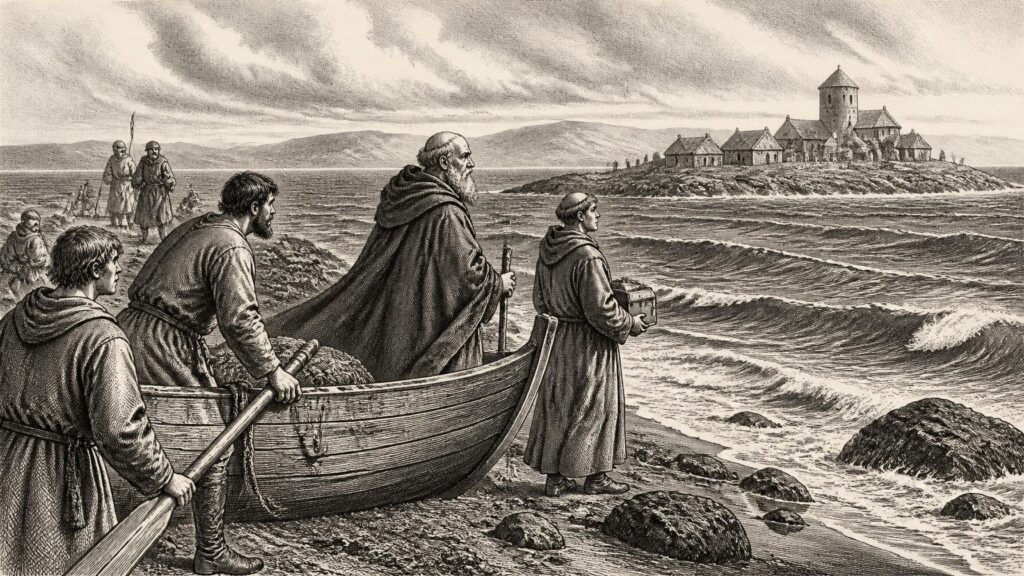
The most precisely dated incident belongs not to Ireland proper but to the Columban community of Í, Iona, whose history was inseparable from Irish religious life. The Annals of Ulster date a great windstorm to the sixteenth day before the Kalends of October, or 16 September, and say that it drowned “some six” of Iona’s community. The cautious phrasing is the annalist’s own: the number was approximately six, not necessarily an audited total, and the entry gives neither the victims’ names nor the circumstances of their deaths.
Even in its brevity, the notice is unusually human. It points to a community in which people regularly had reason to be near or on the sea. Iona was founded by Columba, an Irish churchman, in 563 and remained a major centre within a network that linked Ireland, Dál Riata, Pictland and Northumbria. Its island position made boats essential for travel, supply and communication. The storm should not be converted into evidence for a particular voyage, however. The drowning may have occurred while fishing, crossing a sound, tending boats or travelling on monastic business; the source does not decide between these possibilities.
The loss also gives environmental force to the year. In an agrarian society, weather shaped crops, pasture, travel and the security of homes; for island and coastal communities, it could be immediately lethal. This was no metaphorical tempest in a saint’s tale but an annalistic record of deaths caused by wind and sea. Its exact day makes the event stand out against the generally undated notices for 691, while its spareness preserves the distance between modern readers and the people who died.
Churches Across the Sea
Crónán’s death at Bangor and the deaths at Iona should not be collapsed into one institutional story. Bangor was not a daughter-house of Iona, and the sources do not say that the two events were connected. What they do reveal is a densely religious Irish Sea region in which large communities could command attention across political boundaries. Bangor stood on Belfast Lough; Iona lay off Mull; Dál Riata moved between the Irish and Scottish shores. Geography made these places neighbours in a seaborne world, even when their communities had different patrons, traditions and interests.
The same annal sequence includes the death of Theodore, archbishop of Canterbury. Bede, however, dates Theodore’s death specifically to 690, an important reminder that early medieval annalistic year-numbering must be handled critically. His appearance beside Irish events is still instructive: Irish chroniclers and their source traditions did not understand the Church as confined to one island. They noticed major ecclesiastical figures in neighbouring Britain, just as Irish and Iona-based religious networks reached into Northumbria and beyond.
What the Record Leaves Unsaid
No securely dated battle, royal assembly, lawmaking session, famine or epidemic is recorded for Ireland in this annalistic year. There is no basis for claiming that 691 brought a national settlement, a transformation in kingship or a general crisis. Daily life continued largely beyond the chroniclers’ gaze: cultivation and herding, food preparation, craftwork, legal negotiation, travel, household obligations and worship. The year survives instead through moments thought worth writing down by learned record-keepers: deaths of an abbot and a king, an act of regional predation, and a maritime disaster.
That selectivity is not a defect to be repaired with invention. It is the historical character of 691. Bangor’s abbot, Uí Maine’s king, northern raiders and Iona’s drowned community together show a society whose authority was dispersed but interconnected: local kingdoms mattered; monasteries were public institutions; and the sea was both a route of power and a source of danger. In the surviving record, the September gale is the year’s sharpest image—an event with a firm day, real victims and consequences that the annalist believed should not be forgotten.
Primary Sources
- The Annals of Ulster, Year U691
- The Annals of Tigernach
- Chronicon Scotorum
- Annals of Inisfallen
- Annals of the Four Masters, Part 52
- The Life of Columba, Written by Adomnán
- Ecclesiastical History of the English Nation, Chapter VIII
- The Dating of the Irish Annals
- Early Christian Ireland: Frontmatter and Note on the Chronicle of Ireland
- A New Jerusalem ‘At the Ends of the Earth’: Interpreting Charles Thomas’s Excavations at Iona Abbey 1956–63
- St Mary’s Abbey, Iona, Monastic Settlement (SM12968)
- Iona Abbey and Nunnery: History and Stories
- The Antiphonary of Bangor and its Musical Implications
- Early Medieval Ireland
- Early Medieval Antrim
- Latin Texts at CELT
- Irish Texts at CELT
- The Annals of Ulster
- Annals of Inisfallen: Bibliographical and Textual Information
- List of Published Texts at CELT
- The Cambridge History of Irish Literature: Chronology