
Stone Hands
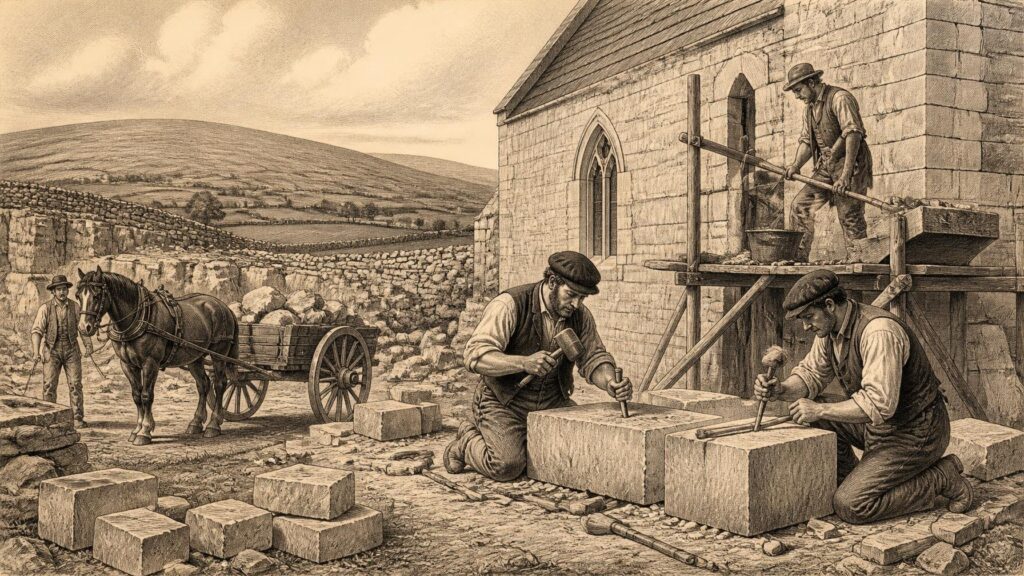
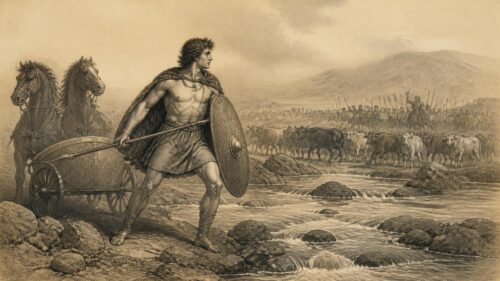
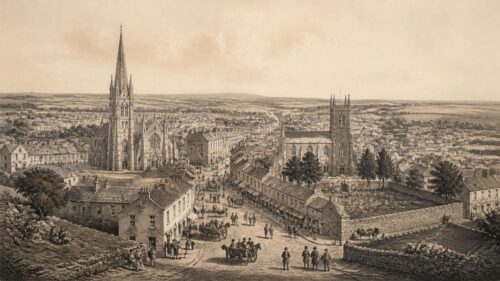
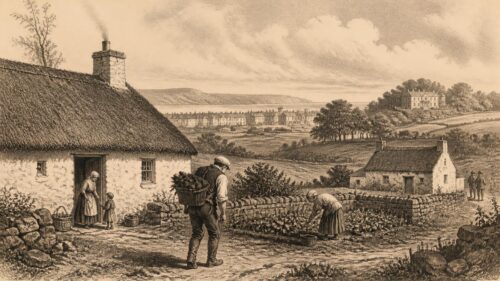
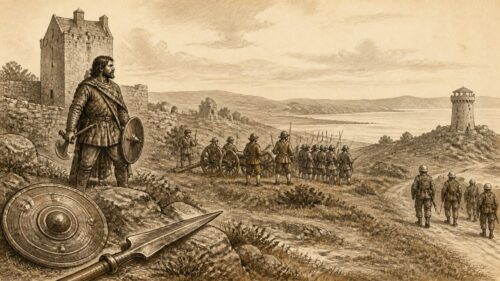
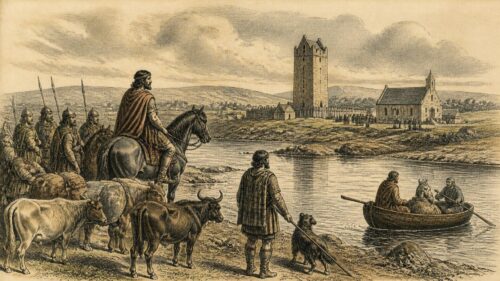
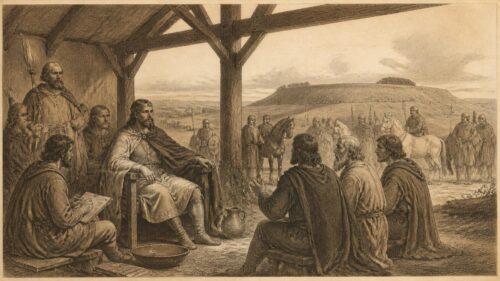
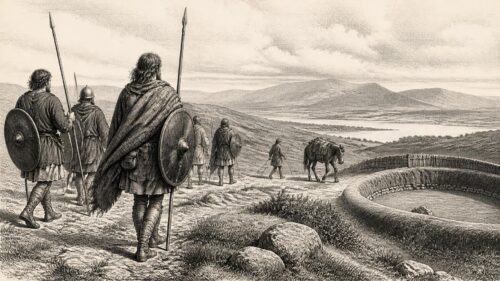
AI generated historical illustration, not a contemporary photograph.
At a Glance
Irish history survives in stone not because stone is silent, but because generations of hands gave it form: quarrymen split it, masons bedded it in mortar, carvers cut scripture and heraldry into it, and rural builders raised walls whose makers are seldom named. The work is visible everywhere, from a weathered church doorway and a high cross to a Dublin cornice or a field boundary in the west. Yet the history of Ireland’s stone masons is not a simple story of an unbroken ancient craft. It is a history of changing materials, patrons, beliefs, building systems, labour arrangements and landscapes.
The phrase “stone masons Ireland” can suggest a single fraternity extending unchanged from prehistoric monuments to the present. The evidence does not permit that comforting simplification. People shaped and assembled stone in Ireland over many millennia, but the identities, training and social organisation of those people changed profoundly. Prehistoric monument builders cannot automatically be called masons in the later occupational sense. Early medieval sculptors and builders worked within ecclesiastical and secular communities whose records only occasionally reveal their status. Medieval and early modern urban tradespeople left more documentary traces, while the names of many nineteenth-century quarry workers and rural wallers remain scattered through contracts, maps, oral tradition and the buildings themselves.
What can be followed with confidence is the material record. Ireland’s varied geology provided granite, limestone, sandstone, slate, schist and many other stones. Their hardness, grain, colour, availability and ease of transport mattered as much as a mason’s skill. A church or house was never merely a design imposed upon a place: it was also an answer to the stone beneath the ground, the road or waterway leading from quarry to site, the patron’s purse, and the capacity of labourers to dress and lift heavy material.
Material Country
Stone is one of Ireland’s most familiar building materials, but its use has never been uniform. In districts with accessible limestone, masons could secure relatively regular blocks and produce crisp ashlar faces. In granite country, the same ambitions encountered a harder and more intractable material, often encouraging a different handling of joints, tooling and ornament. Sandstone could be comparatively workable and was widely valued for carved detail, though its durability depended upon its particular geological character and exposure. Such distinctions explain why Irish buildings do not share a single visual language even when their plans, religion or social purpose were similar.
Stone also carried practical limitations. Large blocks demanded quarrying knowledge, carts, animals, boats, lifting gear and experienced hands. Rubble construction could make use of smaller or irregular pieces, while carefully cut ashlar required time and skill. Lime mortar was not an incidental filler. It helped bind walls, accommodated slight movement and, when properly composed, allowed traditional masonry to manage moisture. Modern conservation guidance repeatedly stresses that historic solid walls were systems of stone, mortar, render and finish rather than collections of independent blocks. That insight is important historically: it cautions against admiring visible stone while forgetting the lime, sand, labour and maintenance that made a wall function.
The countryside offered local stone, but local did not always mean nearby enough or suitable enough. Coastal and river transport could make distant materials commercially viable. In urban Ireland especially, imported stone and specialised materials joined indigenous supplies. The resulting built environment records networks of exchange as clearly as it records native geology. A polished façade in Dublin might involve quarrying in one district, transport by sea, cutting in a yard and assembly by a team whose experience had been acquired in more than one country.
This material perspective helps correct another misconception. The survival of a stone building does not itself prove permanence or wealth. Some modest structures used rubble walls because local material made it sensible; some prestigious structures concealed rubble cores behind dressed stone; and many stone buildings were rendered or limewashed. Bare masonry has often become an aesthetic preference of later viewers, rather than an accurate representation of an earlier building’s intended appearance.
Earlier Builders
Ireland’s prehistoric tombs, ceremonial sites and field monuments demonstrate formidable communal abilities in selecting, moving and arranging stone. They are evidence of planning, physical effort and local knowledge. They should not, however, be presented as direct proof of a continuous professional masonry tradition. The terminology of “stonemason” belongs most securely to later worlds of craft specialisation, construction contracts, workshops and apprenticeship. Assigning it casually to all prehistoric monument makers can obscure both the distance between periods and the distinctive social meanings of their monuments.
Nor should exact dates be invented where archaeological chronology is necessarily broad or debated. The important point is that stone construction had long been part of life on the island before historical records became fuller. Monumental arrangements of boulders and slabs required collaborative organisation; smaller stone features show the everyday use of local material. What they do not normally yield is a named builder, an account book or a technical manual. The stones are evidence, but their makers’ occupational identities are usually beyond recovery.
Folklore later supplied answers where records did not. Megaliths, caves, striking boulders and ruins accumulated stories of giants, saints, supernatural builders and heroic ancestors. Such tales are historically valuable as evidence of how communities explained ancient places, but they are not building accounts. The distinction matters. A tradition that a giant threw a boulder may illuminate local imagination; it does not establish who quarried, moved or set the stone. Good historical writing can respect folklore without turning it into archaeological fact.
In the early medieval period the evidence becomes richer, though still incomplete. Stone was used widely for domestic objects, boundaries, souterrains, querns, grave markers and ecclesiastical structures. A major University College Dublin synthesis of early medieval settlement notes the changing use of the Irish term sáer, which originally had a closer connection with carpentry but came in later sources to denote a stone mason. That linguistic development is suggestive rather than a neat occupational census. It indicates the growing importance of specialist stone-working around the turn of the first millennium, while also reminding us that skills in wood and stone were not always sharply separated.
Christian Carving
Early Irish Christianity created some of the most visible surviving evidence for expert stone-working. Monastic sites required churches, enclosures, grave markers, shrines, crosses and, in certain places, towers. These were not isolated works by solitary geniuses. They emerged from communities of patrons, clergy, labourers, craft specialists and suppliers. The exact division of responsibility is often lost, but the surviving sculpture and masonry make clear that highly experienced workers were involved.
Ogham stones occupy a special place in this history. Their inscriptions preserve an early form of Irish written on stone, generally along an edge or arris, and more than four hundred examples and fragments are known. Linguistic dating places the earliest examples broadly between the fourth and seventh centuries. These stones are not all elaborate carvings, and their production should not be confused with the work of later monumental sculptors. Yet they show stone’s power as a durable medium for names, descent and commemoration. The maker’s cut became an instrument of literacy as well as craft.
The great high crosses reveal another level of accomplishment. At Monasterboice in County Louth, the National Monuments Service describes the Tall Cross as seven metres high and made from four principal stones: base, shaft, cross-head and capstone. Muiredach’s Cross, whose commemorative inscription names the abbot who died in 924, carries densely organised biblical scenes and smaller lively details. These works demand more than iconographic knowledge. They imply control of proportion, stone selection, surface planning and carving tools, together with an ability to work in several stages without losing the overall composition.
It is tempting to speak confidently of a named “school” behind each group of crosses, but the evidence more securely supports the existence of skilled traditions than it does the biographies of individual artists. Similar motifs may point to travelling craftspeople, shared models, apprenticeships or the movement of patrons and objects. They need not prove that one identifiable master made every related monument. The uncertainty is part of the history: Ireland preserves extraordinary work, but not always the personal names attached to it.
Clonmacnoise in County Offaly shows the long duration of such work. The site’s buildings and sculpture span centuries, and its surviving churches include carefully executed architectural carving. The National Monuments Service notes the reuse of fallen ashlar from one damaged tower in another structure. This is a useful corrective to modern assumptions about original fabric. Reuse was not necessarily neglect; dressed stone represented labour, expense and embodied value. A mason encountering a ruined wall saw a potential supply of material as well as a relic of the past.
Monastic Workshops
Large ecclesiastical centres could support organised craft activity, but it would be rash to imagine every monastery as a modern building firm. Documentary evidence is uneven and much of the detailed interpretation comes from archaeological study, art history and comparison. Still, the scale and refinement of particular buildings strongly suggest workshops in which expertise was transmitted. Master masons, carvers and assistants may have worked together, while labourers undertook quarrying, hauling, mortar preparation and other demanding tasks.
The monastery was both a religious institution and an economic place. Churches and towers required patrons able to mobilise resources; sculpture could proclaim devotion, learning, lordship or commemoration. The practical knowledge embedded in a building was therefore linked to politics and belief. A finely carved doorway was a threshold, but it was also a statement about the patron’s participation in a wider Christian culture.
The forms of early stone churches varied. Some relied upon large, carefully laid blocks; others made extensive use of rubble. Clonamery in County Kilkenny preserves a doorway and gable features associated with the pre-Romanesque period, including large granite blocks described as cyclopean masonry. The term refers to the imposing scale of the stones, not to literal giants. It is an architectural description, and it should not be used as a licence to treat the builders as mythical. The work is evidence of deliberate selection and placement within the resources of a particular landscape.
Tool marks can be tantalising, but they are not always easy to interpret. A chisel trace can suggest the type of implement used and the sequence in which a surface was dressed; it cannot always identify a particular worker. Masons’ marks, where they survive, may have aided accounting, quality control or the coordination of work, but their meaning varies by context. They should not automatically be treated as secret signs or as proof of speculative fraternal traditions. The romance of hidden codes has frequently outrun the evidence.
Norman Change
The ecclesiastical reform movements of the twelfth century and the Anglo-Norman intervention after 1169 altered the scale and vocabulary of stone building. Romanesque and, later, Gothic forms demanded new approaches to arches, vaults, mouldings, columns and carved capitals. Castles, town walls, bridges, friaries and parish churches created further demand for stone workers. Yet “Norman” should not become a shorthand for a complete replacement of Irish skills by imported ones. Building practice developed through contact, patronage, movement of people and adaptation to local material.
Scholarly work on medieval Irish architecture stresses a problem central to the history of masons: the builders themselves are often obscure. Architectural style can indicate connections with England, Wales and continental Europe, but it cannot by itself disclose everyone who worked on a structure. Some early post-invasion projects may have involved skilled craftsmen from across the Irish Sea; local workers, meanwhile, were already capable of sophisticated ecclesiastical stone construction. The safest conclusion is not a simplistic opposition between foreign master and native labourer, but a changing field of skills in which migration and local experience both mattered.
Irish Romanesque architecture is particularly important in this respect. Its exuberant doorways, chevrons, animal forms and figurative carving required assured stone-cutting and design. The later medieval O’Tunney family of Ormond is among the better-known examples of hereditary stone workers associated especially with sculpture. Their fame is exceptional precisely because so many other craftspeople are unnamed. Their career demonstrates that family transmission of skill could occur; it does not prove that every medieval workshop was hereditary or that all surviving sculpture can be assigned to known dynasties.
Construction was also shaped by the social world of lordship. A castle wall, abbey cloister or urban gate was a material expression of authority. Its stonework had military, devotional and administrative purposes, while the process of building redistributed money and employment. Masons were neither simply artists nor merely manual labourers. Their work sat at the point where design, calculation, physical exertion and patronal ambition met.
Urban Guilds
Medieval towns preserve a clearer documentary framework for craft organisation. Dublin’s guild system, licensed under a charter of Prince John in 1192, became an important part of the city’s commercial and civic life. By the sixteenth century, carpenters, millers, masons and tilers were linked in a Dublin guild. The combination is revealing. Modern job titles can encourage overly narrow categories, whereas earlier trades often overlapped in work, tools, business relationships and the management of building projects.
Guild membership should not be mistaken for a complete record of everyone who built in stone. Guilds were urban institutions with rules, privileges and exclusions. Many labourers, rural builders, women in craft households, suppliers and seasonal workers do not appear as clearly as masters and freemen. Nor did a guild erase the economic differences within a trade. A prosperous master undertaking a contract occupied a different position from a hired journeyman or a man carrying stone from a boat or quarry.
Nevertheless, guild records matter because they show masonry becoming legible as a civic occupation. They can illuminate admission, regulation, religious association and the political place of trades within the town. They also complicate modern individualism. Much building was collaborative: a wall required quarry supply, carriage, lime burning, timber scaffolding, ironwork and roofing as well as stone setting. The mason’s craft was indispensable, but it was interdependent.
The later seventeenth century brought an additional Dublin charter for bricklayers and plasterers. The formal distinction between bricklaying, plastering, rough masonry, stone cutting and carpentry should not be forced too rigidly. A craft worker’s practical repertoire could cross these lines, while major projects drew on a varied workforce. The archive often records contracts and corporate structures more readily than it records the bodily knowledge of setting a level course, making a template, judging a bedding plane or mixing a workable mortar.
Quarries Roads
Every finished building concealed a supply chain. Quarrying was dangerous, heavy and skilled work in its own right. Stone had to be located, detached, sorted and conveyed; the choice of quarry influenced colour, texture and structural behaviour. Roads, canals, rivers and ports widened the market for certain stone, while high transport costs encouraged the use of local rubble in other circumstances. The history of masons must therefore include quarrymen, carters, sailors, lime burners and merchants.
In Dublin, local calp limestone was useful as a walling stone, while granite, limestone and imported materials furnished more elaborate work. Eighteenth-century builders also drew upon Portland stone from Dorset for particular purposes. The mixture demonstrates that Georgian Dublin was not constructed from a single “Dublin stone”. Its characteristic streets depended on local resources, external trade and the ability of masons to handle material of different qualities.
Stone could arrive at a site in several states: roughly broken for a core or rubble wall; squared for regular courses; or worked in a cutting yard into mouldings, steps, lintels, columns and dressings. The stonecutter, often called a banker mason in British usage and commonly a stonecutter in Irish contexts, could work from templates and measured drawings before a block reached the scaffold. On site, the fixer translated those prepared pieces into a stable building. This division was never absolute, but it helps explain how large works combined repetitive labour with specialised finishing.
Quarry communities were more than anonymous suppliers. Local knowledge of seams, faults and workable beds could determine whether a project succeeded. Yet the historical record is uneven. Contractors and gentlemen are more often named than quarry hands. The absence of a quarryman’s name from a grand building history is not evidence that he was unimportant; it is evidence of the documentary hierarchy through which many histories have been written.
Georgian Fabric
The eighteenth and early nineteenth centuries brought intense building activity in Dublin and other Irish towns. Streets, squares, institutional buildings, churches, bridges and country houses required substantial quantities of masonry. Classical architecture depended upon disciplined lines, repeated proportions and carefully finished elements. Stone dressings could sharpen a brick façade; cut granite or limestone could make an entrance, portico or cornice declare wealth and civic confidence.
This period also makes the relationship between design and trade more visible. Architects supplied drawings and specifications, but they did not turn blocks into moulded profiles unaided. Builders, master masons and stonecutters interpreted paper instructions, costed materials and organised work. The Irish Architectural Archive’s research on eighteenth-century Dublin notes the role of “building knots”: groups of tradesmen, sometimes linked by family and business, who joined in speculative development. The Darley family, prominent in Dublin stone supply and masonry, exemplifies how a building trade could operate as both craft and enterprise.
Such networks challenge the modern habit of treating architecture as the product of a single designer. A street frontage was a collective achievement involving landowners, financiers, surveyors, builders, masons, carpenters and suppliers. It could also be a precarious business. Speculative construction spread risk among participants, and not every tradesman prospered. Stonework, admired today as durable elegance, was created within a commercial world of debt, contracts and changing demand.
Churches supplied some of the era’s most accomplished carving. Granite walls, limestone dressings, imported stone and sculptural detail might appear together in a single building. This complexity has consequences for survival. Different stones weather differently, and later repair using hard cement or incompatible replacement stone can damage rather than preserve historic fabric. The fine detail that made a building impressive in the eighteenth or nineteenth century can be the most vulnerable element under wind, rain and pollution.
Rural Practice
Beyond towns and great estates, stone masonry formed part of ordinary rural life. Field walls, small outbuildings, bridges, gate piers, cottages, farmyards and boundary features were made in response to immediate need and available materials. Dry-stone walling, in which carefully selected stones are stabilised by arrangement rather than mortar, is one of the most recognisable forms. It demands judgement: large stones make a sound base, faces must be tied into the body of the wall, and coping must resist weather and livestock.
It is misleading to describe vernacular work as unskilled simply because it is less ornamented than urban ashlar. Its skills may be practical rather than display-oriented: reading a field’s stone, finding a secure bearing, arranging batter, creating a drain or adapting a wall to uneven ground. Nor was every rural mason a full-time specialist. Farmers, labourers and local builders could possess overlapping competencies, called upon seasonally or for particular tasks. The boundary between “professional mason” and “competent builder” was porous in many places.
Folklore often attaches exceptional builders to local ruins, bridges and walls. Some stories may preserve a memory of a family or contractor; others are clearly later embellishments. Their value lies in cultural memory, not automatic factual precision. The historian should ask whether a story is supported by a dated inscription, a map, a valuation, a newspaper notice, an estate record or a building account. Where such corroboration is absent, the tale should be described as tradition rather than presented as documentary truth.
Industrial Labour
Nineteenth-century expansion altered the conditions under which stone was quarried, cut and built. Railways, larger public works, harbour schemes, institutional construction and urban rebuilding created new demands. Mechanisation increasingly affected extraction and transport, but hand skill remained central in dressing, carving, setting and repair. A machine could assist the movement or preliminary processing of stone; it did not eliminate the need for a worker who understood joints, profiles, weathering and the behaviour of a particular block.
Industrialisation also makes class more visible. Major works assembled large bodies of workers under contractors and engineers. The distinction between master mason, stonecutter, quarry labourer, apprentice and general labourer mattered in pay, status and organisation. Trade unionism became a vehicle through which skilled workers asserted standards and interests. But the story was not one of uninterrupted solidarity or secure employment. Building work fluctuated with finance, public expenditure, seasonal conditions and the fortunes of contractors.
The nineteenth century is also the period from which photographs, trade directories and newspapers offer more frequent glimpses of masons at work. These sources are invaluable, yet they still tend to favour firms, public ceremonies and exceptional buildings over ordinary repairs. A long list of named contractors should not distract from the unnamed workforce who mixed mortar, raised scaffolds, shifted blocks and maintained the structures after the opening ceremony ended.
Living Craft
Stone masonry is not merely an historical subject because historic buildings need informed care. Ireland retains a large stock of traditional structures, generally built with solid stone or brick walls, lime mortars and materials that behave differently from modern cavity construction. Conservation is therefore not simply a matter of replacing decayed surfaces. It requires diagnosis: determining whether failure arises from structural movement, water ingress, failed pointing, inappropriate cement, salt, pollution, vegetation or an incompatible earlier repair.
This is where historical knowledge becomes practical. A wall originally intended to be lime-rendered should not necessarily be stripped back to bare stone; a soft historic mortar should not automatically be replaced by a hard modern one; a carved stone that appears damaged may require specialist assessment before removal or recutting. The aim is not to freeze buildings at an imagined original moment, but to conserve significant fabric while respecting how it was made and how it has changed.
Training remains essential. The Heritage Council identifies stonemasonry among the traditional skills needed for the conservation, repair and maintenance of historic buildings across Ireland. Its support for all-island heritage skills training recognises a basic fact: buildings cannot be preserved by policy documents alone. They need people who can cut, build, point, carve, assess and repair stone with an understanding of traditional materials.
The survival of the craft should not be romanticised. Contemporary masons work amid regulations, commercial pressures, modern tools and changing patterns of construction. Nor are they simply replicas of medieval or Georgian predecessors. What persists is a demanding relationship between hand, tool and material. The best conservation work is historical in the strongest sense: it studies the old fabric closely, accepts uncertainty where evidence is incomplete, and avoids imposing fashionable solutions upon buildings that have endured by different principles.
Enduring Record
The history of Irish stone masons is therefore best read as a history of evidence in layers. Archaeological monuments attest to ancient technical and social capacities but rarely name their makers. Ogham stones and high crosses show stone as writing, image and devotion. Monastic and medieval buildings reveal workshops and networks whose precise membership is often uncertain. Guilds and urban records make some craft structures visible, while Georgian construction exposes the partnership of skilled trade and speculative enterprise. Rural walls remind us that expertise was not confined to monumental architecture. Modern conservation, in turn, demonstrates that the old skills remain materially necessary.
Stone does not preserve every answer. It gives historians a durable but partial archive: tool marks without a name, an inscription without a full account, a wall whose repair history is more evident than its first construction. The responsible response is neither silence nor fantasy. It is to distinguish what is documented from what is inferred, and what is inherited in folklore from what can be verified in records or fabric.
That distinction makes the story more compelling, not less. Ireland’s masons were never only the celebrated carvers of crosses or the builders of grand façades. They included the people who understood a local seam, shaped a quoins’ clean edge, laid a wall true across a slope, repaired a church after weather damage, and taught another pair of hands how stone should sit. Their names are often absent, but their judgement remains visible wherever an Irish wall, monument or building continues to hold its line.
Stone Hands usefully resists the seductive idea of an unchanged Irish masonry tradition, showing instead how geology, transport, patronage and labour shaped buildings across periods. Particularly striking is the article’s reminder that exposed stone may reflect later taste, while original walls often depended on lime mortar, render and reuse. Preserving a building’s character may not always mean preserving its historic functioning. The discussion also raises questions about whose expertise archives reveal, since masters and guilds are more visible than quarrymen, carriers and rural wallers. How should conservation and interpretation balance celebrated craftsmanship with these less documented, collaborative forms of knowledge?