Berht’s June Descent684 CE
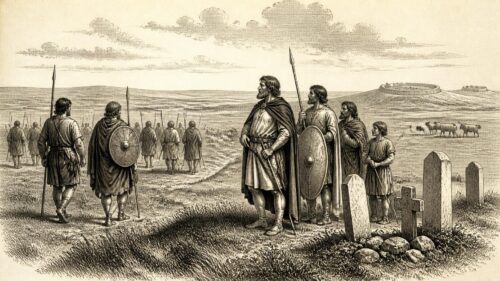
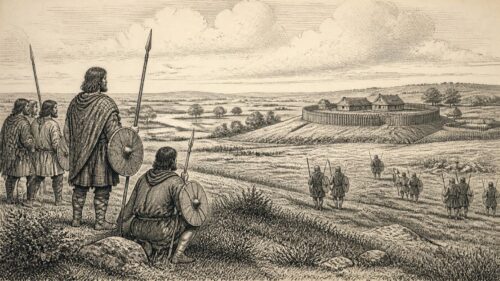
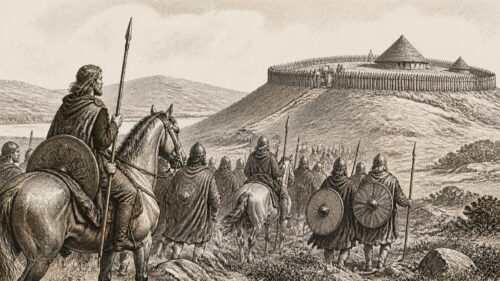
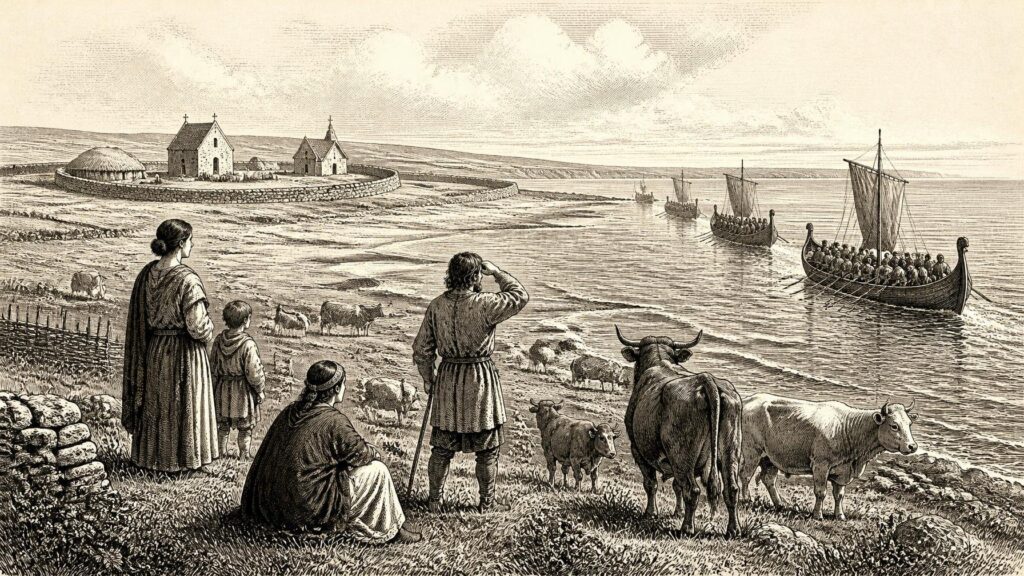
In June 684, King Ecgfrith of Northumbria sent an army under Berht to devastate Mag Breg, or Brega, a wealthy and politically important Irish kingdom. Irish annals and Bede record the destruction of churches; later tradition also reports plunder and captives. The raid struck settlements, ecclesiastical communities and agricultural resources, exposing the Irish Sea as a route for coercion as well as travel and exchange. Its precise motives, landing place, scale and course remain unknown. Contemporary records also note a mortality among children, while later accounts of famine, frost and captive returns cannot securely be assigned to 684.
Dateline
In 684 CE, a Northumbrian force crossed the Irish Sea and devastated Mag Breg, the rich plain of Brega in the eastern midlands. The expedition, sent by Ecgfrith, king of Northumbria, and led by his ealdorman Berht, is the year’s firmly dated Irish event. It was brief in the surviving record, but its targets make it unusually revealing: the raiders struck a politically central region and, according to both Irish and Northumbrian testimony, did not spare churches. For the communities of Brega, June brought not an abstract clash between distant kingdoms but the loss of movable wealth, damaged settlements, disrupted religious houses and the fear of captives being taken to sea.
A June Raid, Firmly Dated
The principal near-contemporary narrative comes from Bede, writing in Northumbria some decades later. He states plainly that in 684 Ecgfrith sent an army to Ireland under Berht. Bede condemns the attack as an assault on a people who had done the English no harm and had long been friendly to them. His moral judgement has its own purpose: he treats Ecgfrith’s death in Pictland on 20 May 685 as divine punishment for the Irish raid. Yet Bede’s indignation also preserves crucial evidence. The invasion was a royal Northumbrian operation, not a chance act of piracy, and churches and monasteries were among its victims.
The Irish annals independently fix the raid in June and identify its theatre more narrowly. The Annals of Ulster and Chronicon Scotorum record that “the Saxons” laid waste Mag Breg and many churches. Their relevant entries are conventionally numbered under 685, a reminder that annal headings and modern calendar years cannot always be treated as identical. Bede’s explicit dating to 684, together with the scholarly reconciliation of the sources, makes June 684 CE the responsible date for the attack. The later Annals of the Four Masters adds that territory and churches were devastated, that captives were carried off and that the force then returned to its ships. That fuller account is valuable, but its much later compilation means that its additional detail should be used cautiously rather than treated as an eyewitness report.
Why Brega Was a Prize
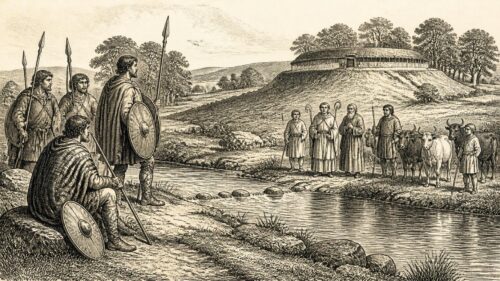
Mag Breg was no remote fringe. Brega extended broadly from the Irish Sea across much of present-day Dublin and Meath, between the Liffey and Boyne and, in places, northwards towards south Louth. It contained Tara, a place of immense ceremonial and dynastic importance, while its routes connected coast, rivers, royal sites and densely occupied agricultural land. Archaeological and landscape research depicts it as one of early medieval Ireland’s wealthy and politically powerful kingdoms. A seaborne army which struck there was reaching into the heart of southern Uí Néill power, not simply touching an exposed coastline.
The leading ruler associated with this political world was Fínsnechta Fledach of Síl nÁedo Sláine, whom later annalistic tradition styles king of Ireland. That title must not be imagined as the office of a unitary monarch commanding a modern state. Irish kingship rested on overlapping lordships, dynastic seniority, tribute, military followings and negotiated recognition. Still, Brega’s ruling kindred possessed a claim to island-wide pre-eminence, and an attack there carried a larger political message. It humiliated an important rival centre, endangered communities that sustained royal authority, and demonstrated that Northumbrian ships could project force across the sea.
What cannot be established is Ecgfrith’s immediate motive. Neither Bede nor the annals gives a reason for the expedition. It has variously been connected with Northumbria’s western ambitions, its relationships with British territories, maritime security and a wish to assert authority over the Irish Sea. Those are interpretations, not recorded causes. Nor do the sources identify Berht’s landing-place, the route followed inland, the individual churches attacked, the size of the force or any battle fought against it. The year’s evidence supports devastation, plunder and captives; it does not support an invented campaign narrative.
Churches in the Path of War
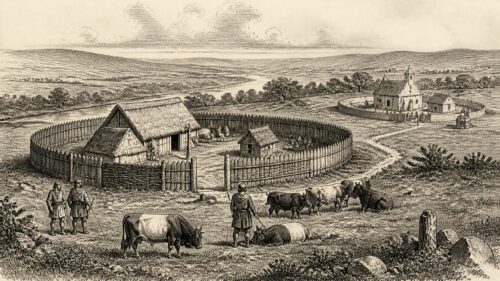
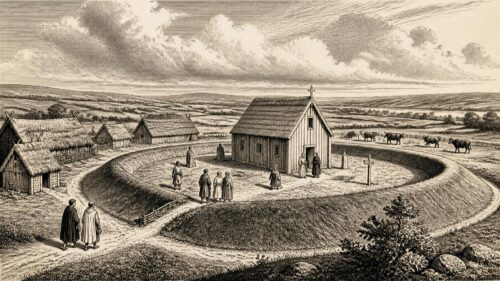
The specific notice that churches were ravaged matters. In seventh-century Ireland, ecclesiastical establishments were not isolated stone shrines inhabited only by clerics. Many were sizeable enclosed communities, with churches, burial grounds, dwellings, workshops, cultivated ground, livestock and dependent lay households. They held land and animals, received gifts, taught, copied texts and provided religious and social services. Such places were obvious repositories of portable goods, food and people, as well as symbols of elite patronage. To raid a church was therefore to strike both a sacred institution and a local economic centre.
Irish monastic life in this period was diverse rather than centrally administered. Major foundations possessed networks of associated churches and communities, but local rulers and kin-groups remained deeply involved in their support and leadership. Latin learning, scriptural study and the writing of Irish were flourishing in the seventh century, even though surviving manuscripts seldom allow us to attach a particular work to the year 684. The raid’s assault on churches therefore belongs in a wider world in which religious houses linked farming households, aristocratic families, artisans, travellers and scholars. Losses from a coastal invasion could travel far beyond the buildings physically burned or stripped.
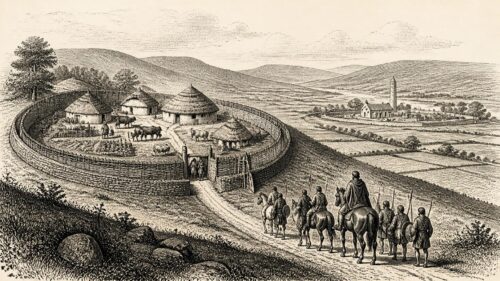
Nendrum in Strangford Lough offers a useful northern comparison for the character of an Irish ecclesiastical settlement, though it was not named as a target of Berht’s raid. It had multiple concentric enclosures, workshops, a church precinct and access to a maritime landscape; excavations have also demonstrated an early seventh-century tidal mill nearby. Annal notices of its clergy begin in the seventh century. Such evidence cautions against imagining “churches” in the annal as featureless points on a map. They were organised places in settled landscapes, and their vulnerability in 684 was inseparable from their material resources and social importance.
Households, Herds and Captivity
The lived effects of the raid can only be reconstructed in broad outline. Most people in Brega lived in dispersed rural settlements, commonly within or near ringforts and other enclosed farmsteads. Cattle were central to wealth, status, food supply, dairying and the payment of obligations; cereals were grown and processed with querns and drying facilities. A raiding force could inflict severe harm without occupying land: seize animals, grain, valuables and hostages; destroy stores; burn structures; and compel communities to divert labour from cultivation and repair to defence and recovery.
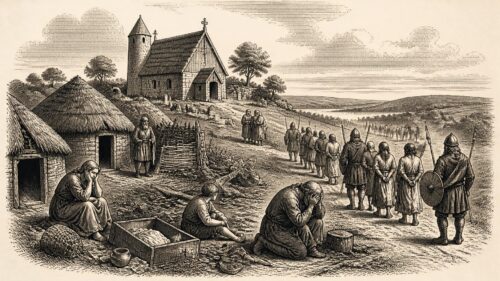
Captivity deserves particular emphasis. Bede does not enumerate captives, but the Four Masters says many were taken. Since enslavement and hostage-taking formed recognised, if brutal, parts of early medieval warfare, the report is plausible; yet its numbers and individual stories are unrecoverable. We should not assume that every captive was enslaved permanently, nor that all were nobles. Some may have been held for ransom or exchanged. What is certain is that the prospect of being carried aboard hostile ships made the Irish Sea not merely a channel of pilgrimage, learning and trade, but a route of coercion.
Illness and Uncertain Annal Years
Alongside the raid, the annalistic record preserves a sombre notice of a continuing “mortality of children”. The outbreak is placed as beginning in October 683 in the Annals of Ulster, Chronicon Scotorum and the Fragmentary Annals; the latter says it lasted three years and gives a dramatic claim about the death of young nobles. A following annal again records the mortality. It is reasonable to say that disease among children and young people was part of the immediate background to 684, but not responsible to diagnose it, calculate its death toll or present the later rhetorical language as demographic fact. The surviving notices reveal anxiety and loss, not a clinical description.
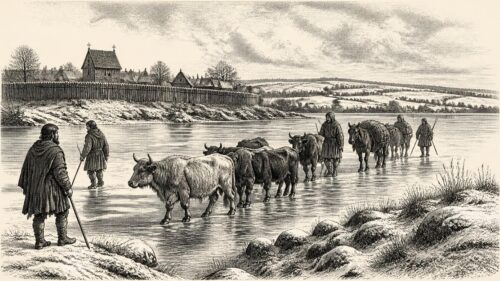
Other supposed events require still greater restraint. The Four Masters, under its entry for 684, describes a three-year mortality among animals and an exceptional frost that froze Irish waters and even the sea route to Scotland. It also places Adomnán’s mission to seek the return of captives in that year. These are striking traditions, but they are not securely corroborated as calendar-year 684 evidence by the earlier annalistic material. The securely recorded return of sixty captives by Adomnán belongs to a later annal entry, while his connection with the particular victims of Berht’s raid cannot be demonstrated from the contemporary record. These traditions illuminate how later Irish historical memory made sense of catastrophe and recovery; they should not be converted into certainties about 684 itself.
An Exposed Sea Road
Berht’s June descent is important precisely because it was exceptional rather than routine. Ireland and Northumbria were bound by travel, scholarship, monastic links and migration, yet those connections did not prevent royal violence. Bede’s language of an “innocent” and friendly people is rhetorical, but it confirms that the attack offended expectations of relations across the Irish Sea. The raid exposed Brega’s eastern coast and riverine approaches to a power able to mobilise ships and men at short notice.
No Irish counter-campaign, treaty or immediate settlement is securely recorded for 684. The evidence leaves a damaged landscape and a political insult, rather than a neat conclusion. In the following year Ecgfrith was killed fighting the Picts, and Bede deliberately joined that defeat to the moral consequences of Ireland. For Irish history, however, 684 stands on its own: a June invasion of Brega, remembered because it reached a central kingdom, violated churches and showed that the sea could bring a foreign army directly into the contested heartlands of Ireland.
Primary Sources
- The Annals of Ulster
- The Annals of Tigernach
- Annals of the Four Masters
- Fragmentary Annals of Ireland
- Annals of Inisfallen
- Chronicon Scotorum
- Bede, Ecclesiastical History of the English People, Book IV, Chapter 26
- The Northumbrian Attack on Brega in A.D. 684
- The Northumbrian Attack on Brega in A.D. 684 (JSTOR record)
- Ireland in the Seventh Century: A Tour
- The Origins and Rise of the Uí Néill
- Mapping Social, Ideological and Economic Transformations: Settlement and Landscape in the Early Medieval Kingdom of Brega, AD 400–1100
- Building on the Past: Brega and Lagore
- Early Medieval Ireland: Archaeological Excavations 1930–2009
- Early Christian Monasteries
- Churches and Ecclesiastical Enclosures
- Farming and Archaeology
- Early Medieval Farmsteads
- Nendrum Ecclesiastical Site
- Nendrum Monastic Site
- The Idea of the Three Orders of Society and Social Stratification in Early Medieval Ireland
- Irish
- The First English Invasion: Irish Responses to the Northumbrian Attack on Brega, 684
- Kingship, Violence and Loch Dá Gabor: Royal Landscapes and the Production of Authority in Early Medieval Brega