Tuaim Snáma’s Defeat678 CE
In 678, Fáelán Senchustul of Uí Cheinnselaig defeated Osraige, killing its king, Tuaim Snáma, and reportedly securing hostages that affirmed Osraige’s submission. The victory formed part of continuing pressure by Leinster’s southern dynasty on its neighbour. Colgú, king of Munster, also died, prompting a poorly documented royal transition. Annals record the deaths of bishops at Glendalough and Ferns, underlining the political and economic importance of church centres. Notices from western Scotland reflect continuing Irish Sea connections, though some are chronologically uncertain. No evidence records famine, plague or a nationwide crisis in Ireland that year.
Dateline
In 678 CE, the most consequential Irish event securely associated with the year was a victory by Uí Cheinnselaig over Osraige in which Tuaim Snáma, king of Osraige, died. The annals are terse, but a fuller annalistic tradition identifies the victor as Fáelán Senchustul of Uí Cheinnselaig and preserves a verse claiming that Osraige gave hostages ‘from Áth Buana to Comar’. This was not a clash between modern counties or nations. It was a contest between neighbouring dynasties in south-eastern Ireland, conducted through armed followings, negotiated submission and the transfer of persons whose custody guaranteed an agreement. The same annalistic year also records the death of Colgú son of Fáelbae Flann, king of Munster, and the deaths of important churchmen at Glendalough and Ferns. Together, these notices reveal a year of political turnover, local warfare and ecclesiastical continuity rather than a single island-wide crisis.
A King Falls in Osraige
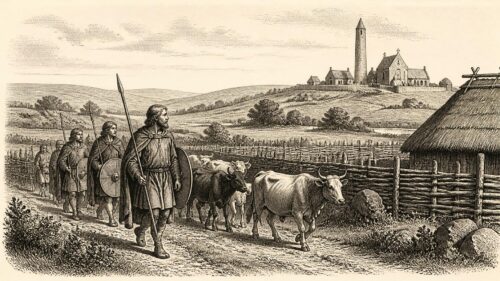
Osraige occupied a strategically important inland zone between Leinster and Munster, centred broadly on the valleys of the Nore, Barrow and Suir. Its rulers could not ignore either larger provincial neighbour. The notice of Tuaim Snáma’s death is therefore significant even though the surviving records do not name a battlefield with certainty or describe troop numbers, weapons or the season of the fighting. The Annals of Ulster simply state that Tuaim Snáma, king of Osraige, died. The Annals of Tigernach and the later Fragmentary Annals of Ireland make the political meaning clearer: he died at the hands of Fáelán Senchustul.
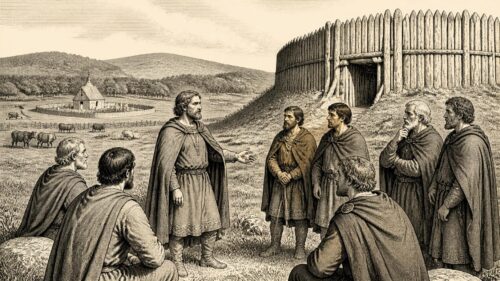
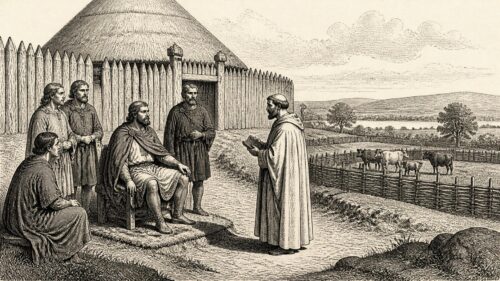
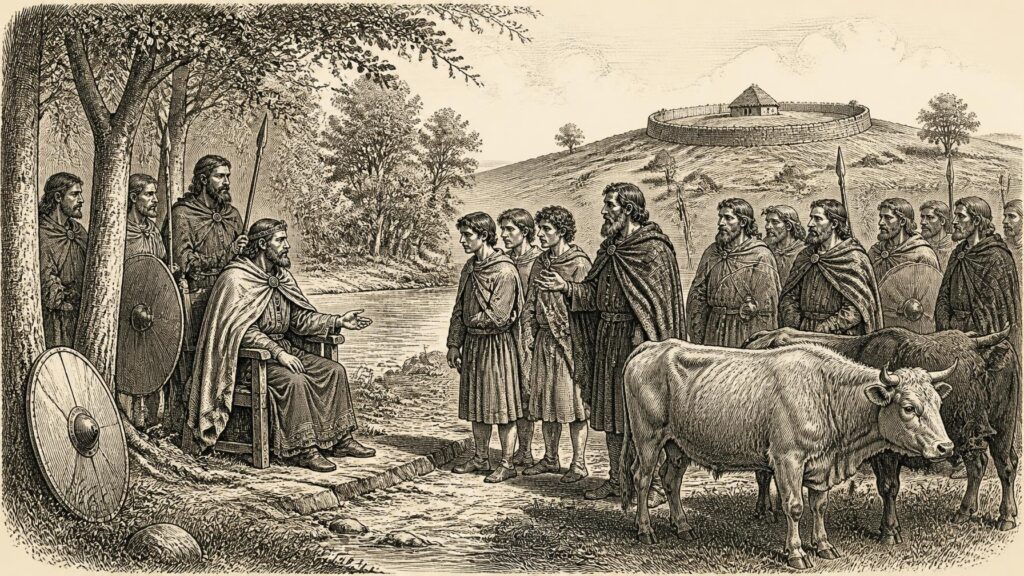
Fáelán belonged to Uí Cheinnselaig, the powerful Leinster dynasty based in the south-east. The preserved verse is especially valuable, not because every poetic flourish can be treated as literal reportage, but because it records the expected language of a settlement after victory. It says that Fáelán compelled a truce and received the hostages of Osraige over a substantial stretch of territory. In early medieval Irish politics, hostages were not an incidental spoil. They were a practical assurance that a defeated ruler or people would observe terms, and their delivery proclaimed a changed balance of power. Such arrangements could involve high-status kin or dependants; they bound households and dynasties as much as territories.
The episode also cautions against imagining kingship as fixed and impersonal. A kingdom was upheld by a ruler’s personal relationships, his kindred, clients, church alliances and military followers. The death of Tuaim Snáma could therefore unsettle more than a royal household. It opened a question of succession within Osraige and gave Uí Cheinnselaig an opportunity to influence its neighbour. A king-list preserved in the Book of Leinster, compiled centuries later but drawing on older tradition, says that Fáelán won seven battles against Osraige, the last being the battle in which Tuaim Snáma fell. That wider claim cannot securely date all seven encounters to 678, but it places the year’s fighting within a remembered pattern of pressure on Osraige rather than an isolated quarrel.
Munster’s Royal Transition
The annals also place the death of Colgú son of Fáelbae Flann, king of Munster, in 678. Colgú was an Eóganacht ruler, one of the competing dynastic branches through which the kingship of Munster was commonly held. His death did not mean that a single, centrally governed province changed hands in the modern sense. Munster contained numerous subject peoples and ambitious regional lineages; its king’s authority depended upon tribute, alliance, ceremonial precedence and the capacity to lead or threaten armed forces.
Colgú’s passing nonetheless mattered well beyond his immediate kin. It created an opening in the senior kingship of the south at the same time that Osraige was suffering defeat to the east. Later regnal tradition associates Finguine son of Cathal Cú-cen-máthair with the Munster kingship from this period, but the surviving annals do not offer a detailed, securely dated account of the accession process in 678 itself. It is best, therefore, to see this as a transition whose outcome is known more clearly than its mechanics. There is no responsible basis for inventing an inauguration at Cashel, a battle for the throne, or a particular settlement between Eóganacht branches.
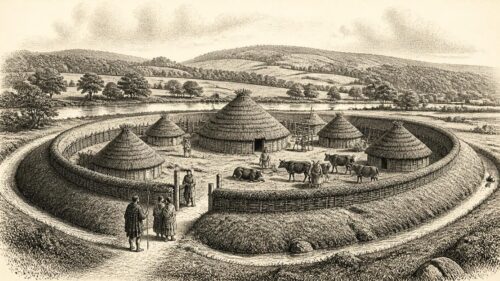
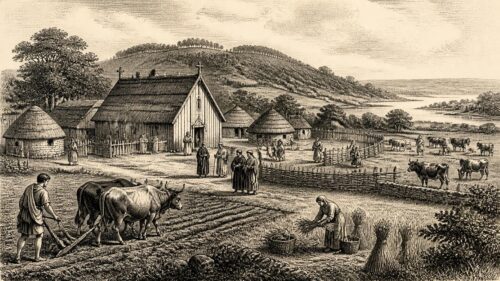
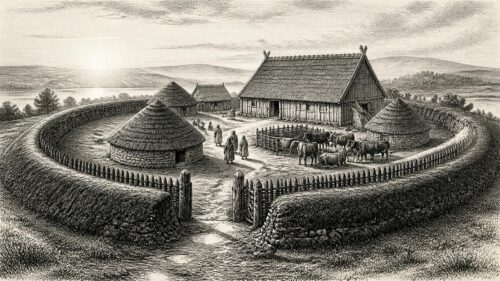
What can be said is that royal mortality and regional warfare were closely connected to everyday political economy. Kings rewarded followers, acquired cattle and food-renders, offered protection, imposed exactions and sought hostages. Cattle remained the principal measure of movable wealth and status across much of early medieval Ireland. Farming communities produced grain as well as livestock, while enclosed rural homesteads—often now known as ringforts—provided the dominant settlement setting. The inhabitants of such places were not passive spectators of dynastic competition: royal demands for food, labour, military service and hostages brought high politics into household life.
Churches at Glendalough and Ferns
Two ecclesiastical deaths recorded under the year give a different view of authority. Dairchell, bishop of Glenn Dá Locha—Glendalough—and Comán, bishop of Ferns, are named in the Annals of Ulster; the Annals of Tigernach additionally names Máel Dogar, bishop of Ferns. Differences of this kind are normal in annalistic transmission: records were copied, supplemented and rearranged over centuries. The broad point is firm. Two important Leinster church centres marked the loss of senior clergy in or closely around 678.
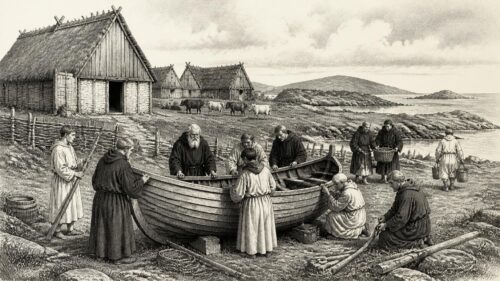
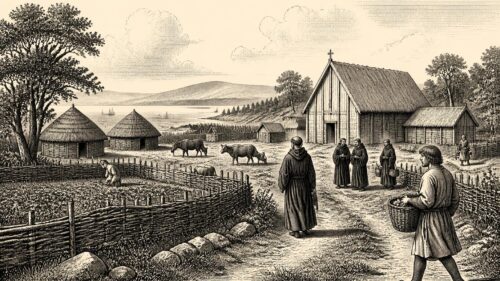
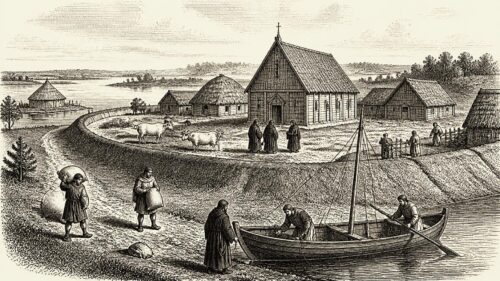
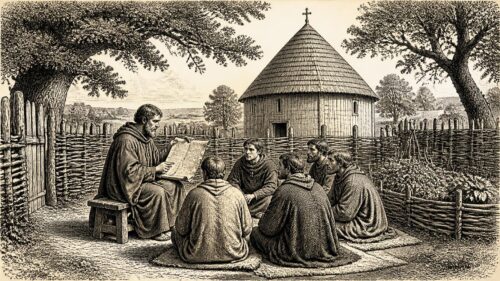
Glendalough, in its steep Wicklow valley, and Ferns, in the territory of Uí Cheinnselaig, were not merely places of prayer. Early Irish churches were communities of clergy, dependants, craftspeople, tenants and visitors. They held land, received gifts, offered burial and commemoration, preserved learning, and could be deeply involved in the political networks of kings and aristocrats. A bishop’s death thus concerned both a religious office and a local institution with economic and social weight.
It would be misleading, however, to picture either site in 678 through the stone towers and later medieval buildings familiar today. The surviving monumental landscape is the result of long development. In the late seventh century, church settlements were often organised around timber buildings, burial grounds, cultivated land and boundaries, with a mixture of materials and forms that rarely survive intact. Their literate culture was already substantial. Latin learning, biblical study, genealogical knowledge and Irish legal and poetic traditions circulated through clerical and secular networks, even if only a minority could read or write.
War Beyond the Island
The annals headed 678 do not confine themselves to Ireland. They record a slaughter of Cenél Loairn in Tíriu, identifying conflict between Ferchar Fota and Britons, and they mention a battle at Calatros in which Domnall Brecc was defeated. These notices belong to the Irish Sea world linking Ireland, Dál Riata in western Scotland, Pictish territories and British kingdoms. Sea crossings were routine for rulers, clerics and traders, while political shocks on one shore could affect kin and church networks on the other.
Yet this material must be handled carefully. The Calatros entry is chronologically troublesome: Domnall Brecc is otherwise associated with an earlier generation, and the annalistic record may preserve a displaced or confused notice. It should not be treated as firm evidence that he personally fought a battle in calendar year 678. The Cenél Loairn entry does more securely show that Irish chroniclers saw events across the channel as relevant to their own political horizon. Ireland in 678 was not isolated, but neither should every Scottish or British notice be turned into an Irish domestic event.
What the Silence Means
The surviving annals do not report a general famine, epidemic, major environmental disaster, nationwide assembly or foreign raid in Ireland for 678. That absence matters. The country had recently endured severe plague years in the 660s, but it is unsafe to claim that such mortality continued into this particular year without a record. Equally, no weather notice permits a reconstruction of the harvest of 678. The year’s evidence is political and institutional: a defeated king in Osraige, a dead king of Munster, episcopal vacancies in Leinster, and signs of continuing connection across the Irish Sea.
For ordinary people, the immediate consequences were likely uneven. Communities near the Osraige–Leinster frontier may have faced mustering, raiding, the movement of armed bands or the delivery of provisions. Families caught up in hostage arrangements bore a more direct human cost. Elsewhere, agricultural routines continued: cattle required herding, fields required cultivation, grain needed processing, and monasteries and royal households required supplies. The sparse record cannot give individual voices, but it does show the structures that shaped them. In 678, Ireland’s political map was made and remade not by a national government, but by the outcomes of struggles such as Fáelán’s victory over Tuaim Snáma and by the successions that followed death in royal and ecclesiastical houses.
Primary Sources
- The Annals of Ulster
- The Annals of Ulster, Year U678
- Fragmentary Annals of Ireland
- Fragmentary Annals of Ireland, Annals FA 68–77
- Fragmentary Annals of Ireland, Annals FA 81–100
- The Annals of Tigernach
- The Annals of Tigernach, Annals T676–T680
- Chronicon Scotorum
- Chronicon Scotorum, Annals CS674–CS678
- Chronicon Scotorum, Annals CS679–CS683
- Book of Leinster, Formerly Lebar na Núachongbála, Section 2
- Book of Leinster, Formerly Lebar na Núachongbála, Section 27
- Adomnán
- Early Mechanisms of Abbatial Succession: The Case of Iona (563–704)
- Agriculture, Settlement and Society in Early Medieval Ireland
- The Economy of Early Medieval Ireland
- Early Medieval Dwellings and Settlements in Ireland, AD 400–1100, Volume 1
- Settlement Patterns and Socio-Economic Change in the Diocese of Tuam c. AD 400–1000
- Early Medieval Ireland, AD 400–1100: The Evidence from Archaeological Excavations
- Exploring the Irish Annals
- CELT: Corpus of Electronic Texts, Irish Texts
- CELT: Frequently Asked Questions
- Law, Law-Books and Tradition in Early Medieval Ireland, Chapter 5