Bolgach and Bennchor680 CE
In 680, Irish annals record dynastic violence, ecclesiastical deaths, local conflict and a severe epidemic called bolgach. Fíanamail mac Máel Tuile, king of Leinster, was killed by Foidsechán of his household, apparently in connection with Fínnechta Fledach of Brega. Colmán, abbot of Bennchor (Bangor), and Máel Fothartaig, bishop of Ard Sratha, also died. Notices mention the siege of Dún Baite, a battle at Bodbgna and other killings. Bolgach may have been a blistering or smallpox-like disease, though its precise nature is uncertain. Irish annalists also noted Ælfwine’s death in northern Britain, reflecting cross-channel connections.
Dateline
In 680 CE, Ireland’s surviving annalistic record brings together a striking mixture of dynastic violence, ecclesiastical change and a grave outbreak of illness. The entries are brief, and the manuscripts that preserve them were written much later, so their calendar headings require care. This account follows modern chronological synchronisation rather than simply repeating the sometimes displaced year-numbers in individual annals. On that basis, several developments can responsibly be assigned to 680: the death of Colmán, abbot of Bennchor (Bangor); the killing of Fíanamail mac Máel Tuile, king of Leinster; deaths and fighting in several regions; and, most memorably, the report of a ‘most severe’ disease in Ireland called bolgach.
A Year Preserved in Short Notices
The Irish annals were not newspapers. They did not aim to describe every season, harvest, household or local quarrel. Their compilers selected matters thought worthy of memory: the deaths of kings, bishops and abbots; battles, raids and sieges; unusual natural phenomena; and epidemics. Silence therefore cannot mean that ordinary life stopped or that a place was unimportant. Equally, an entry naming a disease does not provide a death toll, a map of its spread or an account of treatment. The strength of the annals lies in their near-contemporary chronological framework; their limitation is their severe economy of words.
That restraint matters particularly in 680. The year’s notices show an island divided among many kingdoms and lordships, not a politically unified state. A ruler described as king of Leinster held a position of great standing, but his authority depended on alliances with powerful kindreds, control of tribute and hostages, military followings, and the recognition of churches and neighbouring rulers. The wider ‘kingship of Ireland’ claimed by Fínnechta Fledach of the Uí Néill was real as an ideal and could be forceful in practice, yet it did not abolish provincial and local competition. The events recorded in 680 reveal that political order remained negotiable and often violent.
Leinster’s Murdered King
The clearest political killing was that of Fíanamail mac Máel Tuile, identified as king of Leinster. Both the Annals of Ulster and the Annals of Tigernach report his death, while the latter adds a disturbing detail: Foidsechán, one of Fíanamail’s own household, killed him ‘for the sake of Fínnechta’. The wording is terse, but it strongly suggests that the murder belonged to a struggle extending beyond one personal feud. Fínnechta Fledach, ruler of Brega and claimant to the high-kingship, was an important figure in Irish politics. His name in the notice does not prove that he personally ordered the killing, and it would be unsafe to invent the circumstances. It does, however, indicate that Leinster’s royal politics were entangled with wider contests over influence.
For contemporaries, the killing of a king by a member of his own household would have carried implications far beyond one death. A royal household was a political institution: a place of protection, gift-giving, counsel, armed service and access to the ruler. Its betrayal threatened the reliability of personal bonds on which power rested. It also opened a question of succession. The surviving notices for 680 do not give a full narrative of who immediately secured Leinster or how rival groups responded. What can safely be said is that Fíanamail’s removal made the province more vulnerable to intervention by competitors, including those connected to Brega and the southern Uí Néill.
Bennchor Without Colmán
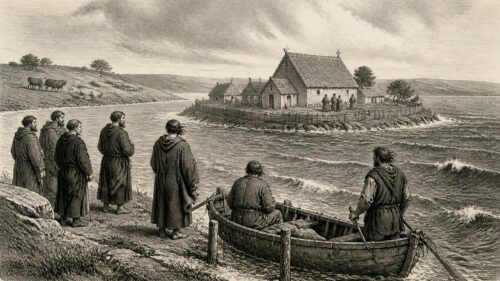
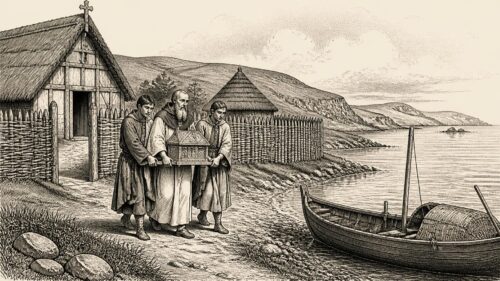
Another firm notice records the death of Colmán, abbot of Bennchor, now Bangor in County Down. His death was not merely a private clerical event. Bennchor was already one of the major ecclesiastical communities of the northern Irish world. A monastery was simultaneously a religious household, a centre of worship and learning, a landholder, and a node in networks of patronage and travel. Its abbot’s standing rested on spiritual authority but also on his capacity to direct people, resources and relationships with secular rulers.
Nothing in the 680 entry permits a detailed reconstruction of Colmán’s administration, his age, or the manner of his death. Nor should later fame be projected too easily backwards. Yet the recording of his death itself shows that the succession at Bennchor was considered significant enough for annalists to preserve. In an Ireland where monasteries could maintain estates, receive gifts, educate clerics and aristocrats, and provide prestigious burial and commemoration, an abbatial vacancy mattered to surrounding society. It invited the appointment or recognition of a successor, while leaving the community’s daily round of prayer, food production, hospitality and book work to continue.
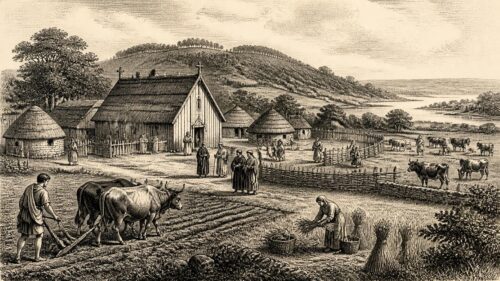
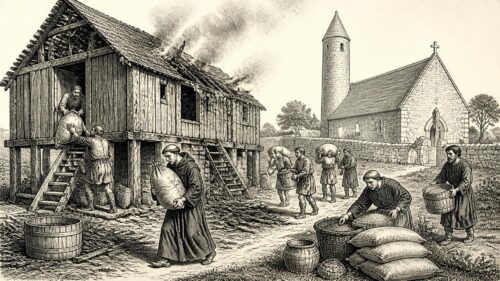
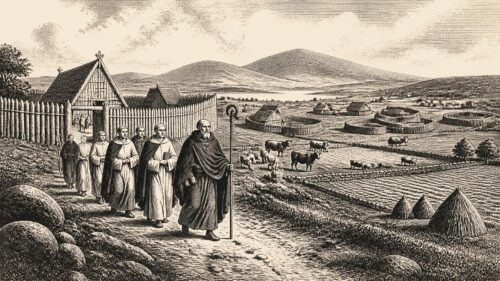
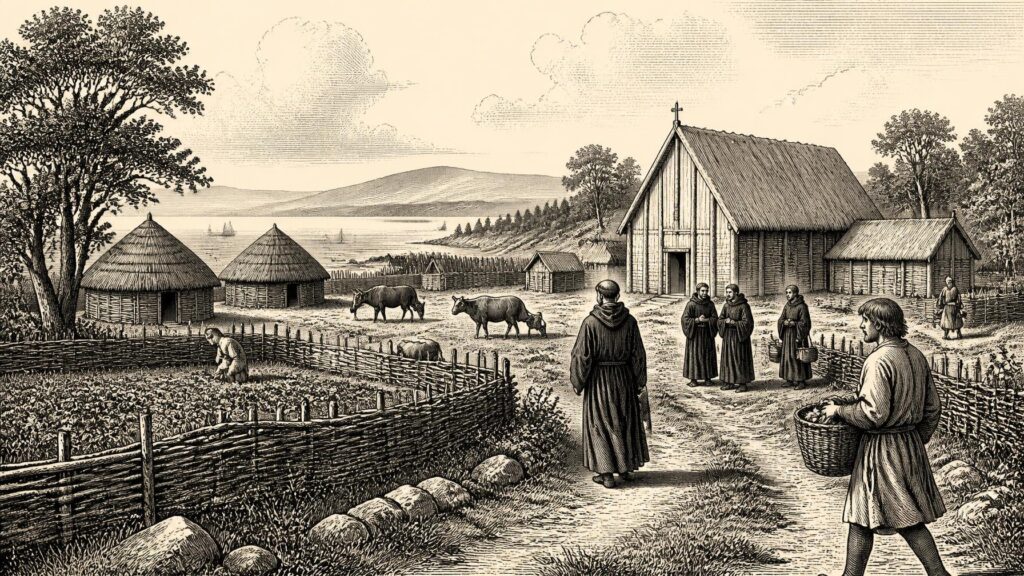
Monastic life was also embedded in a landscape of ordinary settlement. Most people in seventh-century Ireland lived in rural communities, tending cattle and growing crops, with enclosed farmsteads common in the archaeological record. Churches and monasteries did not float apart from this world. They depended upon provisions, labour, livestock, timber, metalwork and the movement of people along roads, rivers and coasts. The annals’ focus on kings and clerics should not obscure the farmers, craftspeople, tenants and dependants whose work sustained both royal households and religious establishments.
Conflict, Forts and Local Power
Other notices from 680 give glimpses of insecurity without enough detail to turn them into a continuous war story. The annals record a siege of Dún Baite, the killing of Dúnchad son of Eóganán, and a battle at Bodbgna in which Conall Oirgnech fell. The sites and participants are not all securely identifiable from the short entries, and no source supplies troop numbers, tactics or motives. These are precisely the cases in which modern readers should resist filling gaps with imagined campaigns.
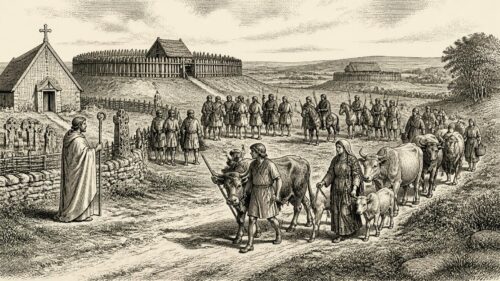
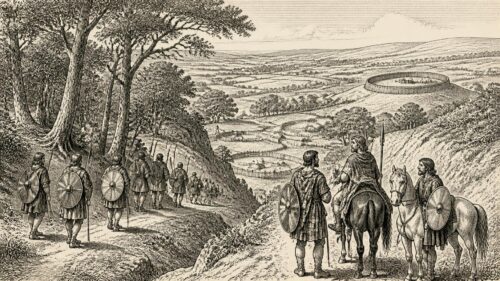
Nevertheless, the language is revealing. A dún was an enclosed stronghold or defended place, and the siege of Dún Baite shows that control of such sites could be contested. Fortified residences and settlement enclosures served practical as well as symbolic purposes: they concentrated people, animals, stores and authority. An attack on one could threaten a local ruler’s standing and his access to resources. Likewise, the death of Conall Oirgnech at Bodbgna is evidence of a conflict important enough to enter the historical record, but not proof of a national confrontation. Ireland’s politics operated through overlapping scales: household, kindred, local kingdom, province and the wider aspirations of powerful dynasties.
The annals also note the death of Máel Fothartaig, bishop of Ard Sratha, modern Ardstraw in the north-west. This is a reminder that ecclesiastical leadership was dispersed across Ireland rather than concentrated in one administrative hierarchy. Bishops, abbots and other churchmen held different forms of authority, often linked to particular churches, saintly traditions and local kin groups. Their deaths, like Colmán’s at Bennchor, marked transitions in institutions that could influence regional politics, landholding and learned culture.
The Meaning of Bolgach
The most unsettling entry calls the outbreak a very severe lepra, named bolgach in Irish. Medieval Latin and vernacular disease terms do not correspond neatly to modern clinical categories. It would therefore be wrong to state that Ireland suffered confirmed Hansen’s disease, or to give a precise diagnosis from a one-line report. Scholars have suggested that bolgach, a word associated with blistering or pustules, may have denoted a smallpox-like illness; that remains a cautious interpretation, not a certainty. The annalist’s strongest claim is severity, not medical precision.
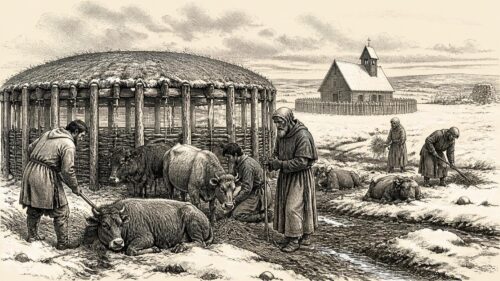
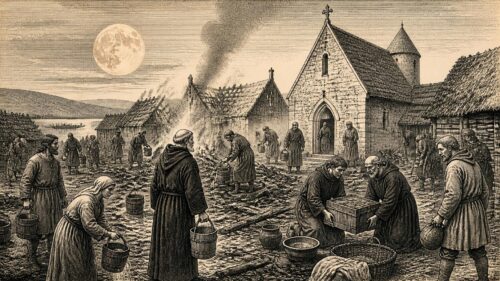
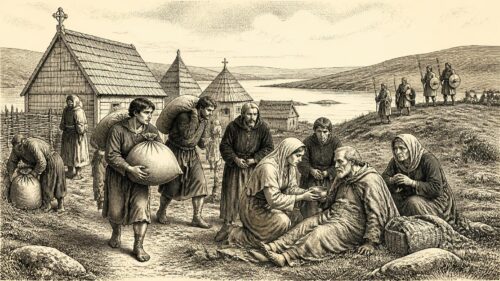
The outbreak deserves emphasis because illness could reach into every part of society. A widespread infectious disease might remove workers during crucial agricultural tasks, burden households caring for the sick, interrupt travel, weaken military retinues and complicate the routines of monasteries. But these are possibilities arising from the nature of an epidemic, not documented consequences for 680. No contemporary Irish source tells us which districts were worst affected, whether Bennchor or Leinster suffered directly, or how long the disease lasted. The responsible conclusion is narrower: the annals judged bolgach exceptional enough to be remembered among the year’s political and ecclesiastical losses.
An Irish Sea Horizon
One further notice records a ‘battle of the Saxons’ in which Ælfwine, son of Oswiu, fell. The event took place in northern Britain, not Ireland, but its appearance in an Irish annal is significant. Ireland’s learned communities watched affairs across the Irish Sea and in northern Britain, where religious, dynastic and maritime connections linked Gaelic-speaking and Brittonic- and English-speaking societies. The record does not demonstrate Irish participation in the battle. Rather, it shows the geographical horizon of the annalists who preserved Ireland’s history: their world included neighbouring shores and rulers as well as local Irish churches and kingdoms.
Thus 680 was not a year of a single decisive Irish battle or settlement. Its surviving record instead captures a political assassination in Leinster, a consequential abbatial death at Bennchor, scattered conflict and siege, the death of a northern bishop, and an alarming disease remembered as bolgach. Taken together, these notices show a society sustained by local production and powerful institutions, but exposed to the fragility of succession, loyalty, health and force. The gaps in the evidence are real. So too is the picture that remains: an interconnected early medieval Ireland in which a king’s murder, an abbot’s death and an epidemic could each become matters for permanent record.
Primary Sources
- The Annals of Ulster
- TEI Header for The Annals of Ulster
- The Annals of Tigernach
- Annals of Tigernach: Background Details and Bibliographic Information
- Chronological Synchronisation of the Irish Annals, AD 488–722
- The Chronology and Sources of the Early Irish Annals
- Exploring the Irish Annals
- From blefed to scamach: Pestilence in Early Medieval Ireland
- Disease and Illness in Medieval Ireland
- Facing Infectious Disease in Early Medieval Ireland
- The Monastery at Bangor
- Introduction: Building on the Past
- Archaeology and Cultural Heritage, Chapter 25
- Latharna: Landscape, History and Archaeology in Early Medieval Antrim
- Annals of the Four Masters
- Annals of Inisfallen
- Fragmentary Annals of Ireland
- The Metrical Dindshenchas: Rath Mór of Mag Line
- History of the Irish State to 1014
- Fínnechtae Fledach mac Dúnchada: High-King of Ireland