Four Calves657 CE
In 657, later tradition dated the joint rule of Diarmait and Blathmac of Síl nÁedo Sláine, kings of Tara, though their claimed sovereignty represented precedence among competing regional rulers rather than unified government. The Annals of Ulster records several deaths, including that of Guret, king of Alt Clut, reflecting Ireland’s links across the Irish Sea. Obituaries also indicate the importance of ecclesiastical communities within secular society. A violent windstorm and the reported birth of four calves to a cow at Láthair Briúin show how weather and livestock mattered in rural life.
Dateline
In 657 CE, Ireland’s surviving annalistic record preserves a year of transition, deaths and unsettling signs rather than a single decisive campaign. A later annalistic tradition places the opening of the joint rule of Diarmait and Blathmac, sons of Áed Sláine, in this year. The Annals of Ulster, whose internal year-numbering is offset at this point, explicitly labels its entry U658 as AD 657: it records several deaths, the death of Guret, king of Alt Clut on the Clyde, a violent windstorm, and an extraordinary cow at Láthair Briúin said to have borne four calves. The notices are brief, but together they illuminate the political, ecclesiastical and agricultural world of seventh-century Ireland.
A Date That Requires Care
The evidence for 657 must be read with unusual chronological caution. Under its annal-number U658, the Annals of Ulster gives “AD 657” in its calendrical heading. The same calendar year is styled M657 in the much later Annals of the Four Masters, compiled in the seventeenth century from earlier materials. That work calls 657 the first year of Diarmait and Blathmac “in the sovereignty of Ireland”. Its statement has long shaped regnal lists, but it should not be mistaken for a contemporary coronation record. Early Irish annals were copied, adjusted and synchronised over centuries; their year-headings can differ even when they preserve related information.
It is therefore safest to say that 657 was understood in later Irish historical tradition as the beginning of the brothers’ shared supremacy, while the broader political reality was more complicated. Diarmait and Blathmac belonged to Síl nÁedo Sláine, a leading southern branch of the Uí Néill. Their father Áed Sláine had been killed in 604. Their kindred was rooted in Brega, the fertile region around the Boyne and lower Blackwater, and possessed a powerful interest in the symbolic landscape of Tara. Yet “sovereignty of Ireland” did not mean government of a united state. It expressed an exceptional claim to precedence among many kings, negotiated through military capacity, alliances, tribute, hostages, clientship and control of prestigious churches.
Diarmait and Blathmac
The accession notice matters because it marks the renewed prominence of this Brega dynasty after years in which northern Uí Néill rulers and other rivals had held, or were later credited with holding, authority at Tara. Modern scholarship accepts that Diarmait and Blathmac were kings of Tara in the mid seventh century, but is more guarded about the precise mechanics of their supposed joint reign. Later king-lists readily represent pairs of rulers; the surviving evidence does not allow us to reconstruct whether the brothers divided territories, alternated in prominence, or simply exercised power as members of the same dominant family.
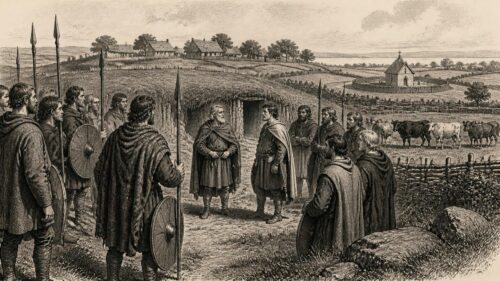
Their position was not secure merely because an annalist supplied them with a grand title. A major victory won by Diarmait at Carn Conaill in Connacht in 649 lay only a few years in the past, demonstrating that the family could project force far beyond Brega. But it also reveals the limits of retrospective labels such as “high king”. Irish politics remained regional and personal. Connacht, Leinster, Munster, Ulster and the north Midlands contained powerful dynasties with their own ambitions, while branches of the Uí Néill themselves competed fiercely. In 657, the brothers’ authority rested on an active web of followers rather than an impersonal royal administration.
The annals do not assign a battle in Ireland specifically to AD 657. That silence is important. It gives no warrant for inventing a campaign, assembly at Tara or formal settlement between competing provinces. The year instead appears as the opening point of a reign remembered chiefly because later developments gave it significance: the brothers would die during the great mortality of 664–665, and Síl nÁedo Sláine would remain central to the succession struggles of the later seventh century.
Deaths and Ecclesiastical Standing
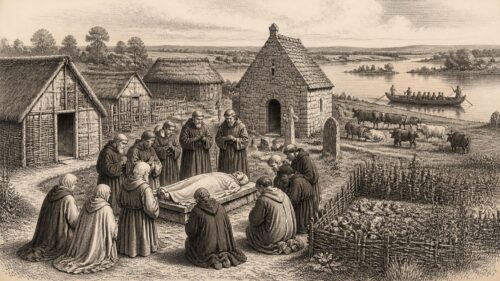
The deaths recorded for the calendar year are more immediate. The Annals of Ulster names Cellach son of Máel Cobo; Cellach son of Sárán, or Rónán; Fiachra Telnán; Blathmac son of Rónán son of Colum; and Tómán son of Taithéne. The names largely stand without explanation, a reminder that annals often preserve the passing of people whose former importance was obvious to their first audience but is now difficult to recover. A short verse attached to Cellach son of Sárán contrasts the place of his birth with the place of his death. Even in an obituary list, the compiler found room for commemoration and literary form.
The Annals of the Four Masters identifies a Cellach son of Sárán as abbot of Othan Mór, and also records the deaths of Mochua son of Lónán and Dúnchad son of Áed Sláine. These details should be used cautiously: the compilation is late, and its assignment of names and dates does not always coincide neatly with earlier annalistic witnesses. Nonetheless, its notice reflects a genuine feature of the age. Abbots, bishops and holy men were not peripheral figures. Religious communities held land, livestock, labour and learned authority; their leaders could be remembered alongside kings and war-leaders.
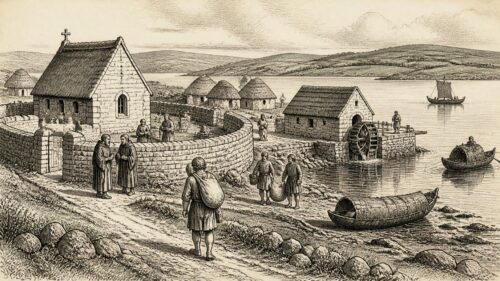
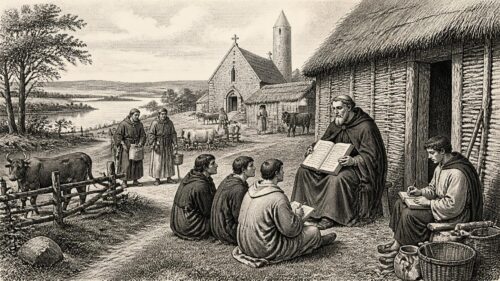
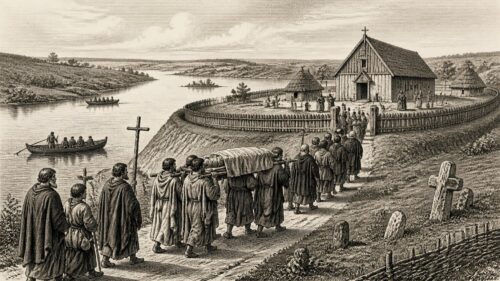
Church organisation in Ireland was not arranged simply as a modern map of dioceses. Networks associated with saints, churches and monasteries connected local communities to larger religious families. Such institutions offered worship, burial, hospitality, education and the copying or transmission of texts. They also mattered in politics, because a king’s standing could be reinforced through protection of a church, patronage of clerics, and association with a saintly founder. The obituary notices of 657 are thus evidence of an ecclesiastical landscape embedded in secular society, not separate from it.
An Irish Sea Horizon
The death of Guret, king of Alt Clut, belongs in an Irish account of 657 because the Irish Sea was a zone of regular movement rather than a hard frontier. Alt Clut, later Dumbarton, was the stronghold of the Britons of Strathclyde on the Clyde rock. Its rulers dealt with neighbouring Picts, Northumbrians, Gaelic-speaking Dál Riata and communities linked to Ireland by sea routes. The Ulster annalist’s decision to note Guret’s death shows that political change in western Britain could be considered relevant to an Irish chronicle.
This does not prove that Diarmait and Blathmac intervened in Alt Clut in 657; no source says that they did. It does show the geographical range of learned attention. Clerics, travellers and kin groups crossed the sea, and Columban connections joined Irish and Scottish churches. News of rulers and conflicts travelled along those same routes. Ireland’s political world was local in its everyday foundations but not isolated.
Wind, Cattle and Rural Life
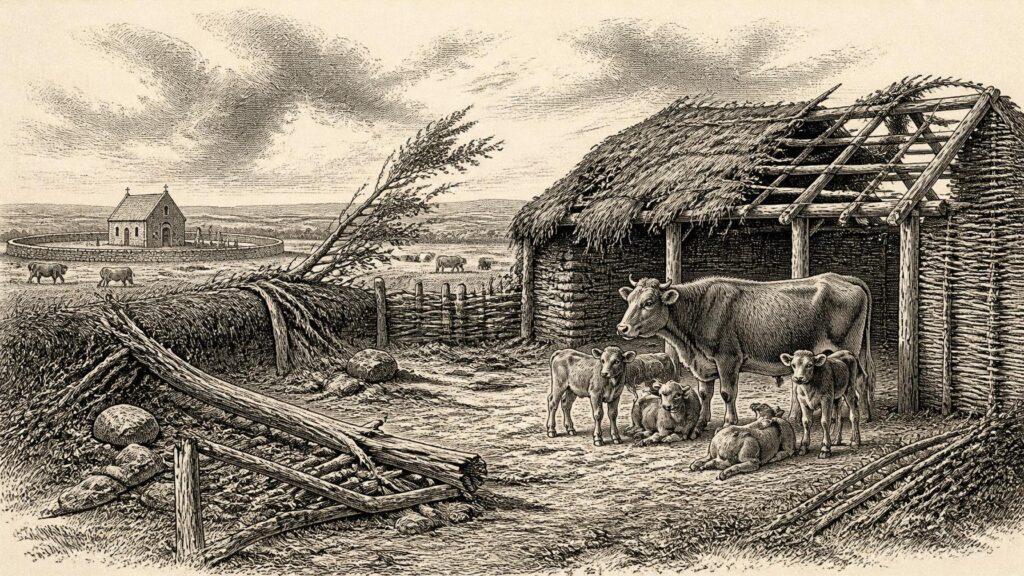
The entry “a violent windstorm” is stark, with neither place nor consequence supplied. It cannot responsibly be turned into a national disaster. Yet its inclusion indicates that severe weather was memorable enough to enter a chronicle otherwise dominated by deaths and rulers. For households living in timber-and-wattle buildings, with crops, fodder, boats, fences and livestock exposed to the weather, a destructive storm could have immediate consequences. The annal offers no measure of damage, however, and no claim about famine or widespread loss can be attached to it.
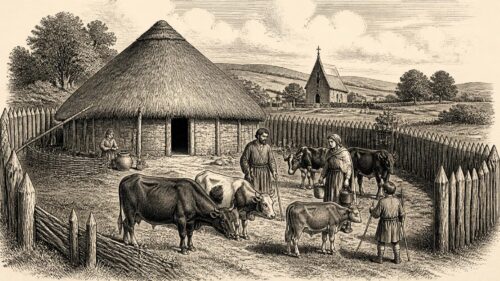
The report from Láthair Briúin of a cow giving birth to four calves is still more revealing of what observers considered worth recording. It was an agricultural marvel, not a routine husbandry note. Cattle were central to early medieval Irish wealth, food supply, dairying, tribute and social rank. A remarkable birth could invite wonder because it concerned an animal of unusual economic and cultural value. The entry does not demonstrate prosperity, breeding practice or a miracle officially recognised by the church. Rather, it preserves a moment when the extraordinary intruded into the rhythms of cattle-keeping.
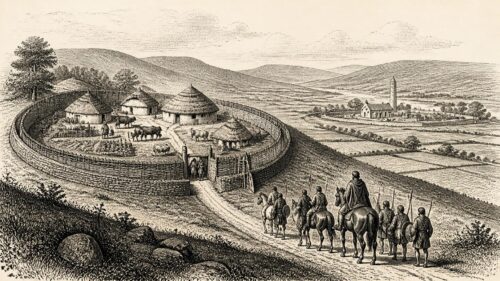
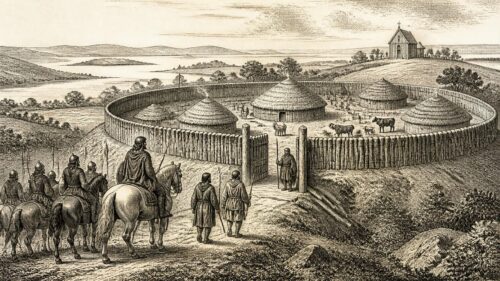
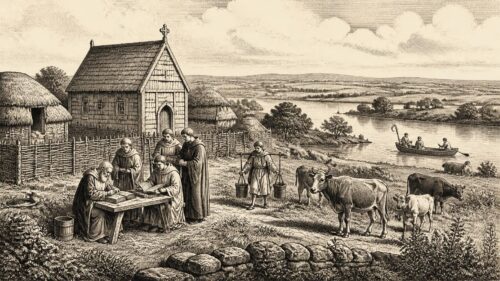
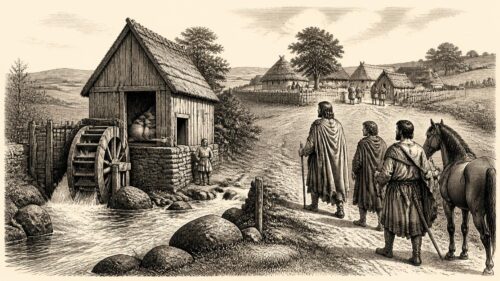
Most people in 657 lived in rural settlements: enclosed farmsteads, smaller habitations and settlements associated with churches. Archaeology and early legal material point to an economy in which cattle were especially important, alongside cultivation of cereals and the management of woodland, pasture and water resources. Labour was structured by rank and dependency. Kings and churches drew support from client communities, while farmers and households faced seasonal demands of ploughing, sowing, harvesting, grazing, dairying and food preservation. The four-calf notice therefore belongs to a world in which animal health and reproduction could be matters of deep practical concern.
A Sparse but Valuable Year
657 is not a year from which a full national narrative can be recovered. Its surviving notices are terse, and some of the most familiar claims about it rest on later compilations and retrospective regnal schemes. But that very sparseness is instructive. The year brings into view a Brega dynasty asserting high status, clerical deaths recorded across several communities, continuing Irish Sea awareness, a storm, and a memorable occurrence in cattle husbandry. These fragments show how early medieval Ireland was experienced: through kinship and kingship, churches and learned memory, weather and livestock, and connections extending beyond the island’s shores.

Primary Sources
- The Annals of Ulster, Year U658
- The Annals of Ulster, Year U657
- The Annals of Ulster: Background Details and Bibliographic Information
- Annals of the Four Masters, Annal M657
- Annals of the Four Masters: Background Details and Bibliographic Information
- Annals of Inisfallen, Part 21
- Annals of Inisfallen
- The Annals of Tigernach: Background Details and Bibliographic Information
- Annals of Tigernach
- Chronicon Scotorum: Background Details and Bibliographic Information
- Chronicon Scotorum
- Fragmentary Annals of Ireland, Part 2
- Blathmac
- Diarmait
- Ireland in the Seventh Century: A Tour
- Agriculture, Settlement and Society in Early Medieval Ireland
- The Economy of Early Medieval Ireland
- Early Medieval Dwellings and Settlements in Ireland, AD 400–1100
- Early Medieval Ireland, AD 400–1100: The Evidence from Archaeological Excavations
- Early Christian Irish Monasteries
- Tírechán’s Motives in Compiling the Collectanea: An Alternative Interpretation
- Baile Chuinn Chétchathaig: Manuscripts and Editions
- Forts and Fields: A Study of ‘Monastic Towns’ in Seventh and Eighth Century Ireland
- Early Medieval Archaeology Project