Episcopal Deaths658 CE
In 658, Irish annals chiefly record the deaths of bishops Díma Dub of Connor and Cuiméne of Nendrum, with the later Four Masters also naming Sillán of Daiminis. These notices show the importance of church settlements as religious, economic and political centres linked to regional patrons. The Four Masters places the year during the prominence of Diarmait and Blathmac of Síl nÁedo Sláine, while also recording dynastic deaths and the reported killing of Faelán of Osraige by Leinstermen. Despite uncertain dating in some sources, the evidence depicts rural communities sustained by farming, cattle, waterways, churches and local lordship.
Dateline
In 658 CE, the most securely attested Irish developments were not a single great battle or royal assembly, but a cluster of deaths that reveal how closely political authority, ecclesiastical institutions and regional society were intertwined. The annals record the deaths of Díma Dub, bishop of Condaire or Connor, and Cuiméne, bishop of Nendrum in Strangford Lough. The Annals of the Four Masters, compiled much later but drawing on older annalistic material, also place in this year the death of Sillán, bishop of Daiminis, probably Devenish in Lough Erne, on 17 May. Its same entry calls 658 the second year of the joint rule of Diarmait and Blathmac, sons of Áed Sláine. These notices are brief, but they illuminate an Ireland in which islands, lakeshores and rural churches were centres of leadership, learning and production as well as worship.
Dating a Sparse Year
Early Irish annals must be read with care. Their surviving manuscripts are later than the events they describe, and their chronological systems do not always agree exactly. The Annals of Ulster place the deaths of Díma Dub and Cuiméne in an entry corresponding to AD 658, while the Annals of Inisfallen puts Díma Dub’s death in its 657 entry. Such variation does not make the men imaginary; rather, it warns against treating every annal-heading as a modern, independently verified date. For this year, the coincidence of the Ulster and Four Masters traditions makes the deaths of the bishops of Connor and Nendrum the firmest focus. Sillán’s precise day, 17 May, is preserved only in the later Four Masters account and should therefore be treated more cautiously than the broader record of episcopal change.
The year’s obituary-like character is itself revealing. Annals were selective records, organised around rulers, churchmen, warfare, unusual weather and calamity. They do not tell us that ordinary life stopped when a bishop died. They do show which losses later record-keepers believed mattered. The passing of several bishops in northern and north-western Ireland was noteworthy because a bishop was not merely a local celebrant of rites. Episcopal status could confer prestige, connect a community to networks of learning and pilgrimage, and strengthen the claims of its church and its patrons within a competitive landscape of small kingdoms.
Diarmait and Blathmac
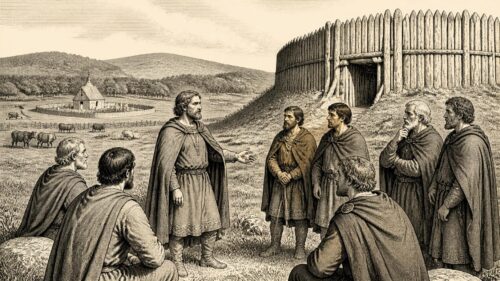
The political framework supplied by the Four Masters is the second year of Diarmait and Blathmac. They belonged to Síl nÁedo Sláine, the powerful southern Uí Néill lineage rooted in Brega, the rich region around the lower Boyne and the central eastern midlands. Later king-lists presented the brothers as joint rulers of Tara and, by extension, as high kings of Ireland. That language should not be mistaken for control of a unified state. Seventh-century Ireland comprised many kingdoms, each governed through kinship, clientship, tribute, fosterage and force. A ruler associated with Tara could claim exceptional precedence, but that claim had to be continually made effective in dealings with provincial kings, rival Uí Néill branches and major churches.
Even the brothers’ joint kingship is not beyond question. The annalistic tradition preserves uncertainty over succession after the death of Domnall mac Áedo in 642, and modern historians have warned that later regnal schemes may have made an untidy political reality appear more orderly. Still, by 658 Diarmait and Blathmac were unmistakably prominent figures in the midlands. Their dynasty had expanded its influence during the middle decades of the century, while its Brega heartland offered access to the Boyne corridor, the Irish Sea coast and routes towards Tara, Mide and Leinster. In practical terms, their authority depended less on a capital administration than on the loyalty of kindreds and the movement of people, cattle, food-render and hostages.
The Four Masters also records the death of Eochaid, a son of Blathmac, and of Ailill, son of Dúnchad, another member of the wider Síl nÁedo Sláine family. Other annalistic traditions place comparable dynastic deaths differently, so it is prudent not to construct a precise succession crisis from the 658 entry alone. Yet the notice does underline a basic fact of early medieval politics: a ruling kindred’s strength rested on a large pool of adult males, and the loss of princes mattered. Dynastic competition was often conducted within families as well as against outsiders, a vulnerability that would become more apparent in the years following 658.
Churches of Lough and Island
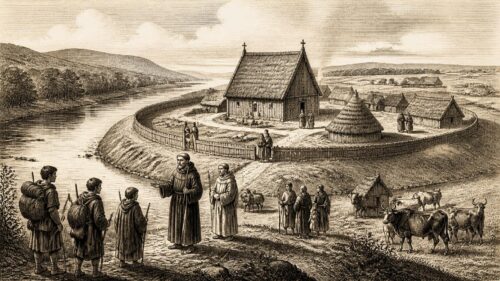
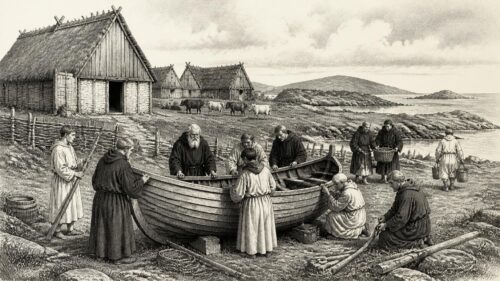
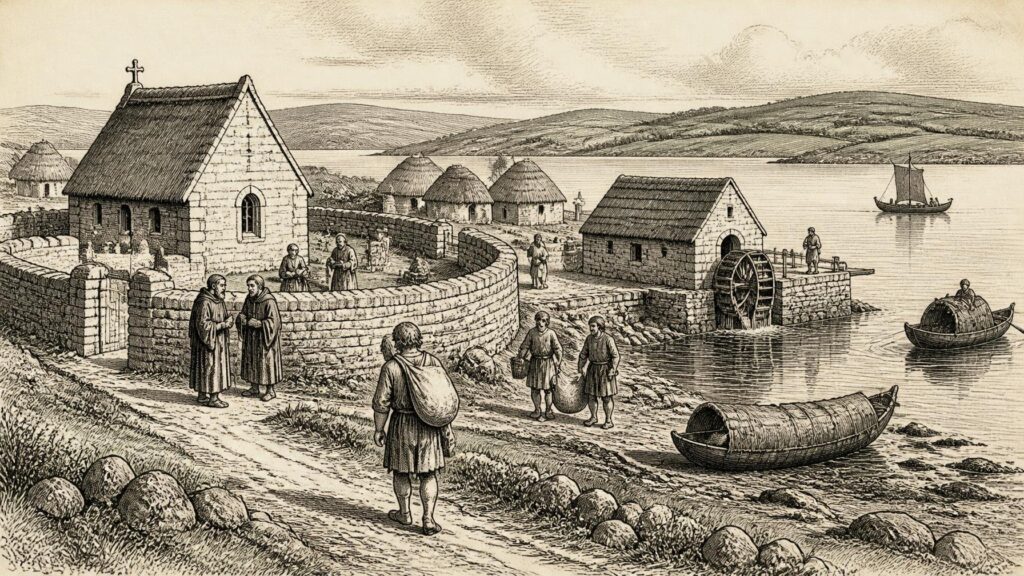
Cuiméne’s death directs attention to Nendrum, on Mahee Island in Strangford Lough. This was not an isolated retreat in the modern sense. Its position amid sheltered water gave it connections by boat to the Ards peninsula, the shores of County Down and the sea routes of the northern Irish Sea. Archaeology confirms Nendrum’s early importance: the site has multiple stone enclosures, and a sophisticated tide mill nearby was operating in the early seventh century. The mill demonstrates organised labour, technical knowledge and a community able to manage a productive waterside landscape. Cuiméne’s title as bishop signals that Nendrum was an ecclesiastical centre of real standing by 658.
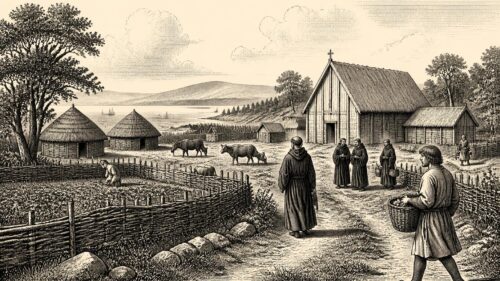
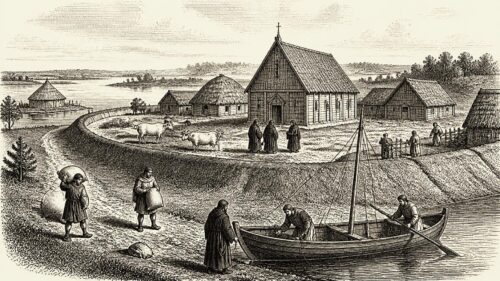
It would be misleading, however, to picture Nendrum as a later medieval monastery governed by a fixed rule and enclosed behind a single institutional boundary. Irish churches of this period varied greatly in size and organisation. A church settlement might include clerics, students, tenants, craftworkers, dependants and visiting lay people, with religious and secular authority overlapping. Bishops were important, but they did not necessarily preside over territorially defined dioceses like those of the modern church. Nendrum’s bishop belonged to a dense ecclesiastical world in which communities competed for land, patronage, relics, scholarly reputation and privileged access to kings.
Díma Dub’s association with Connor similarly points to the importance of church sites in what is now County Antrim. Connor lay within the northern political world of Ulaid and the neighbouring peoples of Dál nAraide. Although the surviving evidence cannot reconstruct the bishop’s daily work, his commemoration shows that Connor was recognised as a place whose leadership deserved record. The deaths of bishops at Connor and Nendrum in the same annal-year should not be taken as proof of a wider epidemic: the sources do not say this. They do, instead, provide a rare glimpse of institutional continuity being tested through succession. Each community would have needed to select or secure a successor, preserve its landed and ritual rights, and maintain ties with powerful lay patrons.
The possible death of Sillán of Daiminis broadens the geographical picture westward to Lough Erne. Whether or not the exact 17 May date can be accepted without reservation, the tradition associates 658 with another island church. Lakes and sea-lochs were not barriers. They were working landscapes: routes for boats, fishing grounds, boundaries, places of refuge and channels through which food, people and news travelled. Churches established on islands could draw authority from a measure of seclusion while remaining deeply involved in the economies and politics of their surrounding territories.
Osraige and Leinster
A more openly violent notice appears in the Four Masters: Faelán, described as chief of Osraige, was slain by the Leinstermen. This entry survives in a late compilation and is not corroborated in the same form by every annalistic witness, so its year-assignment must be stated with caution. If correctly placed, it records a conflict on the frontier between Osraige, centred broadly on the Barrow and Nore valleys, and Leinster to its east. Osraige was a strategically placed kingdom between Leinster and Munster; its rulers had to negotiate pressures from both. The killing of a chief by Leinstermen therefore fits the wider political geography, even though the annal gives neither battlefield nor cause.
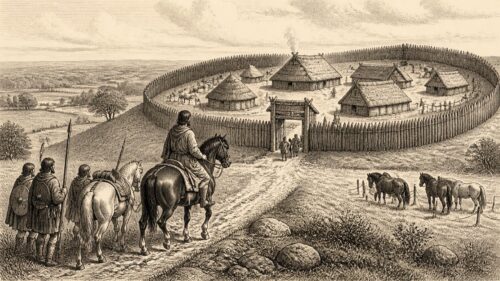
Such terse notices should not be embellished into campaigns for which there is no evidence. They nevertheless remind us that peace at the level of a prominent Brega dynasty did not mean peace across Ireland. Raiding, cattle seizure, retaliatory killing and contests over subordinate territories were ordinary risks in a society where wealth and honour were inseparable from lordship. Warfare was usually local and seasonal rather than a continuous national struggle, but it could bring profound disruption to households: the loss of livestock, the taking of captives, the destruction of stores and the insecurity of travel.
Work, Food and Exchange
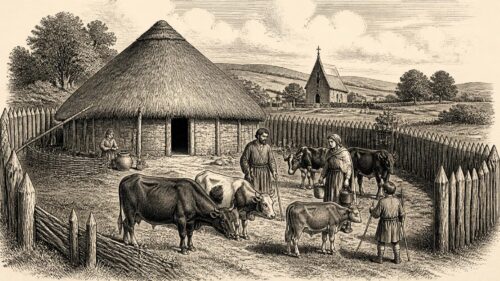
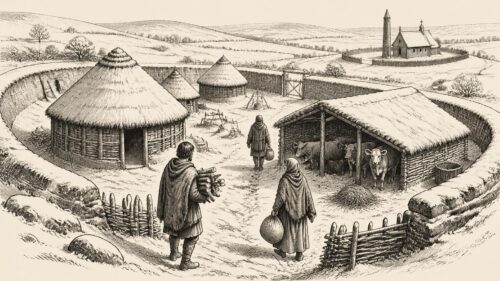
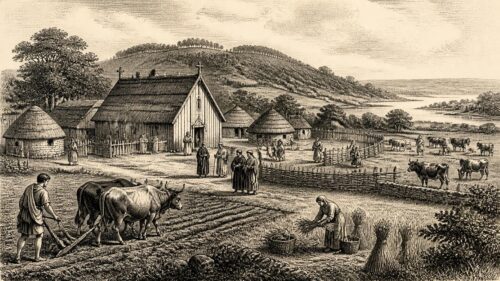
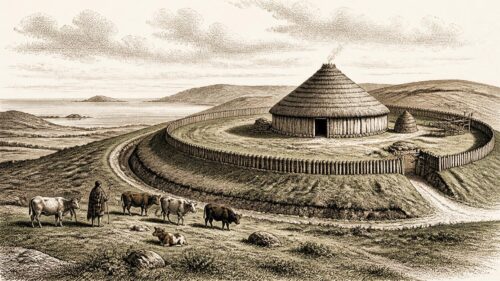
For most people, 658 was shaped above all by agricultural labour. Archaeological and environmental research for the seventh century indicates a thoroughly rural island of dispersed farmsteads, enclosed settlements, pasture and cultivated plots. Cattle were the principal measure of movable wealth and a vital source of milk, meat, hides and social status, but Ireland was not simply a pastoral economy. Barley and oats were major crops, with wheat, flax, peas and beans also grown in some places. Herding, ploughing, sowing, harvesting, grinding grain, dairying, weaving and repairing houses or boundary banks structured the year’s work.
Nendrum’s tide mill gives this ordinary economy a particularly vivid local form. Grain did not become bread or porridge through household effort alone: milling required equipment, access to water power and collective organisation. A mill beside Strangford Lough could serve an ecclesiastical community and those dependent on it, while also expressing the resources that made its religious life possible. Churches were sustained by land, labour, food-renders and gifts; in return, they offered liturgy, burial, learning, intercession and the prestige of association with saints. The death of a bishop therefore mattered to farmers and dependants as well as to clerics, because institutional leadership helped order these reciprocal obligations.
There is no securely dated evidence for a dramatic island-wide economic or environmental shock in 658. The responsible picture is one of continuity under local pressure: productive but vulnerable rural households, politically contested lordships, and church communities embedded in the same networks of land and labour. The year’s surviving records preserve names at the top of society—bishops, princes and a slain chief. Yet beneath those names lies the larger reality of communities maintaining fields, herds, boats, mills and churches. In 658, Nendrum’s loss of Bishop Cuiméne stands as the clearest marker of how religious institutions had become integral to the social and material life of early medieval Ireland.
Primary Sources
- The Annals of Ulster
- The Annals of Ulster, relevant entries for U657–U660
- Annals of the Kingdom of Ireland by the Four Masters
- Annals of the Four Masters, relevant entries for M657–M660
- Annals of Inisfallen
- The Annals of Tigernach
- The Annals of Tigernach: CELT edition and manuscript background
- Blathmac
- Diarmait
- Blaímac mac Áeda [Blathmac]: (d. 665), joint high-king of Ireland
- Nendrum Ecclesiastical Site
- Agriculture, settlement and society in Early Medieval Ireland
- Early Medieval Farming and Food Production: A Review of the Archaeobotanical Evidence from Archaeological Excavations in Ireland
- The Economy of Early Medieval Ireland
- The Economy of Early Medieval Ireland: EMAP Report 7.1
- Early Medieval Archaeology Project: Early Medieval Agriculture and Economy
- Early Medieval Ireland: Archaeological Excavations, 1930–2009
- Technological Change in the Agrarian Economy of Early Medieval Ireland: New Archaeological Evidence for the Introduction of the Coulter Plough
- Nendrum Monastic Site
- This Was the Site of an Early Christian Monastery of Major Importance: Connor Church Trail