Disputed Succession643 CE
In 643, Irish annals recorded disputed succession after the death of Domnall mac Áedo, a prominent northern Uí Néill ruler. Sources variously named his nephews Cellach and Conall Cáel as successors or described shared authority with Diarmait and Blathmac of the southern Uí Néill. Chronological differences place these events around 642–643, but all reflect uncertainty over wider kingship. Regional conflict, including the battle of Cenn Con, demonstrated the independence of Munster dynasties. The death of Bishop Crónán of Naendruim also illustrates the political and economic importance of churches. Ireland remained a network of competing kingdoms, kin groups and ecclesiastical communities.
Dateline
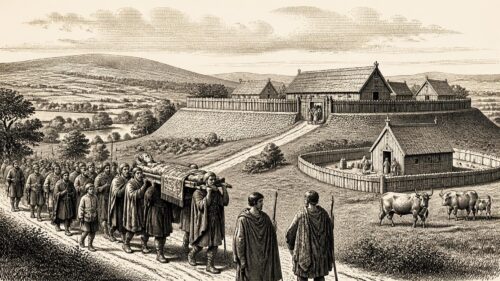
In 643 CE, Ireland’s most important recorded development was a problem of succession rather than a single, unquestioned accession. Medieval Irish annalists associated this year with the aftermath of the death of Domnall mac Áedo, a powerful ruler of the northern Uí Néill whom one chronicle styled rex Hiberniae, ‘king of Ireland’. Yet the same annalistic tradition openly admitted uncertainty over who followed him. Some authorities named his nephews Cellach and Conall Cáel; others asserted that authority was shared among four men, adding Diarmait and Blathmac, sons of Áed Sláine. The candour of that disagreement is itself the central fact of the year. It reveals an island governed through competing kindreds, personal alliances and regional power, not a unified kingdom with an automatic succession.
A Date with Difficult Edges
The evidence requires care. The Annals of Ulster preserve a section labelled U643, but their accompanying calendrical note equates it with AD 642. Chronicon Scotorum, meanwhile, places the disputed succession and several associated Irish events under 643. The Annals of Tigernach also put Domnall’s death and the succession problem in their annal for 643, while a later compilation, the Annals of the Four Masters, assigns other notices to 643. These variations do not mean that nothing happened; rather, they show that seventh-century Irish chronology has to be handled as a reconstruction from related but imperfectly aligned records.
Accordingly, 643 CE is best understood as the year conventionally associated in major annalistic traditions with a transition at the summit of Uí Néill power. Domnall’s death is commonly dated to January 642 by modern reference works, and the political uncertainty recorded immediately afterwards belongs to that same narrow turning point. It would be misleading to pretend that a modern historian can identify the day in 643 when a new high king took office. What can responsibly be said is that the sources preserve a contemporary or near-contemporary memory of contested authority at this moment.
After Domnall mac Áedo
Domnall came from Cenél Conaill, a leading northern branch of the Uí Néill whose power base lay in the north-west. His long political career had been forged through warfare and rivalry, but the tradition remembers his death as peaceful: Adomnán’s Life of Columba, written later in the seventh century, presents it as fulfilment of Columba’s prophecy that Domnall would die at home, in old age and among friends. The annals’ respectful title, ‘king of Ireland’, should not be read as evidence for a centralised Irish state. It signals exceptional prestige and the breadth of his influence, especially among the chroniclers linked with Iona and the Columban world.
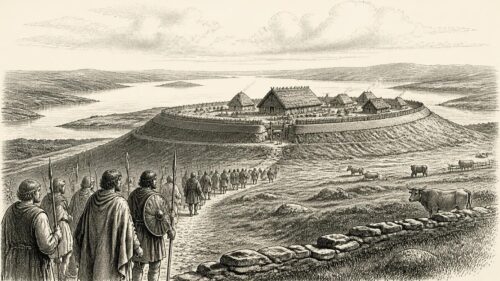
Such influence rested on relationships rather than bureaucracy. A dominant king could demand military service, tribute, hostages and public acknowledgement from subordinate rulers, but his reach varied sharply from one region to another. Kingship was embedded in kinship. Land, cattle, clients, churches and armed followers all mattered; so did marriage connections and fosterage. A ruler’s death therefore created opportunity as well as danger. Rival branches of the Uí Néill could contest leadership, while provincial kings in Leinster, Munster, Connacht, Ulaid and the midlands could reassess the obligations imposed by an overking.
Domnall’s successors did not inherit an office insulated from family competition. Cellach and Conall Cáel were sons of Máel Cobo, Domnall’s brother and an earlier claimant to Uí Néill supremacy. Their position represented the interests of Cenél Conaill. Diarmait and Blathmac belonged to Síl nÁedo Sláine, the powerful southern Uí Néill dynasty centred in Brega, north of the River Liffey. The genealogies in the annal entry are not ornamental detail: they explain why four names could plausibly be advanced. They identify competing branches with their own territories, client networks and claims to seniority.
The Four Kings Question
The wording of the record is striking. Cellach and Conall ‘begin to reign, as some state’; elsewhere the annalist says that it was uncertain who ruled after Domnall. ‘Some historiographers’, he reports, held that Cellach, Conall, Diarmait and Blathmac ruled in a ‘mingled’ or shared kingship. This is not a straightforward royal list. It is a note of disagreement inserted into the historical record, perhaps preserving incompatible traditions from different political milieux.
Shared rule need not mean that four kings jointly administered one realm from a single court. Early Irish political language could accommodate overlapping levels of kingship. Each of the four men may have been king within his own dynastic territory, while claims to the wider Uí Néill overkingship remained unsettled. The formula may also preserve a compromise: Cellach and Conall could be recognised in the north-west, while Diarmait and Blathmac exercised effective authority in Brega and the southern midlands. Whatever the practical arrangement, the annalist’s uncertainty indicates that no successor immediately matched Domnall’s standing.
This mattered beyond the families directly involved. The Uí Néill had long been central to the politics of the north and midlands, and their leading kings sought recognition at Tara, the symbolic inauguration landscape in Meath. But Tara was not a capital city governing Ireland. It was a potent political idea, one sustained through assemblies, genealogies, tribute claims and military demonstrations. In 643, that idea was being renegotiated. The absence of an agreed single ruler gave regional powers more room to manoeuvre and made alliances especially valuable.
Conflict and Regional Lords
Several annalistic notices attached to this chronological horizon underline the unsettled character of the period. The Annals of Ulster and Chronicon Scotorum record the battle of Cenn Con. The terse entry supplies no participants or result, but the Annals of Inisfallen, which place the battle later in their own sequence, identify the opponents as Máel Dúin son of Áed Bennán and Áengus Liath of Áine and report heavy losses on both sides. Because the date and fuller setting differ between compilations, Cenn Con should be connected with the politics around 643 rather than presented as securely fought in that calendar year.
The conflict nevertheless illuminates an important reality. Munster was not a passive southern province awaiting orders from a king at Tara. Its dynasties competed vigorously, and the struggle at Cenn Con involved figures associated with its ruling families. Military action in this world was generally seasonal and local in its immediate objectives: taking cattle, enforcing claims, punishing defection, gaining hostages or eliminating a rival. Yet a battle could alter relationships across much wider territories, especially when it affected a dynasty capable of influencing routes between the south, the midlands and the Irish Sea.
A further annalistic notice records the burning of Iarnbadb son of Gartnaith. The entry is too brief to explain its setting, and the name points beyond Ireland towards the interconnected northern British and Pictish world. It should not be inflated into an Irish campaign. Its presence beside Irish notices is more useful as a reminder that churchmen, royal kindreds and travellers crossed the sea routinely. Ireland’s political horizon included Dál Riata in western Scotland, Iona, Britons, Picts and Northumbria.
Crónán of Naendruim
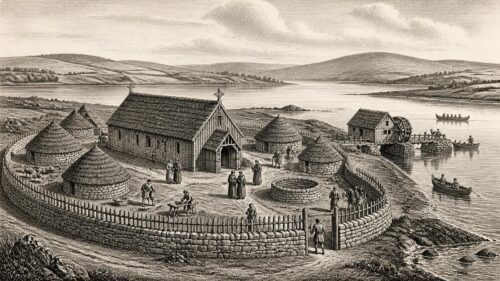
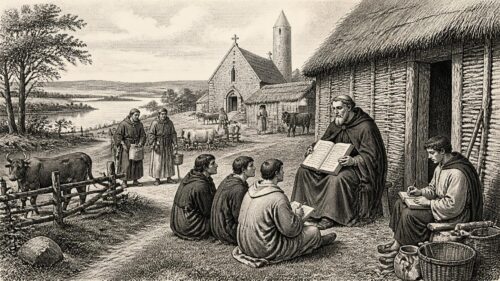
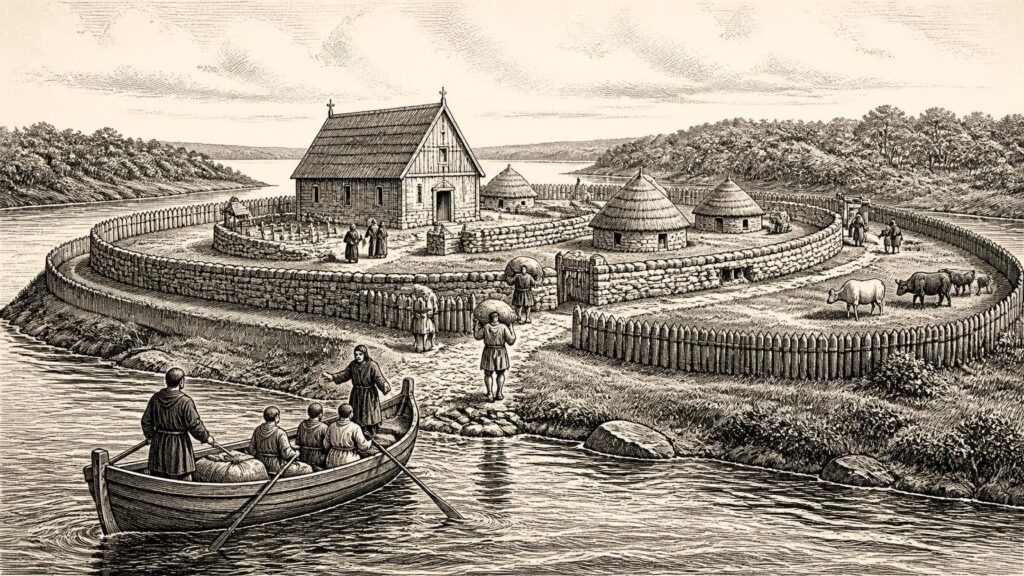
Religion enters the record for 643 in the notice of the death, or ‘repose’, of Crónán, bishop of Naendruim. Naendruim, now Nendrum, occupied Mahee Island in Strangford Lough, County Down. Its island setting offered both separation and connection: boats could reach it readily from the shores of the lough, while water provided a measure of security and a route into the maritime networks of Ulaid and the Irish Sea. The title ‘bishop’ is important. It shows that episcopal office remained meaningful in Irish Christianity, even though monasteries and their communities were increasingly influential centres of landholding, learning and pastoral care.
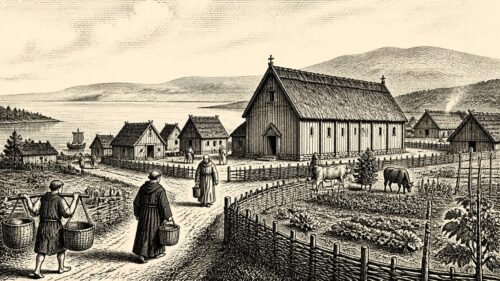
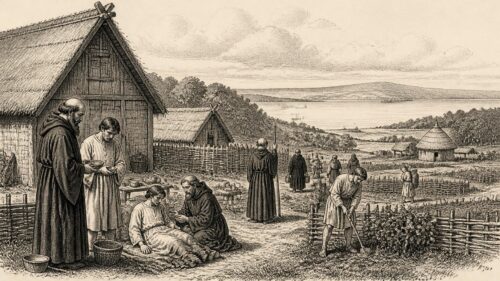
Later archaeology at Nendrum reveals a substantial ecclesiastical enclosure with three concentric zones. That visible layout cannot be assigned specifically to 643, nor can it tell us exactly what Crónán’s community looked like in the year of his death. It does, however, help explain the kind of institution suggested by the annal. A monastery was more than a retreat for monks. It could contain churches, dwellings, workshops, storehouses, grazing land and cultivated ground, drawing in clerics, tenants, labourers, dependants, visitors and patrons. Its leaders dealt in prayer and learning, but also in property, hospitality and political protection.
Crónán’s obituary is therefore a small but significant window onto society. Annalists chose to preserve the deaths of kings and churchmen because both were public figures. A bishop’s death could affect local authority, the management of estates, relationships with neighbouring rulers and the custody of sacred books or relics. The recording of Naendruim alongside royal succession and battle reflects the intertwined nature of ecclesiastical and secular power.
Life Beyond the Annals
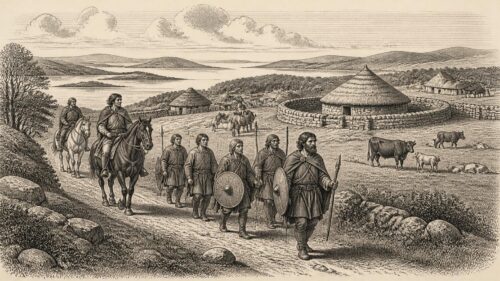
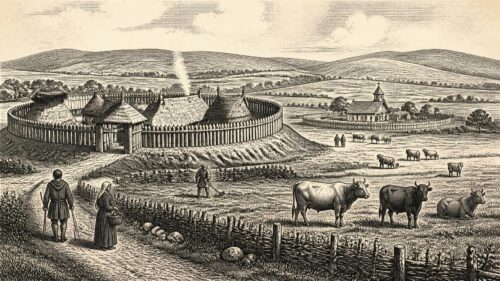
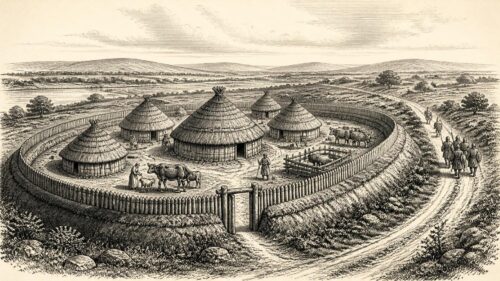
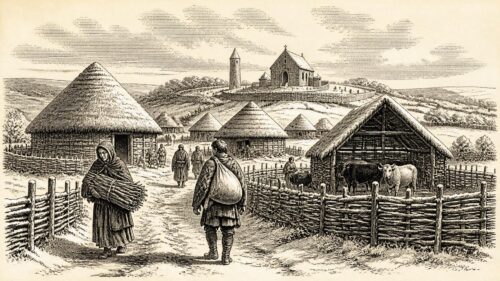
The annals do not report an island-wide harvest, weather event, epidemic or commercial crisis for 643. It would be wrong to invent one. Most people were not named in the written record, and their year was shaped by the agricultural round: tending cattle, sheep and pigs; sowing and harvesting cereals; maintaining houses, fences, boats and tools; grinding grain; preserving food; and meeting obligations to kin and lord. Ringforts and enclosed farmsteads formed the dominant settlement pattern across much of the countryside, while churches and monasteries created other focal points of population and exchange.
Cattle remained a principal measure of wealth, a source of food and dairy produce, and an essential political resource. Grain cultivation was also fundamental, as archaeological evidence for mills, querns and corn-drying kilns demonstrates. Political instability could make ordinary life more precarious, since armies needed provisions and warfare frequently targeted livestock. Conversely, rural production sustained kings, warriors and monasteries alike. The contest after Domnall’s death was thus not merely a dispute among elite names: it concerned who could command the resources of communities spread across fields, pastures, lakeshores and church lands.
Across the sea, the death of the Northumbrian king Oswald in battle in 642 and the accession of Oswiu formed part of the same regional background. Oswald had close associations with Iona and Irish-speaking churchmen, and the Northumbrian church retained strong links with the Columban network. For Ireland in 643, these connections mattered culturally and religiously more than as evidence of direct political control. They enabled the movement of ideas, books, clerics and reputations through a northern Irish Sea zone far more interconnected than modern national boundaries suggest.
An Unsettled Inheritance
Thus 643 is not a year defined by one spectacular Irish battle or royal coronation. Its historical importance lies in an annalist’s doubt. Domnall’s death left behind an inheritance too valuable for one branch of the Uí Néill to claim without challenge. Cellach and Conall emerged as leading contenders, while Diarmait and Blathmac represented a southern alternative. At the same time, regional violence, the death of a bishop at Naendruim and continuing connections across the Irish Sea show a society in which power was multiple, negotiated and deeply local. The uncertainty preserved in the annals is not a defect in the story of 643; it is the story.
Primary Sources
- The Annals of Ulster, Year U643
- The Annals of Tigernach
- Chronicon Scotorum, Annals CS642–CS643
- Annals of Inisfallen, Annals AI644–AI655
- Annals of the Four Masters
- Domnall
- Domnall mac Áeda: (d. 642), high-king of Ireland
- The Chronicle of Ireland: then and now
- Chronological Synchronisation of the Irish Annals
- The Life of Columba, written by Adamnan
- The Life of Columba, written by Adamnan: title page
- Bede's Ecclesiastical History of England
- Exploring the Irish Annals
- Early Christian Monasteries
- Early Irish Monasticism
- Farming and Archaeology: The Irish Historic Landscape
- Rathbeagh Ringfort, Co Kilkenny
- Patrician and Early Christian Architecture
- Churches and Ecclesiastical Enclosures
- Christian Ireland 5th–8th Centuries
- The Annals of Tigernach / Library Catalogue