Domnall’s Passing642 CE
In 642, Domnall mac Áedo of Cenél Conaill died at the end of January, described by the Annals of Ulster as ‘king of Ireland’. His authority, strengthened by victory over Congal Cáech at Mag Roth in 637, rested on personal alliances rather than a unified state and became uncertain after his death. His nephews Conall Cóel and Cellach later emerged as successors. The same annal records the killing of Ailill of Cenél Loegaire, illustrating persistent dynastic violence. It also notes the death in Britain of Domnall Brecc of Dál Riata, reflecting Irish Sea connections. Later Christian tradition portrayed Domnall’s peaceful death as evidence of saintly favour.
Dateline
In 642 CE, the most consequential Irish event securely attached to the year was the death, at the end of January, of Domnall mac Áedo. The Annals of Ulster calls him rex Hiberniae, ‘king of Ireland’, an unusually emphatic title in an island divided among many kingships. Its notice is brief, yet its language makes Domnall’s death a landmark: a powerful overking had gone, and the political arrangements he had sustained were left to be tested. The same annal also records the killing of Ailill son of Colmán, king of Cenél Loegaire, a Uí Néill people of Brega. Thus the record for this one year combines a peaceful royal death with another act of dynastic violence.
A Carefully Dated Death
The evidence requires some care. The Annals of Ulster places Domnall’s death ‘at the end of January’ under its year U642, although its contemporary calendrical heading equates that annal-year with AD 641. Such discrepancies are part of a well-known problem in the early Irish annals: their surviving texts descend from chronicle material whose year-numbering was displaced at points in transmission. Modern reference works conventionally date Domnall’s death to 642, and that is the dating used here. The source does not supply a numbered day in January, so an exact date should not be invented.
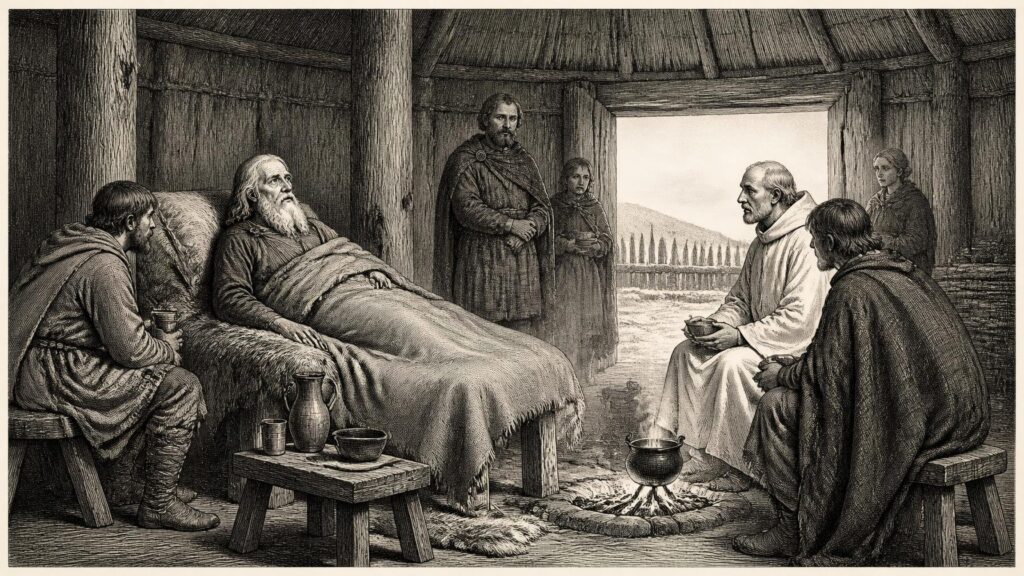
A much later compilation, the seventeenth-century Annals of the Four Masters, places his death under 639 and adds that it occurred at Ard Fothad in Tír Áeda after a year of mortal illness, during which he received communion every Sunday. This is valuable evidence for how Domnall was remembered, but it cannot simply override the earlier annalistic tradition or fix the date. The location-name Ard Fothad belongs to the tradition, while its precise modern identification remains uncertain. What can responsibly be said is that the king’s death was represented not as a battlefield end or assassination, but as a Christian death at home.
The Meaning of ‘King of Ireland’
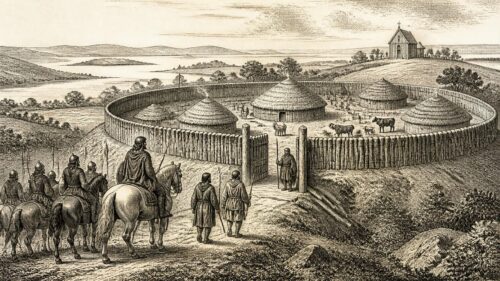
Domnall was a member of Cenél Conaill, a leading branch of the northern Uí Néill, and son of Áed mac Ainmuirech. Calling him king of Ireland did not mean that Ireland had become a united kingdom with a capital, bureaucracy or uniform law. Seventh-century Ireland consisted of numerous túatha, or petty kingdoms, bound together and divided by kinship, clientship, tribute, marriage, fosterage and armed followings. An overking’s authority depended on the recognition of lesser kings, on access to agricultural surplus and livestock, and on the ability to reward allies or punish opponents. It was personal, negotiated and liable to unravel on a ruler’s death.
The title nevertheless mattered. Domnall had earned exceptional standing during the previous decade. His contest with Congal Cáech, overking of Ulaid, culminated in the great battle of Mag Roth, usually dated to 637, where Domnall and his allies defeated Congal’s coalition. On the same day, according to the annalistic tradition, Domnall’s nephew Conall Cóel defeated an opposing fleet at Sailtír. These were not events of 642, but they explain why Domnall’s obit carried more weight than a routine royal notice. His victories had broken a serious northern challenge and strengthened the position of the Uí Néill and their Airgialla associates.
His death did not automatically transfer such authority to one heir. Domnall’s nephews Conall Cóel and Cellach, sons of Máel Cobo, later appear in king-lists and annalistic tradition as joint successors. Yet the surviving evidence does not permit a confident description of a coronation, assembly or island-wide settlement in 642 itself. The later Four Masters assigns their joint rule to an earlier chronological framework, illustrating precisely why its dates cannot be treated as contemporary proof. The sounder conclusion is narrower: Domnall’s death opened a succession in which his nephews were prominent, while the reach of the old overkingship was less secure than its grand title suggested.
A Violent Political Landscape
The killing of Ailill son of Colmán, named in the same Ulster annal, offers a sharp reminder that political status was precarious at every level. Cenél Loegaire, with interests in the Brega region north of the Boyne, was part of the wider Uí Néill world, but kinship did not prevent rivalry. The annal gives neither killer, place nor motive. It would be unsafe to make it a direct consequence of Domnall’s death, even though the proximity of the notices tempts such a reading. Early annals are selective records, not continuous narratives: they preserve that Ailill was killed, but not the local negotiations, grudges and calculations behind the act.
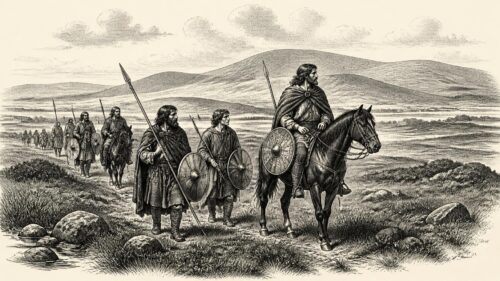
That silence is instructive. Kingship was exercised through households and retinues rather than detached institutions. A king’s standing rested on land, cattle, food-renders, legal supporters, hostages and men capable of fighting. Violence could be directed against a rival king, but it could also take the form of raiding, seizure of livestock or attacks upon dependants. In such a setting, the death of a widely acknowledged overking could alter expectations well beyond his own Cenél Conaill homeland, without creating a single, dramatic ‘national’ crisis recorded by every source.
The Irish Sea World
The annal for 642 looks beyond Ireland as well. After noting Domnall mac Áedo’s death, it records that Domnall Brecc was killed in December at the battle of Srath Caruin, apparently Strathcarron, by Hoan, king of the Britons. Domnall Brecc ruled Dál Riata, a Gaelic polity spanning the sea between north-east Ireland and western Scotland. His death occurred in Britain, not Ireland, but it was directly relevant to Irish affairs because Dál Riata’s sea-lanes, dynastic links and military commitments connected both shores.
Only five years earlier Domnall Brecc had been associated with Congal Cáech’s unsuccessful coalition against Domnall mac Áedo at Mag Roth. It would be rash to present his death in 642 as an Irish campaign or to claim that it immediately changed conditions in Ulster; the annal does neither. Yet the juxtaposition of the two Domnalls’ deaths captures an important reality. Political communities around the northern Irish Sea were neighbours, rivals and partners. Ships carried warriors, clerics, messages and goods across waters that modern national histories can make seem wider than they were.
Events in Northumbria also belonged to this connected world. The Ulster annal records a battle of Oswy against Britons, while Bede dates the death of Oswald of Northumbria to 642. Iona’s community had close associations with Northumbrian Christianity through the mission of Aidan and Lindisfarne. These British notices should not be turned into Irish events, but they show why an Irish-Iona chronicle paid attention to changes of power across the water. Domnall mac Áedo’s death occurred in a year when the political map of northern Britain, as well as Ireland, was in motion.
Christian Memory and Royal Death
Domnall’s obit is followed in the Annals of Ulster by short Old Irish verses attributed to Cuimméne and to Columba. Their preservation beside the death notice reveals the closeness of political memory, poetry and ecclesiastical record-keeping. Attribution does not prove that either verse was newly composed in January 642, nor does it make the poems direct eyewitness testimony. It does, however, show that Domnall’s death was framed within a learned Christian culture able to preserve vernacular verse alongside Latin annalistic prose.
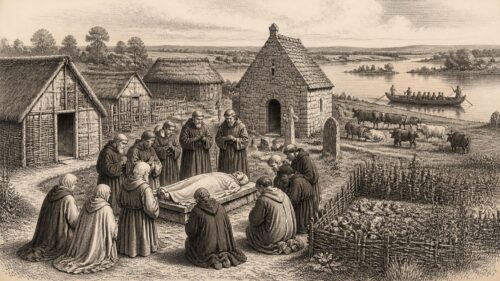
Adomnán’s later Life of Columba shaped this memory more fully. It tells how the young Domnall was brought to Columba at Druim Cett and blessed with a prophecy that he would outlive his brothers, become famous and die peacefully in his own house among familiar companions. The tale cannot be used as a contemporary report of 642: Adomnán wrote decades after both Columba and Domnall had died, and hagiography had purposes beyond chronology. Still, its vision of an ideal king is revealing. A ruler’s peaceful, sacramental end could be understood as the fulfilment of saintly favour, joining dynastic legitimacy to the authority of Iona and Columba.
Life Beyond the Annals
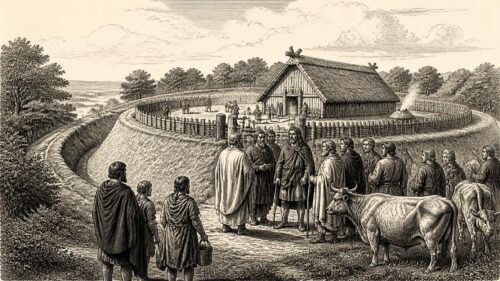
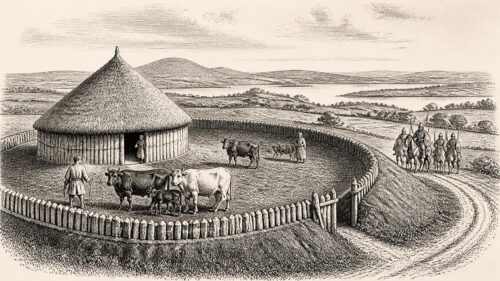
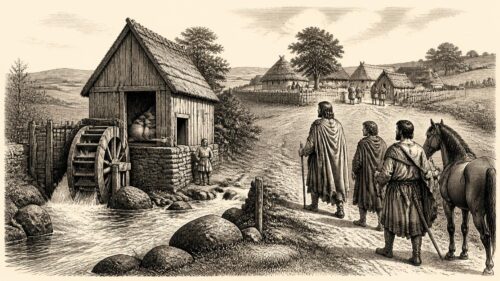
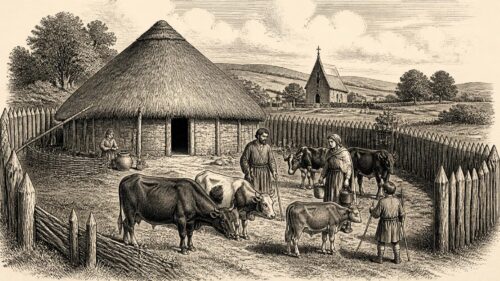
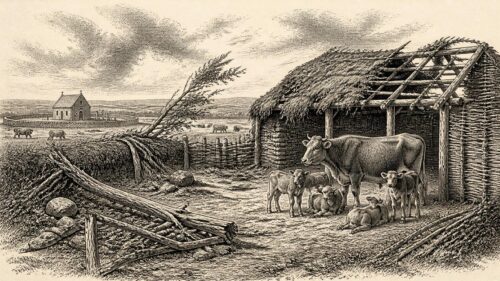
For most inhabitants of Ireland, 642 was not experienced through the death of a king recorded in a monastery’s chronicle. It was lived in dispersed rural communities. Ringforts—earthen raths or stone cashels enclosing timber or dry-stone buildings—were common early medieval farmsteads. Households worked a mixed agricultural landscape in which cattle were central to wealth, dairy produce, social payment and political power, alongside cultivation of cereals and the tending of other animals. Archaeology and later law-texts illuminate these broad conditions, but neither permits us to assign a particular harvest, price, weather event or local hardship to this calendar year.
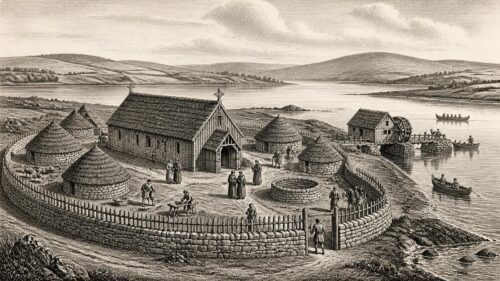
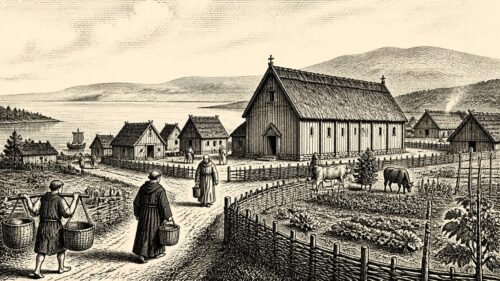
Churches and monasteries formed another layer of settlement and authority. They were places of worship, burial, hospitality, learning and landholding, connected to secular dynasties but not merely controlled by them. Clerics preserved Latin literacy and developed Old Irish literary culture; poets and jurists likewise held recognised social importance. The contemporary annal does not record a new Irish foundation, synod, famine or epidemic for 642. That absence should be respected. The year is historically significant not because every sphere changed at once, but because the death of Domnall mac Áedo marked the end of a ruler whose hard-won authority had briefly made the phrase ‘king of Ireland’ seem meaningful.

Primary Sources
- The Annals of Ulster: Year U642 (English translation)
- The Annals of Ulster: Year U642 (Latin text)
- Annals of Tigernach, Part 8
- Annals of the Four Masters, Part 47
- Chronicon Scotorum
- Domnall
- Domnall mac Áeda: (d. 642), high-king of Ireland
- Life of St. Columba
- The Life of Columba, written by Adamnan
- CELT Project: The Life of Columba, written by Adamnan
- Early Christian Ireland
- Irish Society c. 700: I. Communities
- Religion and Society in Ireland
- Kingship, Society, and Sacrality: Rank, Power, and Ideology in Early Medieval Ireland
- The Organization of Exchange in Early Christian Ireland
- Changing Human–Cattle Relationships in Ireland: A 6000-Year Isotopic Perspective
- Irish Field Monuments: Ringforts
- Early Medieval Farmsteads
- Residence, Ritual and Rulership: A State-of-the-Art for Royal Places in Early Medieval Ireland
- The Idea of the Three Orders of Society and Social Stratification in Early Medieval Ireland
- The Evidence for Consensus in the Irish Law-Texts of the Seventh to Ninth Centuries AD
- Medieval Irish Chronicles Reveal Persistent Volcanic Forcing of Severe Winter Cold Events, 431–1649 CE
- Irish Script on Screen: Royal Irish Academy Collection
- Irish Script on Screen: About